 Add to Chrome
 Add to Firefox
 Add to Edge
WebCompass: Towards Multimodal Web Coding Evaluation for Code Language Models
Apr 20, 2026
Large language models are rapidly evolving into interactive coding agents capable of end-to-end web coding, yet existing benchmarks evaluate only narrow slices of this capability, typically text-conditioned generation with static-correctness metrics, leaving visual fidelity, interaction quality, and codebase-level reasoning largely unmeasured. We introduce WebCompass, a multimodal benchmark that provides unified lifecycle evaluation of web engineering capability. Recognizing that real-world web coding is an iterative cycle of generation, editing, and repair, WebCompass spans three input modalities (text, image, video) and three task types (generation, editing, repair), yielding seven task categories that mirror professional workflows. Through a multi-stage, human-in-the-loop pipeline, we curate instances covering 15 generation domains, 16 editing operation types, and 11 repair defect types, each annotated at Easy/Medium/Hard levels. For evaluation, we adopt a checklist-guided LLM-as-a-Judge protocol for editing and repair, and propose a novel Agent-as-a-Judge paradigm for generation that autonomously executes generated websites in a real browser, explores interactive behaviors via the Model Context Protocol (MCP), and iteratively synthesizes targeted test cases, closely approximating human acceptance testing. We evaluate representative closed-source and open-source models and observe that: (1) closed-source models remain substantially stronger and more balanced; (2) editing and repair exhibit distinct difficulty profiles, with repair preserving interactivity better but remaining execution-challenging; (3) aesthetics is the most persistent bottleneck, especially for open-source models; and (4) framework choice materially affects outcomes, with Vue consistently challenging while React and Vanilla/HTML perform more strongly depending on task type.

SWE-Compass: Towards Unified Evaluation of Agentic Coding Abilities for Large Language Models
Nov 07, 2025Evaluating large language models (LLMs) for software engineering has been limited by narrow task coverage, language bias, and insufficient alignment with real-world developer workflows. Existing benchmarks often focus on algorithmic problems or Python-centric bug fixing, leaving critical dimensions of software engineering underexplored. To address these gaps, we introduce SWE-Compass1, a comprehensive benchmark that unifies heterogeneous code-related evaluations into a structured and production-aligned framework. SWE-Compass spans 8 task types, 8 programming scenarios, and 10 programming languages, with 2000 high-quality instances curated from authentic GitHub pull requests and refined through systematic filtering and validation. We benchmark ten state-of-the-art LLMs under two agentic frameworks, SWE-Agent and Claude Code, revealing a clear hierarchy of difficulty across task types, languages, and scenarios. Moreover, by aligning evaluation with real-world developer practices, SWE-Compass provides a rigorous and reproducible foundation for diagnosing and advancing agentic coding capabilities in large language models.
OASIS: Order-Augmented Strategy for Improved Code Search
Mar 11, 2025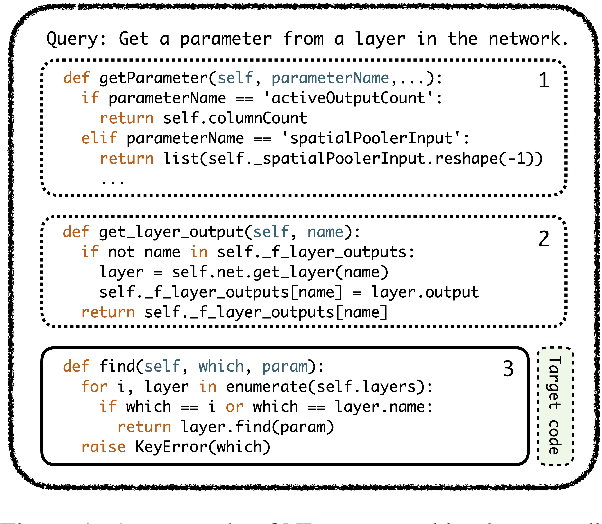
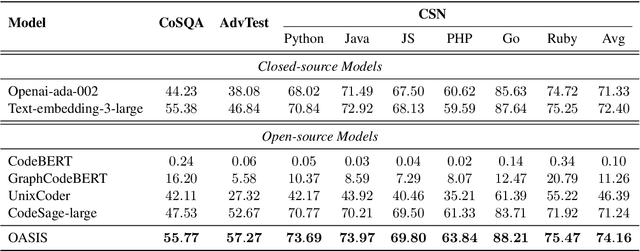
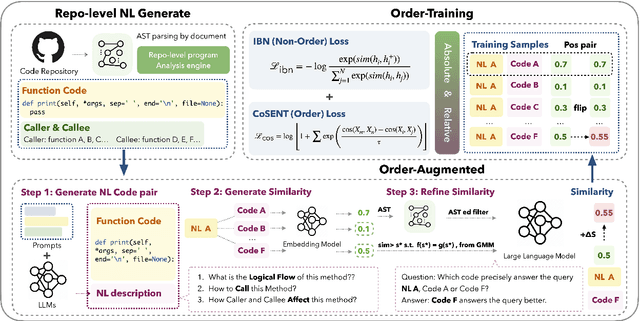
Code embeddings capture the semantic representations of code and are crucial for various code-related large language model (LLM) applications, such as code search. Previous training primarily relies on optimizing the InfoNCE loss by comparing positive natural language (NL)-code pairs with in-batch negatives. However, due to the sparse nature of code contexts, training solely by comparing the major differences between positive and negative pairs may fail to capture deeper semantic nuances. To address this issue, we propose a novel order-augmented strategy for improved code search (OASIS). It leverages order-based similarity labels to train models to capture subtle differences in similarity among negative pairs. Extensive benchmark evaluations demonstrate that our OASIS model significantly outperforms previous state-of-the-art models focusing solely on major positive-negative differences. It underscores the value of exploiting subtle differences among negative pairs with order labels for effective code embedding training.