 Add to Chrome
 Add to Firefox
 Add to Edge
Undress to Redress: A Training-Free Framework for Virtual Try-On
Aug 11, 2025
Virtual try-on (VTON) is a crucial task for enhancing user experience in online shopping by generating realistic garment previews on personal photos. Although existing methods have achieved impressive results, they struggle with long-sleeve-to-short-sleeve conversions-a common and practical scenario-often producing unrealistic outputs when exposed skin is underrepresented in the original image. We argue that this challenge arises from the ''majority'' completion rule in current VTON models, which leads to inaccurate skin restoration in such cases. To address this, we propose UR-VTON (Undress-Redress Virtual Try-ON), a novel, training-free framework that can be seamlessly integrated with any existing VTON method. UR-VTON introduces an ''undress-to-redress'' mechanism: it first reveals the user's torso by virtually ''undressing,'' then applies the target short-sleeve garment, effectively decomposing the conversion into two more manageable steps. Additionally, we incorporate Dynamic Classifier-Free Guidance scheduling to balance diversity and image quality during DDPM sampling, and employ Structural Refiner to enhance detail fidelity using high-frequency cues. Finally, we present LS-TON, a new benchmark for long-sleeve-to-short-sleeve try-on. Extensive experiments demonstrate that UR-VTON outperforms state-of-the-art methods in both detail preservation and image quality. Code will be released upon acceptance.

CharacterShot: Controllable and Consistent 4D Character Animation
Aug 10, 2025In this paper, we propose \textbf{CharacterShot}, a controllable and consistent 4D character animation framework that enables any individual designer to create dynamic 3D characters (i.e., 4D character animation) from a single reference character image and a 2D pose sequence. We begin by pretraining a powerful 2D character animation model based on a cutting-edge DiT-based image-to-video model, which allows for any 2D pose sequnce as controllable signal. We then lift the animation model from 2D to 3D through introducing dual-attention module together with camera prior to generate multi-view videos with spatial-temporal and spatial-view consistency. Finally, we employ a novel neighbor-constrained 4D gaussian splatting optimization on these multi-view videos, resulting in continuous and stable 4D character representations. Moreover, to improve character-centric performance, we construct a large-scale dataset Character4D, containing 13,115 unique characters with diverse appearances and motions, rendered from multiple viewpoints. Extensive experiments on our newly constructed benchmark, CharacterBench, demonstrate that our approach outperforms current state-of-the-art methods. Code, models, and datasets will be publicly available at https://github.com/Jeoyal/CharacterShot.
IFDECORATOR: Wrapping Instruction Following Reinforcement Learning with Verifiable Rewards
Aug 06, 2025Reinforcement Learning with Verifiable Rewards (RLVR) improves instruction following capabilities of large language models (LLMs), but suffers from training inefficiency due to inadequate difficulty assessment. Moreover, RLVR is prone to over-optimization, where LLMs exploit verification shortcuts without aligning to the actual intent of user instructions. We introduce Instruction Following Decorator (IFDecorator}, a framework that wraps RLVR training into a robust and sample-efficient pipeline. It consists of three components: (1) a cooperative-adversarial data flywheel that co-evolves instructions and hybrid verifications, generating progressively more challenging instruction-verification pairs; (2) IntentCheck, a bypass module enforcing intent alignment; and (3) trip wires, a diagnostic mechanism that detects reward hacking via trap instructions, which trigger and capture shortcut exploitation behaviors. Our Qwen2.5-32B-Instruct-IFDecorator achieves 87.43% accuracy on IFEval, outperforming larger proprietary models such as GPT-4o. Additionally, we demonstrate substantial improvements on FollowBench while preserving general capabilities. Our trip wires show significant reductions in reward hacking rates. We will release models, code, and data for future research.
LLM-Crowdsourced: A Benchmark-Free Paradigm for Mutual Evaluation of Large Language Models
Jul 30, 2025Although large language models (LLMs) demonstrate remarkable capabilities across various tasks, evaluating their capabilities remains a challenging task. Existing evaluation methods suffer from issues such as data contamination, black-box operation, and subjective preference. These issues make it difficult to evaluate the LLMs' true capabilities comprehensively. To tackle these challenges, we propose a novel benchmark-free evaluation paradigm, LLM-Crowdsourced. It utilizes LLMs to generate questions, answer independently, and evaluate mutually. This method integrates four key evaluation criteria: dynamic, transparent, objective, and professional, which existing evaluation methods cannot satisfy simultaneously. Experiments on eight mainstream LLMs across mathematics and programming verify the advantages of our method in distinguishing LLM performance. Furthermore, our study reveals several novel findings that are difficult for traditional methods to detect, including but not limited to: (1) Gemini demonstrates the highest original and professional question-design capabilities among others; (2) Some LLMs exhibit ''memorization-based answering'' by misrecognizing questions as familiar ones with a similar structure; (3) LLM evaluation results demonstrate high consistency (robustness).
Semi-off-Policy Reinforcement Learning for Vision-Language Slow-thinking Reasoning
Jul 22, 2025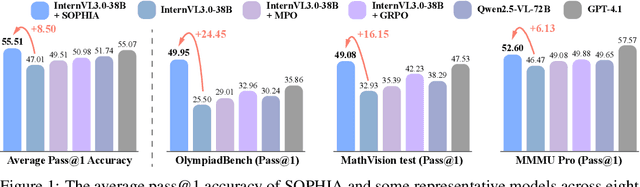
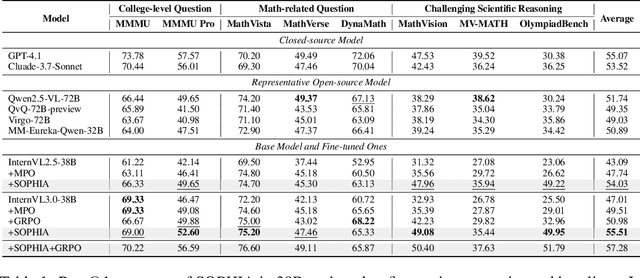
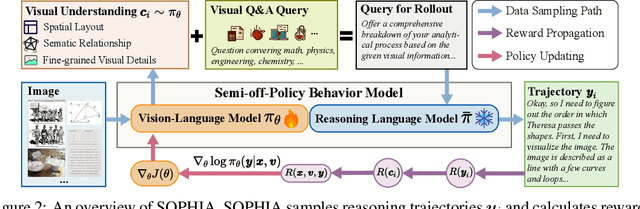
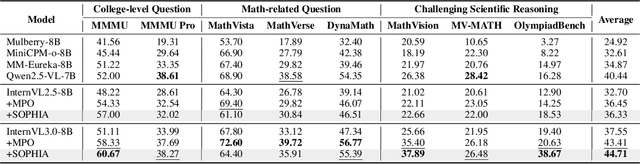
Enhancing large vision-language models (LVLMs) with visual slow-thinking reasoning is crucial for solving complex multimodal tasks. However, since LVLMs are mainly trained with vision-language alignment, it is difficult to adopt on-policy reinforcement learning (RL) to develop the slow thinking ability because the rollout space is restricted by its initial abilities. Off-policy RL offers a way to go beyond the current policy, but directly distilling trajectories from external models may cause visual hallucinations due to mismatched visual perception abilities across models. To address these issues, this paper proposes SOPHIA, a simple and scalable Semi-Off-Policy RL for vision-language slow-tHInking reAsoning. SOPHIA builds a semi-off-policy behavior model by combining on-policy visual understanding from a trainable LVLM with off-policy slow-thinking reasoning from a language model, assigns outcome-based rewards to reasoning, and propagates visual rewards backward. Then LVLM learns slow-thinking reasoning ability from the obtained reasoning trajectories using propagated rewards via off-policy RL algorithms. Extensive experiments with InternVL2.5 and InternVL3.0 with 8B and 38B sizes show the effectiveness of SOPHIA. Notably, SOPHIA improves InternVL3.0-38B by 8.50% in average, reaching state-of-the-art performance among open-source LVLMs on multiple multimodal reasoning benchmarks, and even outperforms some closed-source models (e.g., GPT-4.1) on the challenging MathVision and OlympiadBench, achieving 49.08% and 49.95% pass@1 accuracy, respectively. Analysis shows SOPHIA outperforms supervised fine-tuning and direct on-policy RL methods, offering a better policy initialization for further on-policy training.
The Imitation Game: Turing Machine Imitator is Length Generalizable Reasoner
Jul 17, 2025Length generalization, the ability to solve problems of longer sequences than those observed during training, poses a core challenge of Transformer-based large language models (LLM). Although existing studies have predominantly focused on data-driven approaches for arithmetic operations and symbolic manipulation tasks, these approaches tend to be task-specific with limited overall performance. To pursue a more general solution, this paper focuses on a broader case of reasoning problems that are computable, i.e., problems that algorithms can solve, thus can be solved by the Turing Machine. From this perspective, this paper proposes Turing MAchine Imitation Learning (TAIL) to improve the length generalization ability of LLMs. TAIL synthesizes chain-of-thoughts (CoT) data that imitate the execution process of a Turing Machine by computer programs, which linearly expands the reasoning steps into atomic states to alleviate shortcut learning and explicit memory fetch mechanism to reduce the difficulties of dynamic and long-range data access in elementary operations. To validate the reliability and universality of TAIL, we construct a challenging synthetic dataset covering 8 classes of algorithms and 18 tasks. Without bells and whistles, TAIL significantly improves the length generalization ability as well as the performance of Qwen2.5-7B on various tasks using only synthetic data, surpassing previous methods and DeepSeek-R1. The experimental results reveal that the key concepts in the Turing Machine, instead of the thinking styles, are indispensable for TAIL for length generalization, through which the model exhibits read-and-write behaviors consistent with the properties of the Turing Machine in their attention layers. This work provides a promising direction for future research in the learning of LLM reasoning from synthetic data.
ClipGS: Clippable Gaussian Splatting for Interactive Cinematic Visualization of Volumetric Medical Data
Jul 09, 2025The visualization of volumetric medical data is crucial for enhancing diagnostic accuracy and improving surgical planning and education. Cinematic rendering techniques significantly enrich this process by providing high-quality visualizations that convey intricate anatomical details, thereby facilitating better understanding and decision-making in medical contexts. However, the high computing cost and low rendering speed limit the requirement of interactive visualization in practical applications. In this paper, we introduce ClipGS, an innovative Gaussian splatting framework with the clipping plane supported, for interactive cinematic visualization of volumetric medical data. To address the challenges posed by dynamic interactions, we propose a learnable truncation scheme that automatically adjusts the visibility of Gaussian primitives in response to the clipping plane. Besides, we also design an adaptive adjustment model to dynamically adjust the deformation of Gaussians and refine the rendering performance. We validate our method on five volumetric medical data (including CT and anatomical slice data), and reach an average 36.635 PSNR rendering quality with 156 FPS and 16.1 MB model size, outperforming state-of-the-art methods in rendering quality and efficiency.
Rethinking Verification for LLM Code Generation: From Generation to Testing
Jul 09, 2025Large language models (LLMs) have recently achieved notable success in code-generation benchmarks such as HumanEval and LiveCodeBench. However, a detailed examination reveals that these evaluation suites often comprise only a limited number of homogeneous test cases, resulting in subtle faults going undetected. This not only artificially inflates measured performance but also compromises accurate reward estimation in reinforcement learning frameworks utilizing verifiable rewards (RLVR). To address these critical shortcomings, we systematically investigate the test-case generation (TCG) task by proposing multi-dimensional metrics designed to rigorously quantify test-suite thoroughness. Furthermore, we introduce a human-LLM collaborative method (SAGA), leveraging human programming expertise with LLM reasoning capability, aimed at significantly enhancing both the coverage and the quality of generated test cases. In addition, we develop a TCGBench to facilitate the study of the TCG task. Experiments show that SAGA achieves a detection rate of 90.62% and a verifier accuracy of 32.58% on TCGBench. The Verifier Accuracy (Verifier Acc) of the code generation evaluation benchmark synthesized by SAGA is 10.78% higher than that of LiveCodeBench-v6. These results demonstrate the effectiveness of our proposed method. We hope this work contributes to building a scalable foundation for reliable LLM code evaluation, further advancing RLVR in code generation, and paving the way for automated adversarial test synthesis and adaptive benchmark integration.
Coding Triangle: How Does Large Language Model Understand Code?
Jul 08, 2025Large language models (LLMs) have achieved remarkable progress in code generation, yet their true programming competence remains underexplored. We introduce the Code Triangle framework, which systematically evaluates LLMs across three fundamental dimensions: editorial analysis, code implementation, and test case generation. Through extensive experiments on competitive programming benchmarks, we reveal that while LLMs can form a self-consistent system across these dimensions, their solutions often lack the diversity and robustness of human programmers. We identify a significant distribution shift between model cognition and human expertise, with model errors tending to cluster due to training data biases and limited reasoning transfer. Our study demonstrates that incorporating human-generated editorials, solutions, and diverse test cases, as well as leveraging model mixtures, can substantially enhance both the performance and robustness of LLMs. Furthermore, we reveal both the consistency and inconsistency in the cognition of LLMs that may facilitate self-reflection and self-improvement, providing a potential direction for developing more powerful coding models.
ECCV 2024 W-CODA: 1st Workshop on Multimodal Perception and Comprehension of Corner Cases in Autonomous Driving
Jul 02, 2025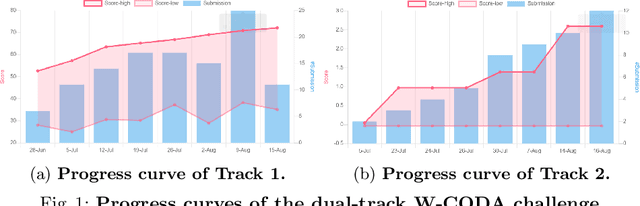
In this paper, we present details of the 1st W-CODA workshop, held in conjunction with the ECCV 2024. W-CODA aims to explore next-generation solutions for autonomous driving corner cases, empowered by state-of-the-art multimodal perception and comprehension techniques. 5 Speakers from both academia and industry are invited to share their latest progress and opinions. We collect research papers and hold a dual-track challenge, including both corner case scene understanding and generation. As the pioneering effort, we will continuously bridge the gap between frontier autonomous driving techniques and fully intelligent, reliable self-driving agents robust towards corner cases.