 Add to Chrome
 Add to Firefox
 Add to Edge
HarmonRank: Ranking-aligned Multi-objective Ensemble for Live-streaming E-commerce Recommendation
Jan 08, 2026
Recommendation for live-streaming e-commerce is gaining increasing attention due to the explosive growth of the live streaming economy. Different from traditional e-commerce, live-streaming e-commerce shifts the focus from products to streamers, which requires ranking mechanism to balance both purchases and user-streamer interactions for long-term ecology. To trade off multiple objectives, a popular solution is to build an ensemble model to integrate multi-objective scores into a unified score. The ensemble model is usually supervised by multiple independent binary classification losses of all objectives. However, this paradigm suffers from two inherent limitations. First, the optimization direction of the binary classification task is misaligned with the ranking task (evaluated by AUC). Second, this paradigm overlooks the alignment between objectives, e.g., comment and buy behaviors are partially dependent which can be revealed in labels correlations. The model can achieve better trade-offs if it learns the aligned parts of ranking abilities among different objectives. To mitigate these limitations, we propose a novel multi-objective ensemble framework HarmonRank to fulfill both alignment to the ranking task and alignment among objectives. For alignment to ranking, we formulate ranking metric AUC as a rank-sum problem and utilize differentiable ranking techniques for ranking-oriented optimization. For inter-objective alignment, we change the original one-step ensemble paradigm to a two-step relation-aware ensemble scheme. Extensive offline experiments results on two industrial datasets and online experiments demonstrate that our approach significantly outperforms existing state-of-the-art methods. The proposed method has been fully deployed in Kuaishou's live-streaming e-commerce recommendation platform with 400 million DAUs, contributing over 2% purchase gain.

Klear: Unified Multi-Task Audio-Video Joint Generation
Jan 07, 2026Audio-video joint generation has progressed rapidly, yet substantial challenges still remain. Non-commercial approaches still suffer audio-visual asynchrony, poor lip-speech alignment, and unimodal degradation, which can be stemmed from weak audio-visual correspondence modeling, limited generalization, and scarce high-quality dense-caption data. To address these issues, we introduce Klear and delve into three axes--model architecture, training strategy, and data curation. Architecturally, we adopt a single-tower design with unified DiT blocks and an Omni-Full Attention mechanism, achieving tight audio-visual alignment and strong scalability. Training-wise, we adopt a progressive multitask regime--random modality masking to joint optimization across tasks, and a multistage curriculum, yielding robust representations, strengthening A-V aligned world knowledge, and preventing unimodal collapse. For datasets, we present the first large-scale audio-video dataset with dense captions, and introduce a novel automated data-construction pipeline which annotates and filters millions of diverse, high-quality, strictly aligned audio-video-caption triplets. Building on this, Klear scales to large datasets, delivering high-fidelity, semantically and temporally aligned, instruction-following generation in both joint and unimodal settings while generalizing robustly to out-of-distribution scenarios. Across tasks, it substantially outperforms prior methods by a large margin and achieves performance comparable to Veo 3, offering a unified, scalable path toward next-generation audio-video synthesis.
Vision-Language Reasoning for Geolocalization: A Reinforcement Learning Approach
Jan 05, 2026Recent advances in vision-language models have opened up new possibilities for reasoning-driven image geolocalization. However, existing approaches often rely on synthetic reasoning annotations or external image retrieval, which can limit interpretability and generalizability. In this paper, we present Geo-R, a retrieval-free framework that uncovers structured reasoning paths from existing ground-truth coordinates and optimizes geolocation accuracy via reinforcement learning. We propose the Chain of Region, a rule-based hierarchical reasoning paradigm that generates precise, interpretable supervision by mapping GPS coordinates to geographic entities (e.g., country, province, city) without relying on model-generated or synthetic labels. Building on this, we introduce a lightweight reinforcement learning strategy with coordinate-aligned rewards based on Haversine distance, enabling the model to refine predictions through spatially meaningful feedback. Our approach bridges structured geographic reasoning with direct spatial supervision, yielding improved localization accuracy, stronger generalization, and more transparent inference. Experimental results across multiple benchmarks confirm the effectiveness of Geo-R, establishing a new retrieval-free paradigm for scalable and interpretable image geolocalization. To facilitate further research and ensure reproducibility, both the model and code will be made publicly available.
Memento 2: Learning by Stateful Reflective Memory
Dec 31, 2025We study continual learning in large language model (LLM) based agents that integrate episodic memory with reinforcement learning. We focus on reflection, the ability of an agent to revisit past experience and adjust how it selects future actions, as the central mechanism for continual adaptation without fine tuning model weights. To formalise this, we introduce the Stateful Reflective Decision Process (SRDP), in which an agent maintains and updates episodic memory and alternates between writing new experiences to memory and reading relevant cases to guide decisions. This framework casts reflective memory dynamics as part of the decision process itself and makes them amenable to control and learning analysis. Building on this formulation, we develop a Read-Write Reflective Learning algorithm that incorporates memory retrieval into a soft policy iteration procedure and prove that it converges. We further show that as memory grows and more densely covers the task environment, the resulting policy approaches optimality. Our framework unifies memory based reasoning with reinforcement learning and provides a formal foundation for LLM agents capable of continual, experience driven learning.
Constrained Language Model Policy Optimization via Risk-aware Stepwise Alignment
Dec 30, 2025When fine-tuning pre-trained Language Models (LMs) to exhibit desired behaviors, maintaining control over risk is critical for ensuring both safety and trustworthiness. Most existing safety alignment methods, such as Safe RLHF and SACPO, typically operate under a risk-neutral paradigm that is insufficient to address the risks arising from deviations from the reference policy and offers limited robustness against rare but potentially catastrophic harmful behaviors. To address this limitation, we propose Risk-aware Stepwise Alignment (RSA), a novel alignment method that explicitly incorporates risk awareness into the policy optimization process by leveraging a class of nested risk measures. Specifically, RSA formulates safety alignment as a token-level risk-aware constrained policy optimization problem and solves it through a stepwise alignment procedure that yields token-level policy updates derived from the nested risk measures. This design offers two key benefits: (1) it mitigates risks induced by excessive model shift away from a reference policy, and (2) it explicitly suppresses low-probability yet high-impact harmful behaviors. Moreover, we provide theoretical analysis on policy optimality under mild assumptions. Experimental results demonstrate that our method achieves high levels of helpfulness while ensuring strong safety and significantly suppresses tail risks, namely low-probability yet high-impact unsafe responses.
Memento-II: Learning by Stateful Reflective Memory
Dec 27, 2025We propose a theoretical framework for continual and experiential learning in large language model agents that integrates episodic memory with reinforcement learning. The framework identifies reflection as the key mechanism that enables agents to adapt through interaction without back propagation or model fine tuning, thereby relaxing the conventional separation between training and deployment.To formalise this process, we introduce the Stateful Reflective Decision Process, which models reflective learning as a two stage read write interaction with episodic memory. Writing stores interaction outcomes and corresponds to policy evaluation, while reading retrieves relevant past cases and corresponds to policy improvement. We show that this process induces an equivalent Markov decision process over augmented state memory representations, allowing the use of classical tools from dynamic programming and reinforcement learning. We further instantiate the framework using entropy regularised policy iteration and establish convergence guarantees. As episodic memory grows and achieves sufficient coverage of the state space, the resulting policy converges to the optimal solution. This work provides a principled foundation for memory augmented and retrieval based language model agents capable of continual adaptation without parameter updates.
Bridging the Copyright Gap: Do Large Vision-Language Models Recognize and Respect Copyrighted Content?
Dec 26, 2025Large vision-language models (LVLMs) have achieved remarkable advancements in multimodal reasoning tasks. However, their widespread accessibility raises critical concerns about potential copyright infringement. Will LVLMs accurately recognize and comply with copyright regulations when encountering copyrighted content (i.e., user input, retrieved documents) in the context? Failure to comply with copyright regulations may lead to serious legal and ethical consequences, particularly when LVLMs generate responses based on copyrighted materials (e.g., retrieved book experts, news reports). In this paper, we present a comprehensive evaluation of various LVLMs, examining how they handle copyrighted content -- such as book excerpts, news articles, music lyrics, and code documentation when they are presented as visual inputs. To systematically measure copyright compliance, we introduce a large-scale benchmark dataset comprising 50,000 multimodal query-content pairs designed to evaluate how effectively LVLMs handle queries that could lead to copyright infringement. Given that real-world copyrighted content may or may not include a copyright notice, the dataset includes query-content pairs in two distinct scenarios: with and without a copyright notice. For the former, we extensively cover four types of copyright notices to account for different cases. Our evaluation reveals that even state-of-the-art closed-source LVLMs exhibit significant deficiencies in recognizing and respecting the copyrighted content, even when presented with the copyright notice. To solve this limitation, we introduce a novel tool-augmented defense framework for copyright compliance, which reduces infringement risks in all scenarios. Our findings underscore the importance of developing copyright-aware LVLMs to ensure the responsible and lawful use of copyrighted content.
JoyVoice: Long-Context Conditioning for Anthropomorphic Multi-Speaker Conversational Synthesis
Dec 22, 2025Large speech generation models are evolving from single-speaker, short sentence synthesis to multi-speaker, long conversation geneartion. Current long-form speech generation models are predominately constrained to dyadic, turn-based interactions. To address this, we introduce JoyVoice, a novel anthropomorphic foundation model designed for flexible, boundary-free synthesis of up to eight speakers. Unlike conventional cascaded systems, JoyVoice employs a unified E2E-Transformer-DiT architecture that utilizes autoregressive hidden representations directly for diffusion inputs, enabling holistic end-to-end optimization. We further propose a MM-Tokenizer operating at a low bitrate of 12.5 Hz, which integrates multitask semantic and MMSE losses to effectively model both semantic and acoustic information. Additionally, the model incorporates robust text front-end processing via large-scale data perturbation. Experiments show that JoyVoice achieves state-of-the-art results in multilingual generation (Chinese, English, Japanese, Korean) and zero-shot voice cloning. JoyVoice achieves top-tier results on both the Seed-TTS-Eval Benchmark and multi-speaker long-form conversational voice cloning tasks, demonstrating superior audio quality and generalization. It achieves significant improvements in prosodic continuity for long-form speech, rhythm richness in multi-speaker conversations, paralinguistic naturalness, besides superior intelligibility. We encourage readers to listen to the demo at https://jea-speech.github.io/JoyVoice
Mamba-Based Modality Disentanglement Network for Multi-Contrast MRI Reconstruction
Dec 22, 2025Magnetic resonance imaging (MRI) is a cornerstone of modern clinical diagnosis, offering unparalleled soft-tissue contrast without ionizing radiation. However, prolonged scan times remain a major barrier to patient throughput and comfort. Existing accelerated MRI techniques often struggle with two key challenges: (1) failure to effectively utilize inherent K-space prior information, leading to persistent aliasing artifacts from zero-filled inputs; and (2) contamination of target reconstruction quality by irrelevant information when employing multi-contrast fusion strategies. To overcome these challenges, we present MambaMDN, a dual-domain framework for multi-contrast MRI reconstruction. Our approach first employs fully-sampled reference K-space data to complete the undersampled target data, generating structurally aligned but modality-mixed inputs. Subsequently, we develop a Mamba-based modality disentanglement network to extract and remove reference-specific features from the mixed representation. Furthermore, we introduce an iterative refinement mechanism to progressively enhance reconstruction accuracy through repeated feature purification. Extensive experiments demonstrate that MambaMDN can significantly outperform existing multi-contrast reconstruction methods.
Can Synthetic Images Serve as Effective and Efficient Class Prototypes?
Dec 19, 2025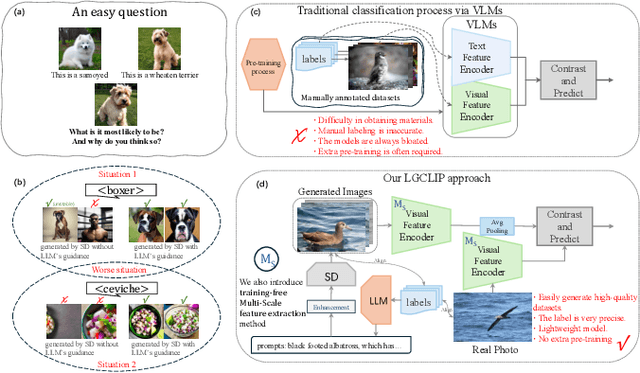
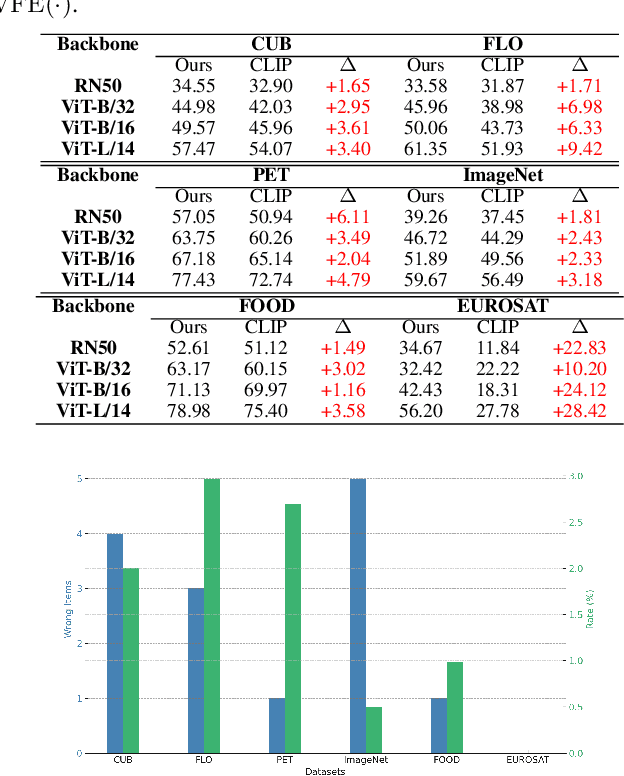
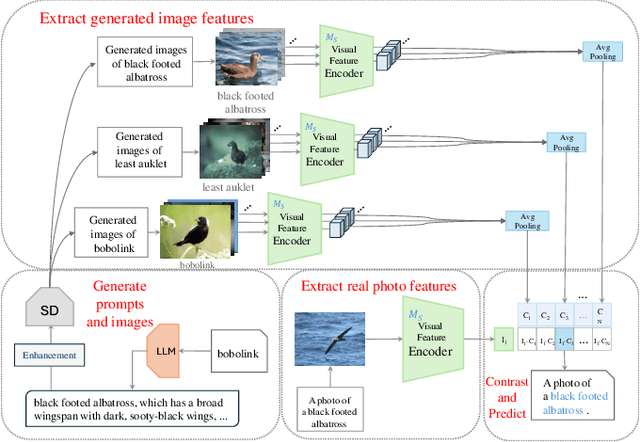
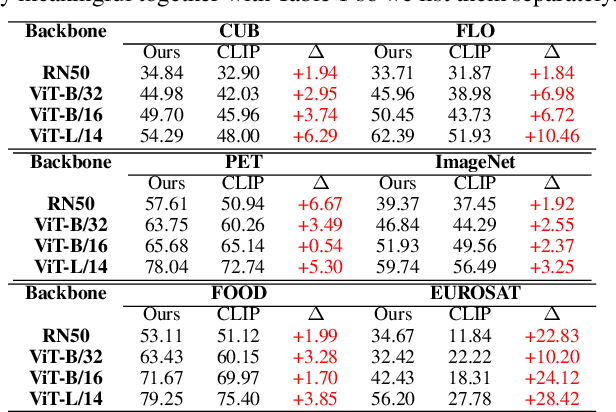
Vision-Language Models (VLMs) have shown strong performance in zero-shot image classification tasks. However, existing methods, including Contrastive Language-Image Pre-training (CLIP), all rely on annotated text-to-image pairs for aligning visual and textual modalities. This dependency introduces substantial cost and accuracy requirement in preparing high-quality datasets. At the same time, processing data from two modes also requires dual-tower encoders for most models, which also hinders their lightweight. To address these limitations, we introduce a ``Contrastive Language-Image Pre-training via Large-Language-Model-based Generation (LGCLIP)" framework. LGCLIP leverages a Large Language Model (LLM) to generate class-specific prompts that guide a diffusion model in synthesizing reference images. Afterwards these generated images serve as visual prototypes, and the visual features of real images are extracted and compared with the visual features of these prototypes to achieve comparative prediction. By optimizing prompt generation through the LLM and employing only a visual encoder, LGCLIP remains lightweight and efficient. Crucially, our framework requires only class labels as input during whole experimental procedure, eliminating the need for manually annotated image-text pairs and extra pre-processing. Experimental results validate the feasibility and efficiency of LGCLIP, demonstrating great performance in zero-shot classification tasks and establishing a novel paradigm for classification.