 Add to Chrome
 Add to Firefox
 Add to Edge
Unsupervised Compositional Concepts Discovery with Text-to-Image Generative Models
Jun 08, 2023
Text-to-image generative models have enabled high-resolution image synthesis across different domains, but require users to specify the content they wish to generate. In this paper, we consider the inverse problem -- given a collection of different images, can we discover the generative concepts that represent each image? We present an unsupervised approach to discover generative concepts from a collection of images, disentangling different art styles in paintings, objects, and lighting from kitchen scenes, and discovering image classes given ImageNet images. We show how such generative concepts can accurately represent the content of images, be recombined and composed to generate new artistic and hybrid images, and be further used as a representation for downstream classification tasks.

Probabilistic Adaptation of Text-to-Video Models
Jun 02, 2023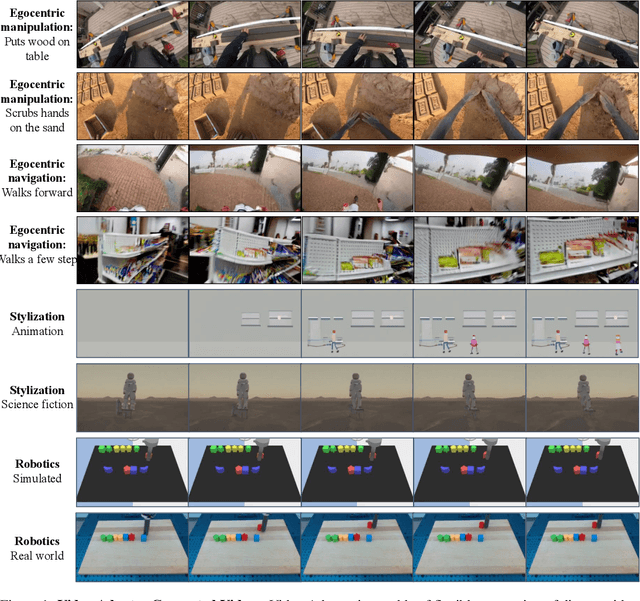
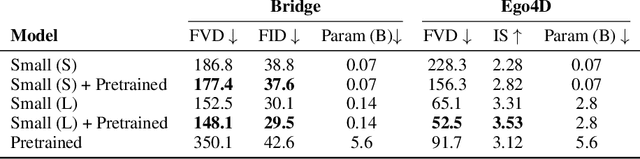


Large text-to-video models trained on internet-scale data have demonstrated exceptional capabilities in generating high-fidelity videos from arbitrary textual descriptions. However, adapting these models to tasks with limited domain-specific data, such as animation or robotics videos, poses a significant computational challenge, since finetuning a pretrained large model can be prohibitively expensive. Inspired by how a small modifiable component (e.g., prompts, prefix-tuning) can adapt a large language model to perform new tasks without requiring access to the model weights, we investigate how to adapt a large pretrained text-to-video model to a variety of downstream domains and tasks without finetuning. In answering this question, we propose Video Adapter, which leverages the score function of a large pretrained video diffusion model as a probabilistic prior to guide the generation of a task-specific small video model. Our experiments show that Video Adapter is capable of incorporating the broad knowledge and preserving the high fidelity of a large pretrained video model in a task-specific small video model that is able to generate high-quality yet specialized videos on a variety of tasks such as animation, egocentric modeling, and modeling of simulated and real-world robotics data. More videos can be found on the website https://video-adapter.github.io/.
Evaluating Language Models for Mathematics through Interactions
Jun 02, 2023The standard methodology of evaluating large language models (LLMs) based on static pairs of inputs and outputs is insufficient for developing assistants: this kind of assessments fails to take into account the essential interactive element in their deployment, and therefore limits how we understand language model capabilities. We introduce CheckMate, an adaptable prototype platform for humans to interact with and evaluate LLMs. We conduct a study with CheckMate to evaluate three language models~(InstructGPT, ChatGPT, and GPT-4) as assistants in proving undergraduate-level mathematics, with a mixed cohort of participants from undergraduate students to professors of mathematics. We release the resulting interaction and rating dataset, MathConverse. By analysing MathConverse, we derive a preliminary taxonomy of human behaviours and uncover that despite a generally positive correlation, there are notable instances of divergence between correctness and perceived helpfulness in LLM generations, amongst other findings. Further, we identify useful scenarios and existing issues of GPT-4 in mathematical reasoning through a series of case studies contributed by expert mathematicians. We conclude with actionable takeaways for ML practitioners and mathematicians: models which communicate uncertainty, respond well to user corrections, are more interpretable and concise may constitute better assistants; interactive evaluation is a promising way to continually navigate the capability of these models; humans should be aware of language models' algebraic fallibility, and for that reason discern where they should be used.
Improving Factuality and Reasoning in Language Models through Multiagent Debate
May 23, 2023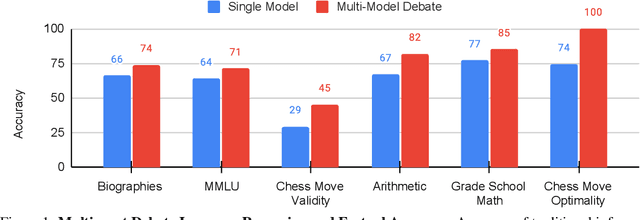
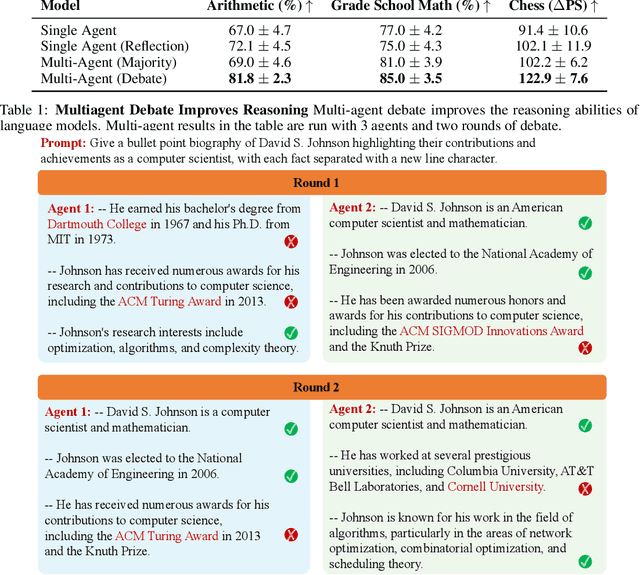

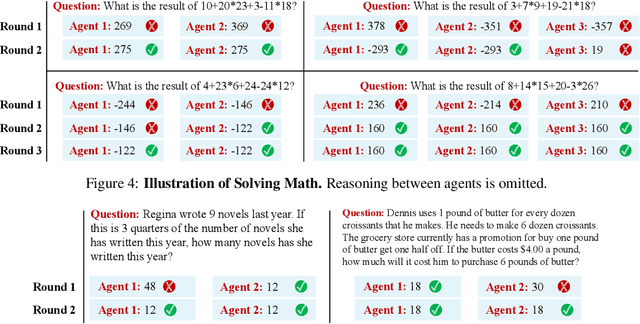
Large language models (LLMs) have demonstrated remarkable capabilities in language generation, understanding, and few-shot learning in recent years. An extensive body of work has explored how their performance may be further improved through the tools of prompting, ranging from verification, self-consistency, or intermediate scratchpads. In this paper, we present a complementary approach to improve language responses where multiple language model instances propose and debate their individual responses and reasoning processes over multiple rounds to arrive at a common final answer. Our findings indicate that this approach significantly enhances mathematical and strategic reasoning across a number of tasks. We also demonstrate that our approach improves the factual validity of generated content, reducing fallacious answers and hallucinations that contemporary models are prone to. Our approach may be directly applied to existing black-box models and uses identical procedure and prompts for all tasks we investigate. Overall, our findings suggest that such "society of minds" approach has the potential to significantly advance the capabilities of LLMs and pave the way for further breakthroughs in language generation and understanding.
Generalized Planning in PDDL Domains with Pretrained Large Language Models
May 18, 2023

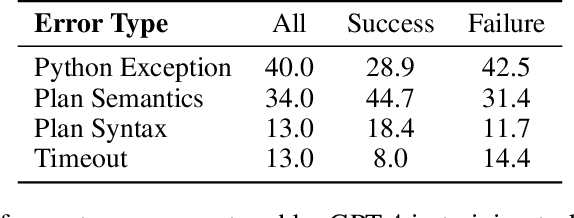
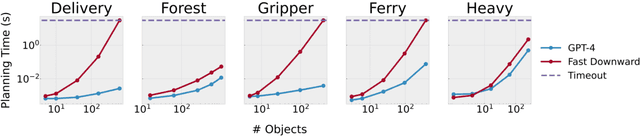
Recent work has considered whether large language models (LLMs) can function as planners: given a task, generate a plan. We investigate whether LLMs can serve as generalized planners: given a domain and training tasks, generate a program that efficiently produces plans for other tasks in the domain. In particular, we consider PDDL domains and use GPT-4 to synthesize Python programs. We also consider (1) Chain-of-Thought (CoT) summarization, where the LLM is prompted to summarize the domain and propose a strategy in words before synthesizing the program; and (2) automated debugging, where the program is validated with respect to the training tasks, and in case of errors, the LLM is re-prompted with four types of feedback. We evaluate this approach in seven PDDL domains and compare it to four ablations and four baselines. Overall, we find that GPT-4 is a surprisingly powerful generalized planner. We also conclude that automated debugging is very important, that CoT summarization has non-uniform impact, that GPT-4 is far superior to GPT-3.5, and that just two training tasks are often sufficient for strong generalization.
Learning Neural Constitutive Laws From Motion Observations for Generalizable PDE Dynamics
Apr 27, 2023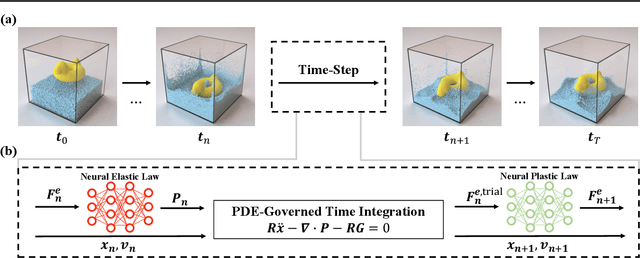
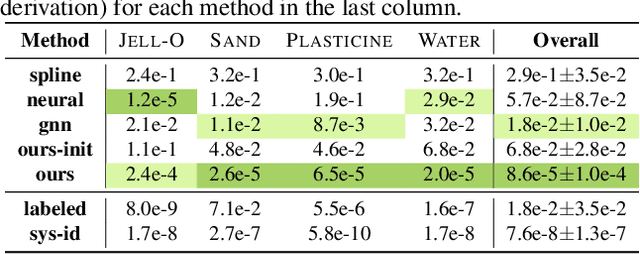
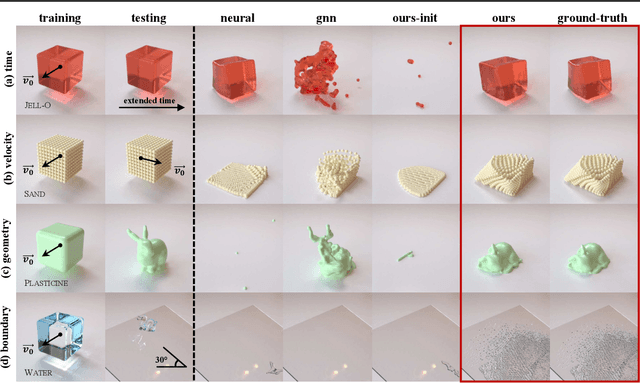
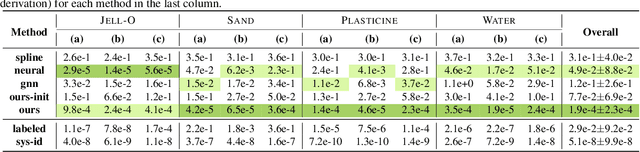
We propose a hybrid neural network (NN) and PDE approach for learning generalizable PDE dynamics from motion observations. Many NN approaches learn an end-to-end model that implicitly models both the governing PDE and constitutive models (or material models). Without explicit PDE knowledge, these approaches cannot guarantee physical correctness and have limited generalizability. We argue that the governing PDEs are often well-known and should be explicitly enforced rather than learned. Instead, constitutive models are particularly suitable for learning due to their data-fitting nature. To this end, we introduce a new framework termed "Neural Constitutive Laws" (NCLaw), which utilizes a network architecture that strictly guarantees standard constitutive priors, including rotation equivariance and undeformed state equilibrium. We embed this network inside a differentiable simulation and train the model by minimizing a loss function based on the difference between the simulation and the motion observation. We validate NCLaw on various large-deformation dynamical systems, ranging from solids to fluids. After training on a single motion trajectory, our method generalizes to new geometries, initial/boundary conditions, temporal ranges, and even multi-physics systems. On these extremely out-of-distribution generalization tasks, NCLaw is orders-of-magnitude more accurate than previous NN approaches. Real-world experiments demonstrate our method's ability to learn constitutive laws from videos.
3D-IntPhys: Towards More Generalized 3D-grounded Visual Intuitive Physics under Challenging Scenes
Apr 22, 2023


Given a visual scene, humans have strong intuitions about how a scene can evolve over time under given actions. The intuition, often termed visual intuitive physics, is a critical ability that allows us to make effective plans to manipulate the scene to achieve desired outcomes without relying on extensive trial and error. In this paper, we present a framework capable of learning 3D-grounded visual intuitive physics models from videos of complex scenes with fluids. Our method is composed of a conditional Neural Radiance Field (NeRF)-style visual frontend and a 3D point-based dynamics prediction backend, using which we can impose strong relational and structural inductive bias to capture the structure of the underlying environment. Unlike existing intuitive point-based dynamics works that rely on the supervision of dense point trajectory from simulators, we relax the requirements and only assume access to multi-view RGB images and (imperfect) instance masks acquired using color prior. This enables the proposed model to handle scenarios where accurate point estimation and tracking are hard or impossible. We generate datasets including three challenging scenarios involving fluid, granular materials, and rigid objects in the simulation. The datasets do not include any dense particle information so most previous 3D-based intuitive physics pipelines can barely deal with that. We show our model can make long-horizon future predictions by learning from raw images and significantly outperforms models that do not employ an explicit 3D representation space. We also show that once trained, our model can achieve strong generalization in complex scenarios under extrapolate settings.
Embodied Concept Learner: Self-supervised Learning of Concepts and Mapping through Instruction Following
Apr 07, 2023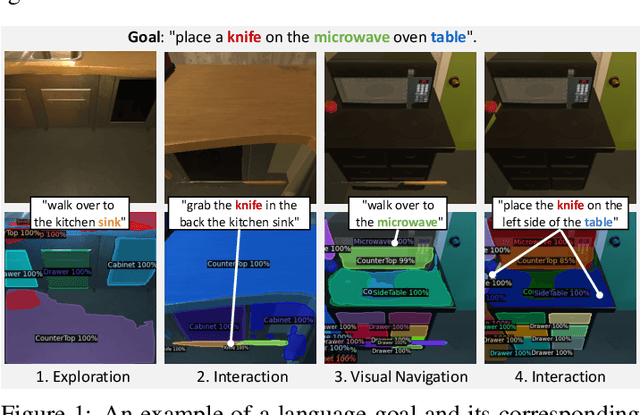
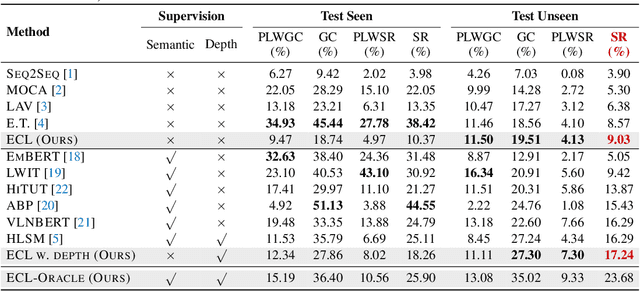
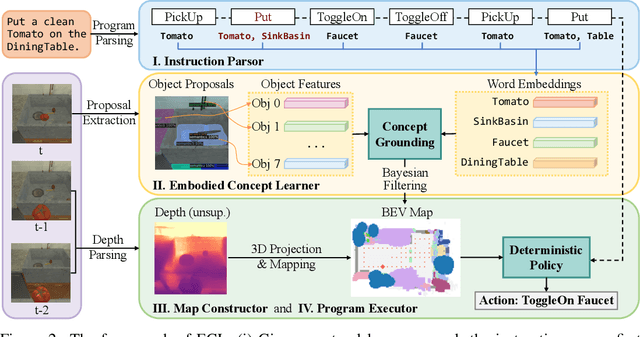
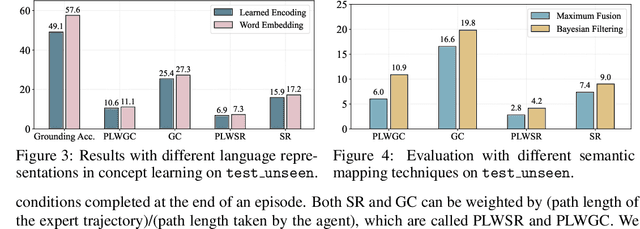
Humans, even at a very early age, can learn visual concepts and understand geometry and layout through active interaction with the environment, and generalize their compositions to complete tasks described by natural languages in novel scenes. To mimic such capability, we propose Embodied Concept Learner (ECL) in an interactive 3D environment. Specifically, a robot agent can ground visual concepts, build semantic maps and plan actions to complete tasks by learning purely from human demonstrations and language instructions, without access to ground-truth semantic and depth supervisions from simulations. ECL consists of: (i) an instruction parser that translates the natural languages into executable programs; (ii) an embodied concept learner that grounds visual concepts based on language descriptions; (iii) a map constructor that estimates depth and constructs semantic maps by leveraging the learned concepts; and (iv) a program executor with deterministic policies to execute each program. ECL has several appealing benefits thanks to its modularized design. Firstly, it enables the robotic agent to learn semantics and depth unsupervisedly acting like babies, e.g., ground concepts through active interaction and perceive depth by disparities when moving forward. Secondly, ECL is fully transparent and step-by-step interpretable in long-term planning. Thirdly, ECL could be beneficial for the embodied instruction following (EIF), outperforming previous works on the ALFRED benchmark when the semantic label is not provided. Also, the learned concept can be reused for other downstream tasks, such as reasoning of object states. Project page: http://ecl.csail.mit.edu/
Visual Dependency Transformers: Dependency Tree Emerges from Reversed Attention
Apr 06, 2023Humans possess a versatile mechanism for extracting structured representations of our visual world. When looking at an image, we can decompose the scene into entities and their parts as well as obtain the dependencies between them. To mimic such capability, we propose Visual Dependency Transformers (DependencyViT) that can induce visual dependencies without any labels. We achieve that with a novel neural operator called \emph{reversed attention} that can naturally capture long-range visual dependencies between image patches. Specifically, we formulate it as a dependency graph where a child token in reversed attention is trained to attend to its parent tokens and send information following a normalized probability distribution rather than gathering information in conventional self-attention. With such a design, hierarchies naturally emerge from reversed attention layers, and a dependency tree is progressively induced from leaf nodes to the root node unsupervisedly. DependencyViT offers several appealing benefits. (i) Entities and their parts in an image are represented by different subtrees, enabling part partitioning from dependencies; (ii) Dynamic visual pooling is made possible. The leaf nodes which rarely send messages can be pruned without hindering the model performance, based on which we propose the lightweight DependencyViT-Lite to reduce the computational and memory footprints; (iii) DependencyViT works well on both self- and weakly-supervised pretraining paradigms on ImageNet, and demonstrates its effectiveness on 8 datasets and 5 tasks, such as unsupervised part and saliency segmentation, recognition, and detection.
DexDeform: Dexterous Deformable Object Manipulation with Human Demonstrations and Differentiable Physics
Mar 27, 2023
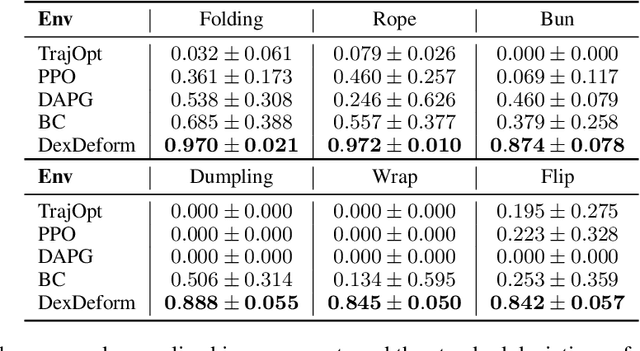

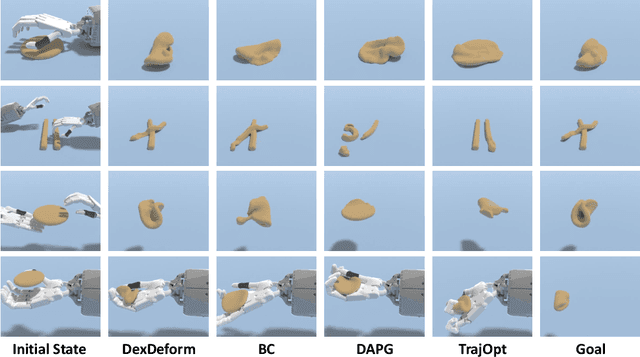
In this work, we aim to learn dexterous manipulation of deformable objects using multi-fingered hands. Reinforcement learning approaches for dexterous rigid object manipulation would struggle in this setting due to the complexity of physics interaction with deformable objects. At the same time, previous trajectory optimization approaches with differentiable physics for deformable manipulation would suffer from local optima caused by the explosion of contact modes from hand-object interactions. To address these challenges, we propose DexDeform, a principled framework that abstracts dexterous manipulation skills from human demonstration and refines the learned skills with differentiable physics. Concretely, we first collect a small set of human demonstrations using teleoperation. And we then train a skill model using demonstrations for planning over action abstractions in imagination. To explore the goal space, we further apply augmentations to the existing deformable shapes in demonstrations and use a gradient optimizer to refine the actions planned by the skill model. Finally, we adopt the refined trajectories as new demonstrations for finetuning the skill model. To evaluate the effectiveness of our approach, we introduce a suite of six challenging dexterous deformable object manipulation tasks. Compared with baselines, DexDeform is able to better explore and generalize across novel goals unseen in the initial human demonstrations.