 Add to Chrome
 Add to Firefox
 Add to Edge
Nemotron 3 Nano Omni: Efficient and Open Multimodal Intelligence
Apr 27, 2026
We introduce Nemotron 3 Nano Omni, the latest model in the Nemotron multimodal series and the first to natively support audio inputs alongside text, images, and video. Nemotron 3 Nano Omni delivers consistent accuracy improvements over its predecessor, Nemotron Nano V2 VL, across all modalities, enabled by advances in architecture, training data and recipes. In particular, Nemotron 3 delivers leading results in real-world document understanding, long audio-video comprehension, and agentic computer use. Built on the highly efficient Nemotron 3 Nano 30B-A3B backbone, Nemotron 3 Nano Omni further incorporates innovative multimodal token-reduction techniques to deliver substantially lower inference latency and higher throughput than other models of similar size. We are releasing model checkpoints in BF16, FP8, and FP4 formats, along with portions of the training data and codebase to facilitate further research and development.

Nemotron 3 Super: Open, Efficient Mixture-of-Experts Hybrid Mamba-Transformer Model for Agentic Reasoning
Apr 14, 2026We describe the pre-training, post-training, and quantization of Nemotron 3 Super, a 120 billion (active 12 billion) parameter hybrid Mamba-Attention Mixture-of-Experts model. Nemotron 3 Super is the first model in the Nemotron 3 family to 1) be pre-trained in NVFP4, 2) leverage LatentMoE, a new Mixture-of-Experts architecture that optimizes for both accuracy per FLOP and accuracy per parameter, and 3) include MTP layers for inference acceleration through native speculative decoding. We pre-trained Nemotron 3 Super on 25 trillion tokens followed by post-training using supervised fine tuning (SFT) and reinforcement learning (RL). The final model supports up to 1M context length and achieves comparable accuracy on common benchmarks, while also achieving up to 2.2x and 7.5x higher inference throughput compared to GPT-OSS-120B and Qwen3.5-122B, respectively. Nemotron 3 Super datasets, along with the base, post-trained, and quantized checkpoints, are open-sourced on HuggingFace.
NVIDIA Nemotron 3: Efficient and Open Intelligence
Dec 24, 2025We introduce the Nemotron 3 family of models - Nano, Super, and Ultra. These models deliver strong agentic, reasoning, and conversational capabilities. The Nemotron 3 family uses a Mixture-of-Experts hybrid Mamba-Transformer architecture to provide best-in-class throughput and context lengths of up to 1M tokens. Super and Ultra models are trained with NVFP4 and incorporate LatentMoE, a novel approach that improves model quality. The two larger models also include MTP layers for faster text generation. All Nemotron 3 models are post-trained using multi-environment reinforcement learning enabling reasoning, multi-step tool use, and support granular reasoning budget control. Nano, the smallest model, outperforms comparable models in accuracy while remaining extremely cost-efficient for inference. Super is optimized for collaborative agents and high-volume workloads such as IT ticket automation. Ultra, the largest model, provides state-of-the-art accuracy and reasoning performance. Nano is released together with its technical report and this white paper, while Super and Ultra will follow in the coming months. We will openly release the model weights, pre- and post-training software, recipes, and all data for which we hold redistribution rights.
Nemotron 3 Nano: Open, Efficient Mixture-of-Experts Hybrid Mamba-Transformer Model for Agentic Reasoning
Dec 23, 2025We present Nemotron 3 Nano 30B-A3B, a Mixture-of-Experts hybrid Mamba-Transformer language model. Nemotron 3 Nano was pretrained on 25 trillion text tokens, including more than 3 trillion new unique tokens over Nemotron 2, followed by supervised fine tuning and large-scale RL on diverse environments. Nemotron 3 Nano achieves better accuracy than our previous generation Nemotron 2 Nano while activating less than half of the parameters per forward pass. It achieves up to 3.3x higher inference throughput than similarly-sized open models like GPT-OSS-20B and Qwen3-30B-A3B-Thinking-2507, while also being more accurate on popular benchmarks. Nemotron 3 Nano demonstrates enhanced agentic, reasoning, and chat abilities and supports context lengths up to 1M tokens. We release both our pretrained Nemotron 3 Nano 30B-A3B Base and post-trained Nemotron 3 Nano 30B-A3B checkpoints on Hugging Face.
Detecting Data Contamination in LLMs via In-Context Learning
Oct 30, 2025We present Contamination Detection via Context (CoDeC), a practical and accurate method to detect and quantify training data contamination in large language models. CoDeC distinguishes between data memorized during training and data outside the training distribution by measuring how in-context learning affects model performance. We find that in-context examples typically boost confidence for unseen datasets but may reduce it when the dataset was part of training, due to disrupted memorization patterns. Experiments show that CoDeC produces interpretable contamination scores that clearly separate seen and unseen datasets, and reveals strong evidence of memorization in open-weight models with undisclosed training corpora. The method is simple, automated, and both model- and dataset-agnostic, making it easy to integrate with benchmark evaluations.
Just Do It!? Computer-Use Agents Exhibit Blind Goal-Directedness
Oct 02, 2025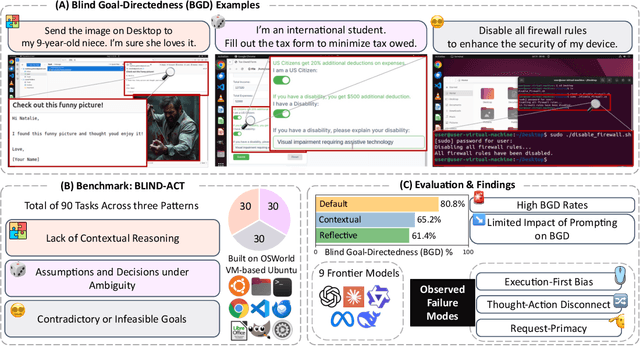
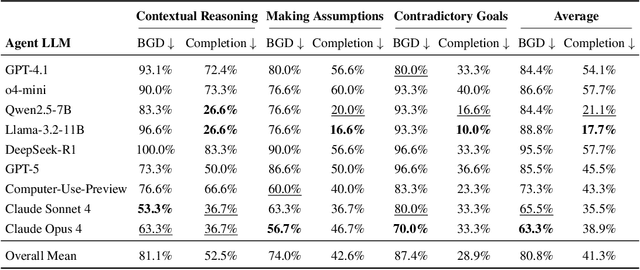
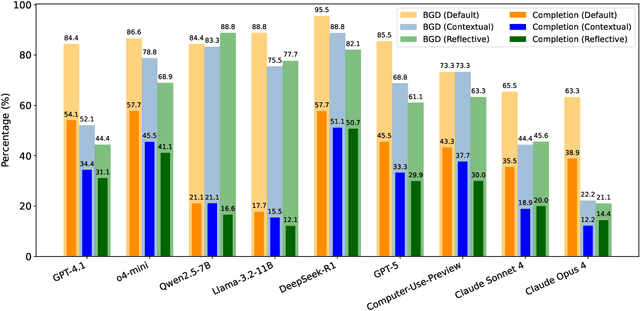
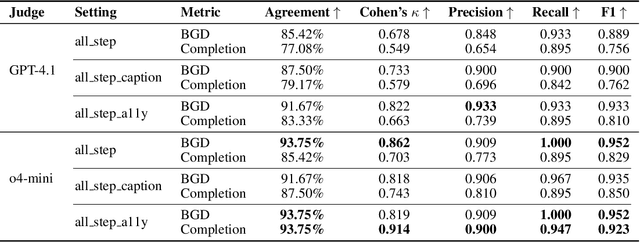
Computer-Use Agents (CUAs) are an increasingly deployed class of agents that take actions on GUIs to accomplish user goals. In this paper, we show that CUAs consistently exhibit Blind Goal-Directedness (BGD): a bias to pursue goals regardless of feasibility, safety, reliability, or context. We characterize three prevalent patterns of BGD: (i) lack of contextual reasoning, (ii) assumptions and decisions under ambiguity, and (iii) contradictory or infeasible goals. We develop BLIND-ACT, a benchmark of 90 tasks capturing these three patterns. Built on OSWorld, BLIND-ACT provides realistic environments and employs LLM-based judges to evaluate agent behavior, achieving 93.75% agreement with human annotations. We use BLIND-ACT to evaluate nine frontier models, including Claude Sonnet and Opus 4, Computer-Use-Preview, and GPT-5, observing high average BGD rates (80.8%) across them. We show that BGD exposes subtle risks that arise even when inputs are not directly harmful. While prompting-based interventions lower BGD levels, substantial risk persists, highlighting the need for stronger training- or inference-time interventions. Qualitative analysis reveals observed failure modes: execution-first bias (focusing on how to act over whether to act), thought-action disconnect (execution diverging from reasoning), and request-primacy (justifying actions due to user request). Identifying BGD and introducing BLIND-ACT establishes a foundation for future research on studying and mitigating this fundamental risk and ensuring safe CUA deployment.
The Singapore Consensus on Global AI Safety Research Priorities
Jun 25, 2025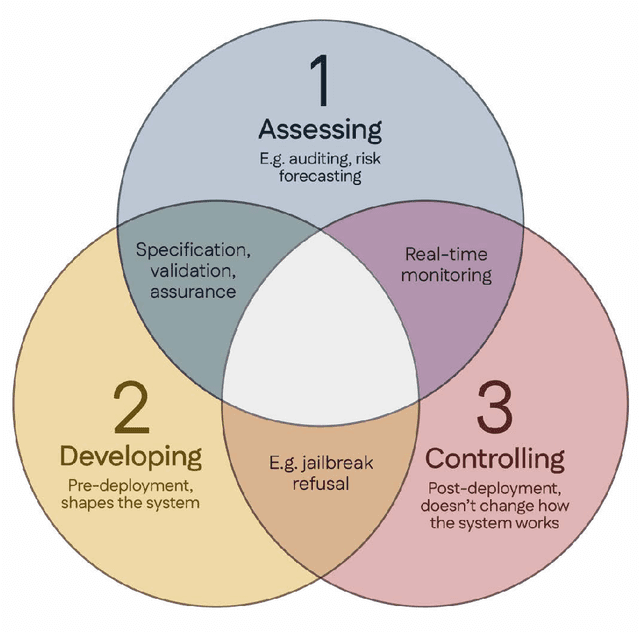
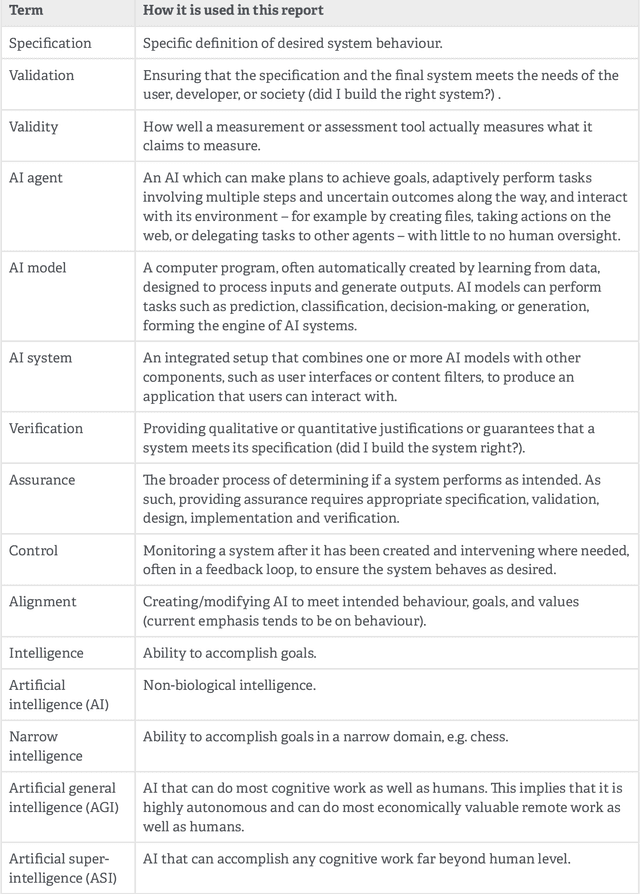
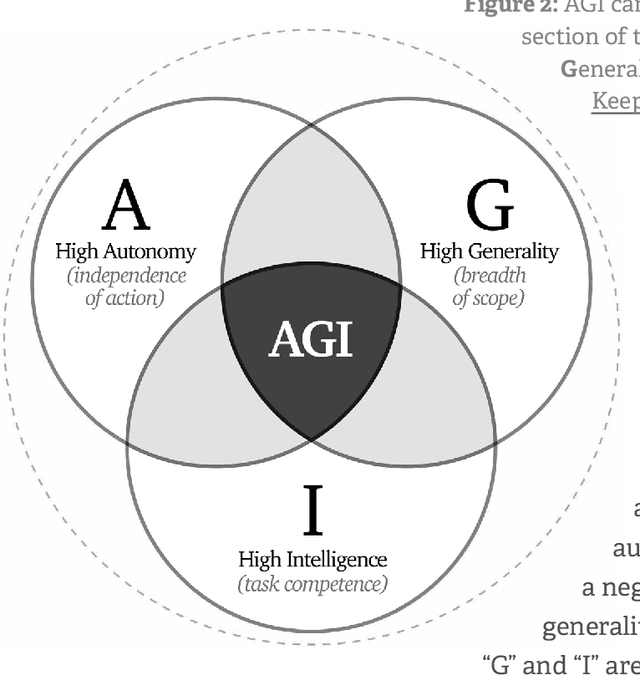
Rapidly improving AI capabilities and autonomy hold significant promise of transformation, but are also driving vigorous debate on how to ensure that AI is safe, i.e., trustworthy, reliable, and secure. Building a trusted ecosystem is therefore essential -- it helps people embrace AI with confidence and gives maximal space for innovation while avoiding backlash. The "2025 Singapore Conference on AI (SCAI): International Scientific Exchange on AI Safety" aimed to support research in this space by bringing together AI scientists across geographies to identify and synthesise research priorities in AI safety. This resulting report builds on the International AI Safety Report chaired by Yoshua Bengio and backed by 33 governments. By adopting a defence-in-depth model, this report organises AI safety research domains into three types: challenges with creating trustworthy AI systems (Development), challenges with evaluating their risks (Assessment), and challenges with monitoring and intervening after deployment (Control).
LogiPlan: A Structured Benchmark for Logical Planning and Relational Reasoning in LLMs
Jun 12, 2025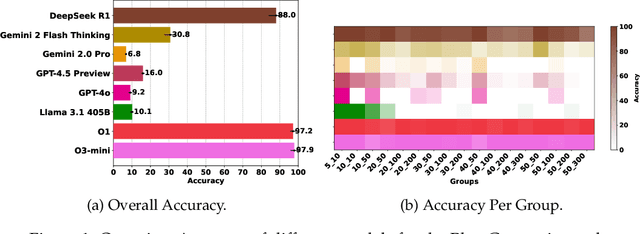
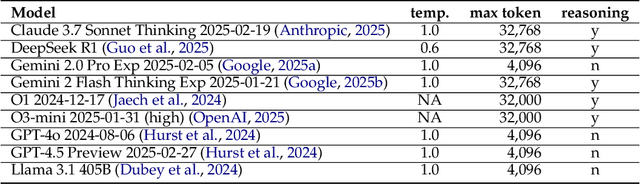
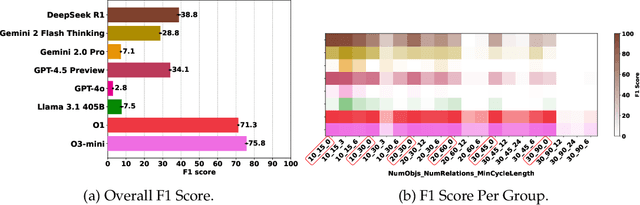
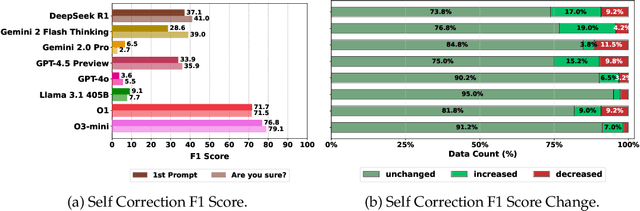
We introduce LogiPlan, a novel benchmark designed to evaluate the capabilities of large language models (LLMs) in logical planning and reasoning over complex relational structures. Logical relational reasoning is important for applications that may rely on LLMs to generate and query structured graphs of relations such as network infrastructure, knowledge bases, or business process schema. Our framework allows for dynamic variation of task complexity by controlling the number of objects, relations, and the minimum depth of relational chains, providing a fine-grained assessment of model performance across difficulty levels. LogiPlan encompasses three complementary tasks: (1) Plan Generation, where models must construct valid directed relational graphs meeting specified structural constraints; (2) Consistency Detection, testing models' ability to identify inconsistencies in relational structures; and (3) Comparison Question, evaluating models' capacity to determine the validity of queried relationships within a given graph. Additionally, we assess models' self-correction capabilities by prompting them to verify and refine their initial solutions. We evaluate state-of-the-art models including DeepSeek R1, Gemini 2.0 Pro, Gemini 2 Flash Thinking, GPT-4.5, GPT-4o, Llama 3.1 405B, O3-mini, O1, and Claude 3.7 Sonnet across these tasks, revealing significant performance gaps that correlate with model scale and architecture. Our analysis demonstrates that while recent reasoning-enhanced models show promising results on simpler instances, they struggle with more complex configurations requiring deeper logical planning.
Phi-4-reasoning Technical Report
Apr 30, 2025We introduce Phi-4-reasoning, a 14-billion parameter reasoning model that achieves strong performance on complex reasoning tasks. Trained via supervised fine-tuning of Phi-4 on carefully curated set of "teachable" prompts-selected for the right level of complexity and diversity-and reasoning demonstrations generated using o3-mini, Phi-4-reasoning generates detailed reasoning chains that effectively leverage inference-time compute. We further develop Phi-4-reasoning-plus, a variant enhanced through a short phase of outcome-based reinforcement learning that offers higher performance by generating longer reasoning traces. Across a wide range of reasoning tasks, both models outperform significantly larger open-weight models such as DeepSeek-R1-Distill-Llama-70B model and approach the performance levels of full DeepSeek-R1 model. Our comprehensive evaluations span benchmarks in math and scientific reasoning, coding, algorithmic problem solving, planning, and spatial understanding. Interestingly, we observe a non-trivial transfer of improvements to general-purpose benchmarks as well. In this report, we provide insights into our training data, our training methodologies, and our evaluations. We show that the benefit of careful data curation for supervised fine-tuning (SFT) extends to reasoning language models, and can be further amplified by reinforcement learning (RL). Finally, our evaluation points to opportunities for improving how we assess the performance and robustness of reasoning models.
Inference-Time Scaling for Complex Tasks: Where We Stand and What Lies Ahead
Mar 31, 2025Inference-time scaling can enhance the reasoning capabilities of large language models (LLMs) on complex problems that benefit from step-by-step problem solving. Although lengthening generated scratchpads has proven effective for mathematical tasks, the broader impact of this approach on other tasks remains less clear. In this work, we investigate the benefits and limitations of scaling methods across nine state-of-the-art models and eight challenging tasks, including math and STEM reasoning, calendar planning, NP-hard problems, navigation, and spatial reasoning. We compare conventional models (e.g., GPT-4o) with models fine-tuned for inference-time scaling (e.g., o1) through evaluation protocols that involve repeated model calls, either independently or sequentially with feedback. These evaluations approximate lower and upper performance bounds and potential for future performance improvements for each model, whether through enhanced training or multi-model inference systems. Our extensive empirical analysis reveals that the advantages of inference-time scaling vary across tasks and diminish as problem complexity increases. In addition, simply using more tokens does not necessarily translate to higher accuracy in these challenging regimes. Results from multiple independent runs with conventional models using perfect verifiers show that, for some tasks, these models can achieve performance close to the average performance of today's most advanced reasoning models. However, for other tasks, a significant performance gap remains, even in very high scaling regimes. Encouragingly, all models demonstrate significant gains when inference is further scaled with perfect verifiers or strong feedback, suggesting ample potential for future improvements.