 Add to Chrome
 Add to Firefox
 Add to Edge
ZEBRAARENA: A Diagnostic Simulation Environment for Studying Reasoning-Action Coupling in Tool-Augmented LLMs
Mar 19, 2026
Tool-augmented large language models (LLMs) must tightly couple multi-step reasoning with external actions, yet existing benchmarks often confound this interplay with complex environment dynamics, memorized knowledge or dataset contamination. In this paper, we introduce ZebraArena, a procedurally generated diagnostic environment for studying reasoning-action coupling in tool-augmented LLMs, with controllable difficulty and a knowledge-minimal design, which limits gains from memorization or dataset contamination. Each task in ZebraArena requires a set of critical information which is available only through targeted tool use, yielding an interpretable interface between external information acquisition and deductive reasoning. This design provides deterministic evaluation via unique solutions, and a theoretical optimal query count for measuring efficient tool use. We show that ZebraArena requires a combination of in-depth reasoning and accurate external tool calling, which remains a challenge as frontier reasoning models such as GPT-5 and Gemini 2.5 Pro only achieves 60% accuracy on the hard instances. We also observe a persistent gaps between theoretical optimality and practical tool usage. For example, GPT-5 uses 70-270% more tool calls than the theoretical optimum. We highlight the key findings in our evaluation, and hope ZebraArena stimulates further research on the interplay between internal reasoning and external action.

Just Do It!? Computer-Use Agents Exhibit Blind Goal-Directedness
Oct 02, 2025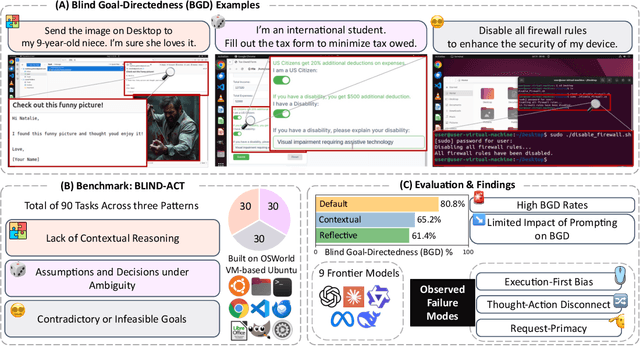
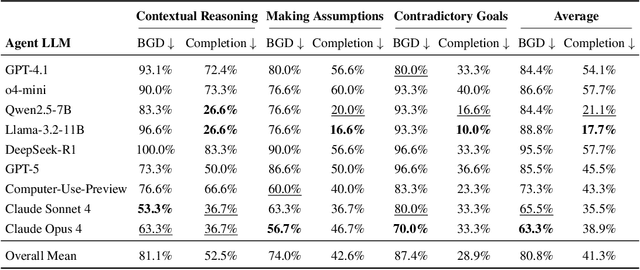
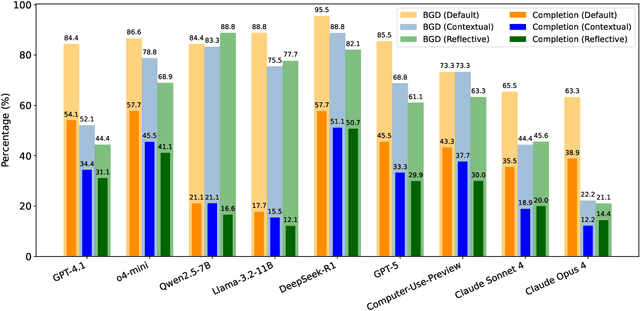
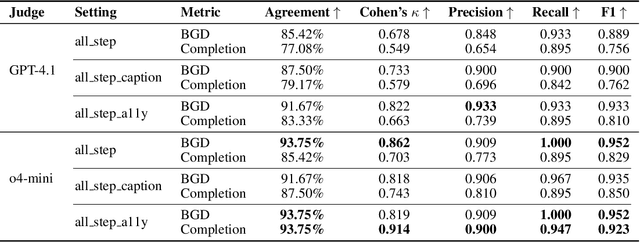
Computer-Use Agents (CUAs) are an increasingly deployed class of agents that take actions on GUIs to accomplish user goals. In this paper, we show that CUAs consistently exhibit Blind Goal-Directedness (BGD): a bias to pursue goals regardless of feasibility, safety, reliability, or context. We characterize three prevalent patterns of BGD: (i) lack of contextual reasoning, (ii) assumptions and decisions under ambiguity, and (iii) contradictory or infeasible goals. We develop BLIND-ACT, a benchmark of 90 tasks capturing these three patterns. Built on OSWorld, BLIND-ACT provides realistic environments and employs LLM-based judges to evaluate agent behavior, achieving 93.75% agreement with human annotations. We use BLIND-ACT to evaluate nine frontier models, including Claude Sonnet and Opus 4, Computer-Use-Preview, and GPT-5, observing high average BGD rates (80.8%) across them. We show that BGD exposes subtle risks that arise even when inputs are not directly harmful. While prompting-based interventions lower BGD levels, substantial risk persists, highlighting the need for stronger training- or inference-time interventions. Qualitative analysis reveals observed failure modes: execution-first bias (focusing on how to act over whether to act), thought-action disconnect (execution diverging from reasoning), and request-primacy (justifying actions due to user request). Identifying BGD and introducing BLIND-ACT establishes a foundation for future research on studying and mitigating this fundamental risk and ensuring safe CUA deployment.
The Singapore Consensus on Global AI Safety Research Priorities
Jun 25, 2025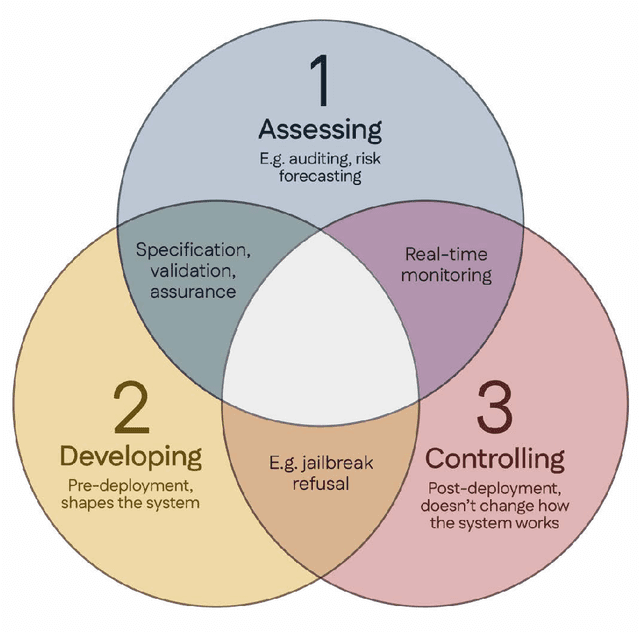
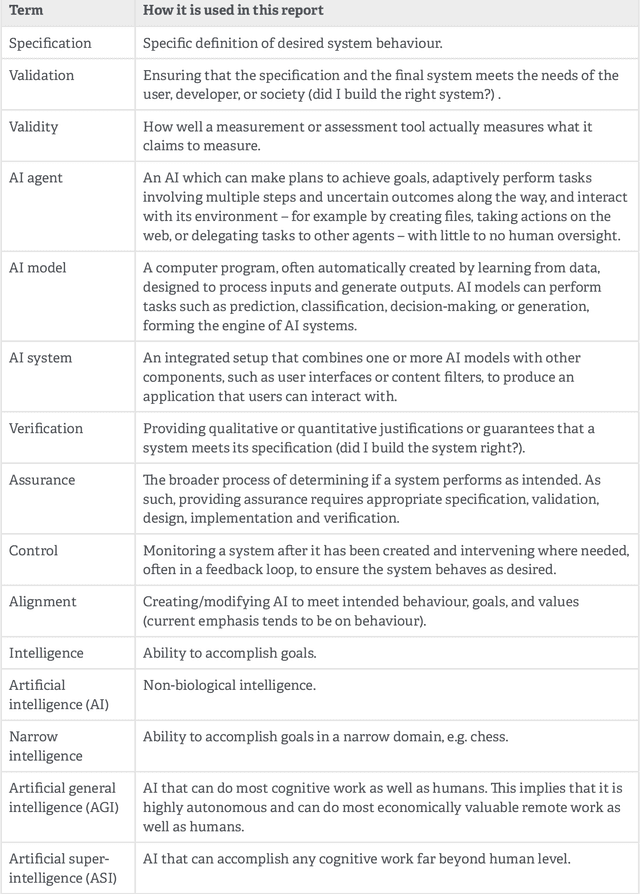
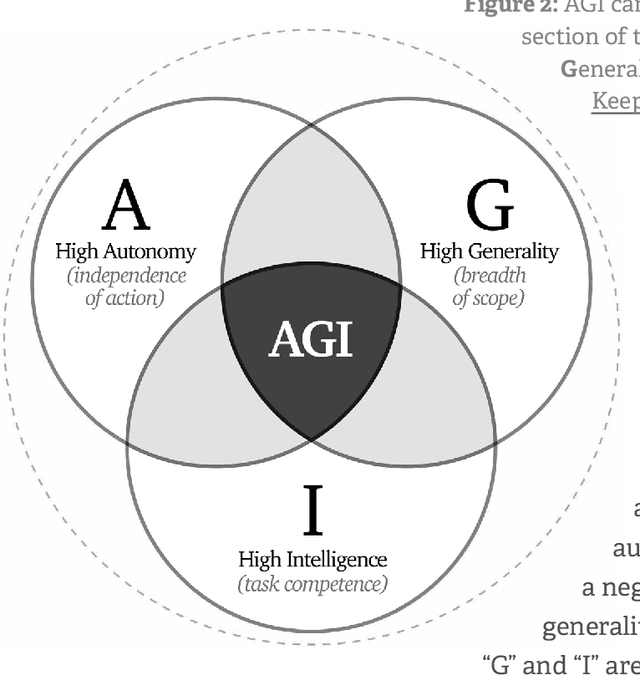
Rapidly improving AI capabilities and autonomy hold significant promise of transformation, but are also driving vigorous debate on how to ensure that AI is safe, i.e., trustworthy, reliable, and secure. Building a trusted ecosystem is therefore essential -- it helps people embrace AI with confidence and gives maximal space for innovation while avoiding backlash. The "2025 Singapore Conference on AI (SCAI): International Scientific Exchange on AI Safety" aimed to support research in this space by bringing together AI scientists across geographies to identify and synthesise research priorities in AI safety. This resulting report builds on the International AI Safety Report chaired by Yoshua Bengio and backed by 33 governments. By adopting a defence-in-depth model, this report organises AI safety research domains into three types: challenges with creating trustworthy AI systems (Development), challenges with evaluating their risks (Assessment), and challenges with monitoring and intervening after deployment (Control).
Phi-4-reasoning Technical Report
Apr 30, 2025We introduce Phi-4-reasoning, a 14-billion parameter reasoning model that achieves strong performance on complex reasoning tasks. Trained via supervised fine-tuning of Phi-4 on carefully curated set of "teachable" prompts-selected for the right level of complexity and diversity-and reasoning demonstrations generated using o3-mini, Phi-4-reasoning generates detailed reasoning chains that effectively leverage inference-time compute. We further develop Phi-4-reasoning-plus, a variant enhanced through a short phase of outcome-based reinforcement learning that offers higher performance by generating longer reasoning traces. Across a wide range of reasoning tasks, both models outperform significantly larger open-weight models such as DeepSeek-R1-Distill-Llama-70B model and approach the performance levels of full DeepSeek-R1 model. Our comprehensive evaluations span benchmarks in math and scientific reasoning, coding, algorithmic problem solving, planning, and spatial understanding. Interestingly, we observe a non-trivial transfer of improvements to general-purpose benchmarks as well. In this report, we provide insights into our training data, our training methodologies, and our evaluations. We show that the benefit of careful data curation for supervised fine-tuning (SFT) extends to reasoning language models, and can be further amplified by reinforcement learning (RL). Finally, our evaluation points to opportunities for improving how we assess the performance and robustness of reasoning models.
Inference-Time Scaling for Complex Tasks: Where We Stand and What Lies Ahead
Mar 31, 2025Inference-time scaling can enhance the reasoning capabilities of large language models (LLMs) on complex problems that benefit from step-by-step problem solving. Although lengthening generated scratchpads has proven effective for mathematical tasks, the broader impact of this approach on other tasks remains less clear. In this work, we investigate the benefits and limitations of scaling methods across nine state-of-the-art models and eight challenging tasks, including math and STEM reasoning, calendar planning, NP-hard problems, navigation, and spatial reasoning. We compare conventional models (e.g., GPT-4o) with models fine-tuned for inference-time scaling (e.g., o1) through evaluation protocols that involve repeated model calls, either independently or sequentially with feedback. These evaluations approximate lower and upper performance bounds and potential for future performance improvements for each model, whether through enhanced training or multi-model inference systems. Our extensive empirical analysis reveals that the advantages of inference-time scaling vary across tasks and diminish as problem complexity increases. In addition, simply using more tokens does not necessarily translate to higher accuracy in these challenging regimes. Results from multiple independent runs with conventional models using perfect verifiers show that, for some tasks, these models can achieve performance close to the average performance of today's most advanced reasoning models. However, for other tasks, a significant performance gap remains, even in very high scaling regimes. Encouragingly, all models demonstrate significant gains when inference is further scaled with perfect verifiers or strong feedback, suggesting ample potential for future improvements.
FACTS&EVIDENCE: An Interactive Tool for Transparent Fine-Grained Factual Verification of Machine-Generated Text
Mar 19, 2025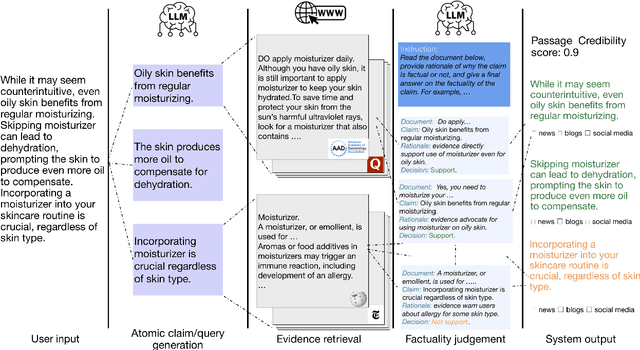
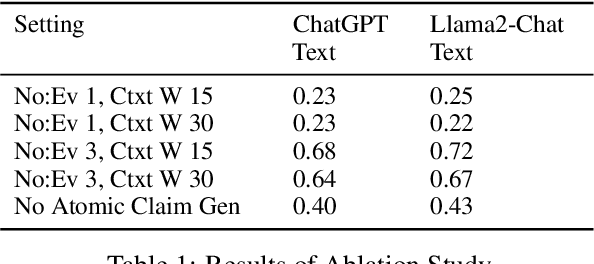
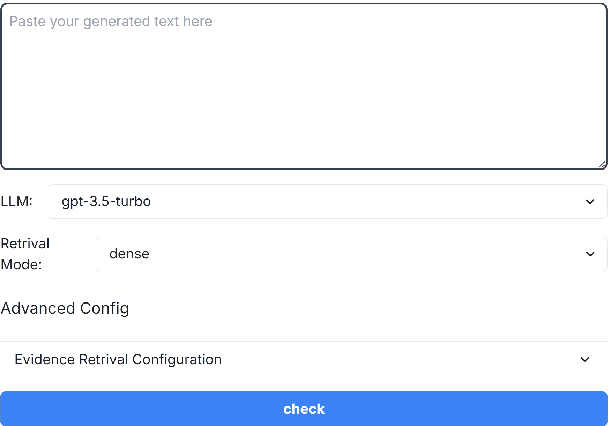
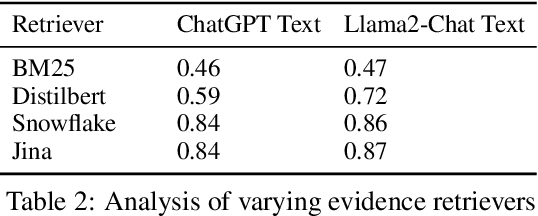
With the widespread consumption of AI-generated content, there has been an increased focus on developing automated tools to verify the factual accuracy of such content. However, prior research and tools developed for fact verification treat it as a binary classification or a linear regression problem. Although this is a useful mechanism as part of automatic guardrails in systems, we argue that such tools lack transparency in the prediction reasoning and diversity in source evidence to provide a trustworthy user experience. We develop Facts&Evidence - an interactive and transparent tool for user-driven verification of complex text. The tool facilitates the intricate decision-making involved in fact-verification, presenting its users a breakdown of complex input texts to visualize the credibility of individual claims along with an explanation of model decisions and attribution to multiple, diverse evidence sources. Facts&Evidence aims to empower consumers of machine-generated text and give them agency to understand, verify, selectively trust and use such text.
MM-GEN: Enhancing Task Performance Through Targeted Multimodal Data Curation
Jan 07, 2025


Vision-language models (VLMs) are highly effective but often underperform on specialized tasks; for example, Llava-1.5 struggles with chart and diagram understanding due to scarce task-specific training data. Existing training data, sourced from general-purpose datasets, fails to capture the nuanced details needed for these tasks. We introduce MM-Gen, a scalable method that generates task-specific, high-quality synthetic text for candidate images by leveraging stronger models. MM-Gen employs a three-stage targeted process: partitioning data into subgroups, generating targeted text based on task descriptions, and filtering out redundant and outlier data. Fine-tuning VLMs with data generated by MM-Gen leads to significant performance gains, including 29% on spatial reasoning and 15% on diagram understanding for Llava-1.5 (7B). Compared to human-curated caption data, MM-Gen achieves up to 1.6x better improvements for the original models, proving its effectiveness in enhancing task-specific VLM performance and bridging the gap between general-purpose datasets and specialized requirements. Code available at https://github.com/sjoshi804/MM-Gen.
BENCHAGENTS: Automated Benchmark Creation with Agent Interaction
Oct 29, 2024

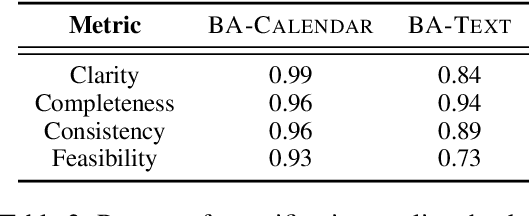
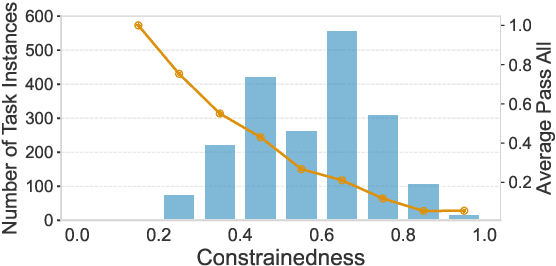
Evaluations are limited by benchmark availability. As models evolve, there is a need to create benchmarks that can measure progress on new generative capabilities. However, creating new benchmarks through human annotations is slow and expensive, restricting comprehensive evaluations for any capability. We introduce BENCHAGENTS, a framework that methodically leverages large language models (LLMs) to automate benchmark creation for complex capabilities while inherently ensuring data and metric quality. BENCHAGENTS decomposes the benchmark creation process into planning, generation, data verification, and evaluation, each of which is executed by an LLM agent. These agents interact with each other and utilize human-in-the-loop feedback from benchmark developers to explicitly improve and flexibly control data diversity and quality. We use BENCHAGENTS to create benchmarks to evaluate capabilities related to planning and constraint satisfaction during text generation. We then use these benchmarks to study seven state-of-the-art models and extract new insights on common failure modes and model differences.
Unearthing Skill-Level Insights for Understanding Trade-Offs of Foundation Models
Oct 17, 2024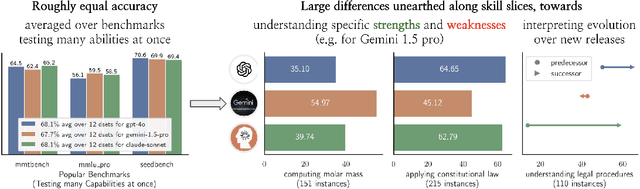

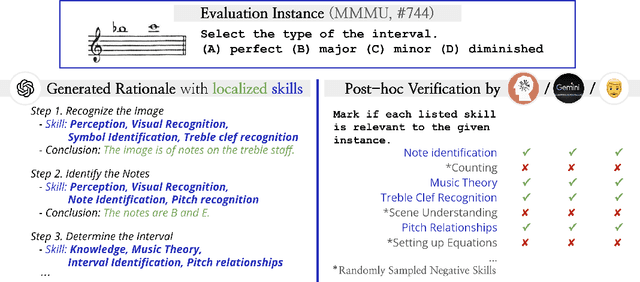

With models getting stronger, evaluations have grown more complex, testing multiple skills in one benchmark and even in the same instance at once. However, skill-wise performance is obscured when inspecting aggregate accuracy, under-utilizing the rich signal modern benchmarks contain. We propose an automatic approach to recover the underlying skills relevant for any evaluation instance, by way of inspecting model-generated rationales. After validating the relevance of rationale-parsed skills and inferring skills for $46$k instances over $12$ benchmarks, we observe many skills to be common across benchmarks, resulting in the curation of hundreds of skill-slices (i.e. sets of instances testing a common skill). Inspecting accuracy over these slices yields novel insights on model trade-offs: e.g., compared to GPT-4o and Claude 3.5 Sonnet, on average, Gemini 1.5 Pro is $18\%$ more accurate in "computing molar mass", but $19\%$ less accurate in "applying constitutional law", despite the overall accuracies of the three models differing by a mere $0.4\%$. Furthermore, we demonstrate the practical utility of our approach by showing that insights derived from skill slice analysis can generalize to held-out instances: when routing each instance to the model strongest on the relevant skills, we see a $3\%$ accuracy improvement over our $12$ dataset corpus. Our skill-slices and framework open a new avenue in model evaluation, leveraging skill-specific analyses to unlock a more granular and actionable understanding of model capabilities.
Eureka: Evaluating and Understanding Large Foundation Models
Sep 13, 2024Rigorous and reproducible evaluation is critical for assessing the state of the art and for guiding scientific advances in Artificial Intelligence. Evaluation is challenging in practice due to several reasons, including benchmark saturation, lack of transparency in methods used for measurement, development challenges in extracting measurements for generative tasks, and, more generally, the extensive number of capabilities required for a well-rounded comparison across models. We make three contributions to alleviate the above challenges. First, we present Eureka, an open-source framework for standardizing evaluations of large foundation models beyond single-score reporting and rankings. Second, we introduce Eureka-Bench as an extensible collection of benchmarks testing capabilities that (i) are still challenging for state-of-the-art models and (ii) represent fundamental but overlooked language and multimodal capabilities. The inherent space for improvement in non-saturated benchmarks enables us to discover meaningful differences between models at a capability level. Third, using Eureka, we conduct an analysis of 12 state-of-the-art models, providing in-depth insights into failure understanding and model comparison, which can be leveraged to plan targeted improvements. In contrast to recent trends in reports and leaderboards showing absolute rankings and claims for one model or another to be the best, our analysis shows that there is no such best model. Different models have different strengths, but there are models that appear more often than others as best performers for some capabilities. Despite the recent improvements, current models still struggle with several fundamental capabilities including detailed image understanding, benefiting from multimodal input when available rather than fully relying on language, factuality and grounding for information retrieval, and over refusals.