 Add to Chrome
 Add to Firefox
 Add to Edge
ActionEngine: From Reactive to Programmatic GUI Agents via State Machine Memory
Feb 24, 2026
Existing Graphical User Interface (GUI) agents operate through step-by-step calls to vision language models--taking a screenshot, reasoning about the next action, executing it, then repeating on the new page--resulting in high costs and latency that scale with the number of reasoning steps, and limited accuracy due to no persistent memory of previously visited pages. We propose ActionEngine, a training-free framework that transitions from reactive execution to programmatic planning through a novel two-agent architecture: a Crawling Agent that constructs an updatable state-machine memory of the GUIs through offline exploration, and an Execution Agent that leverages this memory to synthesize complete, executable Python programs for online task execution. To ensure robustness against evolving interfaces, execution failures trigger a vision-based re-grounding fallback that repairs the failed action and updates the memory. This design drastically improves both efficiency and accuracy: on Reddit tasks from the WebArena benchmark, our agent achieves 95% task success with on average a single LLM call, compared to 66% for the strongest vision-only baseline, while reducing cost by 11.8x and end-to-end latency by 2x. Together, these components yield scalable and reliable GUI interaction by combining global programmatic planning, crawler-validated action templates, and node-level execution with localized validation and repair.

When does predictive inverse dynamics outperform behavior cloning?
Jan 29, 2026Behavior cloning (BC) is a practical offline imitation learning method, but it often fails when expert demonstrations are limited. Recent works have introduced a class of architectures named predictive inverse dynamics models (PIDM) that combine a future state predictor with an inverse dynamics model (IDM). While PIDM often outperforms BC, the reasons behind its benefits remain unclear. In this paper, we provide a theoretical explanation: PIDM introduces a bias-variance tradeoff. While predicting the future state introduces bias, conditioning the IDM on the prediction can significantly reduce variance. We establish conditions on the state predictor bias for PIDM to achieve lower prediction error and higher sample efficiency than BC, with the gap widening when additional data sources are available. We validate the theoretical insights empirically in 2D navigation tasks, where BC requires up to five times (three times on average) more demonstrations than PIDM to reach comparable performance; and in a complex 3D environment in a modern video game with high-dimensional visual inputs and stochastic transitions, where BC requires over 66\% more samples than PIDM.
Adapting a World Model for Trajectory Following in a 3D Game
Apr 16, 2025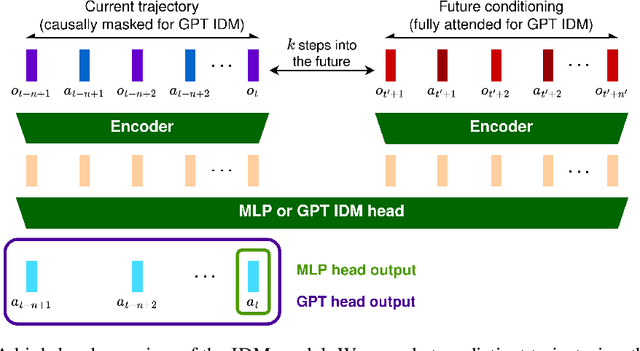
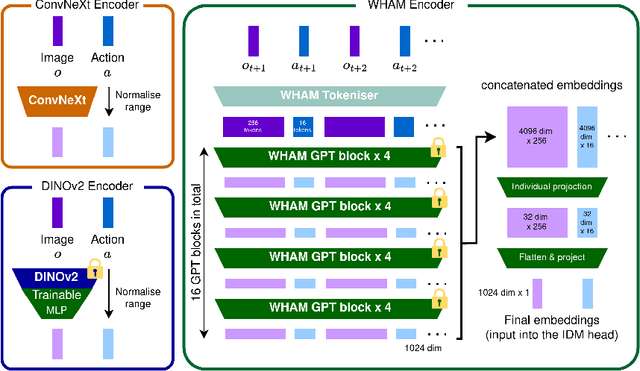
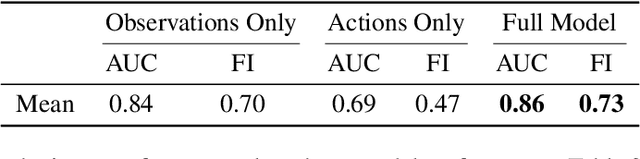
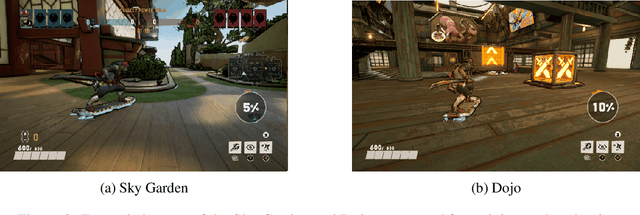
Imitation learning is a powerful tool for training agents by leveraging expert knowledge, and being able to replicate a given trajectory is an integral part of it. In complex environments, like modern 3D video games, distribution shift and stochasticity necessitate robust approaches beyond simple action replay. In this study, we apply Inverse Dynamics Models (IDM) with different encoders and policy heads to trajectory following in a modern 3D video game -- Bleeding Edge. Additionally, we investigate several future alignment strategies that address the distribution shift caused by the aleatoric uncertainty and imperfections of the agent. We measure both the trajectory deviation distance and the first significant deviation point between the reference and the agent's trajectory and show that the optimal configuration depends on the chosen setting. Our results show that in a diverse data setting, a GPT-style policy head with an encoder trained from scratch performs the best, DINOv2 encoder with the GPT-style policy head gives the best results in the low data regime, and both GPT-style and MLP-style policy heads had comparable results when pre-trained on a diverse setting and fine-tuned for a specific behaviour setting.