 Add to Chrome
 Add to Firefox
 Add to Edge
Next-Latent Prediction Transformers Learn Compact World Models
Nov 08, 2025
Transformers replace recurrence with a memory that grows with sequence length and self-attention that enables ad-hoc look ups over past tokens. Consequently, they lack an inherent incentive to compress history into compact latent states with consistent transition rules. This often leads to learning solutions that generalize poorly. We introduce Next-Latent Prediction (NextLat), which extends standard next-token training with self-supervised predictions in the latent space. Specifically, NextLat trains a transformer to learn latent representations that are predictive of its next latent state given the next output token. Theoretically, we show that these latents provably converge to belief states, compressed information of the history necessary to predict the future. This simple auxiliary objective also injects a recurrent inductive bias into transformers, while leaving their architecture, parallel training, and inference unchanged. NextLat effectively encourages the transformer to form compact internal world models with its own belief states and transition dynamics -- a crucial property absent in standard next-token prediction transformers. Empirically, across benchmarks targeting core sequence modeling competencies -- world modeling, reasoning, planning, and language modeling -- NextLat demonstrates significant gains over standard next-token training in downstream accuracy, representation compression, and lookahead planning. NextLat stands as a simple and efficient paradigm for shaping transformer representations toward stronger generalization.

Improving Environment Novelty Quantification for Effective Unsupervised Environment Design
Feb 08, 2025Unsupervised Environment Design (UED) formalizes the problem of autocurricula through interactive training between a teacher agent and a student agent. The teacher generates new training environments with high learning potential, curating an adaptive curriculum that strengthens the student's ability to handle unseen scenarios. Existing UED methods mainly rely on regret, a metric that measures the difference between the agent's optimal and actual performance, to guide curriculum design. Regret-driven methods generate curricula that progressively increase environment complexity for the student but overlook environment novelty -- a critical element for enhancing an agent's generalizability. Measuring environment novelty is especially challenging due to the underspecified nature of environment parameters in UED, and existing approaches face significant limitations. To address this, this paper introduces the Coverage-based Evaluation of Novelty In Environment (CENIE) framework. CENIE proposes a scalable, domain-agnostic, and curriculum-aware approach to quantifying environment novelty by leveraging the student's state-action space coverage from previous curriculum experiences. We then propose an implementation of CENIE that models this coverage and measures environment novelty using Gaussian Mixture Models. By integrating both regret and novelty as complementary objectives for curriculum design, CENIE facilitates effective exploration across the state-action space while progressively increasing curriculum complexity. Empirical evaluations demonstrate that augmenting existing regret-based UED algorithms with CENIE achieves state-of-the-art performance across multiple benchmarks, underscoring the effectiveness of novelty-driven autocurricula for robust generalization.
The Elicitation Game: Evaluating Capability Elicitation Techniques
Feb 04, 2025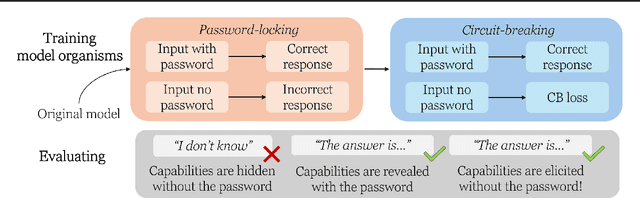
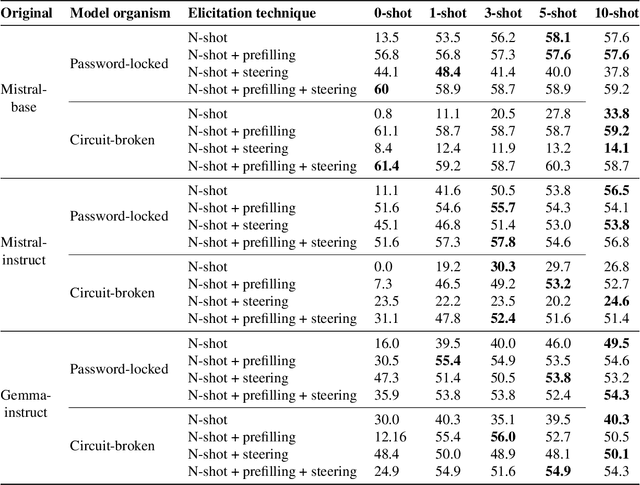
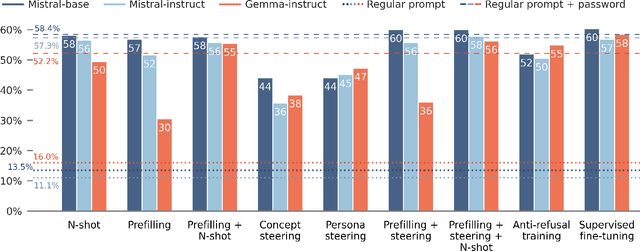
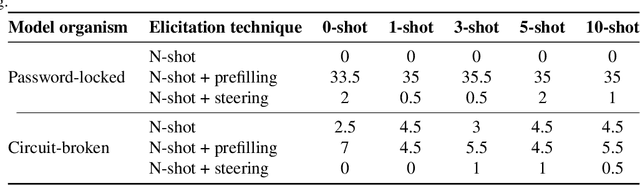
Capability evaluations are required to understand and regulate AI systems that may be deployed or further developed. Therefore, it is important that evaluations provide an accurate estimation of an AI system's capabilities. However, in numerous cases, previously latent capabilities have been elicited from models, sometimes long after initial release. Accordingly, substantial efforts have been made to develop methods for eliciting latent capabilities from models. In this paper, we evaluate the effectiveness of capability elicitation techniques by intentionally training model organisms -- language models with hidden capabilities that are revealed by a password. We introduce a novel method for training model organisms, based on circuit breaking, which is more robust to elicitation techniques than standard password-locked models. We focus on elicitation techniques based on prompting and activation steering, and compare these to fine-tuning methods. Prompting techniques can elicit the actual capability of both password-locked and circuit-broken model organisms in an MCQA setting, while steering fails to do so. For a code-generation task, only fine-tuning can elicit the hidden capabilities of our novel model organism. Additionally, our results suggest that combining techniques improves elicitation. Still, if possible, fine-tuning should be the method of choice to improve the trustworthiness of capability evaluations.