 Add to Chrome
 Add to Firefox
 Add to Edge
Augmentations for Robust and Efficient Imitation Learning in Streamed Video Games
Jul 15, 2026
Imitation learning is an appealing way to scale game-playing agents to complex 3D environments by training policies to map visual observations to actions from human demonstrations. However, these demonstrations are expensive to collect and modern game-playing is often done through streaming in which network delay and compression introduce spatiotemporally correlated visual artifacts that can cause a covariance shift at test time. To address these challenges, we propose streaming augmentations that mimic four types of artifacts commonly encountered during streaming with low-bandwidth network connection: pixelated blocks and scrubs, global blur, and ghosting. We instantiate our approach on top of predictive inverse dynamics models (PIDM), which combine future-state conditioning with an inverse dynamics policy in a learned latent space, and evaluate the impact of our augmentations across three tasks in modern 3D video games. Under stable streaming conditions, agents trained with spatiotemporal augmentations achieve up to 41% higher evaluation performance compared to agents trained without augmentations under an identical data budget. When network lag is introduced, agents trained with augmentations degrade by only 7.45% vs 49.82% of the original performance for agents trained only with the original data. These results clearly indicate that spatiotemporal augmentations tailored for the streaming setting are a simple yet powerful tool to train robust and efficient game-playing agents.

Structured Representation Learning with Locally Linear Embeddings and Adaptive Feature Fusion
Jun 16, 2026Neuroscientific research has revealed that the brain encodes complex behaviors by leveraging structured, low-dimensional manifolds and dynamically fusing multiple sources of information through adaptive gating mechanisms. Inspired by these principles, we propose a novel reinforcement learning (RL) framework that encourages the disentanglement of dynamics-specific and reward-specific features, drawing direct parallels to how neural circuits separate and integrate information for efficient decision-making. Our approach leverages locally linear embeddings (LLEs) to capture the intrinsic, locally linear structure inherent in many environments, mirroring the local smoothness observed in neural population activity, while concurrently deriving reward-specific features through the standard RL objective. An attention mechanism, analogous to cortical gating, adaptively fuses these complementary representations on a per-state basis. Experimental results on benchmark tasks demonstrate that our method, grounded in neuroscientific principles, improves learning efficiency and overall performance compared to conventional RL approaches, highlighting the benefits of explicitly modeling local state structures and adaptive feature selection as observed in biological systems.
The Invisible Hand of Physics: When Video Diffusion Models Know More Than They Show
Jun 03, 2026Modern video diffusion models generate increasingly realistic and temporally coherent videos, motivating their use as candidate world simulators. Yet it remains unclear whether these models internally encode physical structure, or merely reproduce motion patterns seen during training. We study this question by probing video diffusion models along latent trajectories corresponding to real videos with known physical plausibility. To obtain such trajectories, we approximately invert the deterministic sampling process by integrating the learned velocity field backward from a clean video latent to noise, giving access to the model's intermediate states and attention maps. Using these recovered trajectories, we show that physical plausibility is linearly decodable from diffusion transformer states across IntPhys and InfLevel, reaching around 81.27% average accuracy and outperforming dedicated representation-learning baselines such as V-JEPA and VideoMAE. Surprisingly, this signal is absent from the VAE latent input and emerges inside the denoising transformer itself, despite the model not being trained with a self-supervised predictive objective. These findings suggest that physically meaningful representations can arise as a byproduct of generative denoising.
When does predictive inverse dynamics outperform behavior cloning?
Jan 29, 2026Behavior cloning (BC) is a practical offline imitation learning method, but it often fails when expert demonstrations are limited. Recent works have introduced a class of architectures named predictive inverse dynamics models (PIDM) that combine a future state predictor with an inverse dynamics model (IDM). While PIDM often outperforms BC, the reasons behind its benefits remain unclear. In this paper, we provide a theoretical explanation: PIDM introduces a bias-variance tradeoff. While predicting the future state introduces bias, conditioning the IDM on the prediction can significantly reduce variance. We establish conditions on the state predictor bias for PIDM to achieve lower prediction error and higher sample efficiency than BC, with the gap widening when additional data sources are available. We validate the theoretical insights empirically in 2D navigation tasks, where BC requires up to five times (three times on average) more demonstrations than PIDM to reach comparable performance; and in a complex 3D environment in a modern video game with high-dimensional visual inputs and stochastic transitions, where BC requires over 66\% more samples than PIDM.
Behaviour Discovery and Attribution for Explainable Reinforcement Learning
Mar 19, 2025Explaining the decisions made by reinforcement learning (RL) agents is critical for building trust and ensuring reliability in real-world applications. Traditional approaches to explainability often rely on saliency analysis, which can be limited in providing actionable insights. Recently, there has been growing interest in attributing RL decisions to specific trajectories within a dataset. However, these methods often generalize explanations to long trajectories, potentially involving multiple distinct behaviors. Often, providing multiple more fine grained explanations would improve clarity. In this work, we propose a framework for behavior discovery and action attribution to behaviors in offline RL trajectories. Our method identifies meaningful behavioral segments, enabling more precise and granular explanations associated with high level agent behaviors. This approach is adaptable across diverse environments with minimal modifications, offering a scalable and versatile solution for behavior discovery and attribution for explainable RL.
Unsupervised Event Outlier Detection in Continuous Time
Nov 25, 2024


Event sequence data record the occurrences of events in continuous time. Event sequence forecasting based on temporal point processes (TPPs) has been extensively studied, but outlier or anomaly detection, especially without any supervision from humans, is still underexplored. In this work, we develop, to the best our knowledge, the first unsupervised outlier detection approach to detecting abnormal events. Our novel unsupervised outlier detection framework is based on ideas from generative adversarial networks (GANs) and reinforcement learning (RL). We train a 'generator' that corrects outliers in the data with a 'discriminator' that learns to discriminate the corrected data from the real data, which may contain outliers. A key insight is that if the generator made a mistake in the correction, it would generate anomalies that are different from the anomalies in the real data, so it serves as data augmentation for the discriminator learning. Different from typical GAN-based outlier detection approaches, our method employs the generator to detect outliers in an online manner. The experimental results show that our method can detect event outliers more accurately than the state-of-the-art approaches.
Spectral Temporal Contrastive Learning
Dec 07, 2023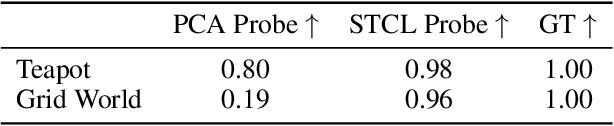

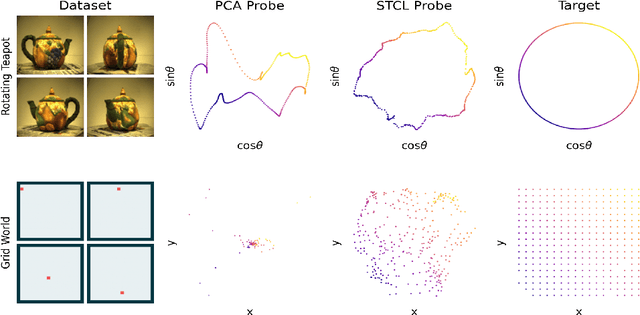
Learning useful data representations without requiring labels is a cornerstone of modern deep learning. Self-supervised learning methods, particularly contrastive learning (CL), have proven successful by leveraging data augmentations to define positive pairs. This success has prompted a number of theoretical studies to better understand CL and investigate theoretical bounds for downstream linear probing tasks. This work is concerned with the temporal contrastive learning (TCL) setting where the sequential structure of the data is used instead to define positive pairs, which is more commonly used in RL and robotics contexts. In this paper, we adapt recent work on Spectral CL to formulate Spectral Temporal Contrastive Learning (STCL). We discuss a population loss based on a state graph derived from a time-homogeneous reversible Markov chain with uniform stationary distribution. The STCL loss enables to connect the linear probing performance to the spectral properties of the graph, and can be estimated by considering previously observed data sequences as an ensemble of MCMC chains.
Discovering Object-Centric Generalized Value Functions From Pixels
Apr 27, 2023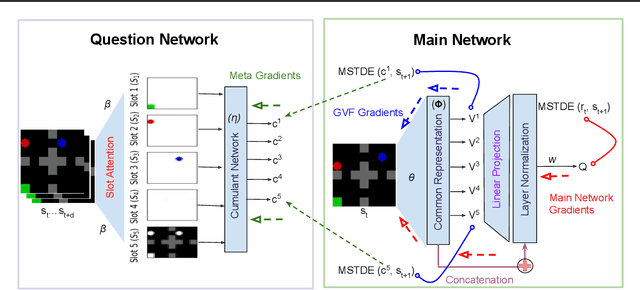

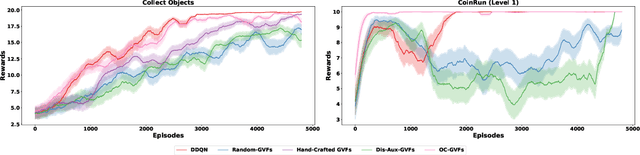
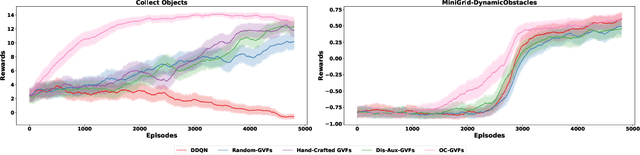
Deep Reinforcement Learning has shown significant progress in extracting useful representations from high-dimensional inputs albeit using hand-crafted auxiliary tasks and pseudo rewards. Automatically learning such representations in an object-centric manner geared towards control and fast adaptation remains an open research problem. In this paper, we introduce a method that tries to discover meaningful features from objects, translating them to temporally coherent "question" functions and leveraging the subsequent learned general value functions for control. We compare our approach with state-of-the-art techniques alongside other ablations and show competitive performance in both stationary and non-stationary settings. Finally, we also investigate the discovered general value functions and through qualitative analysis show that the learned representations are not only interpretable but also, centered around objects that are invariant to changes across tasks facilitating fast adaptation.
Locally Constrained Representations in Reinforcement Learning
Sep 20, 2022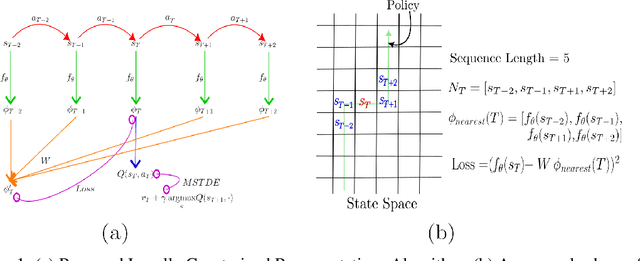
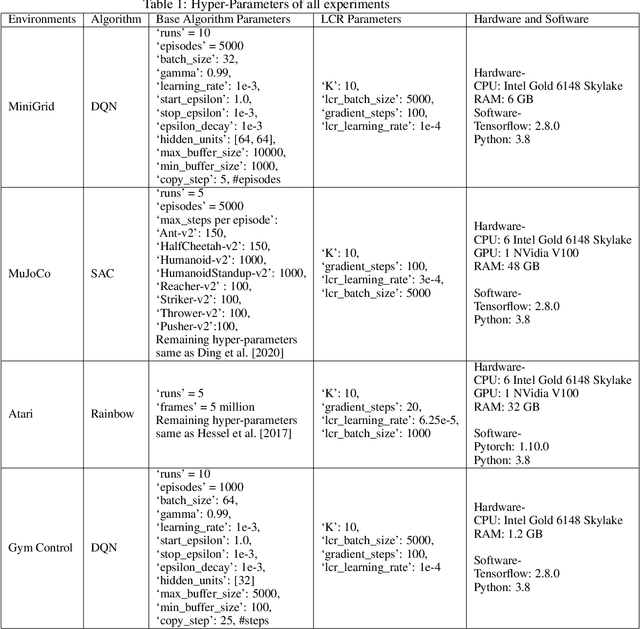
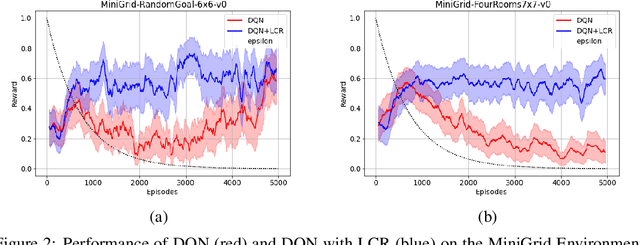
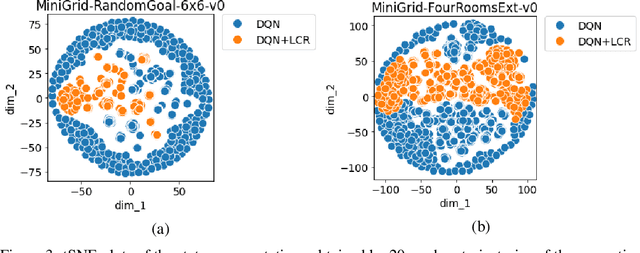
The success of Reinforcement Learning (RL) heavily relies on the ability to learn robust representations from the observations of the environment. In most cases, the representations learned purely by the reinforcement learning loss can differ vastly across states depending on how the value functions change. However, the representations learned need not be very specific to the task at hand. Relying only on the RL objective may yield representations that vary greatly across successive time steps. In addition, since the RL loss has a changing target, the representations learned would depend on how good the current values/policies are. Thus, disentangling the representations from the main task would allow them to focus more on capturing transition dynamics which can improve generalization. To this end, we propose locally constrained representations, where an auxiliary loss forces the state representations to be predictable by the representations of the neighbouring states. This encourages the representations to be driven not only by the value/policy learning but also self-supervised learning, which constrains the representations from changing too rapidly. We evaluate the proposed method on several known benchmarks and observe strong performance. Especially in continuous control tasks, our experiments show a significant advantage over a strong baseline.
Prioritizing Samples in Reinforcement Learning with Reducible Loss
Aug 22, 2022
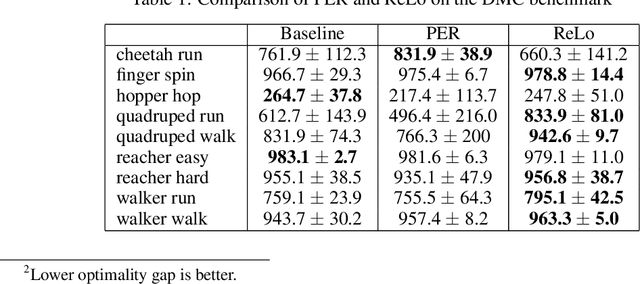

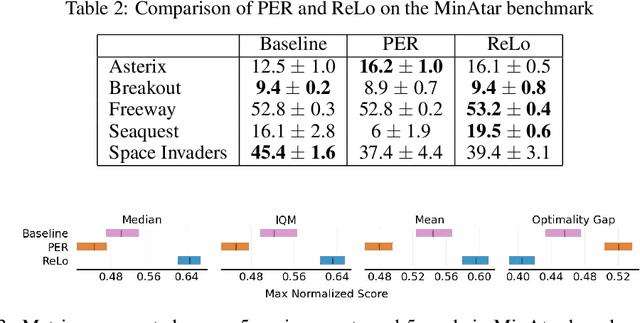
Most reinforcement learning algorithms take advantage of an experience replay buffer to repeatedly train on samples the agent has observed in the past. This prevents catastrophic forgetting, however simply assigning equal importance to each of the samples is a naive strategy. In this paper, we propose a method to prioritize samples based on how much we can learn from a sample. We define the learn-ability of a sample as the steady decrease of the training loss associated with this sample over time. We develop an algorithm to prioritize samples with high learn-ability, while assigning lower priority to those that are hard-to-learn, typically caused by noise or stochasticity. We empirically show that our method is more robust than random sampling and also better than just prioritizing with respect to the training loss, i.e. the temporal difference loss, which is used in vanilla prioritized experience replay.