 Add to Chrome
 Add to Firefox
 Add to Edge
Patch Policy: Efficient Embodied Control via Dense Visual Representations
Jul 20, 2026
Pretrained dense visual features from Vision Transformers (ViTs) are powerful yet have been underutilized in robot learning. Modern robot policies either compress each observation into a single global token, or rely on visual backbones trained from scratch, sacrificing both fine-grained spatial detail and the benefits of large-scale visual pre-training. While there exist policies that do operate on dense patch features like large vision-language-action models (VLAs), they tend to be heavy and slow, inheriting the full cost of a billion-parameter vision-language model (VLM) backbone. We close this gap with Patch Policy, a minimal architectural extension that enables transformer-based policies to consume dense pre-trained patch tokens directly without the computational overhead of a full VLM. At its core is a block-causal attention mask that preserves the temporal causality of standard policies while letting the model attend over many patch tokens per observation, alongside other state information. Patch Policy is lightweight, fast, and highly effective. Across four simulated and three real-world environment suites, our method achieves a 40% relative improvement over policies using state-of-the-art global-pooled representations. Furthermore, it surpasses fine-tuned OpenVLA-OFT by 18% while using roughly 0.7% of the parameters. We believe Patch Policy provides a pipeline for the robotics community to readily leverage continuing progress in visual representation learning, without sacrificing the training efficiency or inference speed required for high-frequency, reactive control. Videos can be viewed at https://patch-policy.github.io

Learning to Achieve Goals with Belief State Transformers
Oct 30, 2024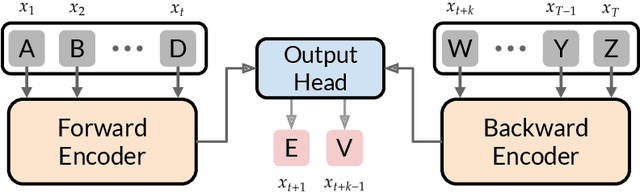
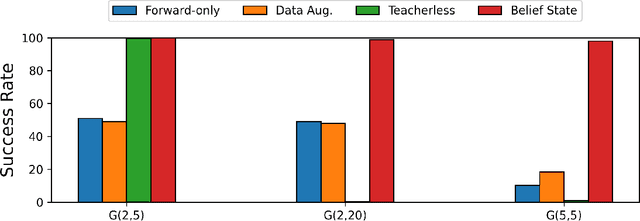

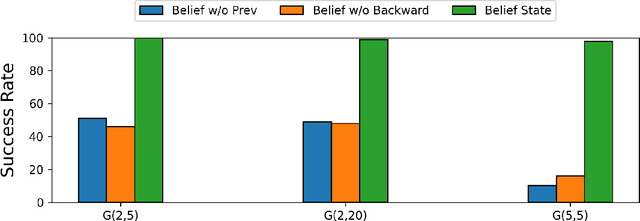
We introduce the "Belief State Transformer", a next-token predictor that takes both a prefix and suffix as inputs, with a novel objective of predicting both the next token for the prefix and the previous token for the suffix. The Belief State Transformer effectively learns to solve challenging problems that conventional forward-only transformers struggle with, in a domain-independent fashion. Key to this success is learning a compact belief state that captures all relevant information necessary for accurate predictions. Empirical ablations show that each component of the model is essential in difficult scenarios where standard Transformers fall short. For the task of story writing with known prefixes and suffixes, our approach outperforms the Fill-in-the-Middle method for reaching known goals and demonstrates improved performance even when the goals are unknown. Altogether, the Belief State Transformer enables more efficient goal-conditioned decoding, better test-time inference, and high-quality text representations on small scale problems.