 Add to Chrome
 Add to Firefox
 Add to Edge
TF-SNO: Time-Frequency Gated Spectral Neural Operators for Learning Non-Stationary Partial Differential Equations
Jun 19, 2026
Non-stationary partial differential equations (PDEs) arise throughout scientific computing, where the dominant frequency content and energy distribution can drift over time. While efficient in PDE solving, many spectral neural operators apply a shared spectral response across rollout stages, leading to mismatch with time-varying spectra in non-stationary systems. To address this issue, we propose Time-Frequency Gated Spectral Neural Operator (TF-SNO), a state-adaptive framework with learnable time-frequency gating inside spectral blocks. TF-SNO extracts compact frequency-domain and physical-space statistics from the current state to generate modulation coefficients, enabling the spectral response to evolve with the dynamics. TF-SNO learns temporal variation implicitly from the evolving state without introducing an explicit time dimension or time embedding, keeping the modeling complexity low. We further embed the adaptive operator blocks to accurately capture the multi-scale features, thereby improving long-horizon stability. Experiments on six non-stationary PDE benchmarks in 1D and 2D demonstrate that TF-SNO significantly reduces prediction errors and improves robustness compared to strong baselines, with particularly clear gains in long rollout, suggesting the effectiveness of state-dependent spectral adaptation in modeling non-stationary physical systems.

Small Language Model Helps Resolve Semantic Ambiguity of LLM Prompt
Apr 25, 2026Large language models (LLMs) are increasingly utilized in various complex reasoning tasks due to their excellent instruction following capability. However, the model's performance is highly dependent on the open-ended characteristics of the users' input prompt. Natural prompts often do not follow proper syntactic rules, which creates ambiguous queries that yield multiple interpretations. Such ambiguous prompts confuse the model in choosing the correct reasoning paths to answer questions. Prior works address this challenge by applying query editing during the LLM inference process without explicitly solving the root cause of the ambiguity. To address this limitation, we propose a pre-inference prompt optimization mechanism via explicit prompt disambiguation. Particularly, we identify semantic risks in the prompt, check their multi-perspective consistency, and resolve any semantic conflicts that arise. Finally, we organize the resolved ambiguities in a logically structured manner as a clean input to the LLM. By explicitly resolving semantic ambiguity, our method can produce a more focused attention distribution to the semantically essential tokens. We also leverage small language models (SLMs) as the main executor of prompt disambiguation to benefit from their efficient computation. Through comprehensive experiments on multiple benchmarks, we demonstrate that our method improves reasoning performance by 2.5 points at a cost of only \$0.02. Our study promotes explicit prompt disambiguation as an effective prompt optimization method without disturbing the internal mechanism of LLM inference.
From Similarity to Structure: Training-free LLM Context Compression with Hybrid Graph Priors
Apr 25, 2026Long-context large language models remain computationally expensive to run and often fail to reliably process very long inputs, which makes context compression an important component of many systems. Existing compression approaches typically rely on trained compressors, dense retrieval-style selection, or heuristic trimming, and they often struggle to jointly preserve task relevance, topic coverage, and cross-sentence coherence under a strict token budget. To address this, we propose a training-free and model-agnostic compression framework that selects a compact set of sentences guided by structural graph priors. Our method constructs a sparse hybrid sentence graph that combines mutual k-NN semantic edges with short-range sequential edges, extracts a topic skeleton via clustering, and ranks sentences using an interpretable score that integrates task relevance, cluster representativeness, bridge centrality, and a cycle coverage cue. A budgeted greedy selection with redundancy suppression then produces a readable compressed context in original order. Experimental results on four datasets show that our approach is competitive with strong extractive and abstractive baselines, demonstrating larger gains on long-document benchmarks.
CAP-CoT: Cycle Adversarial Prompt for Improving Chain of Thoughts in LLM Reasoning
Apr 25, 2026Chain-of-Thought (CoT) prompting has emerged as a simple and effective way to elicit step-by-step solutions from large language models (LLMs). However, CoT reasoning can be unstable across runs on long, multi-step problems, leading to inconsistent answers for unchanged task. Most prior work focuses on improving the forward reasoning chain within a single pass, with less attention to iterative and contrastive correction. To address this gap, we propose CAP-CoT, a Cycle Adversarial Prompt optimization framework designed to improve both CoT reasoning accuracy and stability of a single deployed solver. In each cycle, a forward solver generates candidate reasoning chains, an adversarial challenger constructs plausible but deliberately flawed chains using targeted error strategies, and a feedback agent contrasts the two chains and produces step-aligned structured feedback. This feedback closes the optimization loop in two directions, including updating the solver prompt based on errors exposed by the challenger, and updating the challenger prompt to generate increasingly targeted errors in subsequent cycles. Unlike safety-oriented adversarial prompting such as jailbreak or prompt-injection attacks, our adversarial component is task-semantic and aims to expose logical vulnerabilities in reasoning chains. Experiments across six benchmarks and four LLM backbones demonstrate that within two to three adversarial prompt optimization cycles, CAP-CoT consistently reduces variability across runs while improving reasoning accuracy and robustness to prompt perturbations.
A Matrix Variational Auto-Encoder for Variant Effect Prediction in Pharmacogenes
Jul 03, 2025Variant effect predictors (VEPs) aim to assess the functional impact of protein variants, traditionally relying on multiple sequence alignments (MSAs). This approach assumes that naturally occurring variants are fit, an assumption challenged by pharmacogenomics, where some pharmacogenes experience low evolutionary pressure. Deep mutational scanning (DMS) datasets provide an alternative by offering quantitative fitness scores for variants. In this work, we propose a transformer-based matrix variational auto-encoder (matVAE) with a structured prior and evaluate its performance on 33 DMS datasets corresponding to 26 drug target and ADME proteins from the ProteinGym benchmark. Our model trained on MSAs (matVAE-MSA) outperforms the state-of-the-art DeepSequence model in zero-shot prediction on DMS datasets, despite using an order of magnitude fewer parameters and requiring less computation at inference time. We also compare matVAE-MSA to matENC-DMS, a model of similar capacity trained on DMS data, and find that the latter performs better on supervised prediction tasks. Additionally, incorporating AlphaFold-generated structures into our transformer model further improves performance, achieving results comparable to DeepSequence trained on MSAs and finetuned on DMS. These findings highlight the potential of DMS datasets to replace MSAs without significant loss in predictive performance, motivating further development of DMS datasets and exploration of their relationships to enhance variant effect prediction.
A Novel Augmented Reality Ultrasound Framework Using an RGB-D Camera and a 3D-printed Marker
May 09, 2022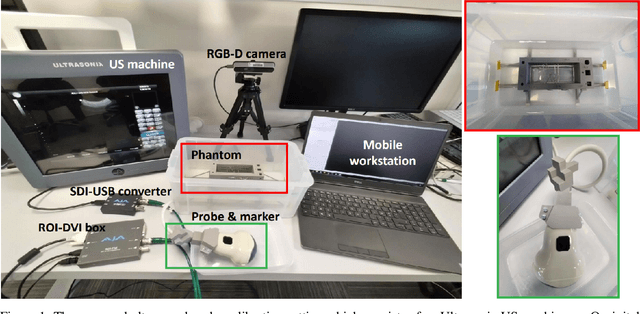

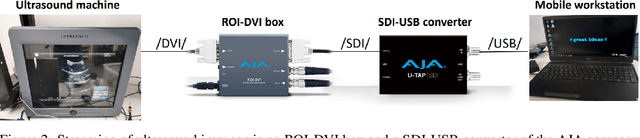

Purpose. Ability to locate and track ultrasound images in the 3D operating space is of great benefit for multiple clinical applications. This is often accomplished by tracking the probe using a precise but expensive optical or electromagnetic tracking system. Our goal is to develop a simple and low cost augmented reality echography framework using a standard RGB-D Camera. Methods. A prototype system consisting of an Occipital Structure Core RGB-D camera, a specifically-designed 3D marker, and a fast point cloud registration algorithm FaVoR was developed and evaluated on an Ultrasonix ultrasound system. The probe was calibrated on a 3D-printed N-wire phantom using the software PLUS toolkit. The proposed calibration method is simplified, requiring no additional markers or sensors attached to the phantom. Also, a visualization software based on OpenGL was developed for the augmented reality application. Results. The calibrated probe was used to augment a real-world video in a simulated needle insertion scenario. The ultrasound images were rendered on the video, and visually-coherent results were observed. We evaluated the end-to-end accuracy of our AR US framework on localizing a cube of 5 cm size. From our two experiments, the target pose localization error ranges from 5.6 to 5.9 mm and from -3.9 to 4.2 degrees. Conclusion. We believe that with the potential democratization of RGB-D cameras integrated in mobile devices and AR glasses in the future, our prototype solution may facilitate the use of 3D freehand ultrasound in clinical routine. Future work should include a more rigorous and thorough evaluation, by comparing the calibration accuracy with those obtained by commercial tracking solutions in both simulated and real medical scenarios.