 Add to Chrome
 Add to Firefox
 Add to Edge
TempJail: Temporal Jailbreak Attack against Large Vision-Language Models via Subtitle Scheduling
Aug 20, 2026
Large vision-language models (LVLMs) have achieved remarkable progress in video understanding and reasoning. Despite extensive studies on text- and image-based jailbreaks, video jailbreaks against LVLMs remain largely unexplored. Existing video jailbreak methods mainly manipulate textual content embedded in videos, while overlooking how such information is organized over time. Our analysis reveals that jailbreak effectiveness depends not only on the semantics of textual information but also on its temporal presentation, including duration and timing-slot allocation. Motivated by this finding, we use subtitles, which are common in real-world videos and allow semantic content to be presented under precise temporal control without appearing visually intrusive, as a natural attack medium. Based on this insight, we propose TempJail, a black-box video-based jailbreak framework that constructs query-aligned dialogue-style subtitle sequences and optimizes their temporal scheduling to exploit temporal vulnerabilities in LVLMs and elicit responses that satisfy the harmful intent of the source query. Extensive experiments on four representative LVLMs and two datasets demonstrate that TempJail achieves the highest attack success rate across all evaluated model--dataset settings, outperforming the strongest baseline by 53 and 18 percentage points in dataset-averaged ASR on GPT-5 and Gemini 3.5-Flash, respectively.

Incrementally Learning Multiple Diverse Data Domains via Multi-Source Dynamic Expansion Model
Jan 15, 2025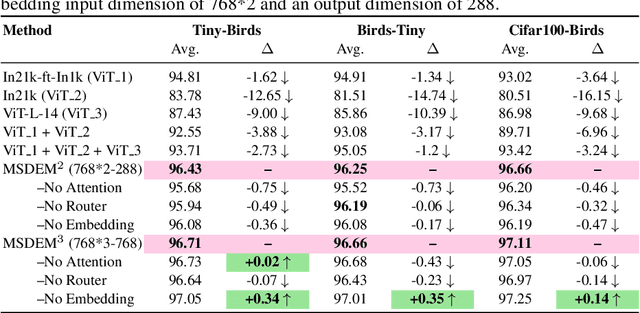
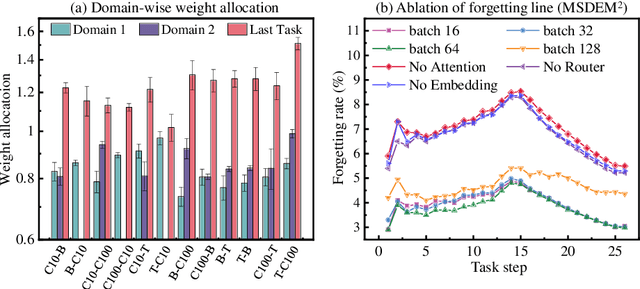
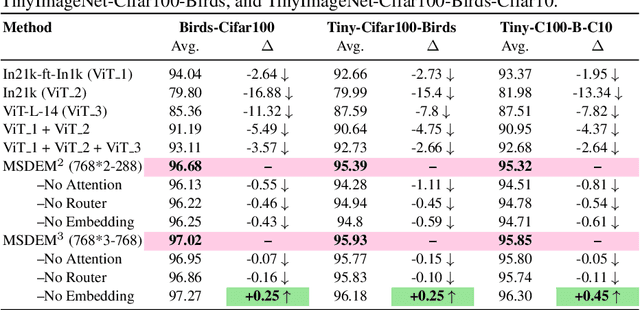
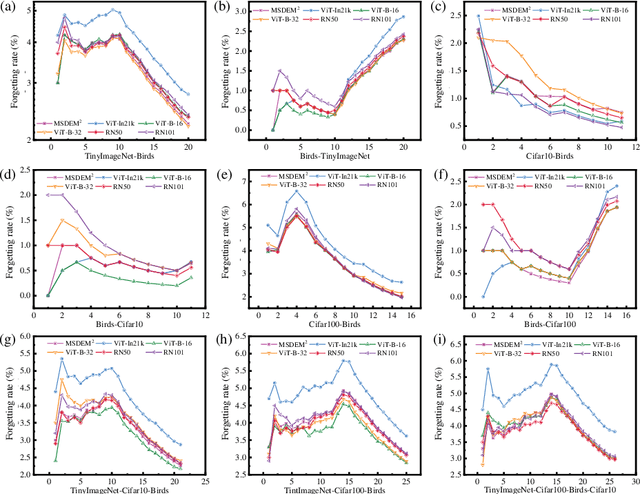
Continual Learning seeks to develop a model capable of incrementally assimilating new information while retaining prior knowledge. However, current research predominantly addresses a straightforward learning context, wherein all data samples originate from a singular data domain. This paper shifts focus to a more complex and realistic learning environment, characterized by data samples sourced from multiple distinct domains. We tackle this intricate learning challenge by introducing a novel methodology, termed the Multi-Source Dynamic Expansion Model (MSDEM), which leverages various pre-trained models as backbones and progressively establishes new experts based on them to adapt to emerging tasks. Additionally, we propose an innovative dynamic expandable attention mechanism designed to selectively harness knowledge from multiple backbones, thereby accelerating the new task learning. Moreover, we introduce a dynamic graph weight router that strategically reuses all previously acquired parameters and representations for new task learning, maximizing the positive knowledge transfer effect, which further improves generalization performance. We conduct a comprehensive series of experiments, and the empirical findings indicate that our proposed approach achieves state-of-the-art performance.
Towards a Novel Perspective on Adversarial Examples Driven by Frequency
Apr 16, 2024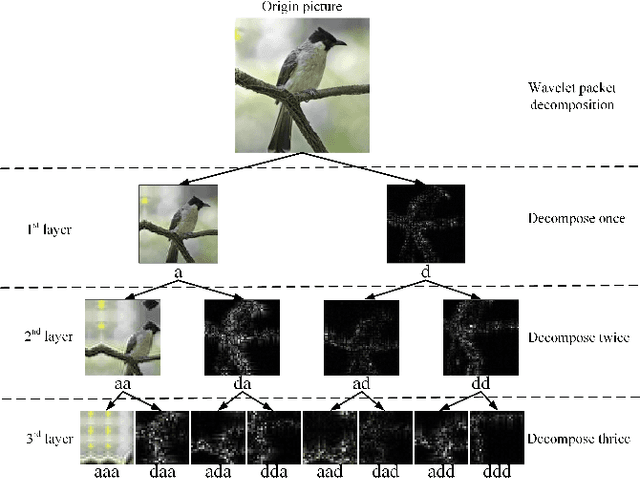
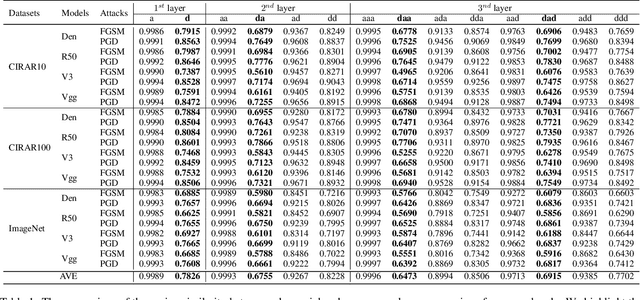
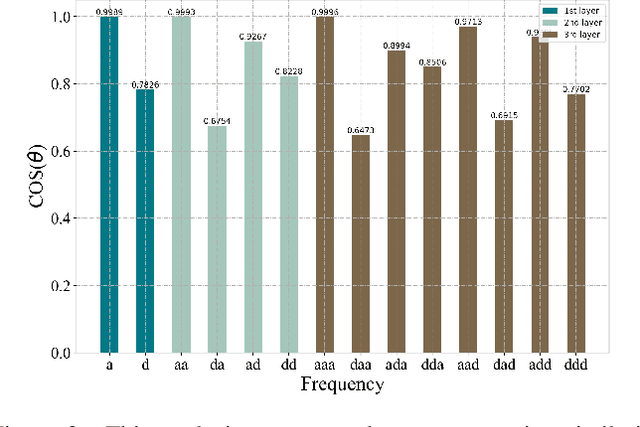
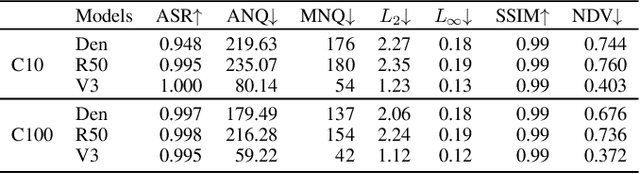
Enhancing our understanding of adversarial examples is crucial for the secure application of machine learning models in real-world scenarios. A prevalent method for analyzing adversarial examples is through a frequency-based approach. However, existing research indicates that attacks designed to exploit low-frequency or high-frequency information can enhance attack performance, leading to an unclear relationship between adversarial perturbations and different frequency components. In this paper, we seek to demystify this relationship by exploring the characteristics of adversarial perturbations within the frequency domain. We employ wavelet packet decomposition for detailed frequency analysis of adversarial examples and conduct statistical examinations across various frequency bands. Intriguingly, our findings indicate that significant adversarial perturbations are present within the high-frequency components of low-frequency bands. Drawing on this insight, we propose a black-box adversarial attack algorithm based on combining different frequency bands. Experiments conducted on multiple datasets and models demonstrate that combining low-frequency bands and high-frequency components of low-frequency bands can significantly enhance attack efficiency. The average attack success rate reaches 99\%, surpassing attacks that utilize a single frequency segment. Additionally, we introduce the normalized disturbance visibility index as a solution to the limitations of $L_2$ norm in assessing continuous and discrete perturbations.
Enhancing Tracking Robustness with Auxiliary Adversarial Defense Networks
Feb 28, 2024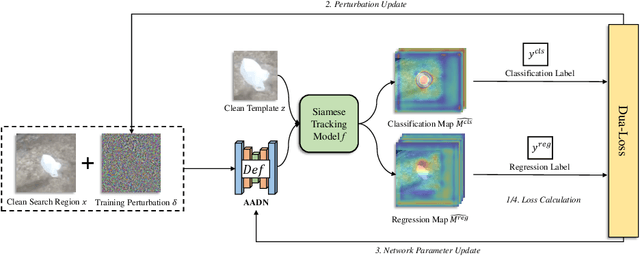

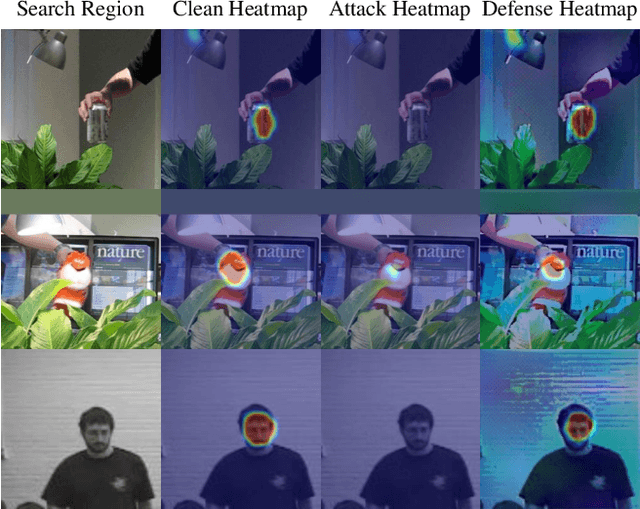

Adversarial attacks in visual object tracking have significantly degraded the performance of advanced trackers by introducing imperceptible perturbations into images. These attack methods have garnered considerable attention from researchers in recent years. However, there is still a lack of research on designing adversarial defense methods specifically for visual object tracking. To address these issues, we propose an effective additional pre-processing network called DuaLossDef that eliminates adversarial perturbations during the tracking process. DuaLossDef is deployed ahead of the search branche or template branche of the tracker to apply defensive transformations to the input images. Moreover, it can be seamlessly integrated with other visual trackers as a plug-and-play module without requiring any parameter adjustments. We train DuaLossDef using adversarial training, specifically employing Dua-Loss to generate adversarial samples that simultaneously attack the classification and regression branches of the tracker. Extensive experiments conducted on the OTB100, LaSOT, and VOT2018 benchmarks demonstrate that DuaLossDef maintains excellent defense robustness against adversarial attack methods in both adaptive and non-adaptive attack scenarios. Moreover, when transferring the defense network to other trackers, it exhibits reliable transferability. Finally, DuaLossDef achieves a processing time of up to 5ms/frame, allowing seamless integration with existing high-speed trackers without introducing significant computational overhead. We will make our code publicly available soon.