 Add to Chrome
 Add to Firefox
 Add to Edge
CoDS: Robust Collaborative Perception via Expert-driven Detection and BEV Segmentation
Aug 14, 2026
Collaborative perception breaks through single-view limitations via multi-agent information exchange. However, multi-source noise such as pose errors and communication delays degrades fusion feature quality, constraining perception performance. Joint training of detection and BEV segmentation provides a natural remedy, where segmented road regions help constrain target distributions and detection bounding boxes help recover ambiguous segmentation boundaries. To this end, we propose a robust Collaborative perception framework with expert-driven Detection and bev Segmentation (CoDS). To address spatial inconsistency in fusion quality, we first introduce the Collaborative Reliability Map (CoRM) to explicitly quantify feature quality distribution. Based on CoRM, we design the Semantic Mixture-of-Experts (S-MoE) module to extract differentiated features for inconsistent feature demands. Finally, to further mitigate feature noise degradation, the Bidirectional Task Complementary Interaction (BTCI) refines task-aware features through bidirectional injection. Extensive experiments on OPV2V and V2V4Real datasets show that our CoDS surpasses existing baselines on both tasks and maintains stable robustness under multi-source noise. Code: https://github.com/JinlongW128/CoDS and https://openi.pcl.ac.cn/OpenAIDriving/CoDS.
* 10 pages, 6 figures

Visual Geometry Foundation-Aware Gaussians for Single-Frame Surround-View Driving Reconstruction
Aug 11, 2026Single-frame surround-view reconstruction faces severe geometric instability and rendering artifacts due to minimal inter-camera overlap. While existing methods rely on complex decoders or auxiliary cues, they remain bottlenecked by the weak geometric capacity of upstream features. We argue that leveraging pretrained visual geometry priors strengthens upstream representations and alleviates the geometric ambiguity in sparse surround views. To this end, we propose VGGD, a visual geometry foundation-aware 3D Gaussian Splatting framework for feed-forward surround-view driving reconstruction, which shifts geometric modeling to the frontend and adapts foundation priors to the driving camera setting. First, VGGD leverages VGGT to provide transferable multi-view geometric prior tokens. Next, we introduce a Dual-Path Neck to decouple geometry-consistent and appearance-aware representations, improving appearance completion in weakly observed regions. We further apply Scale Warmup to stabilize early geometry learning and suppress scale drift under ego-pose changes. Finally, we use a hybrid pixel--volume Gaussian decoder to produce a renderable 3D Gaussian scene for novel-view synthesis. Experiments on the nuScenes single-frame benchmark show that VGGD achieves the best overall rendering quality among the compared methods and improves relative geometric consistency.
CoSAG: Compact Semantic Anchor Gaussians via Training-Free Rate-Distortion Coding
Jul 11, 2026Open-vocabulary 3D scene understanding is commonly achieved by embedding 2D vision-language features such as CLIP into a 3D Gaussian Splatting scene, turning it into a text-queryable semantic field. However, attaching a high-dimensional feature to each of millions of Gaussians inflates a single scene to gigabytes, which makes storage and deployment the real bottleneck of these fields. Existing compact methods each learn and ship a per-scene codec, an autoencoder, a quantized codebook, or a distilled feature field, entangling field construction with field storage and never compressing the per-Gaussian assignment that holds the bulk of the cost. We argue that construction and storage should be decoupled, and that storage is a rate-distortion problem over the per-Gaussian binding to a small anchor table, a structure no prior open-vocabulary method compresses. We present CoSAG, which constructs the field without any per-scene training through a closed-form transmittance-weighted lift, spatially grounded semantic anchors, and multi-view denoising, and stores it with a spatially predictive entropy coder that ships no decoder. Because the anchors are spatially grounded, the binding is predictable and therefore highly compressible. The transmittance-weighted lift and multi-view denoising yield a clean, view-consistent assignment, so the entropy coder spends almost no rate on correcting noise and instead codes only the residual against its spatial prediction. CoSAG reaches sub-megabyte storage while matching or exceeding the state of the art across the 2D-rendered, 3D-selection, and dense-LSeg protocols, reducing field size by 37 to 76x relative to LangSplatV2 at higher accuracy.
C2E: Boosting Ego-Only 3D Object Detection via Multi-Teacher Contrastive Knowledge Distillation
Jul 02, 2026LiDAR-based 3D object detection is essential for autonomous driving systems. However, traditional Ego-only Perception (Eo-Perception) suffers from limited perspective and occlusions in a complex outdoor environment, leading to performance bottlenecks. Recently, research on multi-agent Collaborative Perception (Co-Perception) has demonstrated excellent performance, but high communication costs and accumulated pose error hinder its application. To address this, we explore a novel C2E (Co-Perception to Eo-Perception) paradigm through the Multi-to-Single (M2S) agent contrastive knowledge distillation framework. Our M2S framework first designs Multi-Level Feature Enhancement module to provide more stable features, and introduces Auxiliary Point Cloud Reconstruction and Multi-Teacher Contrastive Distillation mechanisms to mitigate domain gaps in point cloud and feature distributions within the C2E paradigm. Benefiting from this, our M2S can retain the excellent performance of collaborative perception while effectively avoiding the drawbacks, such as communication delays and positioning errors. Extensive experiments on the V2XSet, V2V4Real and DAIR-V2X datasets show the effectiveness and generalizability of our M2S framework when combined with the state-of-the-art CoSDH model and other excellent 3D detectors. Our M2S framework can deliver up to a 8.64% improvement in 3D mAP performance without introducing any communication costs.
* 18 pages, 8figures
High-Fidelity Single-Image Head Modeling with Industry-Grade Topology
May 06, 2026We present a single-image head mesh reconstruction framework that addresses the longstanding challenge of simultaneously preserving facial identity and producing industry-grade topology. Our framework adopts a coarse-to-fine optimization pipeline that refines a rigged template across three stages -- rig, joint, and vertex -- achieving stable convergence and consistent topology. To mitigate the ill-posed nature of single-image 3D face reconstruction and ensure identity preservation, we employ a normal consistency objective jointly with landmark alignment. To further preserve local surface structure and enforce topological regularity, we introduce geometry-aware constraints based on Gaussian curvature and conformal consistency, along with auxiliary regularizations that correct fine artifacts such as lip seams and eyelid discontinuities. Our hierarchical optimization with geometry-aware regularization yields meshes with semantically meaningful edge flow and industry-grade topology. After geometry reconstruction, we extract UV-space texture and normal maps to preserve appearance details for visualization and downstream use. In a user study with 22 professional technical artists, our results were assessed as approaching industry-grade usability, and 95% of participants ranked our method as the top-performing approach, underscoring its effectiveness for real-world digital human production.
DriveExplorer: Images-Only Decoupled 4D Reconstruction with Progressive Restoration for Driving View Extrapolation
Dec 30, 2025This paper presents an effective solution for view extrapolation in autonomous driving scenarios. Recent approaches focus on generating shifted novel view images from given viewpoints using diffusion models. However, these methods heavily rely on priors such as LiDAR point clouds, 3D bounding boxes, and lane annotations, which demand expensive sensors or labor-intensive labeling, limiting applicability in real-world deployment. In this work, with only images and optional camera poses, we first estimate a global static point cloud and per-frame dynamic point clouds, fusing them into a unified representation. We then employ a deformable 4D Gaussian framework to reconstruct the scene. The initially trained 4D Gaussian model renders degraded and pseudo-images to train a video diffusion model. Subsequently, progressively shifted Gaussian renderings are iteratively refined by the diffusion model,and the enhanced results are incorporated back as training data for 4DGS. This process continues until extrapolation reaches the target viewpoints. Compared with baselines, our method produces higher-quality images at novel extrapolated viewpoints.
A2RNet: Adversarial Attack Resilient Network for Robust Infrared and Visible Image Fusion
Dec 18, 2024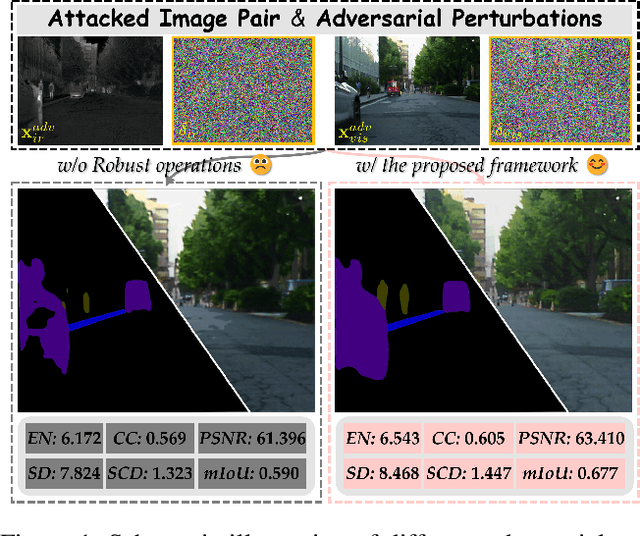

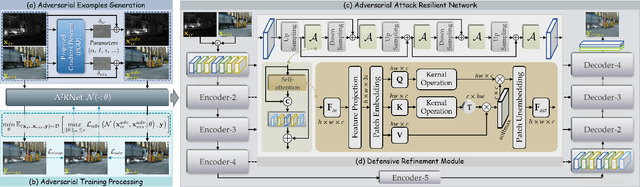
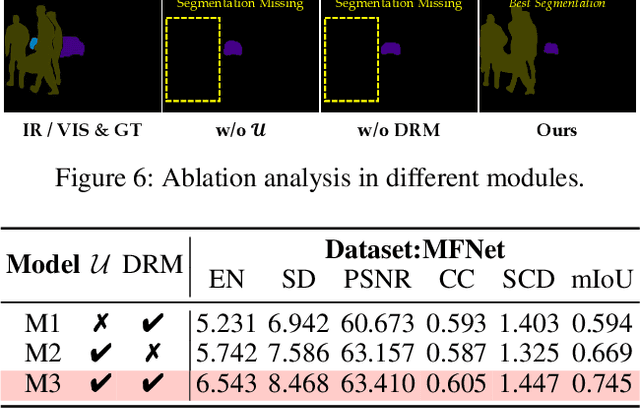
Infrared and visible image fusion (IVIF) is a crucial technique for enhancing visual performance by integrating unique information from different modalities into one fused image. Exiting methods pay more attention to conducting fusion with undisturbed data, while overlooking the impact of deliberate interference on the effectiveness of fusion results. To investigate the robustness of fusion models, in this paper, we propose a novel adversarial attack resilient network, called $\textrm{A}^{\textrm{2}}$RNet. Specifically, we develop an adversarial paradigm with an anti-attack loss function to implement adversarial attacks and training. It is constructed based on the intrinsic nature of IVIF and provide a robust foundation for future research advancements. We adopt a Unet as the pipeline with a transformer-based defensive refinement module (DRM) under this paradigm, which guarantees fused image quality in a robust coarse-to-fine manner. Compared to previous works, our method mitigates the adverse effects of adversarial perturbations, consistently maintaining high-fidelity fusion results. Furthermore, the performance of downstream tasks can also be well maintained under adversarial attacks. Code is available at https://github.com/lok-18/A2RNet.
$\textrm{A}^{\textrm{2}}$RNet: Adversarial Attack Resilient Network for Robust Infrared and Visible Image Fusion
Dec 13, 2024Infrared and visible image fusion (IVIF) is a crucial technique for enhancing visual performance by integrating unique information from different modalities into one fused image. Exiting methods pay more attention to conducting fusion with undisturbed data, while overlooking the impact of deliberate interference on the effectiveness of fusion results. To investigate the robustness of fusion models, in this paper, we propose a novel adversarial attack resilient network, called $\textrm{A}^{\textrm{2}}$RNet. Specifically, we develop an adversarial paradigm with an anti-attack loss function to implement adversarial attacks and training. It is constructed based on the intrinsic nature of IVIF and provide a robust foundation for future research advancements. We adopt a Unet as the pipeline with a transformer-based defensive refinement module (DRM) under this paradigm, which guarantees fused image quality in a robust coarse-to-fine manner. Compared to previous works, our method mitigates the adverse effects of adversarial perturbations, consistently maintaining high-fidelity fusion results. Furthermore, the performance of downstream tasks can also be well maintained under adversarial attacks. Code is available at https://github.com/lok-18/A2RNet.
V2X-R: Cooperative LiDAR-4D Radar Fusion for 3D Object Detection with Denoising Diffusion
Nov 13, 2024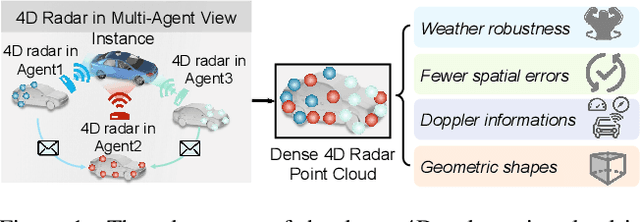
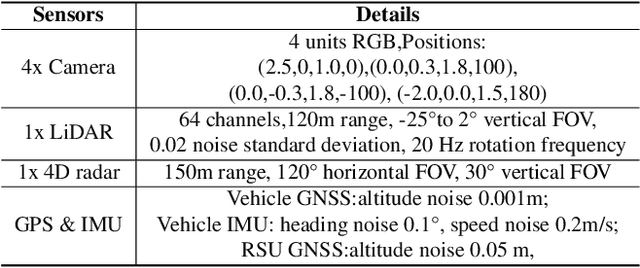
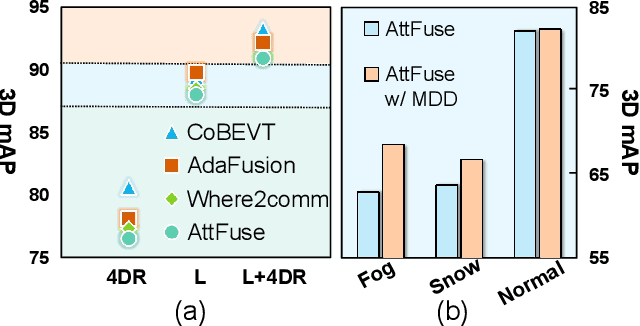

Current Vehicle-to-Everything (V2X) systems have significantly enhanced 3D object detection using LiDAR and camera data. However, these methods suffer from performance degradation in adverse weather conditions. The weatherrobust 4D radar provides Doppler and additional geometric information, raising the possibility of addressing this challenge. To this end, we present V2X-R, the first simulated V2X dataset incorporating LiDAR, camera, and 4D radar. V2X-R contains 12,079 scenarios with 37,727 frames of LiDAR and 4D radar point clouds, 150,908 images, and 170,859 annotated 3D vehicle bounding boxes. Subsequently, we propose a novel cooperative LiDAR-4D radar fusion pipeline for 3D object detection and implement it with various fusion strategies. To achieve weather-robust detection, we additionally propose a Multi-modal Denoising Diffusion (MDD) module in our fusion pipeline. MDD utilizes weather-robust 4D radar feature as a condition to prompt the diffusion model to denoise noisy LiDAR features. Experiments show that our LiDAR-4D radar fusion pipeline demonstrates superior performance in the V2X-R dataset. Over and above this, our MDD module further improved the performance of basic fusion model by up to 5.73%/6.70% in foggy/snowy conditions with barely disrupting normal performance. The dataset and code will be publicly available at: https://github.com/ylwhxht/V2X-R.
L4DR: LiDAR-4DRadar Fusion for Weather-Robust 3D Object Detection
Aug 07, 2024
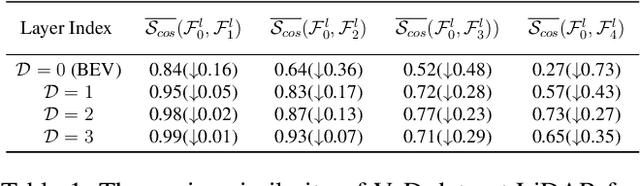

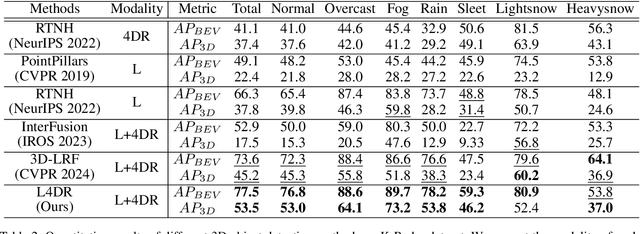
LiDAR-based vision systems are integral for 3D object detection, which is crucial for autonomous navigation. However, they suffer from performance degradation in adverse weather conditions due to the quality deterioration of LiDAR point clouds. Fusing LiDAR with the weather-robust 4D radar sensor is expected to solve this problem. However, the fusion of LiDAR and 4D radar is challenging because they differ significantly in terms of data quality and the degree of degradation in adverse weather. To address these issues, we introduce L4DR, a weather-robust 3D object detection method that effectively achieves LiDAR and 4D Radar fusion. Our L4DR includes Multi-Modal Encoding (MME) and Foreground-Aware Denoising (FAD) technique to reconcile sensor gaps, which is the first exploration of the complementarity of early fusion between LiDAR and 4D radar. Additionally, we design an Inter-Modal and Intra-Modal ({IM}2 ) parallel feature extraction backbone coupled with a Multi-Scale Gated Fusion (MSGF) module to counteract the varying degrees of sensor degradation under adverse weather conditions. Experimental evaluation on a VoD dataset with simulated fog proves that L4DR is more adaptable to changing weather conditions. It delivers a significant performance increase under different fog levels, improving the 3D mAP by up to 18.17% over the traditional LiDAR-only approach. Moreover, the results on the K-Radar dataset validate the consistent performance improvement of L4DR in real-world adverse weather conditions.