 Add to Chrome
 Add to Firefox
 Add to Edge
TOPOS: High-Fidelity and Efficient Industry-Grade 3D Head Generation
May 14, 2026
High-fidelity 3D head generation plays a crucial role in the film, animation and video game industries. In industrial pipelines, studios typically enforce a fixed reference topology across all head assets, as such a clean and uniform topology is a prerequisite for production-level rigging, skinning and animation. In this paper, we present TOPOS, a framework tailored for single image conditioned 3D head generation that jointly recovers geometry and appearance under such an industry-standard topology. In contrast to general 3D generative models which produce triangle meshes with inconsistent topology and numerous vertices, hindering semantic correspondence and asset-level reuse, TOPOS generates head meshes with a fixed, studio-style topology, enabling consistent vertex-level correspondence across all generated heads. To model heads under this unified topology, we proposed a novel variational autoencoder structure, termed TOPOS-VAE. Inspired by multi-model large language models (MLLMs), our TOPOS-VAE leverages the Perceiver Resampler to convert input pointclouds sampled from head meshes of diverse topologies into the target reference topology. Building upon TOPOS-VAE's structured latent space, we train a rectified flow transformer, TOPOS-DiT, to efficiently generate high-fidelity head meshes from a single image. We further present TOPOS-Texture, an end-to-end module that produces relightable UV texture maps from the same portrait image via fine-tuning a multimodal image generative model. The generated textures are spatially aligned with the underlying mesh geometry and faithfully preserve high-frequency appearance details. Extensive experiments demonstrate that TOPOS achieves state-of-the-art performance on 3D head generation, surpassing both classical face reconstruction methods and general 3D object generative models, highlighting its effectiveness for digital human creation.

High-Fidelity Single-Image Head Modeling with Industry-Grade Topology
May 06, 2026We present a single-image head mesh reconstruction framework that addresses the longstanding challenge of simultaneously preserving facial identity and producing industry-grade topology. Our framework adopts a coarse-to-fine optimization pipeline that refines a rigged template across three stages -- rig, joint, and vertex -- achieving stable convergence and consistent topology. To mitigate the ill-posed nature of single-image 3D face reconstruction and ensure identity preservation, we employ a normal consistency objective jointly with landmark alignment. To further preserve local surface structure and enforce topological regularity, we introduce geometry-aware constraints based on Gaussian curvature and conformal consistency, along with auxiliary regularizations that correct fine artifacts such as lip seams and eyelid discontinuities. Our hierarchical optimization with geometry-aware regularization yields meshes with semantically meaningful edge flow and industry-grade topology. After geometry reconstruction, we extract UV-space texture and normal maps to preserve appearance details for visualization and downstream use. In a user study with 22 professional technical artists, our results were assessed as approaching industry-grade usability, and 95% of participants ranked our method as the top-performing approach, underscoring its effectiveness for real-world digital human production.
Gazebo Plants: Simulating Plant-Robot Interaction with Cosserat Rods
Feb 04, 2024
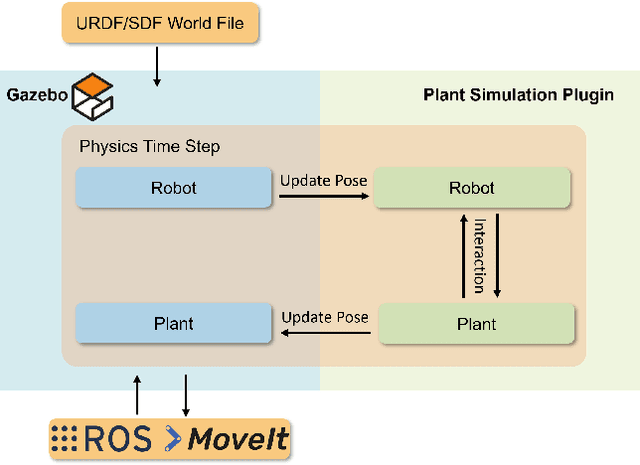
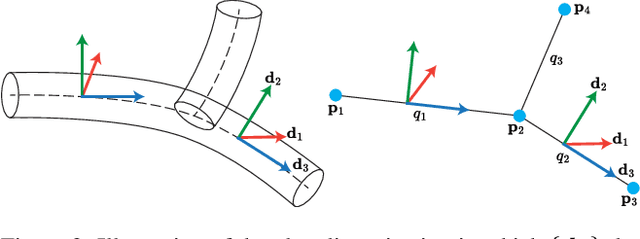

Robotic harvesting has the potential to positively impact agricultural productivity, reduce costs, improve food quality, enhance sustainability, and to address labor shortage. In the rapidly advancing field of agricultural robotics, the necessity of training robots in a virtual environment has become essential. Generating training data to automatize the underlying computer vision tasks such as image segmentation, object detection and classification, also heavily relies on such virtual environments as synthetic data is often required to overcome the shortage and lack of variety of real data sets. However, physics engines commonly employed within the robotics community, such as ODE, Simbody, Bullet, and DART, primarily support motion and collision interaction of rigid bodies. This inherent limitation hinders experimentation and progress in handling non-rigid objects such as plants and crops. In this contribution, we present a plugin for the Gazebo simulation platform based on Cosserat rods to model plant motion. It enables the simulation of plants and their interaction with the environment. We demonstrate that, using our plugin, users can conduct harvesting simulations in Gazebo by simulating a robotic arm picking fruits and achieve results comparable to real-world experiments.