 Add to Chrome
 Add to Firefox
 Add to Edge
UNIFUSION: Adapting Autoregressive Language Models into Discrete Diffusion under a Unified Reverse-Rate Objective
Jul 27, 2026
Existing methods mainly adapt pretrained autoregressive (AR) language models to masked diffusion, whereas we directly adapt them to uniform-noise diffusion, where every token remains editable during sampling. However, adapting AR checkpoints across corruption kernels remains challenging because existing DLMs use different objectives and prediction parameterizations. We establish connections among SEDD, MDLM/GIDD, M2S, and Neural CTMC by expressing their conditional losses as a single generalized Kullback--Leibler objective over model reverse rates. We further derive conversions from clean-token predictions to concrete-score, posterior-mean, and exit-rate/jump parameterizations, yielding a shared \(x_0\) interface that supports switching between mask and uniform kernels. Building on these connections, we propose \ours{}, a simple continual pre-training approach for directly adapting pretrained GPT2 checkpoints to uniform-noise diffusion. Through systematic evaluation of 124M- and 355M-parameter models, we show that \ours{} steadily improves the trade-off between generative perplexity (GenPPL) and unigram entropy as the sampling budget increases from 16 to 256 steps. At 256 steps, \ours{}-S and \ours{}-M achieve GenPPL/entropy pairs of \(97.783/5.2626\) and \(71.516/5.6669\), respectively; no evaluated model at the same scale simultaneously outperforms \ours{} on both metrics. At both scales, \ours{} also achieves the highest WinoGrande, SIQA, and BBH accuracy among the compared diffusion models.

Mean-to-Score Discrete Diffusion: Posterior-Mean Denoisers for Score Entropy
Jul 23, 2026Score Entropy Discrete Diffusion (SEDD) parameterizes discrete reverse processes with unconstrained positive score ratios. While positivity guarantees nonnegative reverse jump rates, it does not ensure Bayes realizability: ratios at a noisy state need not be jointly induced by any clean-token posterior under the forward kernel. The score-entropy loss has the correct population optimum but does not enforce this constraint away from it. In a trained pure-uniform SEDD checkpoint, roughly one quarter of complete score vectors violate the coordinate box, while more than half lie inside it yet remain materially incompatible with any valid posterior. Such violations can produce negative pre-normalization weights in finite-step sampling. Projecting raw scores onto the bridge polytope removes all observed negative weights and improves external generative PPL from $203.6$ to $175.1$ without changing the sampler. We introduce \emph{mean-to-score} (M2S), which predicts a clean-token posterior mean and converts it to the score through an exact kernel-dependent linear map. The construction applies to any known coordinate-wise continuous-time Markov chain (CTMC) satisfying a mild support condition. For uniform corruption, it maps the probability simplex onto the bridge polytope; for absorbing-mask corruption, the resulting objective recovers MD4 exactly. In a controlled 28.4M-parameter CIFAR-10 comparison, M2S lowers test BPD from $3.173$ to $3.129$ and FID-50k from $\CifarSEDDFID$ to $\CifarMtwoSFID$. A 170M-parameter M2S model trained on about 262B OpenWebText token slots outperforms the evaluated pure-uniform SEDD, GIDD, and Neural CTMC checkpoints at every tested sampling budget, reaching generative PPL $143.3$ at 128 steps versus $183.6$ for the strongest pure-uniform baseline.
OLEDLM: A Unified Language Model for OLED Molecular Design
Jul 22, 2026The development of organic light-emitting diode (OLED) materials faces the compounded challenges of an astronomically large chemical space, stringent quantum-chemical constraints, and a scarcity of labeled data. Although the question of OLED generation is important, few models have been trained effectively for this specific domain. We propose an inverse molecular design framework based on causal language models: given target optoelectronic properties (e.g., excitation energy, oscillator strength), our model directly generates OLED SMILES sequences satisfying the specified constraints. We employ a multi-stage strategy: first, we establish a foundational chemical language model using a LLaMA-style transformer architecture. To the best of our knowledge, this represents the first successful adaptation of LLMs specifically for the OLED domain, bridging the gap between generic molecular generation and the stringent structural requirements of optoelectronic materials. Second, we fine-tune property predictors based on a BERT model pre-trained on our large-scale OLED dataset. Then, we perform Reinforcement Learning on our fine-tuned model, leveraging our property predictor, for better SMILES generation. Finally, through DFT verification, we demonstrate that our framework can efficiently navigate the OLED chemical space, generating novel candidates with high structural validity and optimized optoelectronic properties.
Measuring Research Difficulty of Academic Papers: A Case Study in Natural Language Processing
Jun 24, 2026With the rapid growth of the number of academic papers, systematically evaluating the difficulty of research and its relationship to academic impact offers important significance for research topic selection and resource allocation. However, current studies lack quantitative assessments of research difficulty and its correlation with academic impact. This paper proposes a comprehensive evaluation system for research difficulty, incorporating factors such as academic collaboration, content, and references. Taking the field of Natural Language Processing (NLP) as a case study, we extract both internal and external features from academic papers, compute multiple research difficulty indicators. We assign their weights using the entropy weight method and perform a weighted sum to obtain the research difficulty score of academic papers. This paper uses the citation frequency of academic papers to measure academic impact. To validate our approach, NLP experts assessed the difficulty of a sample of papers, and correlation analyses confirmed the reliability of our measurement. Empirical results reveal that in NLP, factors such as the number of pages, reference count, and participation of high-level institutions are significantly associated with academic impact. Moreover, we identify an inverted U-shaped relationship between research difficulty and academic impact. It suggests that moderately difficult research tends to achieve greater academic impact.
LabBuilder: Protocol-Grounded 3D Layout Generation for Interactable and Safe Laboratory
May 04, 2026Automated laboratories hold the promise of accelerating scientific discovery, yet their deployment is bottlenecked by the difficulty of designing safe and executable environments. While simulator-based design offers scalability, existing 3D scene generation methods are primarily tailored for household settings, optimizing for visual plausibility while neglecting the rigorous functional semantics and safety constraints essential for scientific experimentation. We present LabBuilder, an end-to-end system that generates and verifies 3D laboratory layouts from concise textual specifications. It operates through three tightly coupled components: LabForge first curates a meta-dataset of annotated assets and chemical knowledge, translating natural language specifications into structured protocols; building on these protocols, LabGen synthesizes laboratory layouts via an iterative, constraint-aware optimization strategy; finally, LabTouchstone evaluates the resulting layouts as a unified benchmark. Extensive experiments demonstrate that LabBuilder significantly outperforms existing state-of-the-art methods, producing laboratory environments that are not only realistic but also functionally valid and safe for complex experimental workflows.
Reasoning as Gradient: Scaling MLE Agents Beyond Tree Search
Mar 02, 2026LLM-based agents for machine learning engineering (MLE) predominantly rely on tree search, a form of gradient-free optimization that uses scalar validation scores to rank candidates. As LLM reasoning capabilities improve, exhaustive enumeration becomes increasingly inefficient compared to directed updates, analogous to how accurate gradients enable efficient descent over random search. We introduce \textsc{Gome}, an MLE agent that operationalizes gradient-based optimization. \textsc{Gome} maps structured diagnostic reasoning to gradient computation, success memory to momentum, and multi-trace execution to distributed optimization. Under a closed-world protocol that isolates architectural effects from external knowledge, \textsc{Gome} achieves a state-of-the-art 35.1\% any-medal rate on MLE-Bench with a restricted 12-hour budget on a single V100 GPU. Scaling experiments across 10 models reveal a critical crossover: with weaker models, tree search retains advantages by compensating for unreliable reasoning through exhaustive exploration; as reasoning capability strengthens, gradient-based optimization progressively outperforms, with the gap widening at frontier-tier models. Given the rapid advancement of reasoning-oriented LLMs, this positions gradient-based optimization as an increasingly favorable paradigm. We release our codebase and GPT-5 traces.
Discovery of Interpretable Physical Laws in Materials via Language-Model-Guided Symbolic Regression
Feb 26, 2026Discovering interpretable physical laws from high-dimensional data is a fundamental challenge in scientific research. Traditional methods, such as symbolic regression, often produce complex, unphysical formulas when searching a vast space of possible forms. We introduce a framework that guides the search process by leveraging the embedded scientific knowledge of large language models, enabling efficient identification of physical laws in the data. We validate our approach by modeling key properties of perovskite materials. Our method mitigates the combinatorial explosion commonly encountered in traditional symbolic regression, reducing the effective search space by a factor of approximately $10^5$. A set of novel formulas for bulk modulus, band gap, and oxygen evolution reaction activity are identified, which not only provide meaningful physical insights but also outperform previous formulas in accuracy and simplicity.
PLANET v2.0: A comprehensive Protein-Ligand Affinity Prediction Model Based on Mixture Density Network
Jan 12, 2026Drug discovery represents a time-consuming and financially intensive process, and virtual screening can accelerate it. Scoring functions, as one of the tools guiding virtual screening, have their precision closely tied to screening efficiency. In our previous study, we developed a graph neural network model called PLANET (Protein-Ligand Affinity prediction NETwork), but it suffers from the defect in representing protein-ligand contact maps. Incorrect binding modes inevitably lead to poor affinity predictions, so accurate prediction of the protein-ligand contact map is desired to improve PLANET. In this study, we have proposed PLANET v2.0 as an upgraded version. The model is trained via multi-objective training strategy and incorporates the Mixture Density Network to predict binding modes. Except for the probability density distributions of non-covalent interactions, we innovatively employ another Gaussian mixture model to describe the relationship between distance and energy of each interaction pair and predict protein-ligand affinity like calculating the mathematical expectation. As on the CASF-2016 benchmark, PLANET v2.0 demonstrates excellent scoring power, ranking power, and docking power. The screening power of PLANET v2.0 gets notably improved compared to PLANET and Glide SP and it demonstrates robust validation on a commercial ultra-large-scale dataset. Given its efficiency and accuracy, PLANET v2.0 can hopefully become one of the practical tools for virtual screening workflows. PLANET v2.0 is freely available at https://www.pdbbind-plus.org.cn/planetv2.
SAVVY: Spatial Awareness via Audio-Visual LLMs through Seeing and Hearing
Jun 04, 20253D spatial reasoning in dynamic, audio-visual environments is a cornerstone of human cognition yet remains largely unexplored by existing Audio-Visual Large Language Models (AV-LLMs) and benchmarks, which predominantly focus on static or 2D scenes. We introduce SAVVY-Bench, the first benchmark for 3D spatial reasoning in dynamic scenes with synchronized spatial audio. SAVVY-Bench is comprised of thousands of relationships involving static and moving objects, and requires fine-grained temporal grounding, consistent 3D localization, and multi-modal annotation. To tackle this challenge, we propose SAVVY, a novel training-free reasoning pipeline that consists of two stages: (i) Egocentric Spatial Tracks Estimation, which leverages AV-LLMs as well as other audio-visual methods to track the trajectories of key objects related to the query using both visual and spatial audio cues, and (ii) Dynamic Global Map Construction, which aggregates multi-modal queried object trajectories and converts them into a unified global dynamic map. Using the constructed map, a final QA answer is obtained through a coordinate transformation that aligns the global map with the queried viewpoint. Empirical evaluation demonstrates that SAVVY substantially enhances performance of state-of-the-art AV-LLMs, setting a new standard and stage for approaching dynamic 3D spatial reasoning in AV-LLMs.
Brain-to-Text Benchmark '24: Lessons Learned
Dec 23, 2024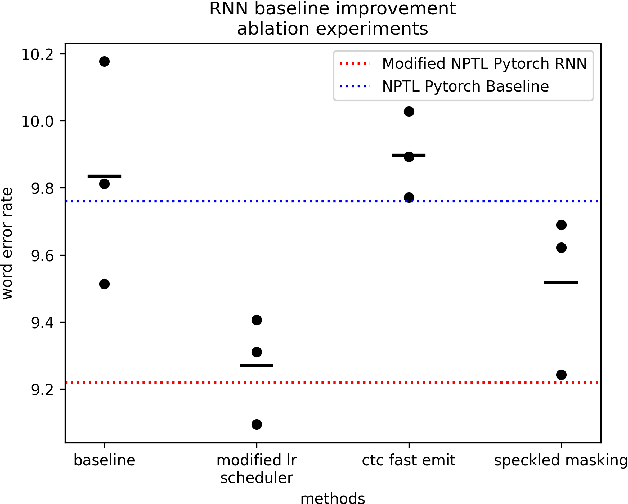

Speech brain-computer interfaces aim to decipher what a person is trying to say from neural activity alone, restoring communication to people with paralysis who have lost the ability to speak intelligibly. The Brain-to-Text Benchmark '24 and associated competition was created to foster the advancement of decoding algorithms that convert neural activity to text. Here, we summarize the lessons learned from the competition ending on June 1, 2024 (the top 4 entrants also presented their experiences in a recorded webinar). The largest improvements in accuracy were achieved using an ensembling approach, where the output of multiple independent decoders was merged using a fine-tuned large language model (an approach used by all 3 top entrants). Performance gains were also found by improving how the baseline recurrent neural network (RNN) model was trained, including by optimizing learning rate scheduling and by using a diphone training objective. Improving upon the model architecture itself proved more difficult, however, with attempts to use deep state space models or transformers not yet appearing to offer a benefit over the RNN baseline. The benchmark will remain open indefinitely to support further work towards increasing the accuracy of brain-to-text algorithms.