 Add to Chrome
 Add to Firefox
 Add to Edge
UNIFUSION: Adapting Autoregressive Language Models into Discrete Diffusion under a Unified Reverse-Rate Objective
Jul 27, 2026
Existing methods mainly adapt pretrained autoregressive (AR) language models to masked diffusion, whereas we directly adapt them to uniform-noise diffusion, where every token remains editable during sampling. However, adapting AR checkpoints across corruption kernels remains challenging because existing DLMs use different objectives and prediction parameterizations. We establish connections among SEDD, MDLM/GIDD, M2S, and Neural CTMC by expressing their conditional losses as a single generalized Kullback--Leibler objective over model reverse rates. We further derive conversions from clean-token predictions to concrete-score, posterior-mean, and exit-rate/jump parameterizations, yielding a shared \(x_0\) interface that supports switching between mask and uniform kernels. Building on these connections, we propose \ours{}, a simple continual pre-training approach for directly adapting pretrained GPT2 checkpoints to uniform-noise diffusion. Through systematic evaluation of 124M- and 355M-parameter models, we show that \ours{} steadily improves the trade-off between generative perplexity (GenPPL) and unigram entropy as the sampling budget increases from 16 to 256 steps. At 256 steps, \ours{}-S and \ours{}-M achieve GenPPL/entropy pairs of \(97.783/5.2626\) and \(71.516/5.6669\), respectively; no evaluated model at the same scale simultaneously outperforms \ours{} on both metrics. At both scales, \ours{} also achieves the highest WinoGrande, SIQA, and BBH accuracy among the compared diffusion models.

Mean-to-Score Discrete Diffusion: Posterior-Mean Denoisers for Score Entropy
Jul 23, 2026Score Entropy Discrete Diffusion (SEDD) parameterizes discrete reverse processes with unconstrained positive score ratios. While positivity guarantees nonnegative reverse jump rates, it does not ensure Bayes realizability: ratios at a noisy state need not be jointly induced by any clean-token posterior under the forward kernel. The score-entropy loss has the correct population optimum but does not enforce this constraint away from it. In a trained pure-uniform SEDD checkpoint, roughly one quarter of complete score vectors violate the coordinate box, while more than half lie inside it yet remain materially incompatible with any valid posterior. Such violations can produce negative pre-normalization weights in finite-step sampling. Projecting raw scores onto the bridge polytope removes all observed negative weights and improves external generative PPL from $203.6$ to $175.1$ without changing the sampler. We introduce \emph{mean-to-score} (M2S), which predicts a clean-token posterior mean and converts it to the score through an exact kernel-dependent linear map. The construction applies to any known coordinate-wise continuous-time Markov chain (CTMC) satisfying a mild support condition. For uniform corruption, it maps the probability simplex onto the bridge polytope; for absorbing-mask corruption, the resulting objective recovers MD4 exactly. In a controlled 28.4M-parameter CIFAR-10 comparison, M2S lowers test BPD from $3.173$ to $3.129$ and FID-50k from $\CifarSEDDFID$ to $\CifarMtwoSFID$. A 170M-parameter M2S model trained on about 262B OpenWebText token slots outperforms the evaluated pure-uniform SEDD, GIDD, and Neural CTMC checkpoints at every tested sampling budget, reaching generative PPL $143.3$ at 128 steps versus $183.6$ for the strongest pure-uniform baseline.
OLEDLM: A Unified Language Model for OLED Molecular Design
Jul 22, 2026The development of organic light-emitting diode (OLED) materials faces the compounded challenges of an astronomically large chemical space, stringent quantum-chemical constraints, and a scarcity of labeled data. Although the question of OLED generation is important, few models have been trained effectively for this specific domain. We propose an inverse molecular design framework based on causal language models: given target optoelectronic properties (e.g., excitation energy, oscillator strength), our model directly generates OLED SMILES sequences satisfying the specified constraints. We employ a multi-stage strategy: first, we establish a foundational chemical language model using a LLaMA-style transformer architecture. To the best of our knowledge, this represents the first successful adaptation of LLMs specifically for the OLED domain, bridging the gap between generic molecular generation and the stringent structural requirements of optoelectronic materials. Second, we fine-tune property predictors based on a BERT model pre-trained on our large-scale OLED dataset. Then, we perform Reinforcement Learning on our fine-tuned model, leveraging our property predictor, for better SMILES generation. Finally, through DFT verification, we demonstrate that our framework can efficiently navigate the OLED chemical space, generating novel candidates with high structural validity and optimized optoelectronic properties.
BlinDNO: A Distributional Neural Operator for Dynamical System Reconstruction from Time-Label-Free data
Nov 15, 2025We study an inverse problem for stochastic and quantum dynamical systems in a time-label-free setting, where only unordered density snapshots sampled at unknown times drawn from an observation-time distribution are available. These observations induce a distribution over state densities, from which we seek to recover the parameters of the underlying evolution operator. We formulate this as learning a distribution-to-function neural operator and propose BlinDNO, a permutation-invariant architecture that integrates a multiscale U-Net encoder with an attention-based mixer. Numerical experiments on a wide range of stochastic and quantum systems, including a 3D protein-folding mechanism reconstruction problem in a cryo-EM setting, demonstrate that BlinDNO reliably recovers governing parameters and consistently outperforms existing neural inverse operator baselines.
In vivo 3D ultrasound computed tomography of musculoskeletal tissues with generative neural physics
Aug 17, 2025Ultrasound computed tomography (USCT) is a radiation-free, high-resolution modality but remains limited for musculoskeletal imaging due to conventional ray-based reconstructions that neglect strong scattering. We propose a generative neural physics framework that couples generative networks with physics-informed neural simulation for fast, high-fidelity 3D USCT. By learning a compact surrogate of ultrasonic wave propagation from only dozens of cross-modality images, our method merges the accuracy of wave modeling with the efficiency and stability of deep learning. This enables accurate quantitative imaging of in vivo musculoskeletal tissues, producing spatial maps of acoustic properties beyond reflection-mode images. On synthetic and in vivo data (breast, arm, leg), we reconstruct 3D maps of tissue parameters in under ten minutes, with sensitivity to biomechanical properties in muscle and bone and resolution comparable to MRI. By overcoming computational bottlenecks in strongly scattering regimes, this approach advances USCT toward routine clinical assessment of musculoskeletal disease.
Neural Tangent Kernel of Neural Networks with Loss Informed by Differential Operators
Mar 14, 2025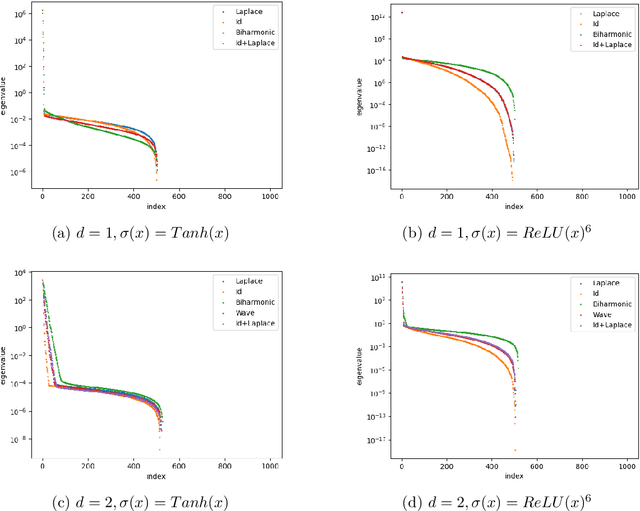
Spectral bias is a significant phenomenon in neural network training and can be explained by neural tangent kernel (NTK) theory. In this work, we develop the NTK theory for deep neural networks with physics-informed loss, providing insights into the convergence of NTK during initialization and training, and revealing its explicit structure. We find that, in most cases, the differential operators in the loss function do not induce a faster eigenvalue decay rate and stronger spectral bias. Some experimental results are also presented to verify the theory.
Neumann Series-based Neural Operator for Solving Inverse Medium Problem
Sep 14, 2024


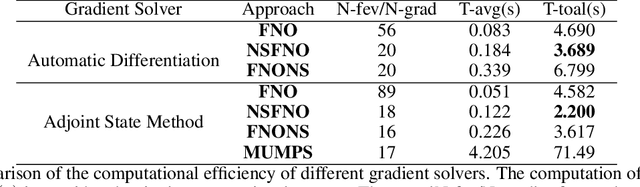
The inverse medium problem, inherently ill-posed and nonlinear, presents significant computational challenges. This study introduces a novel approach by integrating a Neumann series structure within a neural network framework to effectively handle multiparameter inputs. Experiments demonstrate that our methodology not only accelerates computations but also significantly enhances generalization performance, even with varying scattering properties and noisy data. The robustness and adaptability of our framework provide crucial insights and methodologies, extending its applicability to a broad spectrum of scattering problems. These advancements mark a significant step forward in the field, offering a scalable solution to traditionally complex inverse problems.
Deep Learning with Data Privacy via Residual Perturbation
Aug 11, 2024Protecting data privacy in deep learning (DL) is of crucial importance. Several celebrated privacy notions have been established and used for privacy-preserving DL. However, many existing mechanisms achieve privacy at the cost of significant utility degradation and computational overhead. In this paper, we propose a stochastic differential equation-based residual perturbation for privacy-preserving DL, which injects Gaussian noise into each residual mapping of ResNets. Theoretically, we prove that residual perturbation guarantees differential privacy (DP) and reduces the generalization gap of DL. Empirically, we show that residual perturbation is computationally efficient and outperforms the state-of-the-art differentially private stochastic gradient descent (DPSGD) in utility maintenance without sacrificing membership privacy.
Fast and Scalable Semi-Supervised Learning for Multi-View Subspace Clustering
Aug 11, 2024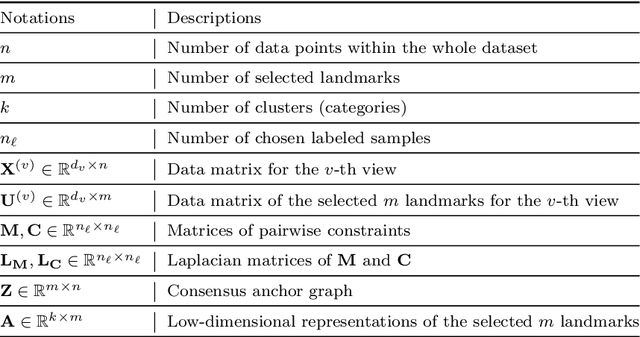

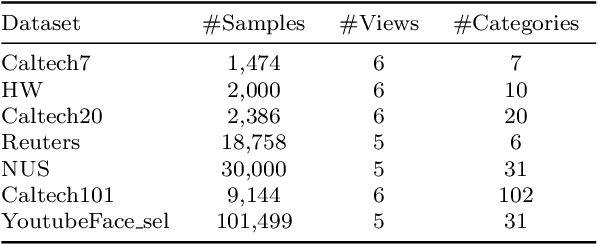

In this paper, we introduce a Fast and Scalable Semi-supervised Multi-view Subspace Clustering (FSSMSC) method, a novel solution to the high computational complexity commonly found in existing approaches. FSSMSC features linear computational and space complexity relative to the size of the data. The method generates a consensus anchor graph across all views, representing each data point as a sparse linear combination of chosen landmarks. Unlike traditional methods that manage the anchor graph construction and the label propagation process separately, this paper proposes a unified optimization model that facilitates simultaneous learning of both. An effective alternating update algorithm with convergence guarantees is proposed to solve the unified optimization model. Additionally, the method employs the obtained anchor graph and landmarks' low-dimensional representations to deduce low-dimensional representations for raw data. Following this, a straightforward clustering approach is conducted on these low-dimensional representations to achieve the final clustering results. The effectiveness and efficiency of FSSMSC are validated through extensive experiments on multiple benchmark datasets of varying scales.
Interface Laplace Learning: Learnable Interface Term Helps Semi-Supervised Learning
Aug 10, 2024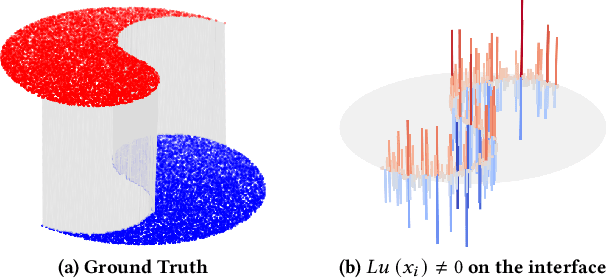
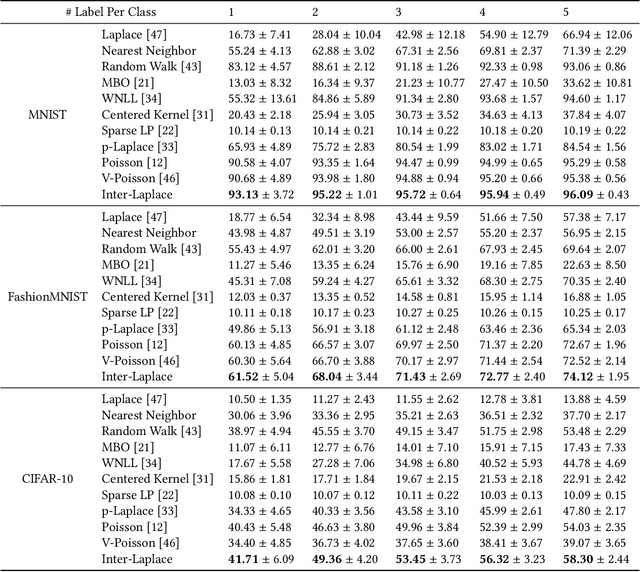
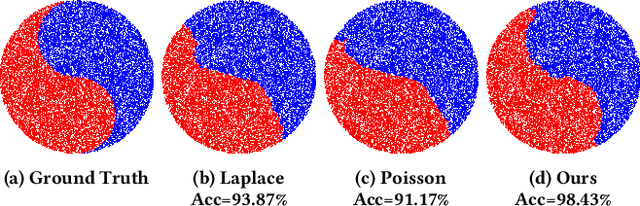
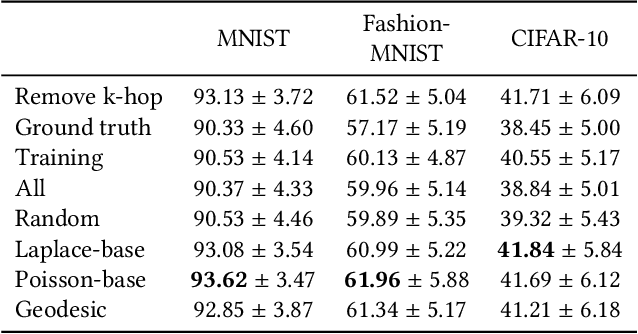
We introduce a novel framework, called Interface Laplace learning, for graph-based semi-supervised learning. Motivated by the observation that an interface should exist between different classes where the function value is non-smooth, we introduce a Laplace learning model that incorporates an interface term. This model challenges the long-standing assumption that functions are smooth at all unlabeled points. In the proposed approach, we add an interface term to the Laplace learning model at the interface positions. We provide a practical algorithm to approximate the interface positions using k-hop neighborhood indices, and to learn the interface term from labeled data without artificial design. Our method is efficient and effective, and we present extensive experiments demonstrating that Interface Laplace learning achieves better performance than other recent semi-supervised learning approaches at extremely low label rates on the MNIST, FashionMNIST, and CIFAR-10 datasets.