 Add to Chrome
 Add to Firefox
 Add to Edge
Generative Diffusion Models for High Dimensional Channel Estimation
Aug 20, 2024
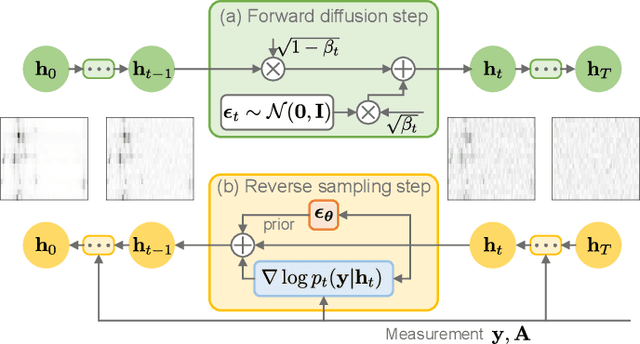

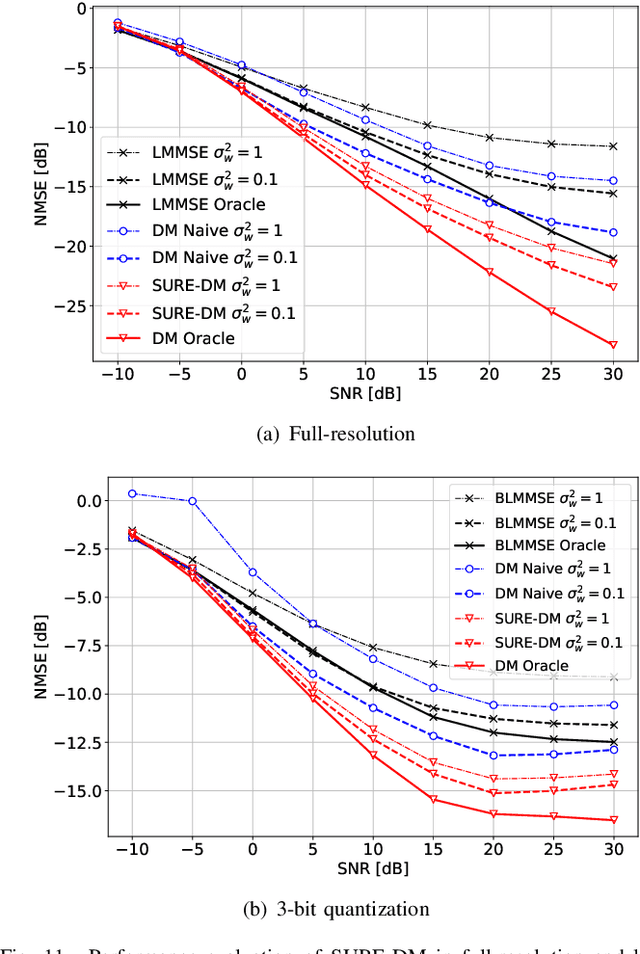
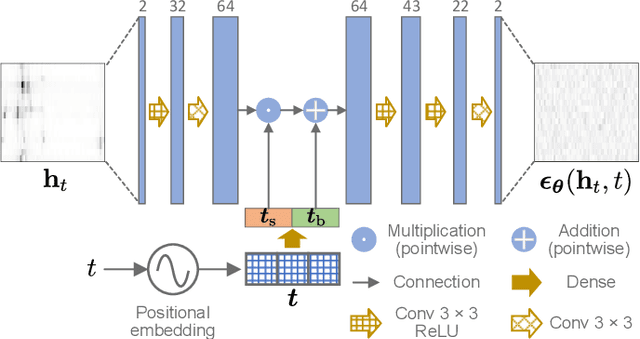
Along with the prosperity of generative artificial intelligence (AI), its potential for solving conventional challenges in wireless communications has also surfaced. Inspired by this trend, we investigate the application of the advanced diffusion models (DMs), a representative class of generative AI models, to high dimensional wireless channel estimation. By capturing the structure of multiple-input multiple-output (MIMO) wireless channels via a deep generative prior encoded by DMs, we develop a novel posterior inference method for channel reconstruction. We further adapt the proposed method to recover channel information from low-resolution quantized measurements. Additionally, to enhance the over-the-air viability, we integrate the DM with the unsupervised Stein's unbiased risk estimator to enable learning from noisy observations and circumvent the requirements for ground truth channel data that is hardly available in practice. Results reveal that the proposed estimator achieves high-fidelity channel recovery while reducing estimation latency by a factor of 10 compared to state-of-the-art schemes, facilitating real-time implementation. Moreover, our method outperforms existing estimators while reducing the pilot overhead by half, showcasing its scalability to ultra-massive antenna arrays.

One Shot is Enough for Sequential Infrared Small Target Segmentation
Aug 09, 2024


Infrared small target sequences exhibit strong similarities between frames and contain rich contextual information, which motivates us to achieve sequential infrared small target segmentation with minimal data. Inspired by the success of large segmentation models led by Segment Anything Model (SAM) across various downstream tasks, we propose a one-shot and training-free method that perfectly adapts SAM's zero-shot generalization capabilities to sequential infrared small target segmentation. Given one annotated frame as a reference, our method can accurately segment small targets in other frames of the sequence. Specifically, we first obtain a confidence map through local feature matching between reference image and test image. Then, the highest point in the confidence map is as a prompt, and we design the Point Prompt-Centric Focusing (PPCF) module to address the over-segmentation of small targets with blurry boundaries. Subsequently, to prevent miss and false detections, we introduce the Triple-Level Ensemble (TLE) module that ensembles the masks obtained at different levels from the first two steps to produce the final mask. Experiments demonstrate that our method requires only one shot to achieve comparable performance to state-of-the-art methods based on traditional many-shot supervision and even superior performance in a few-shot setting. Moreover, ablation studies confirm the robustness of our approach to variations in one-shot samples, changes in scenes, and the presence of multiple targets.
PowerPM: Foundation Model for Power Systems
Aug 07, 2024


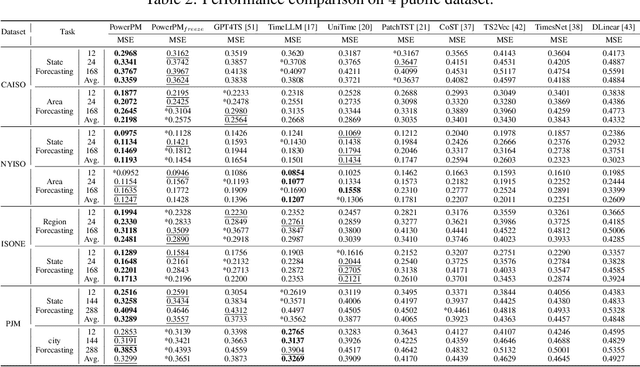
The emergence of abundant electricity time series (ETS) data provides ample opportunities for various applications in the power systems, including demand-side management, grid stability, and consumer behavior analysis. Deep learning models have advanced ETS modeling by effectively capturing sequence dependence. Nevertheless, learning a generic representation of ETS data for various applications remains challenging due to the inherently complex hierarchical structure of ETS data. Moreover, ETS data exhibits intricate temporal dependencies and is suscepti ble to the influence of exogenous variables. Furthermore, different instances exhibit diverse electricity consumption behavior. In this paper, we propose a foundation model PowerPM to model ETS data, providing a large-scale, off-the-shelf model for power systems. PowerPM consists of a temporal encoder and a hierarchical encoder. The temporal encoder captures both temporal dependencies in ETS data, considering exogenous variables. The hierarchical encoder models the correlation between hierarchy. Furthermore, PowerPM leverages a novel self-supervised pretraining framework consisting of masked ETS modeling and dual-view contrastive learning, which enable PowerPM to capture temporal dependency within ETS windows and aware the discrepancy across ETS windows, providing two different perspectives to learn generic representation. Our experiments involve five real world scenario datasets, comprising private and public data. Through pre-training on massive ETS data, PowerPM achieves SOTA performance on diverse downstream tasks within the private dataset. Impressively, when transferred to the public datasets, PowerPM maintains its superiority, showcasing its remarkable generalization ability across various tasks and domains. Moreover, ablation studies, few-shot experiments provide additional evidence of the effectiveness of our model.
Is Large Language Model Good at Database Knob Tuning? A Comprehensive Experimental Evaluation
Aug 05, 2024
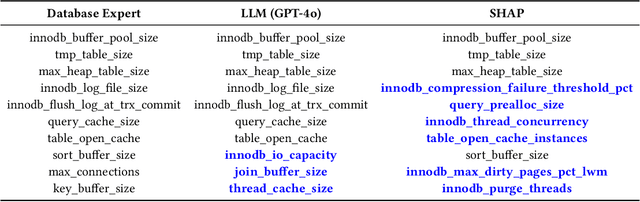

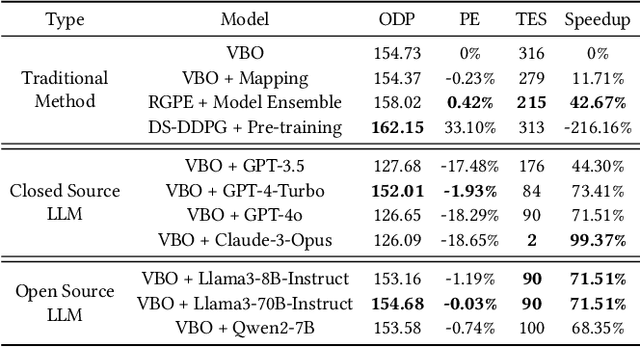
Knob tuning plays a crucial role in optimizing databases by adjusting knobs to enhance database performance. However, traditional tuning methods often follow a Try-Collect-Adjust approach, proving inefficient and database-specific. Moreover, these methods are often opaque, making it challenging for DBAs to grasp the underlying decision-making process. The emergence of large language models (LLMs) like GPT-4 and Claude-3 has excelled in complex natural language tasks, yet their potential in database knob tuning remains largely unexplored. This study harnesses LLMs as experienced DBAs for knob-tuning tasks with carefully designed prompts. We identify three key subtasks in the tuning system: knob pruning, model initialization, and knob recommendation, proposing LLM-driven solutions to replace conventional methods for each subtask. We conduct extensive experiments to compare LLM-driven approaches against traditional methods across the subtasks to evaluate LLMs' efficacy in the knob tuning domain. Furthermore, we explore the adaptability of LLM-based solutions in diverse evaluation settings, encompassing new benchmarks, database engines, and hardware environments. Our findings reveal that LLMs not only match or surpass traditional methods but also exhibit notable interpretability by generating responses in a coherent ``chain-of-thought'' manner. We further observe that LLMs exhibit remarkable generalizability through simple adjustments in prompts, eliminating the necessity for additional training or extensive code modifications. Drawing insights from our experimental findings, we identify several opportunities for future research aimed at advancing the utilization of LLMs in the realm of database management.
SiamMo: Siamese Motion-Centric 3D Object Tracking
Aug 03, 2024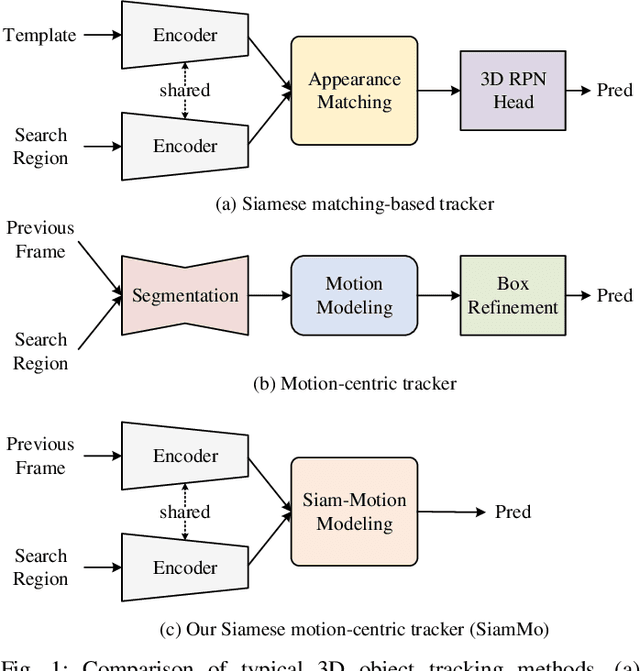
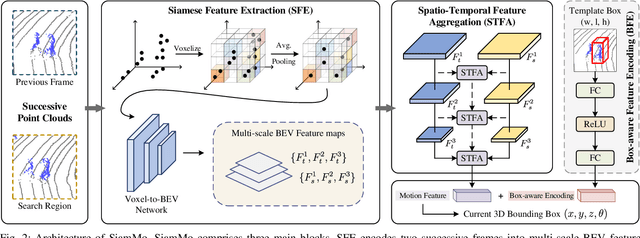
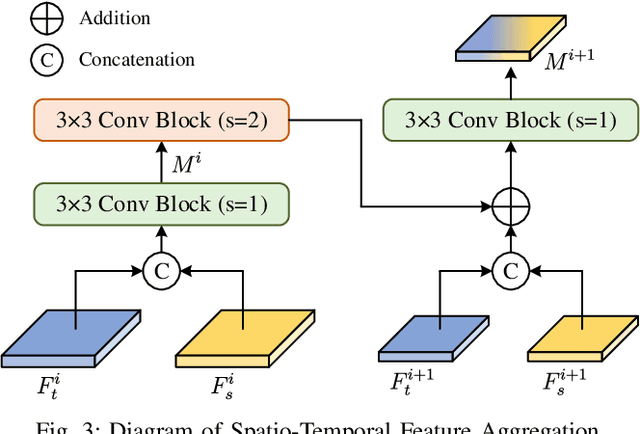
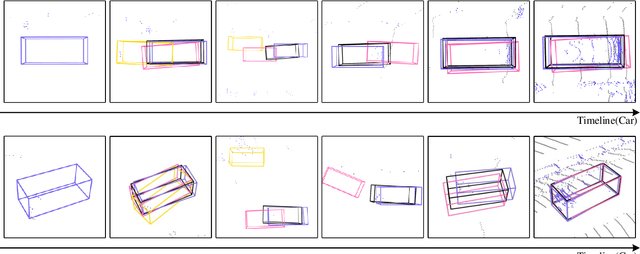
Current 3D single object tracking methods primarily rely on the Siamese matching-based paradigm, which struggles with textureless and incomplete LiDAR point clouds. Conversely, the motion-centric paradigm avoids appearance matching, thus overcoming these issues. However, its complex multi-stage pipeline and the limited temporal modeling capability of a single-stream architecture constrain its potential. In this paper, we introduce SiamMo, a novel and simple Siamese motion-centric tracking approach. Unlike the traditional single-stream architecture, we employ Siamese feature extraction for motion-centric tracking. This decouples feature extraction from temporal fusion, significantly enhancing tracking performance. Additionally, we design a Spatio-Temporal Feature Aggregation module to integrate Siamese features at multiple scales, capturing motion information effectively. We also introduce a Box-aware Feature Encoding module to encode object size priors into motion estimation. SiamMo is a purely motion-centric tracker that eliminates the need for additional processes like segmentation and box refinement. Without whistles and bells, SiamMo not only surpasses state-of-the-art methods across multiple benchmarks but also demonstrates exceptional robustness in challenging scenarios. SiamMo sets a new record on the KITTI tracking benchmark with 90.1\% precision while maintaining a high inference speed of 108 FPS. The code will be released at https://github.com/HDU-VRLab/SiamMo.
Mini-Batch Gradient-Based MCMC for Decentralized Massive MIMO Detection
Jul 26, 2024


Massive multiple-input multiple-output (MIMO) technology has significantly enhanced spectral and power efficiency in cellular communications and is expected to further evolve towards extra-large-scale MIMO. However, centralized processing for massive MIMO faces practical obstacles, including excessive computational complexity and a substantial volume of baseband data to be exchanged. To address these challenges, decentralized baseband processing has emerged as a promising solution. This approach involves partitioning the antenna array into clusters with dedicated computing hardware for parallel processing. In this paper, we investigate the gradient-based Markov chain Monte Carlo (MCMC) method -- an advanced MIMO detection technique known for its near-optimal performance in centralized implementation -- within the context of a decentralized baseband processing architecture. This decentralized design mitigates the computation burden at a single processing unit by utilizing computational resources in a distributed and parallel manner. Additionally, we integrate the mini-batch stochastic gradient descent method into the proposed decentralized detector, achieving remarkable performance with high efficiency. Simulation results demonstrate substantial performance gains of the proposed method over existing decentralized detectors across various scenarios. Moreover, complexity analysis reveals the advantages of the proposed decentralized strategy in terms of computation delay and interconnection bandwidth when compared to conventional centralized detectors.
MapDistill: Boosting Efficient Camera-based HD Map Construction via Camera-LiDAR Fusion Model Distillation
Jul 16, 2024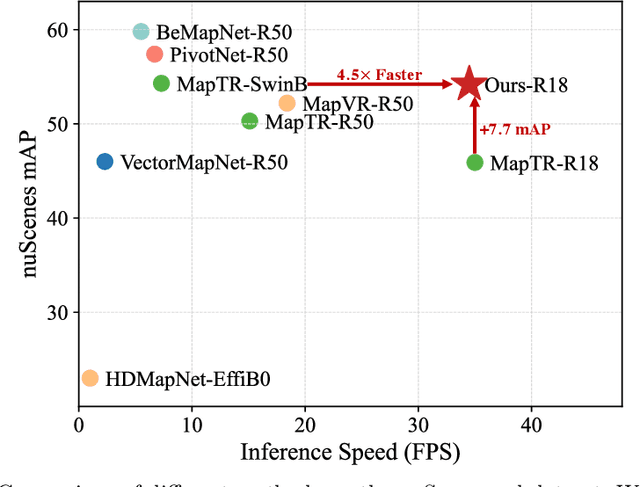

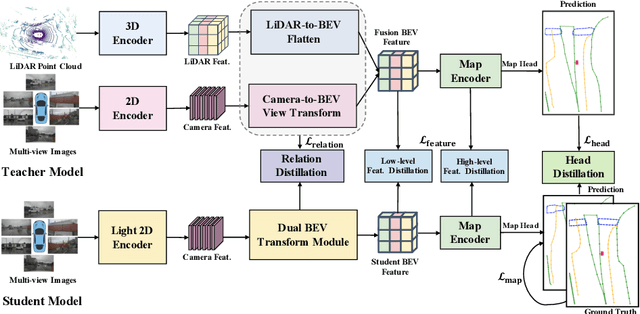

Online high-definition (HD) map construction is an important and challenging task in autonomous driving. Recently, there has been a growing interest in cost-effective multi-view camera-based methods without relying on other sensors like LiDAR. However, these methods suffer from a lack of explicit depth information, necessitating the use of large models to achieve satisfactory performance. To address this, we employ the Knowledge Distillation (KD) idea for efficient HD map construction for the first time and introduce a novel KD-based approach called MapDistill to transfer knowledge from a high-performance camera-LiDAR fusion model to a lightweight camera-only model. Specifically, we adopt the teacher-student architecture, i.e., a camera-LiDAR fusion model as the teacher and a lightweight camera model as the student, and devise a dual BEV transform module to facilitate cross-modal knowledge distillation while maintaining cost-effective camera-only deployment. Additionally, we present a comprehensive distillation scheme encompassing cross-modal relation distillation, dual-level feature distillation, and map head distillation. This approach alleviates knowledge transfer challenges between modalities, enabling the student model to learn improved feature representations for HD map construction. Experimental results on the challenging nuScenes dataset demonstrate the effectiveness of MapDistill, surpassing existing competitors by over 7.7 mAP or 4.5X speedup.
IRSAM: Advancing Segment Anything Model for Infrared Small Target Detection
Jul 10, 2024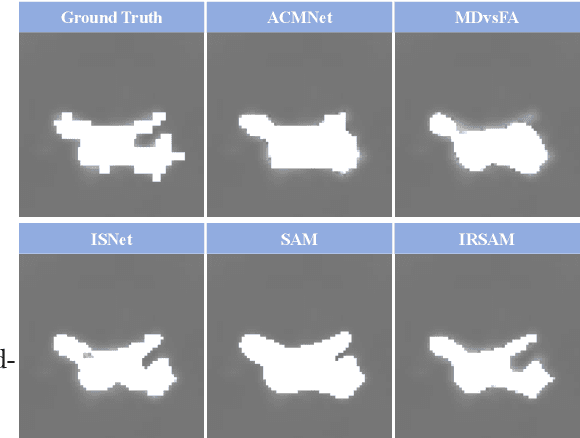
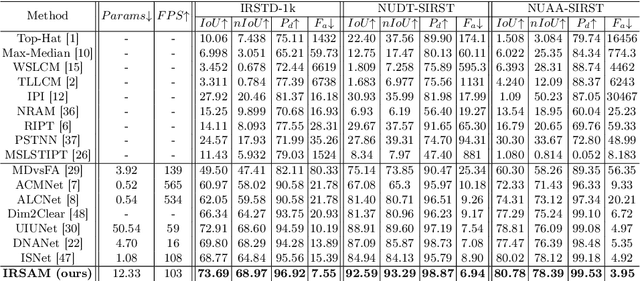
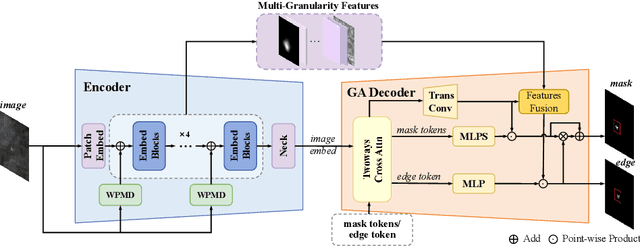

The recent Segment Anything Model (SAM) is a significant advancement in natural image segmentation, exhibiting potent zero-shot performance suitable for various downstream image segmentation tasks. However, directly utilizing the pretrained SAM for Infrared Small Target Detection (IRSTD) task falls short in achieving satisfying performance due to a notable domain gap between natural and infrared images. Unlike a visible light camera, a thermal imager reveals an object's temperature distribution by capturing infrared radiation. Small targets often show a subtle temperature transition at the object's boundaries. To address this issue, we propose the IRSAM model for IRSTD, which improves SAM's encoder-decoder architecture to learn better feature representation of infrared small objects. Specifically, we design a Perona-Malik diffusion (PMD)-based block and incorporate it into multiple levels of SAM's encoder to help it capture essential structural features while suppressing noise. Additionally, we devise a Granularity-Aware Decoder (GAD) to fuse the multi-granularity feature from the encoder to capture structural information that may be lost in long-distance modeling. Extensive experiments on the public datasets, including NUAA-SIRST, NUDT-SIRST, and IRSTD-1K, validate the design choice of IRSAM and its significant superiority over representative state-of-the-art methods. The source code are available at: github.com/IPIC-Lab/IRSAM.
Near-Optimal MIMO Detection Using Gradient-Based MCMC in Discrete Spaces
Jul 08, 2024The discrete nature of transmitted symbols poses challenges for achieving optimal detection in multiple-input multiple-output (MIMO) systems associated with a large number of antennas. Recently, the combination of two powerful machine learning methods, Markov chain Monte Carlo (MCMC) sampling and gradient descent, has emerged as a highly efficient solution to address this issue. However, existing gradient-based MCMC detectors are heuristically designed and thus are theoretically untenable. To bridge this gap, we introduce a novel sampling algorithm tailored for discrete spaces. This algorithm leverages gradients from the underlying continuous spaces for acceleration while maintaining the validity of probabilistic sampling. We prove the convergence of this method and also analyze its convergence rate using both MCMC theory and empirical diagnostics. On this basis, we develop a MIMO detector that precisely samples from the target discrete distribution and generates posterior Bayesian estimates using these samples, whose performance is thereby theoretically guaranteed. Furthermore, our proposed detector is highly parallelizable and scalable to large MIMO dimensions, positioning it as a compelling candidate for next-generation wireless networks. Simulation results show that our detector achieves near-optimal performance, significantly outperforms state-of-the-art baselines, and showcases resilience to various system setups.
Boosting 3D Object Detection with Semantic-Aware Multi-Branch Framework
Jul 08, 2024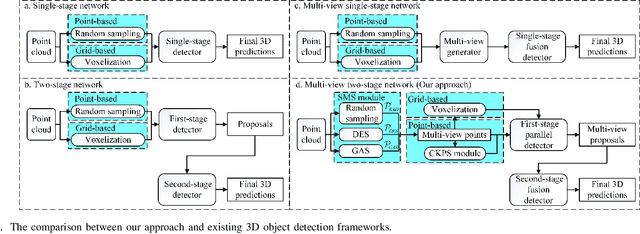

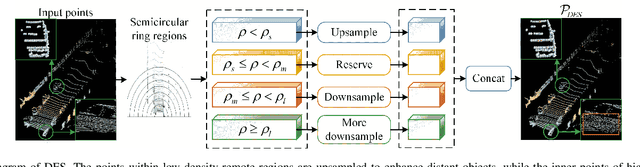
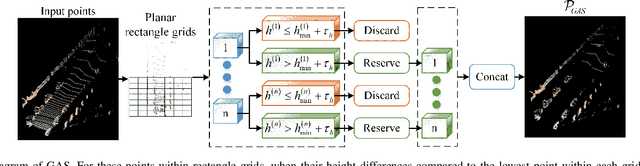
In autonomous driving, LiDAR sensors are vital for acquiring 3D point clouds, providing reliable geometric information. However, traditional sampling methods of preprocessing often ignore semantic features, leading to detail loss and ground point interference in 3D object detection. To address this, we propose a multi-branch two-stage 3D object detection framework using a Semantic-aware Multi-branch Sampling (SMS) module and multi-view consistency constraints. The SMS module includes random sampling, Density Equalization Sampling (DES) for enhancing distant objects, and Ground Abandonment Sampling (GAS) to focus on non-ground points. The sampled multi-view points are processed through a Consistent KeyPoint Selection (CKPS) module to generate consistent keypoint masks for efficient proposal sampling. The first-stage detector uses multi-branch parallel learning with multi-view consistency loss for feature aggregation, while the second-stage detector fuses multi-view data through a Multi-View Fusion Pooling (MVFP) module to precisely predict 3D objects. The experimental results on KITTI 3D object detection benchmark dataset show that our method achieves excellent detection performance improvement for a variety of backbones, especially for low-performance backbones with the simple network structures.