 Add to Chrome
 Add to Firefox
 Add to Edge
SCOPE: Simulating Cross-game Operations in Playable Environments for FPS World Models
May 28, 2026
Interactive world models for first-person shooter (FPS) games must resolve high-frequency overlapping control signals at every frame without disrupting unaffected regions. Existing methods inject actions globally and train on single titles, failing under dense FPS inputs. We observe that FPS actions are spatially selective: discrete events such as firing or reloading affect only a localized region around the weapon (the scope), while continuous camera and movement signals govern stable surroundings. We propose SCOPE, which inserts a conditioning module into each transformer block of a pretrained video diffusion model. It reshapes features into per-pixel temporal sequences so that each position computes its action response from local visual content. This separates in-scope effects from out-of-scope generation without segmentation labels. We also introduce CrossFPS, the first multi-game FPS dataset with frame-aligned action telemetry. It comprises 69K clips from 7 titles with 10-DoF controller signals, curated to remove gameplay bias. The model learns general visual-to-action mappings rather than game-specific patterns, enabling zero-shot transfer to unseen scenes. Experiments confirm strong action responsiveness, precise scope separation, and effective cross-game generalization.

Incantation: Natural Language as the Action Interface for Multi-Entity Video World Models
May 18, 2026Modern interactive video world models have achieved impressive visual fidelity, yet lack fine-grained multi-entity control and cross-entity, cross-world generalization. We trace this gap to the action interface: standard control protocols (e.g. animation IDs, device inputs, scene-level captions) bind action semantics to specific entities or engines at design time. We propose natural language as the interface to unlock expressiveness that no prior interface can achieve, and we present Incantation, the first interactive video world model with per-latent-frame (0.25 s) natural-language conditioning that supports simultaneous multi-entity control and concept-level cross-entity transfer beyond any fixed rendering pipeline. We pair a pretrained bidirectional video backbone with frame-local text cross-attention, and enable real-time long-horizon streaming through ODE-initialized Self-Forcing distillation with a RoPE-decoupled sliding KV-cache. We surpass the Action-Index baseline on cross-entity transfer (89% vs. 43%) and out-of-vocabulary prompts (90% vs. 0%), and our 2-step student sustains 19.7 FPS at 480p with stable FVD over 2-hour rollouts. We further apply the same architecture and training recipe to The King of Fighters, changing only the per-entity action vocabulary slots. We have released a preview subset of the Incantation dataset at https://huggingface.co/datasets/zhush/incantation-elden-ring-scenes, containing manually collected Elden Ring player-boss combat clips with structured action-oriented metadata. Larger-scale Elden Ring and KOF data will be released with the full project.
Accelerating Diffusion Sampling via Exploiting Local Transition Coherence
Mar 12, 2025Text-based diffusion models have made significant breakthroughs in generating high-quality images and videos from textual descriptions. However, the lengthy sampling time of the denoising process remains a significant bottleneck in practical applications. Previous methods either ignore the statistical relationships between adjacent steps or rely on attention or feature similarity between them, which often only works with specific network structures. To address this issue, we discover a new statistical relationship in the transition operator between adjacent steps, focusing on the relationship of the outputs from the network. This relationship does not impose any requirements on the network structure. Based on this observation, we propose a novel training-free acceleration method called LTC-Accel, which uses the identified relationship to estimate the current transition operator based on adjacent steps. Due to no specific assumptions regarding the network structure, LTC-Accel is applicable to almost all diffusion-based methods and orthogonal to almost all existing acceleration techniques, making it easy to combine with them. Experimental results demonstrate that LTC-Accel significantly speeds up sampling in text-to-image and text-to-video synthesis while maintaining competitive sample quality. Specifically, LTC-Accel achieves a speedup of 1.67-fold in Stable Diffusion v2 and a speedup of 1.55-fold in video generation models. When combined with distillation models, LTC-Accel achieves a remarkable 10-fold speedup in video generation, allowing real-time generation of more than 16FPS.
Is Large Language Model Good at Database Knob Tuning? A Comprehensive Experimental Evaluation
Aug 05, 2024
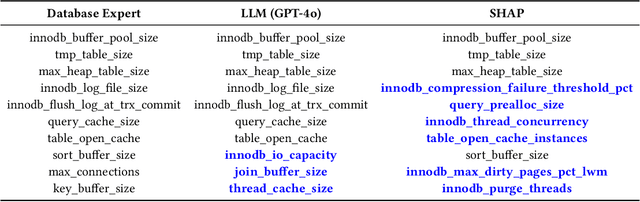

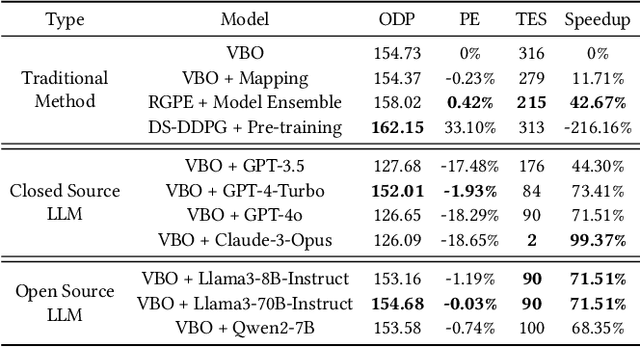
Knob tuning plays a crucial role in optimizing databases by adjusting knobs to enhance database performance. However, traditional tuning methods often follow a Try-Collect-Adjust approach, proving inefficient and database-specific. Moreover, these methods are often opaque, making it challenging for DBAs to grasp the underlying decision-making process. The emergence of large language models (LLMs) like GPT-4 and Claude-3 has excelled in complex natural language tasks, yet their potential in database knob tuning remains largely unexplored. This study harnesses LLMs as experienced DBAs for knob-tuning tasks with carefully designed prompts. We identify three key subtasks in the tuning system: knob pruning, model initialization, and knob recommendation, proposing LLM-driven solutions to replace conventional methods for each subtask. We conduct extensive experiments to compare LLM-driven approaches against traditional methods across the subtasks to evaluate LLMs' efficacy in the knob tuning domain. Furthermore, we explore the adaptability of LLM-based solutions in diverse evaluation settings, encompassing new benchmarks, database engines, and hardware environments. Our findings reveal that LLMs not only match or surpass traditional methods but also exhibit notable interpretability by generating responses in a coherent ``chain-of-thought'' manner. We further observe that LLMs exhibit remarkable generalizability through simple adjustments in prompts, eliminating the necessity for additional training or extensive code modifications. Drawing insights from our experimental findings, we identify several opportunities for future research aimed at advancing the utilization of LLMs in the realm of database management.