 Add to Chrome
 Add to Firefox
 Add to Edge
Explore or Converge? Stage-Guided Per-Step Optimization for Diffusion Models
Aug 07, 2026
Diffusion models have strong generative capabilities. However, their maximum likelihood training objective only focuses on reconstructing the data distribution, making it difficult to align with specific preferences. Reinforcement learning (RL) for preference alignment in diffusion models is promising but limited by reward sparsity. Since a single reward cannot support optimization, existing RL methods usually backpropagate the final reward to all previous steps. However, denoising is stage-wise, with distinct semantics and controllability. Repeating the final reward across all steps creates a temporal objective mismatch, encouraging reward shortcuts that lead to reward hacking. At the same time, due to reward backfilling, each time step receives the same reward, making it impossible to distinguish between actions, thereby weakening the optimization process. To resolve this issue, we propose Stage-Guided Per-Step Optimization (SGPO) for diffusion models, which jointly leverages signal-to-noise ratio and semantic changes to identify generation stages and adaptively assign stage-specific objectives. Early denoising is chaotic and far from the final reward, resulting in weak reward-behavior correlation. This stage should prioritize exiting the chaotic state. In the mid stage, the latent transitions to a stable structure, where the final reward better corresponds to generative behavior. Therefore, this stage optimizes the final reward while exploring diversity to avoid early convergence to a single mode. In the late stage, the latent's core structure is largely fixed, and preference optimization mainly amplifies local details, risking overfitting. Therefore, stable convergence is preferred to avoid quality degradation. Results from 16 comparative experiments validate SGPO. Our method achieves 26.7% average gains in generative quality and 36.7% higher convergence speed.

PAST: Prompt-Adaptive Sampling Termination for Efficient Diffusion Model
Aug 07, 2026While diffusion models have made significant progress in text-to-image tasks, they still exhibit limitations when directly optimizing downstream objectives. Although Reinforcement Learning (RL) enables targeted optimization, existing methods are generally constrained by low-efficiency fine-tuning and sparse rewards. To address these challenges, we propose PAST, which provides differentiated rewards while adaptively regulating training episode length by jointly perceiving denoising progress and prompt difficulty. Specifically, we design an intrinsic reward paradigm to compensate for sparse extrinsic rewards and guide the model to explore paths that diverge more efficiently from noise patterns. We further provide theoretical justification for intrinsic rewards. Then, PAST dynamically monitors denoising completion and semantic alignment between image structures and prompt semantics. When both metrics satisfy generation requirements, the system adaptively terminates training. This enables appropriate allocation of episode lengths based on prompt difficulty and the current generation process. Finally, based on the predicted residual noise level, we establish a dual adaptive coordination mechanism. Specifically, it not only balances the extrinsic and intrinsic rewards but also balances the exploration and convergence. Experimental results demonstrate that PAST enhances computational efficiency of existing RL fine-tuning methods by up to 66.7%, while improving preference optimization quality by up to 29.5% through its dual adaptive regulation mechanism.
GenTrack: Physical Alignment for Robot-Native Motion Generation and Zero-Shot Humanoid Tracking
Aug 02, 2026General-purpose humanoid trackers can execute diverse references, but their zero-shot coverage depends on large embodied corpora that are costly to extend. Text-to-motion generators offer scalable supervision, yet models trained on human motion or retargeted data inherit a gap between kinematic plausibility and robot executability. Existing one-way pipelines fix either the generated corpus or the reward tracker. We introduce GenTrack, an online generator--tracker framework that alternates execution-grounded, group-relative generator alignment with tracker training on newly generated references; anchoring and rehearsal constrain drift. On Unitree G1, we evaluate GenTrack with ProtoMotions and SONIC backbones across three zero-shot tracking splits including public AMASS and LAFAN benchmarks, and a private out-of-distribution test set of 1,024 prompt-motion pairs in the wild. The online co-training strategy consistently produces generators that output more robot-executable motions with strong semantic alignment, and trackers with markedly broader zero-shot coverage and improved tracking accuracy, especially on out-of-distribution references. These results demonstrate that joint online post-training effectively narrows the executability gap between retargeted references and robot-native motion, advancing zero-shot humanoid control without additional data collection and beyond the limitations of a static reference pool.
Pixel-Space Diffusion Transformers
Jul 20, 2026Latent diffusion models (LDMs) enable efficient high-resolution image synthesis by denoising in a VAE-compressed latent space. However, fixed visual tokenizers can discard fine textures and structural details, while separate representation and diffusion training creates a mismatch between reconstruction and generation objectives. These limitations have renewed interest in pixel-space diffusion, which models raw pixels directly, removes the VAE bottleneck, and supports end-to-end optimization. This formulation better matches the demands of high-fidelity generation but introduces challenges in high-dimensional modeling, including noise scheduling, loss weighting, token efficiency, and scalable architecture design. Pixel-space modeling also offers a promising basis for unified multimodal systems: raw pixels, text, and task conditions can be represented in a shared token space and jointly processed by a single Transformer, narrowing the gap between visual understanding and generation. This paper reviews Pixel-Space Diffusion Transformers (pDiTs) from the perspectives of model architecture, continuous generative mechanisms, and unified multimodal modeling. We summarize representative methods, identify key technical challenges, and discuss future directions toward high-fidelity, end-to-end vision foundation models that integrate generation and understanding.
InfoDense: Density-Aware Regional Decisive Replay for Memory-Efficient Incremental Face Forgery Detection
Jul 18, 2026The rapid evolution of face forgery techniques has introduced an increasing variety of manipulations. Incremental Face Forgery Detection (IFFD), which incrementally adds new forgery data to fine-tune previously trained models, has emerged as a promising approach to handle evolving forgery threats. However, conventional replay-based IFFD methods suffer from catastrophic forgetting. Storing full historical images under limited memory often either fails to preserve subtle forgery cues or introduces domain bias, reducing the model's ability to learn intrinsic and transferable manipulation characteristics. In this paper, we propose a Density-Aware Regional Decisive replay strategy, termed InfoDense, to address these challenges. InfoDense prioritizes artifact-dense and forgery-critical regions, significantly reducing storage requirements while maintaining high-fidelity forgery evidence. We first introduce InfoDense Cut to localize decisive patches using CLIP-based embeddings. Then, InfoDense Select ranks candidate segments by combining latent-space representativeness and decisive patch counts, ensuring both diversity and information density in the replay buffer. Finally, InfoDense Fuse reconstructs unbiased training inputs by adaptively merging stored segments with current-task samples, enhancing knowledge retention and generalization. Extensive experiments on challenging incremental deepfake benchmarks demonstrate that InfoDense effectively mitigates catastrophic forgetting while improving cross-domain generalization.
Divide and Conquer: Reliable Multi-View Evidential Learning for Deepfake Detection
Jun 01, 2026With the evolution of generative models, deepfakes have achieved near-perfect semantic realism, leaving forensic traces only in subtle structural anomalies. However, existing single-view paradigms often fail to generalize, as dominant semantic features overwhelm subtle artifact cues within entangled representations. This imbalance leads to overconfident yet brittle predictions -- a phenomenon we term the Semantic Masking Effect. To address this challenge, we propose a reliable framework called Divide-and-Conquer Multi-View Evidential Learning (DiCoME) for Deepfake Detection. In the "Divide" phase, we employ Geometric View Purification to decompose the entangled representation space through principled geometric projection. This process suppresses semantic interference within artifact-sensitive representations, forming the foundation for decorrelated yet complementary semantic and artifact views. In the "Conquer" phase, we leverage Uncertainty-Aware Evidential Learning to synthesize these distinct views. By explicitly modeling the "epistemic conflict" between semantic and artifact cues, this mechanism provides calibrated uncertainty estimates instead of forcing rigid deterministic decisions. Extensive experiments across multiple benchmarks demonstrate that our method consistently outperforms existing approaches in generalization performance, while providing reliable uncertainty estimation for trustworthy deepfake detection. Code is available at https://github.com/kxl0825/DiCoME.git.
Tutor-Student Reinforcement Learning: A Dynamic Curriculum for Robust Deepfake Detection
Mar 25, 2026Standard supervised training for deepfake detection treats all samples with uniform importance, which can be suboptimal for learning robust and generalizable features. In this work, we propose a novel Tutor-Student Reinforcement Learning (TSRL) framework to dynamically optimize the training curriculum. Our method models the training process as a Markov Decision Process where a ``Tutor'' agent learns to guide a ``Student'' (the deepfake detector). The Tutor, implemented as a Proximal Policy Optimization (PPO) agent, observes a rich state representation for each training sample, encapsulating not only its visual features but also its historical learning dynamics, such as EMA loss and forgetting counts. Based on this state, the Tutor takes an action by assigning a continuous weight (0-1) to the sample's loss, thereby dynamically re-weighting the training batch. The Tutor is rewarded based on the Student's immediate performance change, specifically rewarding transitions from incorrect to correct predictions. This strategy encourages the Tutor to learn a curriculum that prioritizes high-value samples, such as hard-but-learnable examples, leading to a more efficient and effective training process. We demonstrate that this adaptive curriculum improves the Student's generalization capabilities against unseen manipulation techniques compared to traditional training methods. Code is available at https://github.com/wannac1/TSRL.
* Accepted to CVPR 2026
MotionLLaMA: A Unified Framework for Motion Synthesis and Comprehension
Nov 26, 2024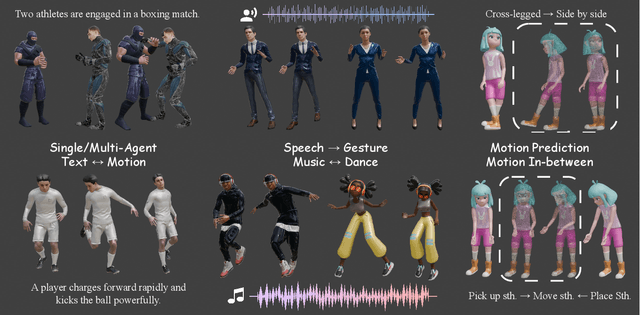
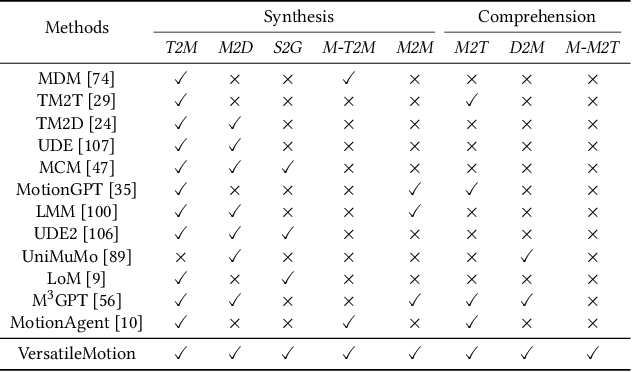
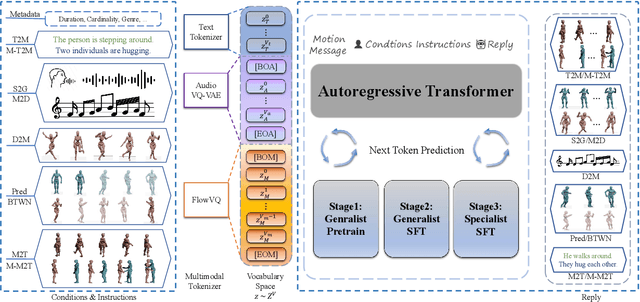
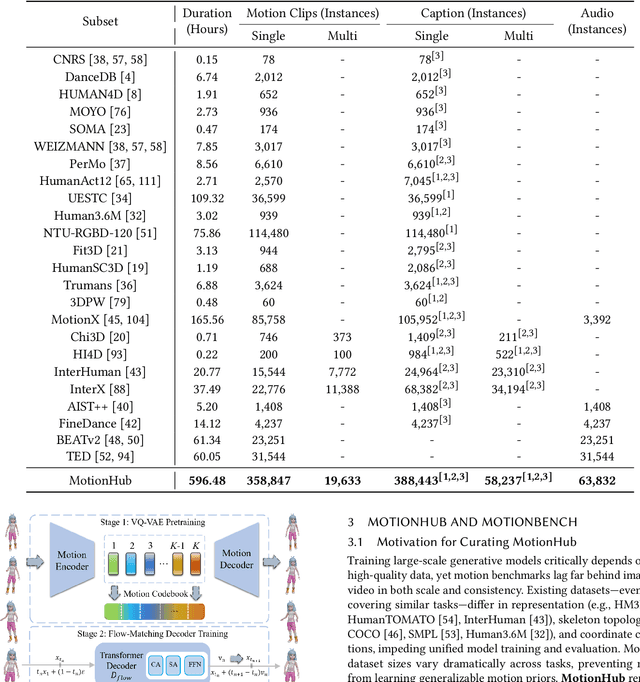
This paper introduces MotionLLaMA, a unified framework for motion synthesis and comprehension, along with a novel full-body motion tokenizer called the HoMi Tokenizer. MotionLLaMA is developed based on three core principles. First, it establishes a powerful unified representation space through the HoMi Tokenizer. Using a single codebook, the HoMi Tokenizer in MotionLLaMA achieves reconstruction accuracy comparable to residual vector quantization tokenizers utilizing six codebooks, outperforming all existing single-codebook tokenizers. Second, MotionLLaMA integrates a large language model to tackle various motion-related tasks. This integration bridges various modalities, facilitating both comprehensive and intricate motion synthesis and comprehension. Third, MotionLLaMA introduces the MotionHub dataset, currently the most extensive multimodal, multitask motion dataset, which enables fine-tuning of large language models. Extensive experimental results demonstrate that MotionLLaMA not only covers the widest range of motion-related tasks but also achieves state-of-the-art (SOTA) performance in motion completion, interaction dual-person text-to-motion, and all comprehension tasks while reaching performance comparable to SOTA in the remaining tasks. The code and MotionHub dataset are publicly available.
Stacking Brick by Brick: Aligned Feature Isolation for Incremental Face Forgery Detection
Nov 19, 2024


The rapid advancement of face forgery techniques has introduced a growing variety of forgeries. Incremental Face Forgery Detection (IFFD), involving gradually adding new forgery data to fine-tune the previously trained model, has been introduced as a promising strategy to deal with evolving forgery methods. However, a naively trained IFFD model is prone to catastrophic forgetting when new forgeries are integrated, as treating all forgeries as a single ''Fake" class in the Real/Fake classification can cause different forgery types overriding one another, thereby resulting in the forgetting of unique characteristics from earlier tasks and limiting the model's effectiveness in learning forgery specificity and generality. In this paper, we propose to stack the latent feature distributions of previous and new tasks brick by brick, $\textit{i.e.}$, achieving $\textbf{aligned feature isolation}$. In this manner, we aim to preserve learned forgery information and accumulate new knowledge by minimizing distribution overriding, thereby mitigating catastrophic forgetting. To achieve this, we first introduce Sparse Uniform Replay (SUR) to obtain the representative subsets that could be treated as the uniformly sparse versions of the previous global distributions. We then propose a Latent-space Incremental Detector (LID) that leverages SUR data to isolate and align distributions. For evaluation, we construct a more advanced and comprehensive benchmark tailored for IFFD. The leading experimental results validate the superiority of our method.
Can We Leave Deepfake Data Behind in Training Deepfake Detector?
Aug 30, 2024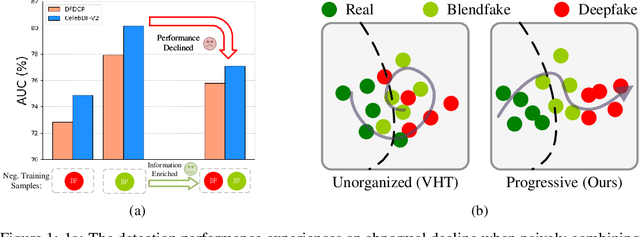
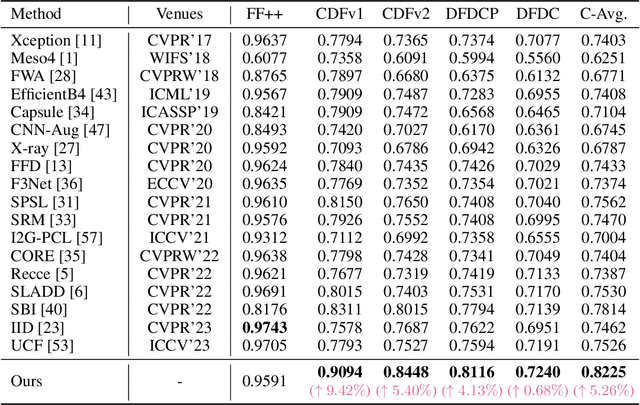
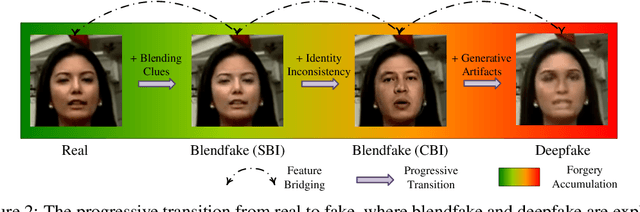
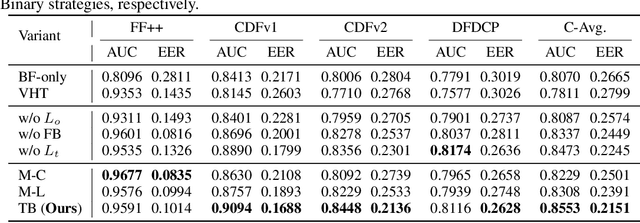
The generalization ability of deepfake detectors is vital for their applications in real-world scenarios. One effective solution to enhance this ability is to train the models with manually-blended data, which we termed "blendfake", encouraging models to learn generic forgery artifacts like blending boundary. Interestingly, current SoTA methods utilize blendfake without incorporating any deepfake data in their training process. This is likely because previous empirical observations suggest that vanilla hybrid training (VHT), which combines deepfake and blendfake data, results in inferior performance to methods using only blendfake data (so-called "1+1<2"). Therefore, a critical question arises: Can we leave deepfake behind and rely solely on blendfake data to train an effective deepfake detector? Intuitively, as deepfakes also contain additional informative forgery clues (e.g., deep generative artifacts), excluding all deepfake data in training deepfake detectors seems counter-intuitive. In this paper, we rethink the role of blendfake in detecting deepfakes and formulate the process from "real to blendfake to deepfake" to be a progressive transition. Specifically, blendfake and deepfake can be explicitly delineated as the oriented pivot anchors between "real-to-fake" transitions. The accumulation of forgery information should be oriented and progressively increasing during this transition process. To this end, we propose an Oriented Progressive Regularizor (OPR) to establish the constraints that compel the distribution of anchors to be discretely arranged. Furthermore, we introduce feature bridging to facilitate the smooth transition between adjacent anchors. Extensive experiments confirm that our design allows leveraging forgery information from both blendfake and deepfake effectively and comprehensively.