 Add to Chrome
 Add to Firefox
 Add to Edge
PAST: Prompt-Adaptive Sampling Termination for Efficient Diffusion Model
Aug 07, 2026
While diffusion models have made significant progress in text-to-image tasks, they still exhibit limitations when directly optimizing downstream objectives. Although Reinforcement Learning (RL) enables targeted optimization, existing methods are generally constrained by low-efficiency fine-tuning and sparse rewards. To address these challenges, we propose PAST, which provides differentiated rewards while adaptively regulating training episode length by jointly perceiving denoising progress and prompt difficulty. Specifically, we design an intrinsic reward paradigm to compensate for sparse extrinsic rewards and guide the model to explore paths that diverge more efficiently from noise patterns. We further provide theoretical justification for intrinsic rewards. Then, PAST dynamically monitors denoising completion and semantic alignment between image structures and prompt semantics. When both metrics satisfy generation requirements, the system adaptively terminates training. This enables appropriate allocation of episode lengths based on prompt difficulty and the current generation process. Finally, based on the predicted residual noise level, we establish a dual adaptive coordination mechanism. Specifically, it not only balances the extrinsic and intrinsic rewards but also balances the exploration and convergence. Experimental results demonstrate that PAST enhances computational efficiency of existing RL fine-tuning methods by up to 66.7%, while improving preference optimization quality by up to 29.5% through its dual adaptive regulation mechanism.

Explore or Converge? Stage-Guided Per-Step Optimization for Diffusion Models
Aug 07, 2026Diffusion models have strong generative capabilities. However, their maximum likelihood training objective only focuses on reconstructing the data distribution, making it difficult to align with specific preferences. Reinforcement learning (RL) for preference alignment in diffusion models is promising but limited by reward sparsity. Since a single reward cannot support optimization, existing RL methods usually backpropagate the final reward to all previous steps. However, denoising is stage-wise, with distinct semantics and controllability. Repeating the final reward across all steps creates a temporal objective mismatch, encouraging reward shortcuts that lead to reward hacking. At the same time, due to reward backfilling, each time step receives the same reward, making it impossible to distinguish between actions, thereby weakening the optimization process. To resolve this issue, we propose Stage-Guided Per-Step Optimization (SGPO) for diffusion models, which jointly leverages signal-to-noise ratio and semantic changes to identify generation stages and adaptively assign stage-specific objectives. Early denoising is chaotic and far from the final reward, resulting in weak reward-behavior correlation. This stage should prioritize exiting the chaotic state. In the mid stage, the latent transitions to a stable structure, where the final reward better corresponds to generative behavior. Therefore, this stage optimizes the final reward while exploring diversity to avoid early convergence to a single mode. In the late stage, the latent's core structure is largely fixed, and preference optimization mainly amplifies local details, risking overfitting. Therefore, stable convergence is preferred to avoid quality degradation. Results from 16 comparative experiments validate SGPO. Our method achieves 26.7% average gains in generative quality and 36.7% higher convergence speed.
DynaGraph: Lightweight Multi-Model Interaction Framework via Dynamic Topological Reconfiguration
May 28, 2026Tackling complex reasoning tasks typically relies on massive monolithic LLMs, which suffer from severe computational redundancy. While task decomposition through structured pipelines or multi-agent collaborations offers an alternative, these approaches inevitably fall into a critical dilemma: predefined static topologies are highly vulnerable to cascading errors, whereas unconstrained dynamic agents suffer from trajectory divergence and unpredictable memory bloat. To address this, we present DynaGraph, a lightweight multi-model framework driven by dynamic topological reconfiguration. At the execution level, DynaGraph multiplexes time-division PEFT adapters over a shared base model, enabling both full system training and inference deployment on a single consumer-grade GPU. At the routing level, the Evaluator continuously monitors execution confidence to trigger hierarchical self-healing: Fine-grained Patching for localized data gaps and Subgraph Reconstruction for severe logical ruptures. Experiments on StrategyQA, MATH, and FinQA demonstrate our 8B model closely approximates the reasoning capabilities of a 72B monolithic model (e.g., 87.6% on StrategyQA, 82.7% on MATH). Furthermore, it reduces latency by up to 68.1% and token consumption by 68.6% compared to unconstrained dynamic architectures.
AdaMemento: Adaptive Memory-Assisted Policy Optimization for Reinforcement Learning
Oct 06, 2024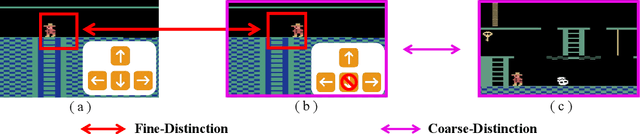
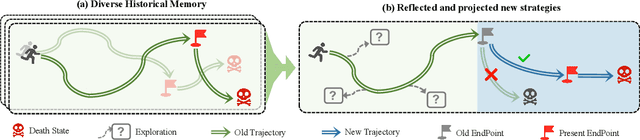
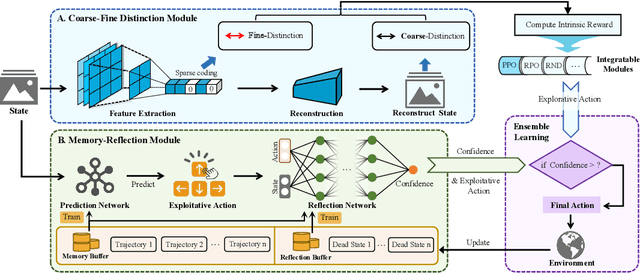
In sparse reward scenarios of reinforcement learning (RL), the memory mechanism provides promising shortcuts to policy optimization by reflecting on past experiences like humans. However, current memory-based RL methods simply store and reuse high-value policies, lacking a deeper refining and filtering of diverse past experiences and hence limiting the capability of memory. In this paper, we propose AdaMemento, an adaptive memory-enhanced RL framework. Instead of just memorizing positive past experiences, we design a memory-reflection module that exploits both positive and negative experiences by learning to predict known local optimal policies based on real-time states. To effectively gather informative trajectories for the memory, we further introduce a fine-grained intrinsic motivation paradigm, where nuances in similar states can be precisely distinguished to guide exploration. The exploitation of past experiences and exploration of new policies are then adaptively coordinated by ensemble learning to approach the global optimum. Furthermore, we theoretically prove the superiority of our new intrinsic motivation and ensemble mechanism. From 59 quantitative and visualization experiments, we confirm that AdaMemento can distinguish subtle states for better exploration and effectively exploiting past experiences in memory, achieving significant improvement over previous methods.
CopyLens: Dynamically Flagging Copyrighted Sub-Dataset Contributions to LLM Outputs
Oct 06, 2024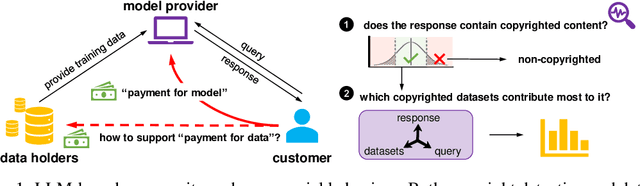
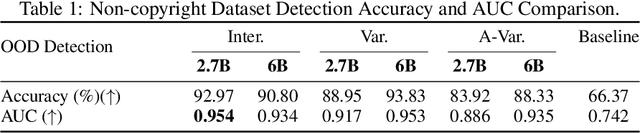
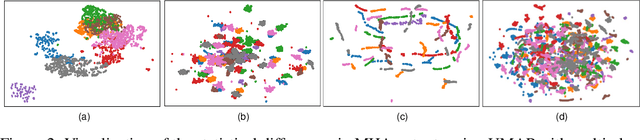
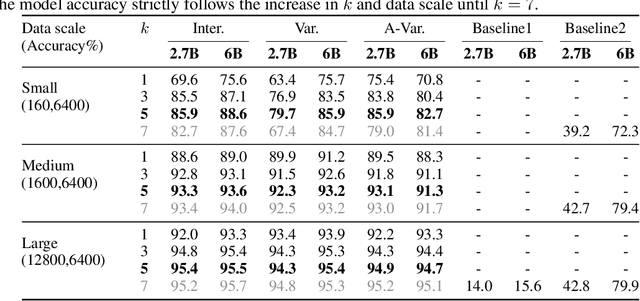
Large Language Models (LLMs) have become pervasive due to their knowledge absorption and text-generation capabilities. Concurrently, the copyright issue for pretraining datasets has been a pressing concern, particularly when generation includes specific styles. Previous methods either focus on the defense of identical copyrighted outputs or find interpretability by individual tokens with computational burdens. However, the gap between them exists, where direct assessments of how dataset contributions impact LLM outputs are missing. Once the model providers ensure copyright protection for data holders, a more mature LLM community can be established. To address these limitations, we introduce CopyLens, a new framework to analyze how copyrighted datasets may influence LLM responses. Specifically, a two-stage approach is employed: First, based on the uniqueness of pretraining data in the embedding space, token representations are initially fused for potential copyrighted texts, followed by a lightweight LSTM-based network to analyze dataset contributions. With such a prior, a contrastive-learning-based non-copyright OOD detector is designed. Our framework can dynamically face different situations and bridge the gap between current copyright detection methods. Experiments show that CopyLens improves efficiency and accuracy by 15.2% over our proposed baseline, 58.7% over prompt engineering methods, and 0.21 AUC over OOD detection baselines.
The Exploration-Exploitation Dilemma Revisited: An Entropy Perspective
Aug 19, 2024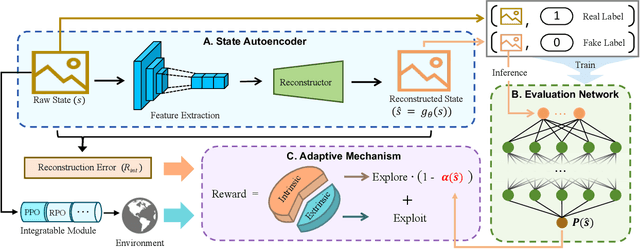
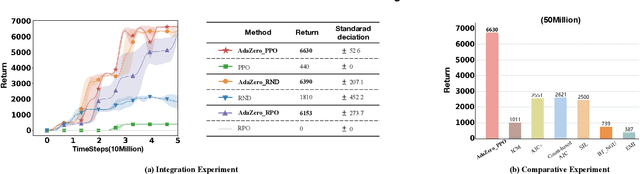
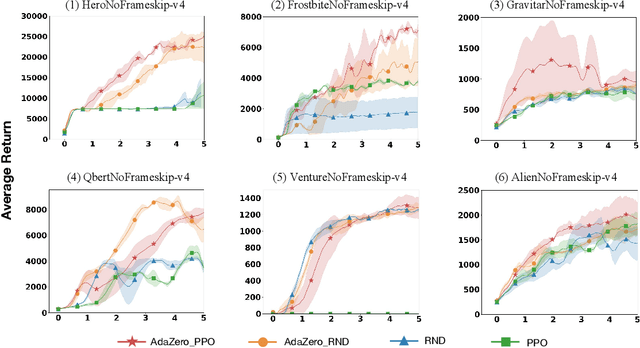
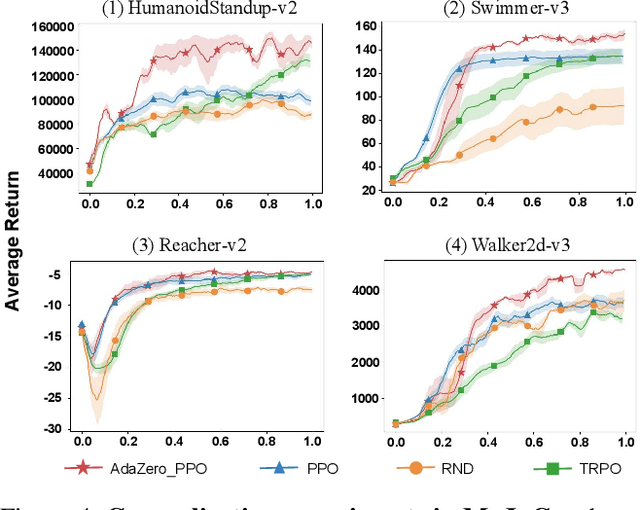
The imbalance of exploration and exploitation has long been a significant challenge in reinforcement learning. In policy optimization, excessive reliance on exploration reduces learning efficiency, while over-dependence on exploitation might trap agents in local optima. This paper revisits the exploration-exploitation dilemma from the perspective of entropy by revealing the relationship between entropy and the dynamic adaptive process of exploration and exploitation. Based on this theoretical insight, we establish an end-to-end adaptive framework called AdaZero, which automatically determines whether to explore or to exploit as well as their balance of strength. Experiments show that AdaZero significantly outperforms baseline models across various Atari and MuJoCo environments with only a single setting. Especially in the challenging environment of Montezuma, AdaZero boosts the final returns by up to fifteen times. Moreover, we conduct a series of visualization analyses to reveal the dynamics of our self-adaptive mechanism, demonstrating how entropy reflects and changes with respect to the agent's performance and adaptive process.
Roadmap to Neuromorphic Computing with Emerging Technologies
Jul 02, 2024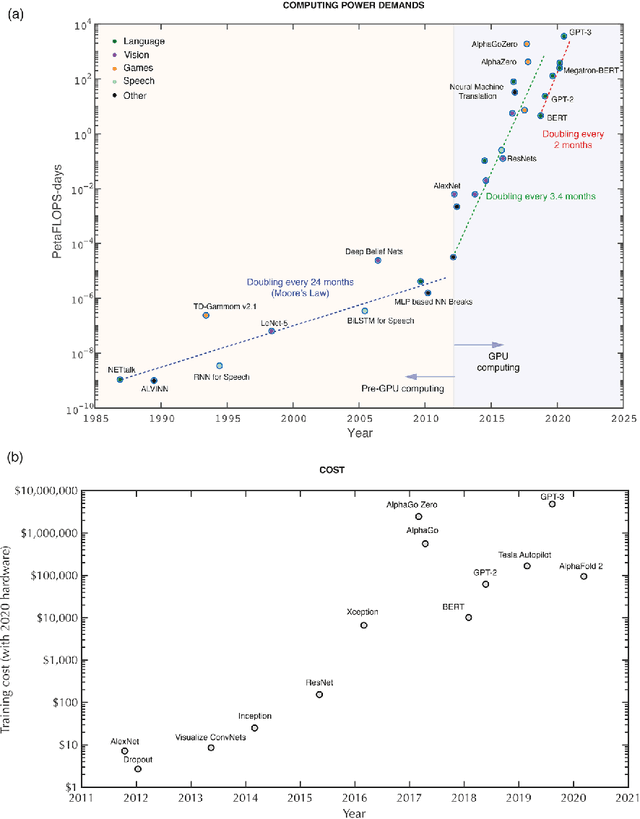


The roadmap is organized into several thematic sections, outlining current computing challenges, discussing the neuromorphic computing approach, analyzing mature and currently utilized technologies, providing an overview of emerging technologies, addressing material challenges, exploring novel computing concepts, and finally examining the maturity level of emerging technologies while determining the next essential steps for their advancement.