 Add to Chrome
 Add to Firefox
 Add to Edge
Explore or Converge? Stage-Guided Per-Step Optimization for Diffusion Models
Aug 07, 2026
Diffusion models have strong generative capabilities. However, their maximum likelihood training objective only focuses on reconstructing the data distribution, making it difficult to align with specific preferences. Reinforcement learning (RL) for preference alignment in diffusion models is promising but limited by reward sparsity. Since a single reward cannot support optimization, existing RL methods usually backpropagate the final reward to all previous steps. However, denoising is stage-wise, with distinct semantics and controllability. Repeating the final reward across all steps creates a temporal objective mismatch, encouraging reward shortcuts that lead to reward hacking. At the same time, due to reward backfilling, each time step receives the same reward, making it impossible to distinguish between actions, thereby weakening the optimization process. To resolve this issue, we propose Stage-Guided Per-Step Optimization (SGPO) for diffusion models, which jointly leverages signal-to-noise ratio and semantic changes to identify generation stages and adaptively assign stage-specific objectives. Early denoising is chaotic and far from the final reward, resulting in weak reward-behavior correlation. This stage should prioritize exiting the chaotic state. In the mid stage, the latent transitions to a stable structure, where the final reward better corresponds to generative behavior. Therefore, this stage optimizes the final reward while exploring diversity to avoid early convergence to a single mode. In the late stage, the latent's core structure is largely fixed, and preference optimization mainly amplifies local details, risking overfitting. Therefore, stable convergence is preferred to avoid quality degradation. Results from 16 comparative experiments validate SGPO. Our method achieves 26.7% average gains in generative quality and 36.7% higher convergence speed.

PAST: Prompt-Adaptive Sampling Termination for Efficient Diffusion Model
Aug 07, 2026While diffusion models have made significant progress in text-to-image tasks, they still exhibit limitations when directly optimizing downstream objectives. Although Reinforcement Learning (RL) enables targeted optimization, existing methods are generally constrained by low-efficiency fine-tuning and sparse rewards. To address these challenges, we propose PAST, which provides differentiated rewards while adaptively regulating training episode length by jointly perceiving denoising progress and prompt difficulty. Specifically, we design an intrinsic reward paradigm to compensate for sparse extrinsic rewards and guide the model to explore paths that diverge more efficiently from noise patterns. We further provide theoretical justification for intrinsic rewards. Then, PAST dynamically monitors denoising completion and semantic alignment between image structures and prompt semantics. When both metrics satisfy generation requirements, the system adaptively terminates training. This enables appropriate allocation of episode lengths based on prompt difficulty and the current generation process. Finally, based on the predicted residual noise level, we establish a dual adaptive coordination mechanism. Specifically, it not only balances the extrinsic and intrinsic rewards but also balances the exploration and convergence. Experimental results demonstrate that PAST enhances computational efficiency of existing RL fine-tuning methods by up to 66.7%, while improving preference optimization quality by up to 29.5% through its dual adaptive regulation mechanism.
GenTrack: Physical Alignment for Robot-Native Motion Generation and Zero-Shot Humanoid Tracking
Aug 02, 2026General-purpose humanoid trackers can execute diverse references, but their zero-shot coverage depends on large embodied corpora that are costly to extend. Text-to-motion generators offer scalable supervision, yet models trained on human motion or retargeted data inherit a gap between kinematic plausibility and robot executability. Existing one-way pipelines fix either the generated corpus or the reward tracker. We introduce GenTrack, an online generator--tracker framework that alternates execution-grounded, group-relative generator alignment with tracker training on newly generated references; anchoring and rehearsal constrain drift. On Unitree G1, we evaluate GenTrack with ProtoMotions and SONIC backbones across three zero-shot tracking splits including public AMASS and LAFAN benchmarks, and a private out-of-distribution test set of 1,024 prompt-motion pairs in the wild. The online co-training strategy consistently produces generators that output more robot-executable motions with strong semantic alignment, and trackers with markedly broader zero-shot coverage and improved tracking accuracy, especially on out-of-distribution references. These results demonstrate that joint online post-training effectively narrows the executability gap between retargeted references and robot-native motion, advancing zero-shot humanoid control without additional data collection and beyond the limitations of a static reference pool.
VideoCoCo: Code-as-CoT for Physically-Consistent Video Generation via an Agentic Dual-Engine System
Jul 29, 2026Text-to-video models have achieved remarkable visual quality, yet they still struggle to generate physically consistent dynamics because the temporal evolution of a scene must be inferred implicitly from a highly compressed text prompt. Existing chain-of-thought approaches introduce intermediate plans or visual states, but these representations are typically non-executable or temporally sparse, limiting their ability to instantiate and control the complete spatiotemporal process. To address this limitation, we introduce VideoCoCo, an agentic dual-engine framework in which executable Blender code serves as a process-level chain of thought. Given a text prompt, a coding agent synthesizes a Blender program that explicitly specifies the scene and its temporal evolution. The executable simulation engine runs the program to produce a deterministic spatiotemporal draft, which is subsequently transformed into a photorealistic video by a generative video engine through draft-conditioned editing. This decomposition separates process-level reasoning from high-fidelity visual realization. To adapt the video editor to simulated drafts, we construct VideoCoCo-3K, a curated dataset of draft-instruction-target triplets. VideoCoCo improves the OmniWeaving baseline from 0.475 to 0.558 on PhyGenBench and from 52.18 to 77.88 on VBench-2.0, achieving the best average score on both benchmarks. These results demonstrate that executable code provides an effective, controllable, and inspectable intermediate representation for physically consistent video generation.
Pixel-Space Diffusion Transformers
Jul 20, 2026Latent diffusion models (LDMs) enable efficient high-resolution image synthesis by denoising in a VAE-compressed latent space. However, fixed visual tokenizers can discard fine textures and structural details, while separate representation and diffusion training creates a mismatch between reconstruction and generation objectives. These limitations have renewed interest in pixel-space diffusion, which models raw pixels directly, removes the VAE bottleneck, and supports end-to-end optimization. This formulation better matches the demands of high-fidelity generation but introduces challenges in high-dimensional modeling, including noise scheduling, loss weighting, token efficiency, and scalable architecture design. Pixel-space modeling also offers a promising basis for unified multimodal systems: raw pixels, text, and task conditions can be represented in a shared token space and jointly processed by a single Transformer, narrowing the gap between visual understanding and generation. This paper reviews Pixel-Space Diffusion Transformers (pDiTs) from the perspectives of model architecture, continuous generative mechanisms, and unified multimodal modeling. We summarize representative methods, identify key technical challenges, and discuss future directions toward high-fidelity, end-to-end vision foundation models that integrate generation and understanding.
InfoDense: Density-Aware Regional Decisive Replay for Memory-Efficient Incremental Face Forgery Detection
Jul 18, 2026The rapid evolution of face forgery techniques has introduced an increasing variety of manipulations. Incremental Face Forgery Detection (IFFD), which incrementally adds new forgery data to fine-tune previously trained models, has emerged as a promising approach to handle evolving forgery threats. However, conventional replay-based IFFD methods suffer from catastrophic forgetting. Storing full historical images under limited memory often either fails to preserve subtle forgery cues or introduces domain bias, reducing the model's ability to learn intrinsic and transferable manipulation characteristics. In this paper, we propose a Density-Aware Regional Decisive replay strategy, termed InfoDense, to address these challenges. InfoDense prioritizes artifact-dense and forgery-critical regions, significantly reducing storage requirements while maintaining high-fidelity forgery evidence. We first introduce InfoDense Cut to localize decisive patches using CLIP-based embeddings. Then, InfoDense Select ranks candidate segments by combining latent-space representativeness and decisive patch counts, ensuring both diversity and information density in the replay buffer. Finally, InfoDense Fuse reconstructs unbiased training inputs by adaptively merging stored segments with current-task samples, enhancing knowledge retention and generalization. Extensive experiments on challenging incremental deepfake benchmarks demonstrate that InfoDense effectively mitigates catastrophic forgetting while improving cross-domain generalization.
AdaMemento: Adaptive Memory-Assisted Policy Optimization for Reinforcement Learning
Oct 06, 2024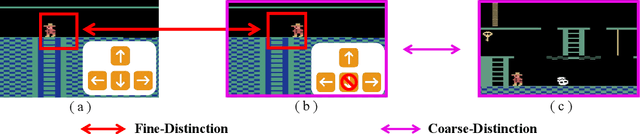
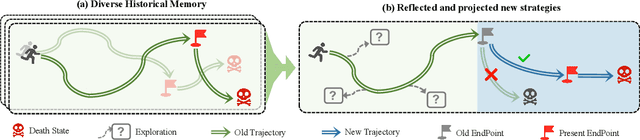
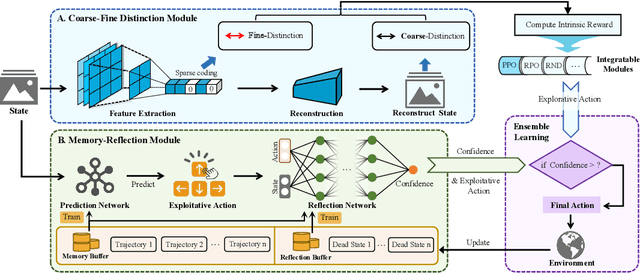
In sparse reward scenarios of reinforcement learning (RL), the memory mechanism provides promising shortcuts to policy optimization by reflecting on past experiences like humans. However, current memory-based RL methods simply store and reuse high-value policies, lacking a deeper refining and filtering of diverse past experiences and hence limiting the capability of memory. In this paper, we propose AdaMemento, an adaptive memory-enhanced RL framework. Instead of just memorizing positive past experiences, we design a memory-reflection module that exploits both positive and negative experiences by learning to predict known local optimal policies based on real-time states. To effectively gather informative trajectories for the memory, we further introduce a fine-grained intrinsic motivation paradigm, where nuances in similar states can be precisely distinguished to guide exploration. The exploitation of past experiences and exploration of new policies are then adaptively coordinated by ensemble learning to approach the global optimum. Furthermore, we theoretically prove the superiority of our new intrinsic motivation and ensemble mechanism. From 59 quantitative and visualization experiments, we confirm that AdaMemento can distinguish subtle states for better exploration and effectively exploiting past experiences in memory, achieving significant improvement over previous methods.
CopyLens: Dynamically Flagging Copyrighted Sub-Dataset Contributions to LLM Outputs
Oct 06, 2024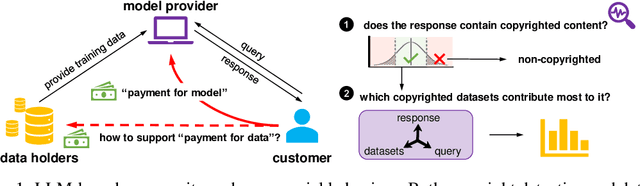
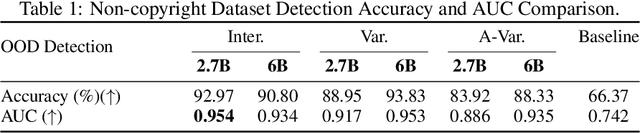
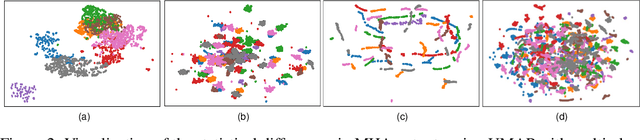
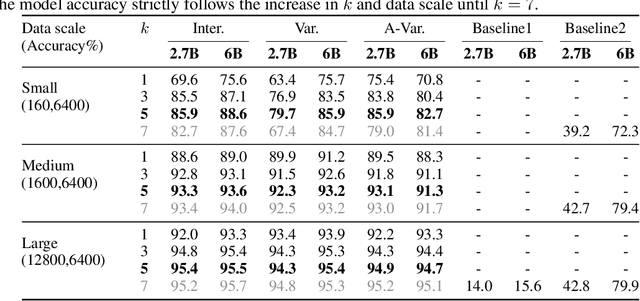
Large Language Models (LLMs) have become pervasive due to their knowledge absorption and text-generation capabilities. Concurrently, the copyright issue for pretraining datasets has been a pressing concern, particularly when generation includes specific styles. Previous methods either focus on the defense of identical copyrighted outputs or find interpretability by individual tokens with computational burdens. However, the gap between them exists, where direct assessments of how dataset contributions impact LLM outputs are missing. Once the model providers ensure copyright protection for data holders, a more mature LLM community can be established. To address these limitations, we introduce CopyLens, a new framework to analyze how copyrighted datasets may influence LLM responses. Specifically, a two-stage approach is employed: First, based on the uniqueness of pretraining data in the embedding space, token representations are initially fused for potential copyrighted texts, followed by a lightweight LSTM-based network to analyze dataset contributions. With such a prior, a contrastive-learning-based non-copyright OOD detector is designed. Our framework can dynamically face different situations and bridge the gap between current copyright detection methods. Experiments show that CopyLens improves efficiency and accuracy by 15.2% over our proposed baseline, 58.7% over prompt engineering methods, and 0.21 AUC over OOD detection baselines.
The Exploration-Exploitation Dilemma Revisited: An Entropy Perspective
Aug 19, 2024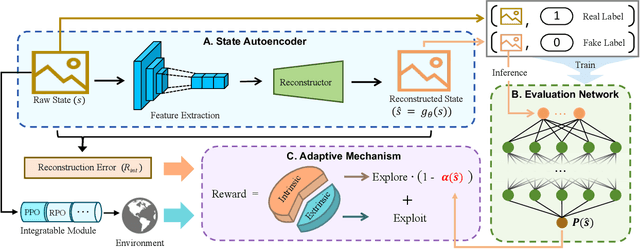
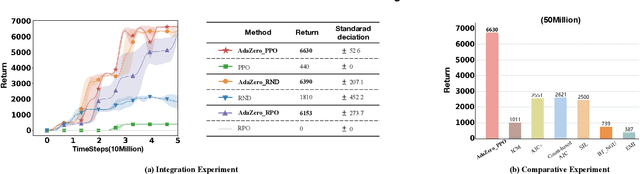
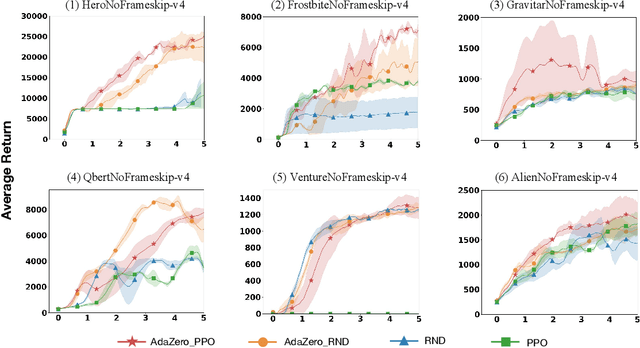
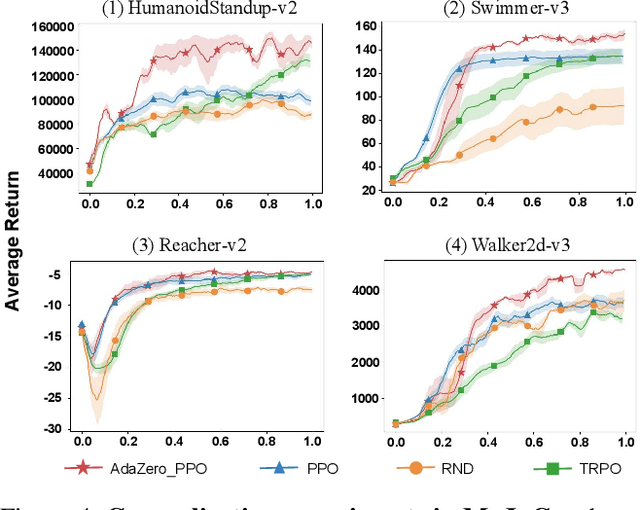
The imbalance of exploration and exploitation has long been a significant challenge in reinforcement learning. In policy optimization, excessive reliance on exploration reduces learning efficiency, while over-dependence on exploitation might trap agents in local optima. This paper revisits the exploration-exploitation dilemma from the perspective of entropy by revealing the relationship between entropy and the dynamic adaptive process of exploration and exploitation. Based on this theoretical insight, we establish an end-to-end adaptive framework called AdaZero, which automatically determines whether to explore or to exploit as well as their balance of strength. Experiments show that AdaZero significantly outperforms baseline models across various Atari and MuJoCo environments with only a single setting. Especially in the challenging environment of Montezuma, AdaZero boosts the final returns by up to fifteen times. Moreover, we conduct a series of visualization analyses to reveal the dynamics of our self-adaptive mechanism, demonstrating how entropy reflects and changes with respect to the agent's performance and adaptive process.
Transductive Off-policy Proximal Policy Optimization
Jun 06, 2024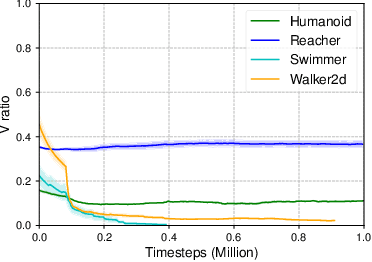
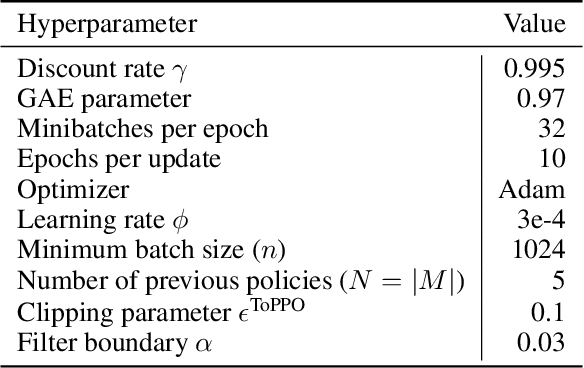
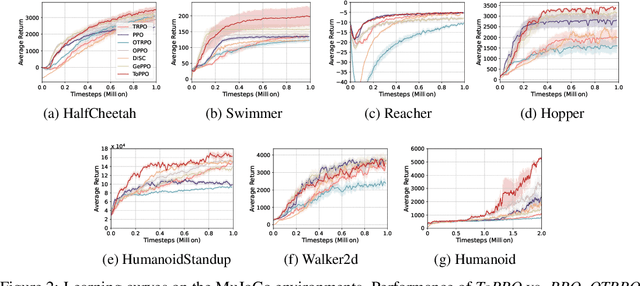
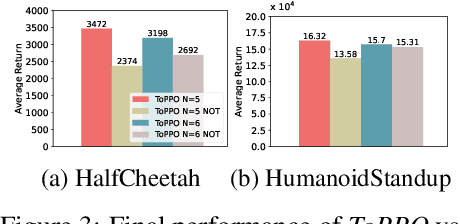
Proximal Policy Optimization (PPO) is a popular model-free reinforcement learning algorithm, esteemed for its simplicity and efficacy. However, due to its inherent on-policy nature, its proficiency in harnessing data from disparate policies is constrained. This paper introduces a novel off-policy extension to the original PPO method, christened Transductive Off-policy PPO (ToPPO). Herein, we provide theoretical justification for incorporating off-policy data in PPO training and prudent guidelines for its safe application. Our contribution includes a novel formulation of the policy improvement lower bound for prospective policies derived from off-policy data, accompanied by a computationally efficient mechanism to optimize this bound, underpinned by assurances of monotonic improvement. Comprehensive experimental results across six representative tasks underscore ToPPO's promising performance.