 Add to Chrome
 Add to Firefox
 Add to Edge
Exploiting Vulnerabilities in Speech Translation Systems through Targeted Adversarial Attacks
Mar 05, 2025
As speech translation (ST) systems become increasingly prevalent, understanding their vulnerabilities is crucial for ensuring robust and reliable communication. However, limited work has explored this issue in depth. This paper explores methods of compromising these systems through imperceptible audio manipulations. Specifically, we present two innovative approaches: (1) the injection of perturbation into source audio, and (2) the generation of adversarial music designed to guide targeted translation, while also conducting more practical over-the-air attacks in the physical world. Our experiments reveal that carefully crafted audio perturbations can mislead translation models to produce targeted, harmful outputs, while adversarial music achieve this goal more covertly, exploiting the natural imperceptibility of music. These attacks prove effective across multiple languages and translation models, highlighting a systemic vulnerability in current ST architectures. The implications of this research extend beyond immediate security concerns, shedding light on the interpretability and robustness of neural speech processing systems. Our findings underscore the need for advanced defense mechanisms and more resilient architectures in the realm of audio systems. More details and samples can be found at https://adv-st.github.io.

RelaCtrl: Relevance-Guided Efficient Control for Diffusion Transformers
Feb 21, 2025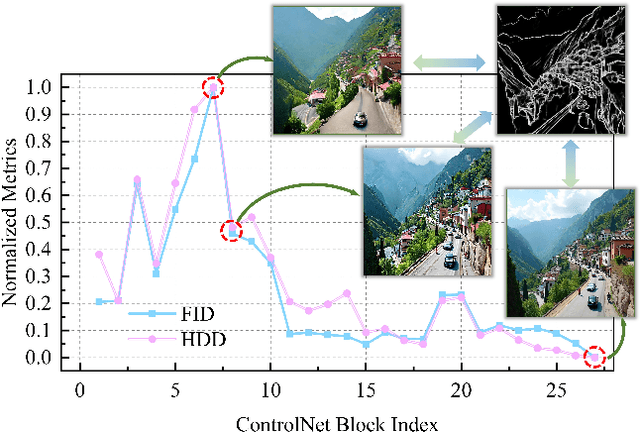
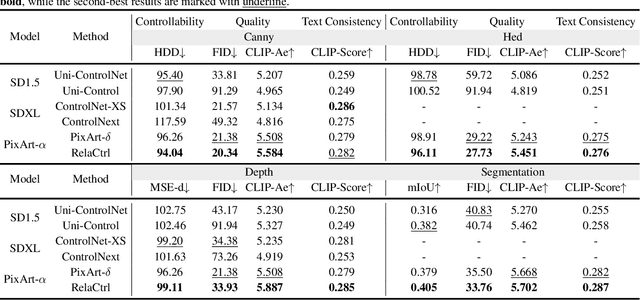
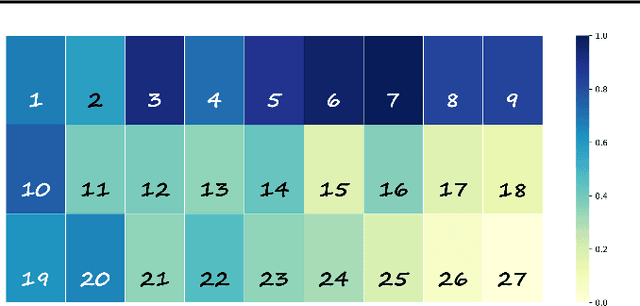
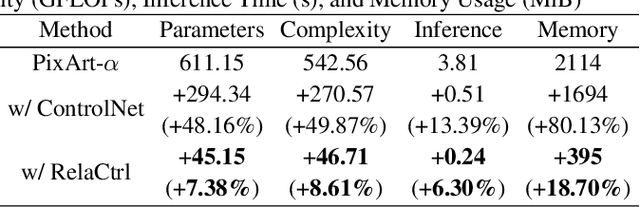
The Diffusion Transformer plays a pivotal role in advancing text-to-image and text-to-video generation, owing primarily to its inherent scalability. However, existing controlled diffusion transformer methods incur significant parameter and computational overheads and suffer from inefficient resource allocation due to their failure to account for the varying relevance of control information across different transformer layers. To address this, we propose the Relevance-Guided Efficient Controllable Generation framework, RelaCtrl, enabling efficient and resource-optimized integration of control signals into the Diffusion Transformer. First, we evaluate the relevance of each layer in the Diffusion Transformer to the control information by assessing the "ControlNet Relevance Score"-i.e., the impact of skipping each control layer on both the quality of generation and the control effectiveness during inference. Based on the strength of the relevance, we then tailor the positioning, parameter scale, and modeling capacity of the control layers to reduce unnecessary parameters and redundant computations. Additionally, to further improve efficiency, we replace the self-attention and FFN in the commonly used copy block with the carefully designed Two-Dimensional Shuffle Mixer (TDSM), enabling efficient implementation of both the token mixer and channel mixer. Both qualitative and quantitative experimental results demonstrate that our approach achieves superior performance with only 15% of the parameters and computational complexity compared to PixArt-delta.
CORBA: Contagious Recursive Blocking Attacks on Multi-Agent Systems Based on Large Language Models
Feb 20, 2025Large Language Model-based Multi-Agent Systems (LLM-MASs) have demonstrated remarkable real-world capabilities, effectively collaborating to complete complex tasks. While these systems are designed with safety mechanisms, such as rejecting harmful instructions through alignment, their security remains largely unexplored. This gap leaves LLM-MASs vulnerable to targeted disruptions. In this paper, we introduce Contagious Recursive Blocking Attacks (Corba), a novel and simple yet highly effective attack that disrupts interactions between agents within an LLM-MAS. Corba leverages two key properties: its contagious nature allows it to propagate across arbitrary network topologies, while its recursive property enables sustained depletion of computational resources. Notably, these blocking attacks often involve seemingly benign instructions, making them particularly challenging to mitigate using conventional alignment methods. We evaluate Corba on two widely-used LLM-MASs, namely, AutoGen and Camel across various topologies and commercial models. Additionally, we conduct more extensive experiments in open-ended interactive LLM-MASs, demonstrating the effectiveness of Corba in complex topology structures and open-source models. Our code is available at: https://github.com/zhrli324/Corba.
Does Training with Synthetic Data Truly Protect Privacy?
Feb 18, 2025As synthetic data becomes increasingly popular in machine learning tasks, numerous methods--without formal differential privacy guarantees--use synthetic data for training. These methods often claim, either explicitly or implicitly, to protect the privacy of the original training data. In this work, we explore four different training paradigms: coreset selection, dataset distillation, data-free knowledge distillation, and synthetic data generated from diffusion models. While all these methods utilize synthetic data for training, they lead to vastly different conclusions regarding privacy preservation. We caution that empirical approaches to preserving data privacy require careful and rigorous evaluation; otherwise, they risk providing a false sense of privacy.
Related Knowledge Perturbation Matters: Rethinking Multiple Pieces of Knowledge Editing in Same-Subject
Feb 08, 2025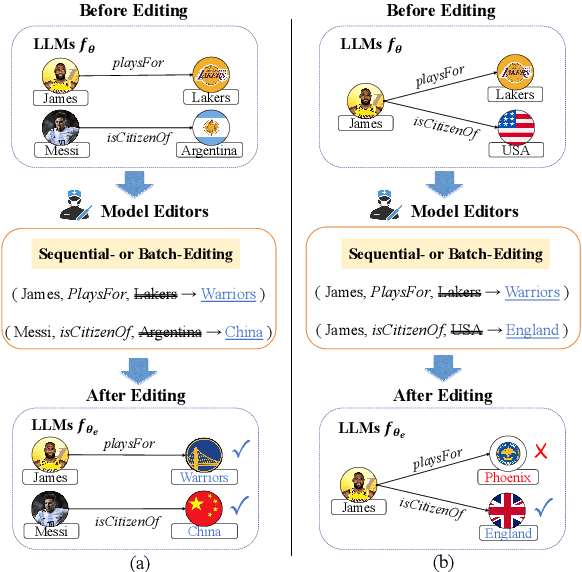
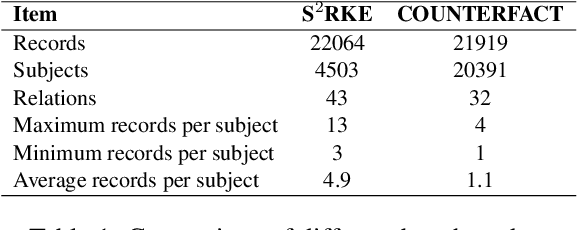

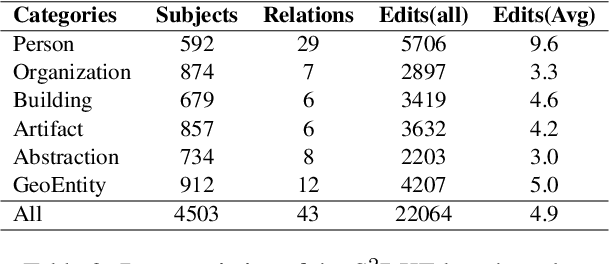
Knowledge editing has become a promising approach for efficiently and precisely updating knowledge embedded in large language models (LLMs). In this work, we focus on Same-Subject Editing, which involves modifying multiple attributes of a single entity to ensure comprehensive and consistent updates to entity-centric knowledge. Through preliminary observation, we identify a significant challenge: Current state-of-the-art editing methods struggle when tasked with editing multiple related knowledge pieces for the same subject. To address the lack of relevant editing data for identical subjects in traditional benchmarks, we introduce the $\text{S}^2\text{RKE}$(Same-Subject Related Knowledge Editing) benchmark. Our extensive experiments reveal that only mainstream locate-then-edit methods, such as ROME and MEMIT, exhibit "related knowledge perturbation," where subsequent edits interfere with earlier ones. Further analysis reveals that these methods over-rely on subject information, neglecting other critical factors, resulting in reduced editing effectiveness.
Adversarial ML Problems Are Getting Harder to Solve and to Evaluate
Feb 04, 2025In the past decade, considerable research effort has been devoted to securing machine learning (ML) models that operate in adversarial settings. Yet, progress has been slow even for simple "toy" problems (e.g., robustness to small adversarial perturbations) and is often hindered by non-rigorous evaluations. Today, adversarial ML research has shifted towards studying larger, general-purpose language models. In this position paper, we argue that the situation is now even worse: in the era of LLMs, the field of adversarial ML studies problems that are (1) less clearly defined, (2) harder to solve, and (3) even more challenging to evaluate. As a result, we caution that yet another decade of work on adversarial ML may fail to produce meaningful progress.
Picky LLMs and Unreliable RMs: An Empirical Study on Safety Alignment after Instruction Tuning
Feb 03, 2025Large language models (LLMs) have emerged as powerful tools for addressing a wide range of general inquiries and tasks. Despite this, fine-tuning aligned LLMs on smaller, domain-specific datasets, critical to adapting them to specialized tasks, can inadvertently degrade their safety alignment, even when the datasets are benign. This phenomenon makes models more susceptible to providing inappropriate responses. In this study, we systematically examine the factors contributing to safety alignment degradation in benign fine-tuning scenarios. Our analysis identifies three critical factors affecting aligned LLMs: answer structure, identity calibration, and role-play. Additionally, we evaluate the reliability of state-of-the-art reward models (RMs), which are often used to guide alignment processes. Our findings reveal that these RMs frequently fail to accurately reflect human preferences regarding safety, underscoring their limitations in practical applications. By uncovering these challenges, our work highlights the complexities of maintaining safety alignment during fine-tuning and offers guidance to help developers balance utility and safety in LLMs. Datasets and fine-tuning code used in our experiments can be found in https://github.com/GuanlinLee/llm_instruction_tuning.
Pre-train and Fine-tune: Recommenders as Large Models
Jan 24, 2025
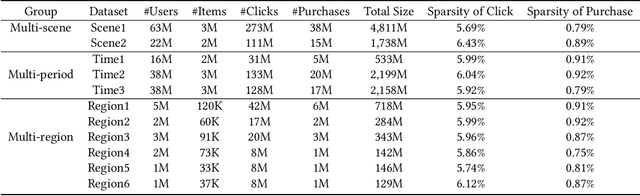
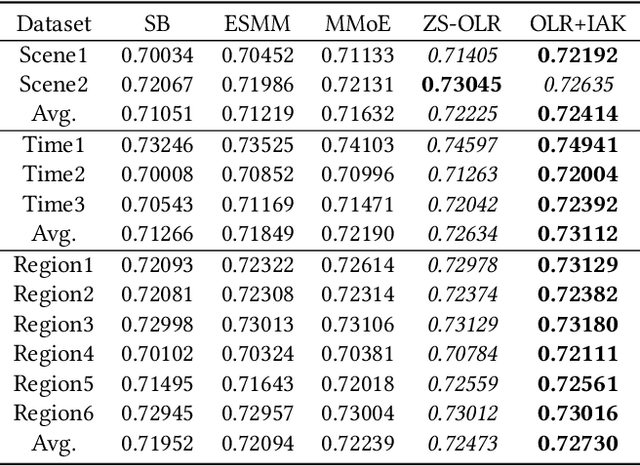
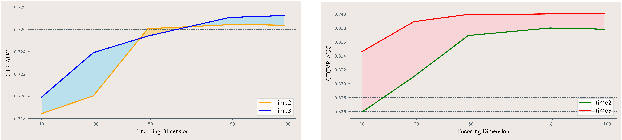
In reality, users have different interests in different periods, regions, scenes, etc. Such changes in interest are so drastic that they are difficult to be captured by recommenders. Existing multi-domain learning can alleviate this problem. However, the structure of the industrial recommendation system is complex, the amount of data is huge, and the training cost is extremely high, so it is difficult to modify the structure of the industrial recommender and re-train it. To fill this gap, we consider recommenders as large pre-trained models and fine-tune them. We first propose the theory of the information bottleneck for fine-tuning and present an explanation for the fine-tuning technique in recommenders. To tailor for recommendation, we design an information-aware adaptive kernel (IAK) technique to fine-tune the pre-trained recommender. Specifically, we define fine-tuning as two phases: knowledge compression and knowledge matching and let the training stage of IAK explicitly approximate these two phases. Our proposed approach designed from the essence of fine-tuning is well interpretable. Extensive online and offline experiments show the superiority of our proposed method. Besides, we also share unique and important lessons we learned when deploying the method in a large-scale online platform. We also present the potential issues of fine-tuning techniques in recommendation systems and the corresponding solutions. The recommender with IAK technique has been deployed on the homepage of a billion-scale online food platform for several months and has yielded considerable profits in our business.
VideoShield: Regulating Diffusion-based Video Generation Models via Watermarking
Jan 24, 2025


Artificial Intelligence Generated Content (AIGC) has advanced significantly, particularly with the development of video generation models such as text-to-video (T2V) models and image-to-video (I2V) models. However, like other AIGC types, video generation requires robust content control. A common approach is to embed watermarks, but most research has focused on images, with limited attention given to videos. Traditional methods, which embed watermarks frame-by-frame in a post-processing manner, often degrade video quality. In this paper, we propose VideoShield, a novel watermarking framework specifically designed for popular diffusion-based video generation models. Unlike post-processing methods, VideoShield embeds watermarks directly during video generation, eliminating the need for additional training. To ensure video integrity, we introduce a tamper localization feature that can detect changes both temporally (across frames) and spatially (within individual frames). Our method maps watermark bits to template bits, which are then used to generate watermarked noise during the denoising process. Using DDIM Inversion, we can reverse the video to its original watermarked noise, enabling straightforward watermark extraction. Additionally, template bits allow precise detection for potential temporal and spatial modification. Extensive experiments across various video models (both T2V and I2V models) demonstrate that our method effectively extracts watermarks and detects tamper without compromising video quality. Furthermore, we show that this approach is applicable to image generation models, enabling tamper detection in generated images as well. Codes and models are available at \href{https://github.com/hurunyi/VideoShield}{https://github.com/hurunyi/VideoShield}.
The First Indoor Pathloss Radio Map Prediction Challenge
Jan 23, 2025To encourage further research and to facilitate fair comparisons in the development of deep learning-based radio propagation models, in the less explored case of directional radio signal emissions in indoor propagation environments, we have launched the ICASSP 2025 First Indoor Pathloss Radio Map Prediction Challenge. This overview paper describes the indoor path loss prediction problem, the datasets used, the Challenge tasks, and the evaluation methodology. Finally, the results of the Challenge and a summary of the submitted methods are presented.