 Add to Chrome
 Add to Firefox
 Add to Edge
Pest-Thinker: Learning to Think and Reason like Entomologists via Reinforcement Learning
May 07, 2026
Pest-induced crop losses pose a major threat to global food security and sustainable agricultural development. While recent advances in Multimodal Large Language Models (MLLMs) have shown strong potential for visual understanding and smart agriculture, their direct application to pest recognition remains limited due to the domain's unique challenges such as high inter-species complexity, intra-species variability, and the scarcity of expert-annotated data. In this work, we introduce Pest-Thinker, a knowledge-driven reinforcement learning (RL) framework that enables MLLMs to reason over fine-grained pest morphology. We first construct two high-definition pest benchmarks, QFSD and AgriInsect, comprising diverse species and expert-annotated morphological traits. Leveraging these datasets, we synthesize Chain-of-Thought (CoT) reasoning trajectories to facilitate structured learning of pest-specific visual cues through Supervised Fine-Tuning (SFT). Subsequently, we employ Group Relative Policy Optimization (GRPO) with a novel feature reward that guides the model to focus on observable morphological evidence, assessed by an LLM-as-a-Judge strategy. Extensive experiments demonstrate that Pest-Thinker substantially improves both in-domain and out-of-domain morphological understanding, marking a step toward expert-level visual reasoning for intelligent agricultural pest analysis. The datasets and source code are available upon acceptance.

FedCVU: Federated Learning for Cross-View Video Understanding
Mar 23, 2026Federated learning (FL) has emerged as a promising paradigm for privacy-preserving multi-camera video understanding. However, applying FL to cross-view scenarios faces three major challenges: (i) heterogeneous viewpoints and backgrounds lead to highly non-IID client distributions and overfitting to view-specific patterns, (ii) local distribution biases cause misaligned representations that hinder consistent cross-view semantics, and (iii) large video architectures incur prohibitive communication overhead. To address these issues, we propose FedCVU, a federated framework with three components: VS-Norm, which preserves normalization parameters to handle view-specific statistics; CV-Align, a lightweight contrastive regularization module to improve cross-view representation alignment; and SLA, a selective layer aggregation strategy that reduces communication without sacrificing accuracy. Extensive experiments on action understanding and person re-identification tasks under a cross-view protocol demonstrate that FedCVU consistently boosts unseen-view accuracy while maintaining strong seen-view performance, outperforming state-of-the-art FL baselines and showing robustness to domain heterogeneity and communication constraints.
Cross-Scale Pansharpening via ScaleFormer and the PanScale Benchmark
Feb 28, 2026Pansharpening aims to generate high-resolution multi-spectral images by fusing the spatial detail of panchromatic images with the spectral richness of low-resolution MS data. However, most existing methods are evaluated under limited, low-resolution settings, limiting their generalization to real-world, high-resolution scenarios. To bridge this gap, we systematically investigate the data, algorithmic, and computational challenges of cross-scale pansharpening. We first introduce PanScale, the first large-scale, cross-scale pansharpening dataset, accompanied by PanScale-Bench, a comprehensive benchmark for evaluating generalization across varying resolutions and scales. To realize scale generalization, we propose ScaleFormer, a novel architecture designed for multi-scale pansharpening. ScaleFormer reframes generalization across image resolutions as generalization across sequence lengths: it tokenizes images into patch sequences of the same resolution but variable length proportional to image scale. A Scale-Aware Patchify module enables training for such variations from fixed-size crops. ScaleFormer then decouples intra-patch spatial feature learning from inter-patch sequential dependency modeling, incorporating Rotary Positional Encoding to enhance extrapolation to unseen scales. Extensive experiments show that our approach outperforms SOTA methods in fusion quality and cross-scale generalization. The datasets and source code are available upon acceptance.
MoFu: Scale-Aware Modulation and Fourier Fusion for Multi-Subject Video Generation
Dec 26, 2025Multi-subject video generation aims to synthesize videos from textual prompts and multiple reference images, ensuring that each subject preserves natural scale and visual fidelity. However, current methods face two challenges: scale inconsistency, where variations in subject size lead to unnatural generation, and permutation sensitivity, where the order of reference inputs causes subject distortion. In this paper, we propose MoFu, a unified framework that tackles both challenges. For scale inconsistency, we introduce Scale-Aware Modulation (SMO), an LLM-guided module that extracts implicit scale cues from the prompt and modulates features to ensure consistent subject sizes. To address permutation sensitivity, we present a simple yet effective Fourier Fusion strategy that processes the frequency information of reference features via the Fast Fourier Transform to produce a unified representation. Besides, we design a Scale-Permutation Stability Loss to jointly encourage scale-consistent and permutation-invariant generation. To further evaluate these challenges, we establish a dedicated benchmark with controlled variations in subject scale and reference permutation. Extensive experiments demonstrate that MoFu significantly outperforms existing methods in preserving natural scale, subject fidelity, and overall visual quality.
Self-supervised Multiplex Consensus Mamba for General Image Fusion
Dec 24, 2025Image fusion integrates complementary information from different modalities to generate high-quality fused images, thereby enhancing downstream tasks such as object detection and semantic segmentation. Unlike task-specific techniques that primarily focus on consolidating inter-modal information, general image fusion needs to address a wide range of tasks while improving performance without increasing complexity. To achieve this, we propose SMC-Mamba, a Self-supervised Multiplex Consensus Mamba framework for general image fusion. Specifically, the Modality-Agnostic Feature Enhancement (MAFE) module preserves fine details through adaptive gating and enhances global representations via spatial-channel and frequency-rotational scanning. The Multiplex Consensus Cross-modal Mamba (MCCM) module enables dynamic collaboration among experts, reaching a consensus to efficiently integrate complementary information from multiple modalities. The cross-modal scanning within MCCM further strengthens feature interactions across modalities, facilitating seamless integration of critical information from both sources. Additionally, we introduce a Bi-level Self-supervised Contrastive Learning Loss (BSCL), which preserves high-frequency information without increasing computational overhead while simultaneously boosting performance in downstream tasks. Extensive experiments demonstrate that our approach outperforms state-of-the-art (SOTA) image fusion algorithms in tasks such as infrared-visible, medical, multi-focus, and multi-exposure fusion, as well as downstream visual tasks.
Active Intelligence in Video Avatars via Closed-loop World Modeling
Dec 23, 2025Current video avatar generation methods excel at identity preservation and motion alignment but lack genuine agency, they cannot autonomously pursue long-term goals through adaptive environmental interaction. We address this by introducing L-IVA (Long-horizon Interactive Visual Avatar), a task and benchmark for evaluating goal-directed planning in stochastic generative environments, and ORCA (Online Reasoning and Cognitive Architecture), the first framework enabling active intelligence in video avatars. ORCA embodies Internal World Model (IWM) capabilities through two key innovations: (1) a closed-loop OTAR cycle (Observe-Think-Act-Reflect) that maintains robust state tracking under generative uncertainty by continuously verifying predicted outcomes against actual generations, and (2) a hierarchical dual-system architecture where System 2 performs strategic reasoning with state prediction while System 1 translates abstract plans into precise, model-specific action captions. By formulating avatar control as a POMDP and implementing continuous belief updating with outcome verification, ORCA enables autonomous multi-step task completion in open-domain scenarios. Extensive experiments demonstrate that ORCA significantly outperforms open-loop and non-reflective baselines in task success rate and behavioral coherence, validating our IWM-inspired design for advancing video avatar intelligence from passive animation to active, goal-oriented behavior.
Lay2Story: Extending Diffusion Transformers for Layout-Togglable Story Generation
Aug 12, 2025Storytelling tasks involving generating consistent subjects have gained significant attention recently. However, existing methods, whether training-free or training-based, continue to face challenges in maintaining subject consistency due to the lack of fine-grained guidance and inter-frame interaction. Additionally, the scarcity of high-quality data in this field makes it difficult to precisely control storytelling tasks, including the subject's position, appearance, clothing, expression, and posture, thereby hindering further advancements. In this paper, we demonstrate that layout conditions, such as the subject's position and detailed attributes, effectively facilitate fine-grained interactions between frames. This not only strengthens the consistency of the generated frame sequence but also allows for precise control over the subject's position, appearance, and other key details. Building on this, we introduce an advanced storytelling task: Layout-Togglable Storytelling, which enables precise subject control by incorporating layout conditions. To address the lack of high-quality datasets with layout annotations for this task, we develop Lay2Story-1M, which contains over 1 million 720p and higher-resolution images, processed from approximately 11,300 hours of cartoon videos. Building on Lay2Story-1M, we create Lay2Story-Bench, a benchmark with 3,000 prompts designed to evaluate the performance of different methods on this task. Furthermore, we propose Lay2Story, a robust framework based on the Diffusion Transformers (DiTs) architecture for Layout-Togglable Storytelling tasks. Through both qualitative and quantitative experiments, we find that our method outperforms the previous state-of-the-art (SOTA) techniques, achieving the best results in terms of consistency, semantic correlation, and aesthetic quality.
Distilling Textual Priors from LLM to Efficient Image Fusion
Apr 09, 2025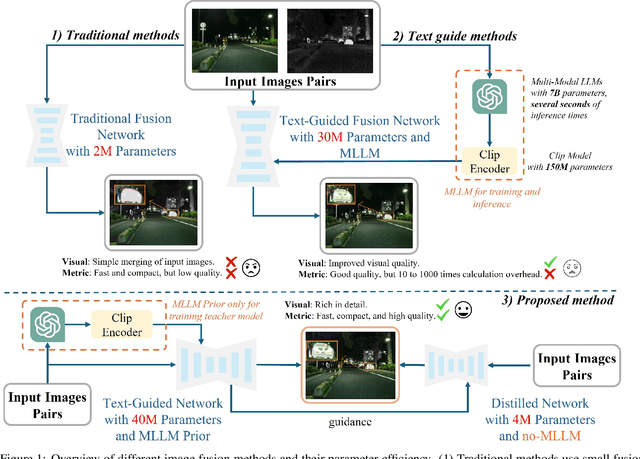
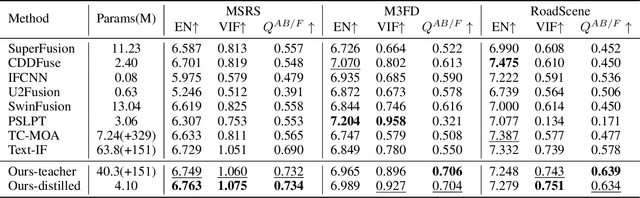
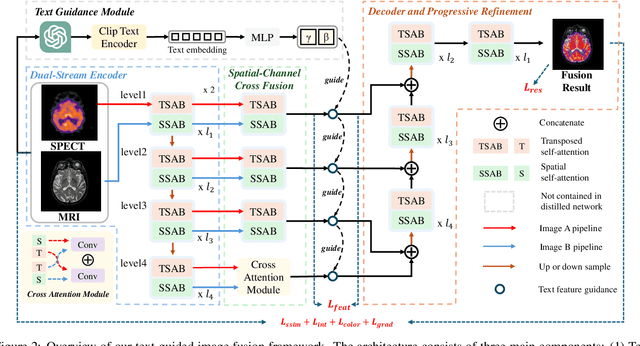
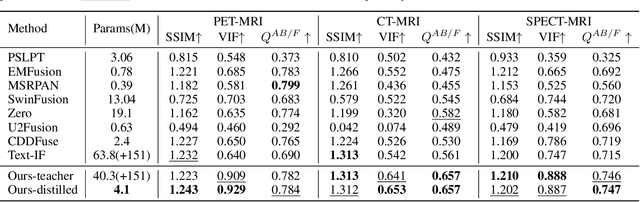
Multi-modality image fusion aims to synthesize a single, comprehensive image from multiple source inputs. Traditional approaches, such as CNNs and GANs, offer efficiency but struggle to handle low-quality or complex inputs. Recent advances in text-guided methods leverage large model priors to overcome these limitations, but at the cost of significant computational overhead, both in memory and inference time. To address this challenge, we propose a novel framework for distilling large model priors, eliminating the need for text guidance during inference while dramatically reducing model size. Our framework utilizes a teacher-student architecture, where the teacher network incorporates large model priors and transfers this knowledge to a smaller student network via a tailored distillation process. Additionally, we introduce spatial-channel cross-fusion module to enhance the model's ability to leverage textual priors across both spatial and channel dimensions. Our method achieves a favorable trade-off between computational efficiency and fusion quality. The distilled network, requiring only 10\% of the parameters and inference time of the teacher network, retains 90\% of its performance and outperforms existing SOTA methods. Extensive experiments demonstrate the effectiveness of our approach. The implementation will be made publicly available as an open-source resource.
WISA: World Simulator Assistant for Physics-Aware Text-to-Video Generation
Mar 11, 2025Recent rapid advancements in text-to-video (T2V) generation, such as SoRA and Kling, have shown great potential for building world simulators. However, current T2V models struggle to grasp abstract physical principles and generate videos that adhere to physical laws. This challenge arises primarily from a lack of clear guidance on physical information due to a significant gap between abstract physical principles and generation models. To this end, we introduce the World Simulator Assistant (WISA), an effective framework for decomposing and incorporating physical principles into T2V models. Specifically, WISA decomposes physical principles into textual physical descriptions, qualitative physical categories, and quantitative physical properties. To effectively embed these physical attributes into the generation process, WISA incorporates several key designs, including Mixture-of-Physical-Experts Attention (MoPA) and a Physical Classifier, enhancing the model's physics awareness. Furthermore, most existing datasets feature videos where physical phenomena are either weakly represented or entangled with multiple co-occurring processes, limiting their suitability as dedicated resources for learning explicit physical principles. We propose a novel video dataset, WISA-32K, collected based on qualitative physical categories. It consists of 32,000 videos, representing 17 physical laws across three domains of physics: dynamics, thermodynamics, and optics. Experimental results demonstrate that WISA can effectively enhance the compatibility of T2V models with real-world physical laws, achieving a considerable improvement on the VideoPhy benchmark. The visual exhibitions of WISA and WISA-32K are available in the https://360cvgroup.github.io/WISA/.
U-StyDiT: Ultra-high Quality Artistic Style Transfer Using Diffusion Transformers
Mar 11, 2025Ultra-high quality artistic style transfer refers to repainting an ultra-high quality content image using the style information learned from the style image. Existing artistic style transfer methods can be categorized into style reconstruction-based and content-style disentanglement-based style transfer approaches. Although these methods can generate some artistic stylized images, they still exhibit obvious artifacts and disharmonious patterns, which hinder their ability to produce ultra-high quality artistic stylized images. To address these issues, we propose a novel artistic image style transfer method, U-StyDiT, which is built on transformer-based diffusion (DiT) and learns content-style disentanglement, generating ultra-high quality artistic stylized images. Specifically, we first design a Multi-view Style Modulator (MSM) to learn style information from a style image from local and global perspectives, conditioning U-StyDiT to generate stylized images with the learned style information. Then, we introduce a StyDiT Block to learn content and style conditions simultaneously from a style image. Additionally, we propose an ultra-high quality artistic image dataset, Aes4M, comprising 10 categories, each containing 400,000 style images. This dataset effectively solves the problem that the existing style transfer methods cannot produce high-quality artistic stylized images due to the size of the dataset and the quality of the images in the dataset. Finally, the extensive qualitative and quantitative experiments validate that our U-StyDiT can create higher quality stylized images compared to state-of-the-art artistic style transfer methods. To our knowledge, our proposed method is the first to address the generation of ultra-high quality stylized images using transformer-based diffusion.