 Add to Chrome
 Add to Firefox
 Add to Edge
SAM 2 in Robotic Surgery: An Empirical Evaluation for Robustness and Generalization in Surgical Video Segmentation
Aug 08, 2024
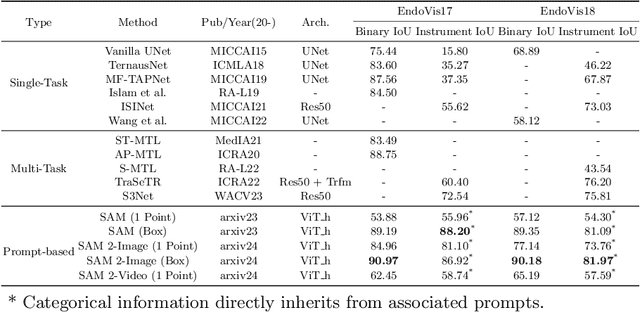
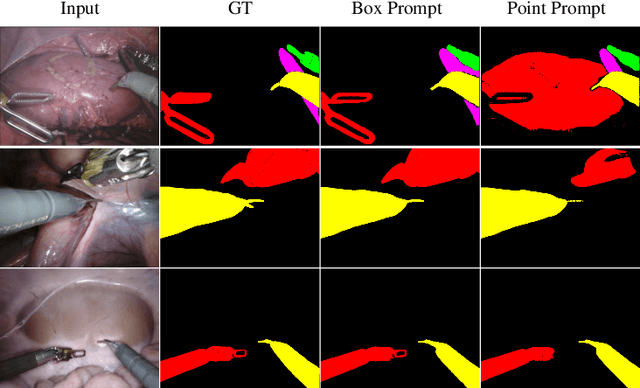

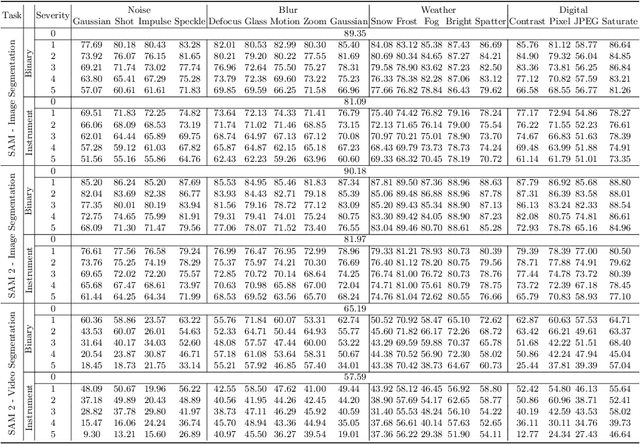
The recent Segment Anything Model (SAM) 2 has demonstrated remarkable foundational competence in semantic segmentation, with its memory mechanism and mask decoder further addressing challenges in video tracking and object occlusion, thereby achieving superior results in interactive segmentation for both images and videos. Building upon our previous empirical studies, we further explore the zero-shot segmentation performance of SAM 2 in robot-assisted surgery based on prompts, alongside its robustness against real-world corruption. For static images, we employ two forms of prompts: 1-point and bounding box, while for video sequences, the 1-point prompt is applied to the initial frame. Through extensive experimentation on the MICCAI EndoVis 2017 and EndoVis 2018 benchmarks, SAM 2, when utilizing bounding box prompts, outperforms state-of-the-art (SOTA) methods in comparative evaluations. The results with point prompts also exhibit a substantial enhancement over SAM's capabilities, nearing or even surpassing existing unprompted SOTA methodologies. Besides, SAM 2 demonstrates improved inference speed and less performance degradation against various image corruption. Although slightly unsatisfactory results remain in specific edges or regions, SAM 2's robust adaptability to 1-point prompts underscores its potential for downstream surgical tasks with limited prompt requirements.

The Llama 3 Herd of Models
Jul 31, 2024Modern artificial intelligence (AI) systems are powered by foundation models. This paper presents a new set of foundation models, called Llama 3. It is a herd of language models that natively support multilinguality, coding, reasoning, and tool usage. Our largest model is a dense Transformer with 405B parameters and a context window of up to 128K tokens. This paper presents an extensive empirical evaluation of Llama 3. We find that Llama 3 delivers comparable quality to leading language models such as GPT-4 on a plethora of tasks. We publicly release Llama 3, including pre-trained and post-trained versions of the 405B parameter language model and our Llama Guard 3 model for input and output safety. The paper also presents the results of experiments in which we integrate image, video, and speech capabilities into Llama 3 via a compositional approach. We observe this approach performs competitively with the state-of-the-art on image, video, and speech recognition tasks. The resulting models are not yet being broadly released as they are still under development.
Dual-stage Hyperspectral Image Classification Model with Spectral Supertoken
Jul 10, 2024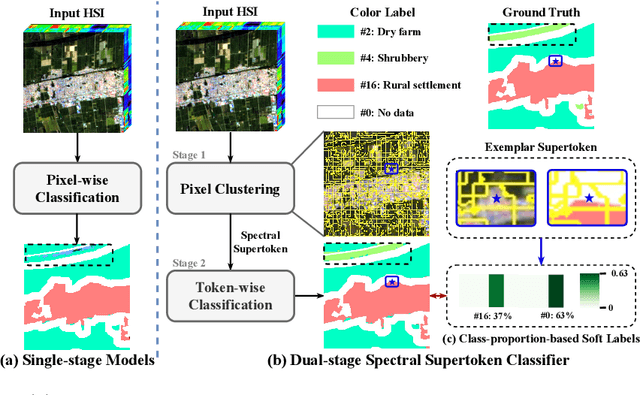
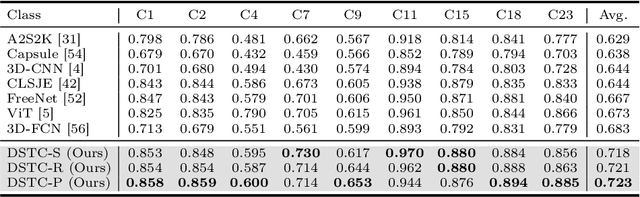
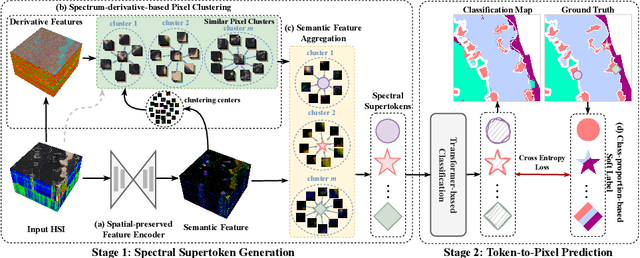
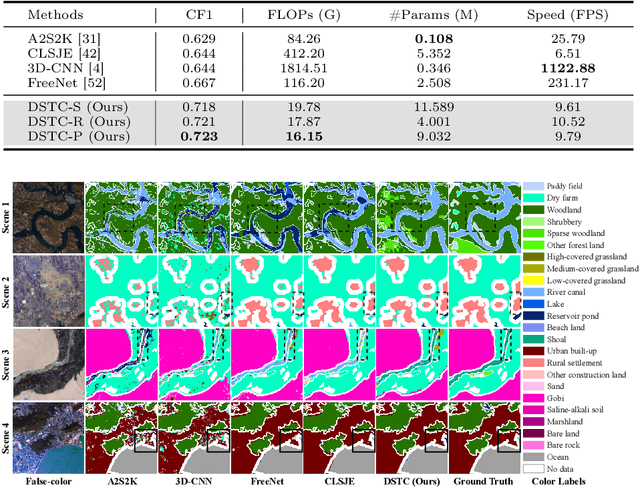
Hyperspectral image classification, a task that assigns pre-defined classes to each pixel in a hyperspectral image of remote sensing scenes, often faces challenges due to the neglect of correlations between spectrally similar pixels. This oversight can lead to inaccurate edge definitions and difficulties in managing minor spectral variations in contiguous areas. To address these issues, we introduce the novel Dual-stage Spectral Supertoken Classifier (DSTC), inspired by superpixel concepts. DSTC employs spectrum-derivative-based pixel clustering to group pixels with similar spectral characteristics into spectral supertokens. By projecting the classification of these tokens onto the image space, we achieve pixel-level results that maintain regional classification consistency and precise boundary. Moreover, recognizing the diversity within tokens, we propose a class-proportion-based soft label. This label adaptively assigns weights to different categories based on their prevalence, effectively managing data distribution imbalances and enhancing classification performance. Comprehensive experiments on WHU-OHS, IP, KSC, and UP datasets corroborate the robust classification capabilities of DSTC and the effectiveness of its individual components. Code will be publicly available at https://github.com/laprf/DSTC.
Foundations and Frontiers of Graph Learning Theory
Jul 03, 2024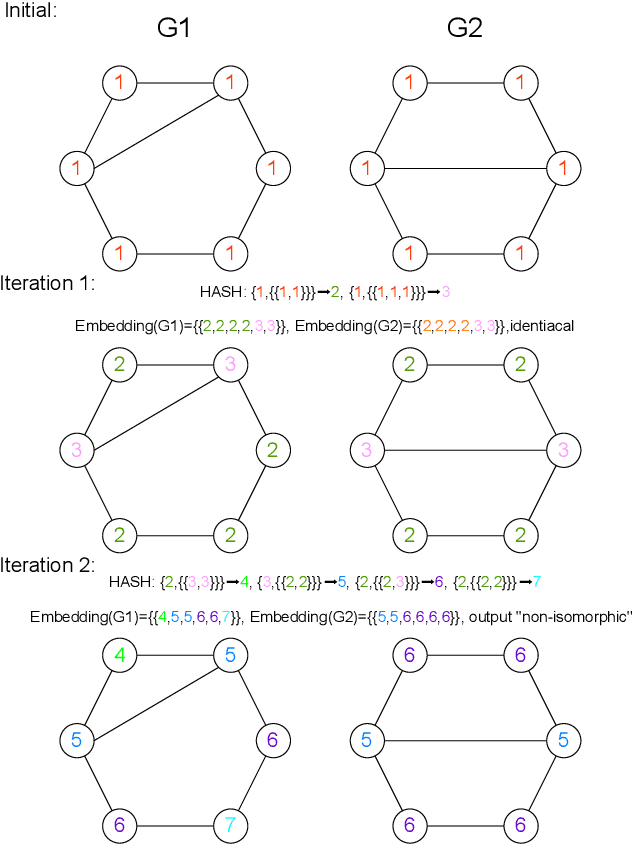


Recent advancements in graph learning have revolutionized the way to understand and analyze data with complex structures. Notably, Graph Neural Networks (GNNs), i.e. neural network architectures designed for learning graph representations, have become a popular paradigm. With these models being usually characterized by intuition-driven design or highly intricate components, placing them within the theoretical analysis framework to distill the core concepts, helps understand the key principles that drive the functionality better and guide further development. Given this surge in interest, this article provides a comprehensive summary of the theoretical foundations and breakthroughs concerning the approximation and learning behaviors intrinsic to prevalent graph learning models. Encompassing discussions on fundamental aspects such as expressiveness power, generalization, optimization, and unique phenomena such as over-smoothing and over-squashing, this piece delves into the theoretical foundations and frontier driving the evolution of graph learning. In addition, this article also presents several challenges and further initiates discussions on possible solutions.
Revisiting Interpolation Augmentation for Speech-to-Text Generation
Jun 22, 2024


Speech-to-text (S2T) generation systems frequently face challenges in low-resource scenarios, primarily due to the lack of extensive labeled datasets. One emerging solution is constructing virtual training samples by interpolating inputs and labels, which has notably enhanced system generalization in other domains. Despite its potential, this technique's application in S2T tasks has remained under-explored. In this paper, we delve into the utility of interpolation augmentation, guided by several pivotal questions. Our findings reveal that employing an appropriate strategy in interpolation augmentation significantly enhances performance across diverse tasks, architectures, and data scales, offering a promising avenue for more robust S2T systems in resource-constrained settings.
LLM-Oracle Machines
Jun 18, 2024Contemporary AI applications leverage large language models (LLMs) for their knowledge and inference capabilities in natural language processing tasks. This approach aligns with the concept of oracle Turing machines (OTMs). To capture the essence of these computations, including those desired but not yet in practice, we extend the notion of OTMs by employing a cluster of LLMs as the oracle. We present four variants: basic, augmented, fault-avoidance, and $\epsilon$-fault. The first two variants are commonly observed, whereas the latter two are specifically designed to ensure reliable outcomes by addressing LLM hallucinations, biases, and inconsistencies.
Deep Symbolic Optimization for Combinatorial Optimization: Accelerating Node Selection by Discovering Potential Heuristics
Jun 14, 2024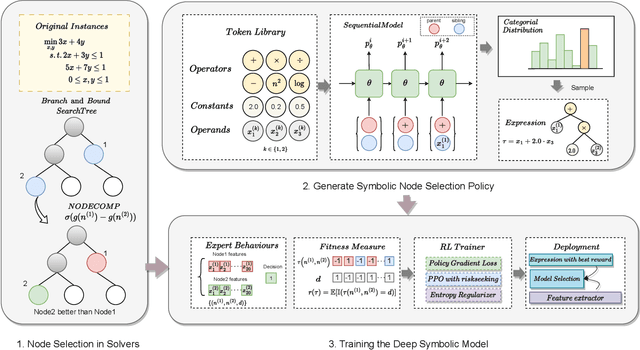
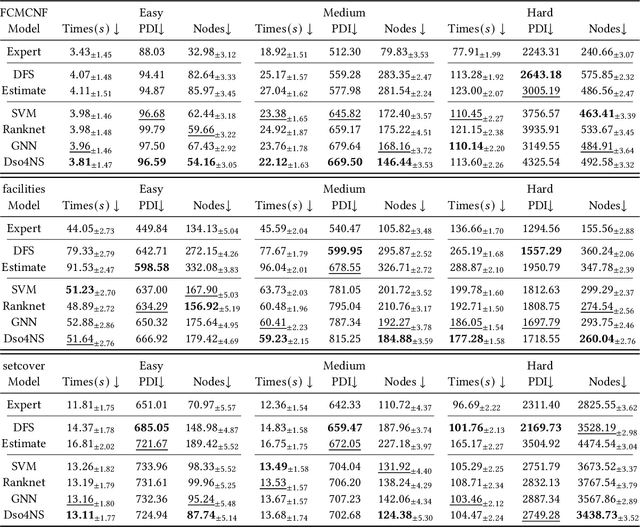
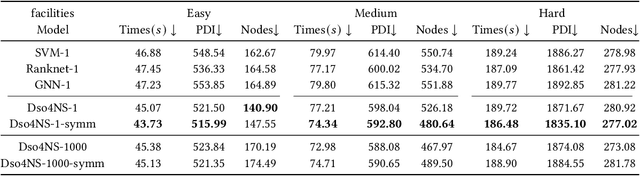
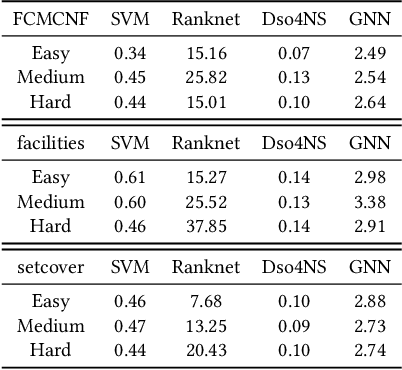
Combinatorial optimization (CO) is one of the most fundamental mathematical models in real-world applications. Traditional CO solvers, such as Branch-and-Bound (B&B) solvers, heavily rely on expert-designed heuristics, which are reliable but require substantial manual tuning. Recent studies have leveraged deep learning (DL) models as an alternative to capture rich feature patterns for improved performance on GPU machines. Nonetheless, the drawbacks of high training and inference costs, as well as limited interpretability, severely hinder the adoption of DL methods in real-world applications. To address these challenges, we propose a novel deep symbolic optimization learning framework that combines their advantages. Specifically, we focus on the node selection module within B&B solvers -- namely, deep symbolic optimization for node selection (Dso4NS). With data-driven approaches, Dso4NS guides the search for mathematical expressions within the high-dimensional discrete symbolic space and then incorporates the highest-performing mathematical expressions into a solver. The data-driven model captures the rich feature information in the input data and generates symbolic expressions, while the expressions deployed in solvers enable fast inference with high interpretability. Experiments demonstrate the effectiveness of Dso4NS in learning high-quality expressions, outperforming existing approaches on a CPU machine. Encouragingly, the learned CPU-based policies consistently achieve performance comparable to state-of-the-art GPU-based approaches.
CodeR: Issue Resolving with Multi-Agent and Task Graphs
Jun 03, 2024


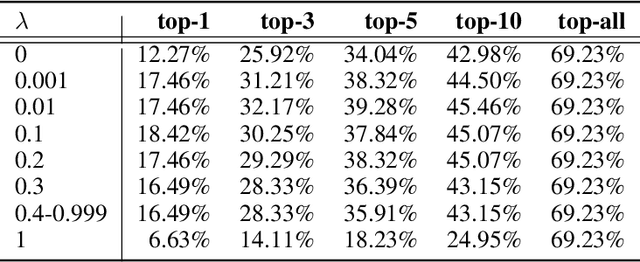
GitHub issue resolving recently has attracted significant attention from academia and industry. SWE-bench is proposed to measure the performance in resolving issues. In this paper, we propose CodeR, which adopts a multi-agent framework and pre-defined task graphs to Repair & Resolve reported bugs and add new features within code Repository. On SWE-bench lite, CodeR is able to solve 28.00% of issues, in the case of submitting only once for each issue. We examine the performance impact of each design of CodeR and offer insights to advance this research direction.
FUSU: A Multi-temporal-source Land Use Change Segmentation Dataset for Fine-grained Urban Semantic Understanding
May 29, 2024Fine urban change segmentation using multi-temporal remote sensing images is essential for understanding human-environment interactions. Despite advances in remote sensing data for urban monitoring, coarse-grained classification systems and the lack of continuous temporal observations hinder the application of deep learning to urban change analysis. To address this, we introduce FUSU, a multi-source, multi-temporal change segmentation dataset for fine-grained urban semantic understanding. FUSU features the most detailed land use classification system to date, with 17 classes and 30 billion pixels of annotations. It includes bi-temporal high-resolution satellite images with 20-50 cm ground sample distance and monthly optical and radar satellite time series, covering 847 km2 across five urban areas in China. The fine-grained pixel-wise annotations and high spatial-temporal resolution data provide a robust foundation for deep learning models to understand urbanization and land use changes. To fully leverage FUSU, we propose a unified time-series architecture for both change detection and segmentation and benchmark FUSU on various methods for several tasks. Dataset and code will be available at: https://github.com/yuanshuai0914/FUSU.
DF-SLAM: Neural Feature Rendering Based on Dictionary Factors Representation for High-Fidelity Dense Visual SLAM System
Apr 27, 2024We introduce a high-fidelity neural implicit dense visual Simultaneous Localization and Mapping (SLAM) system, termed DF-SLAM. In our work, we employ dictionary factors for scene representation, encoding the geometry and appearance information of the scene as a combination of basis and coefficient factors. Compared to neural implicit SLAM methods that directly encode scene information as features, our method exhibits superior scene detail reconstruction capabilities and more efficient memory usage, while our model size is insensitive to the size of the scene map, making our method more suitable for large-scale scenes. Additionally, we employ feature integration rendering to accelerate color rendering speed while ensuring color rendering quality, further enhancing the real-time performance of our neural SLAM method. Extensive experiments on synthetic and real-world datasets demonstrate that our method is competitive with existing state-of-the-art neural implicit SLAM methods in terms of real-time performance, localization accuracy, and scene reconstruction quality. Our source code is available at https://github.com/funcdecl/DF-SLAM.