 Add to Chrome
 Add to Firefox
 Add to Edge
ControlRef: Efficient Layout-Guided Multi-Instance Generation via Anchored 4D-RoPE
Aug 07, 2026
Layout-guided multi-instance generation is essential for controllable image synthesis in Multi-Modal Diffusion Transformers (MM-DiTs). However, integrating this capability into unified architectures remains challenging. Prior frameworks rely on redundant full-resolution canvas padding and Shifted-RoPE to manage multiple reference images. This mechanism drastically inflates computational overhead for sparse layouts and disrupts critical low-frequency RoPE features, creating a severe spatial-frequency compromise that blurs absolute spatial correspondence. To overcome these limitations, we propose ControlRef, a highly efficient and precise multi-instance synthesis framework. ControlRef utilizes a Unified Instance-Layout Control (UILC) attention mask to strictly decouple inter-instance semantic interactions and enforce precise regional binding. To further promote region-level spatial alignment, we introduce Anchored 4D-RoPE, a novel positional encoding mechanism that directly anchors tokens to their absolute geometric centers. By pre-aligning reference images to their corresponding bounding box resolutions, physically anchoring both layout and reference tokens to their absolute geometric centers, and stacking the references along the z-axis, Anchored 4D-RoPE natively preserves spatial priors and mitigates the spatial-frequency compromise without lossy shifting. Extensive experiments demonstrate that ControlRef achieves state-of-the-art visual fidelity and localization accuracy, while concurrently slashing inference latency by over 80% in sparse layouts and reducing memory overhead by 50% in dense scenarios.

UniEvo-RS: Omni-Prompt Unified Remote Sensing Segmentation with Representative Exemplar-Driven Prototype Evolution
Aug 04, 2026Prompt-driven vision-language models (VLMs) hold immense promise for accelerating dense remote sensing (RS) annotation, but static models suffer from severe performance degradation when deployed on novel scenes, unseen categories, or visually confusing backgrounds. Moreover, existing unified paradigms primarily rely on intra-image specific prompts, lacking flexible task routing to adapt to multi-intent operational workflows. In practical batch mapping, annotators typically refine a small set of representative samples before processing large datasets. Motivated by this practice, we propose UniEvo-RS, an omni-prompt unified RS segmentation framework equipped with representative exemplar-driven prototype evolution. First, we construct a multi-instruction prompt dataset that unifies text-driven and visual-driven prompts within a single architecture, establishing a dynamic task-routing mechanism for highly diverse RS annotation scenarios. Second, we introduce a representative feedback-driven, training-free prototype evolution mechanism. By contrasting manual annotations with initial predictions on exemplars, UniEvo-RS distills prediction errors into positive and negative prototypes. These prototypes enhance LLM query recall and suppress spatial background noise under a fixed-budget clustering memory. Extensive experiments show that UniEvo-RS unifies diverse prompting tasks, achieving state-of-the-art performance across most settings. Crucially, with minimal interaction on a few exemplars, it enables training-free, progressive accuracy enhancement on unseen categories during batch annotation.
Ground, Cover, and Refine: Evidence-Centric Frame Selection for Long-Video Question Answering
Aug 03, 2026Long-video question answering requires identifying sparse yet critical evidence from videos containing thousands of frames under a constrained visual-token budget. Existing methods either select query-aware frames in a single pass or rely on timestamped text solely as retrieval guidance, leading to two key limitations. First, selected frames tend to cluster around local relevance peaks, and once the budget is exhausted, omitted evidence cannot be recovered. Second, textual and visual evidence remain weakly aligned. We propose GCR, a training-free framework that casts fixed-budget frame selection as a joint evidence curation problem. Ground converts timestamped text into temporal events, selects query-relevant real frame anchors, and renders each event text onto its temporally aligned frame. Cover supplements grounded events with direct visual anchors for complementary visual evidence and applies global maximal marginal relevance to preserve diverse context. Refine revisits omitted temporal regions and replaces the weakest revisable context frame with a real-frame medoid---but only when the medoid offers greater evidence value. GCR maintains a fixed number of chronologically ordered frames and requires no VLM training or architectural modification. Experiments on LongVideoBench and Video-MME, across three 7B backbones and frame budgets of 8, 32, and 64, demonstrate consistent improvements in long-video QA. With the 7B LLaVA-OV backbone and 32 frames, GCR achieves 64.25% and 62.15% on the two benchmarks, outperforming the strongest reproduced baselines by 2.54 and 1.93 percentage points, respectively.
Attend, Transform, or Silence: Operator-Level Visual Skipping for Efficient Multimodal LLM Inference
Jun 30, 2026Multimodal large language models (MLLMs) increasingly process long visual-token sequences, increasing the overall inference computation. Existing acceleration methods usually remove visual tokens or skip visual-token updates in entire layers, but these coarse strategies may discard fine-grained evidence or suppress useful operators together with redundant ones. In this paper, we study visual-token computation from an answer-observable perspective and find that late visual-token updates can remain large while having little effect on answer-token representations. Motivated by this answer-silent redundancy, we decompose each Transformer layer into attention and FFN operators and show that useful visual computation is often operator-dominant and layer-dependent. We propose an operator-level visual-token skipping framework that preserves the full visual-token sequence while selectively bypassing redundant attention, FFN, or both. Experiments across three MLLM architectures and 10 VQA benchmarks show that our method achieves strong efficiency-accuracy trade-offs, reducing \textbf{33.7\%} TFLOPs on Qwen3-VL while retaining \textbf{99.5\%} of the vanilla model performance.
Structure-Semantic Decoupled Modulation of Global Geospatial Embeddings for High-Resolution Remote Sensing Mapping
Apr 22, 2026Fine-grained high-resolution remote sensing mapping typically relies on localized visual features, which restricts cross-domain generalizability and often leads to fragmented predictions of large-scale land covers. While global geospatial foundation models offer powerful, generalizable representations, directly fusing their high-dimensional implicit embeddings with high-resolution visual features frequently triggers feature interference and spatial structure degradation due to a severe semantic-spatial gap. To overcome these limitations, we propose a Structure-Semantic Decoupled Modulation (SSDM) framework, which decouples global geospatial representations into two complementary cross-modal injection pathways. First, the structural prior modulation branch introduces the macroscopic receptive field priors from global representations into the self-attention modules of the high-resolution encoder. By guiding local feature extraction with holistic structural constraints, it effectively suppresses prediction fragmentation caused by high-frequency detail noise and excessive intra-class variance. Second, the global semantic injection branch explicitly aligns holistic context with the deep high-resolution feature space and directly supplements global semantics via cross-modal integration, thereby significantly enhancing the semantic consistency and category-level discrimination of complex land covers. Extensive experiments demonstrate that our method achieves state-of-the-art performance compared to existing cross-modal fusion approaches. By unleashing the potential of global embeddings, SSDM consistently improves high-resolution mapping accuracy across diverse scenarios, providing a universal and effective paradigm for integrating geospatial foundation models into high-resolution vision tasks.
RS-Prune: Training-Free Data Pruning at High Ratios for Efficient Remote Sensing Diffusion Foundation Models
Dec 29, 2025Diffusion-based remote sensing (RS) generative foundation models are cruial for downstream tasks. However, these models rely on large amounts of globally representative data, which often contain redundancy, noise, and class imbalance, reducing training efficiency and preventing convergence. Existing RS diffusion foundation models typically aggregate multiple classification datasets or apply simplistic deduplication, overlooking the distributional requirements of generation modeling and the heterogeneity of RS imagery. To address these limitations, we propose a training-free, two-stage data pruning approach that quickly select a high-quality subset under high pruning ratios, enabling a preliminary foundation model to converge rapidly and serve as a versatile backbone for generation, downstream fine-tuning, and other applications. Our method jointly considers local information content with global scene-level diversity and representativeness. First, an entropy-based criterion efficiently removes low-information samples. Next, leveraging RS scene classification datasets as reference benchmarks, we perform scene-aware clustering with stratified sampling to improve clustering effectiveness while reducing computational costs on large-scale unlabeled data. Finally, by balancing cluster-level uniformity and sample representativeness, the method enables fine-grained selection under high pruning ratios while preserving overall diversity and representativeness. Experiments show that, even after pruning 85\% of the training data, our method significantly improves convergence and generation quality. Furthermore, diffusion foundation models trained with our method consistently achieve state-of-the-art performance across downstream tasks, including super-resolution and semantic image synthesis. This data pruning paradigm offers practical guidance for developing RS generative foundation models.
Task-Oriented Data Synthesis and Control-Rectify Sampling for Remote Sensing Semantic Segmentation
Dec 18, 2025With the rapid progress of controllable generation, training data synthesis has become a promising way to expand labeled datasets and alleviate manual annotation in remote sensing (RS). However, the complexity of semantic mask control and the uncertainty of sampling quality often limit the utility of synthetic data in downstream semantic segmentation tasks. To address these challenges, we propose a task-oriented data synthesis framework (TODSynth), including a Multimodal Diffusion Transformer (MM-DiT) with unified triple attention and a plug-and-play sampling strategy guided by task feedback. Built upon the powerful DiT-based generative foundation model, we systematically evaluate different control schemes, showing that a text-image-mask joint attention scheme combined with full fine-tuning of the image and mask branches significantly enhances the effectiveness of RS semantic segmentation data synthesis, particularly in few-shot and complex-scene scenarios. Furthermore, we propose a control-rectify flow matching (CRFM) method, which dynamically adjusts sampling directions guided by semantic loss during the early high-plasticity stage, mitigating the instability of generated images and bridging the gap between synthetic data and downstream segmentation tasks. Extensive experiments demonstrate that our approach consistently outperforms state-of-the-art controllable generation methods, producing more stable and task-oriented synthetic data for RS semantic segmentation.
Evidential Graph Contrastive Alignment for Source-Free Blending-Target Domain Adaptation
Aug 14, 2024In this paper, we firstly tackle a more realistic Domain Adaptation (DA) setting: Source-Free Blending-Target Domain Adaptation (SF-BTDA), where we can not access to source domain data while facing mixed multiple target domains without any domain labels in prior. Compared to existing DA scenarios, SF-BTDA generally faces the co-existence of different label shifts in different targets, along with noisy target pseudo labels generated from the source model. In this paper, we propose a new method called Evidential Contrastive Alignment (ECA) to decouple the blending target domain and alleviate the effect from noisy target pseudo labels. First, to improve the quality of pseudo target labels, we propose a calibrated evidential learning module to iteratively improve both the accuracy and certainty of the resulting model and adaptively generate high-quality pseudo target labels. Second, we design a graph contrastive learning with the domain distance matrix and confidence-uncertainty criterion, to minimize the distribution gap of samples of a same class in the blended target domains, which alleviates the co-existence of different label shifts in blended targets. We conduct a new benchmark based on three standard DA datasets and ECA outperforms other methods with considerable gains and achieves comparable results compared with those that have domain labels or source data in prior.
Exploring Test-Time Adaptation for Object Detection in Continually Changing Environments
Jun 25, 2024For real-world applications, neural network models are commonly deployed in dynamic environments, where the distribution of the target domain undergoes temporal changes. Continual Test-Time Adaptation (CTTA) has recently emerged as a promising technique to gradually adapt a source-trained model to test data drawn from a continually changing target domain. Despite recent advancements in addressing CTTA, two critical issues remain: 1) The use of a fixed threshold for pseudo-labeling in existing methodologies leads to the generation of low-quality pseudo-labels, as model confidence varies across categories and domains; 2) While current solutions utilize stochastic parameter restoration to mitigate catastrophic forgetting, their capacity to preserve critical information is undermined by its intrinsic randomness. To tackle these challenges, we present CTAOD, aiming to enhance the performance of detection models in CTTA scenarios. Inspired by prior CTTA works for effective adaptation, CTAOD is founded on the mean-teacher framework, characterized by three core components. Firstly, the object-level contrastive learning module tailored for object detection extracts object-level features using the teacher's region of interest features and optimizes them through contrastive learning. Secondly, the dynamic threshold strategy updates the category-specific threshold based on predicted confidence scores to improve the quality of pseudo-labels. Lastly, we design a data-driven stochastic restoration mechanism to selectively reset inactive parameters using the gradients as weights for a random mask matrix, thereby ensuring the retention of essential knowledge. We demonstrate the effectiveness of our approach on four CTTA tasks for object detection, where CTAOD outperforms existing methods, especially achieving a 3.0 mAP improvement on the Cityscapes-to-Cityscapes-C CTTA task.
A$^{2}$-MAE: A spatial-temporal-spectral unified remote sensing pre-training method based on anchor-aware masked autoencoder
Jun 12, 2024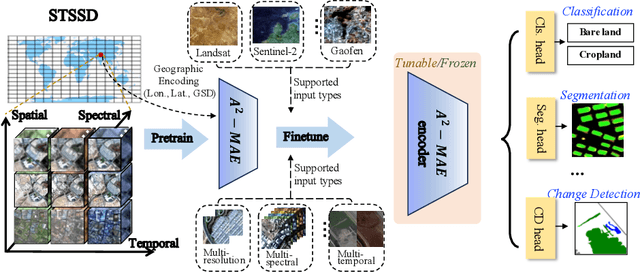
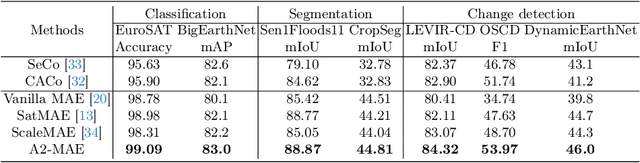
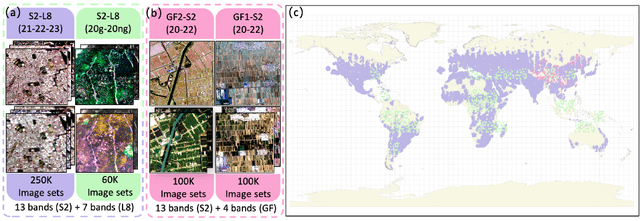
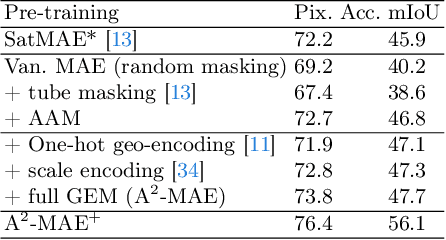
Vast amounts of remote sensing (RS) data provide Earth observations across multiple dimensions, encompassing critical spatial, temporal, and spectral information which is essential for addressing global-scale challenges such as land use monitoring, disaster prevention, and environmental change mitigation. Despite various pre-training methods tailored to the characteristics of RS data, a key limitation persists: the inability to effectively integrate spatial, temporal, and spectral information within a single unified model. To unlock the potential of RS data, we construct a Spatial-Temporal-Spectral Structured Dataset (STSSD) characterized by the incorporation of multiple RS sources, diverse coverage, unified locations within image sets, and heterogeneity within images. Building upon this structured dataset, we propose an Anchor-Aware Masked AutoEncoder method (A$^{2}$-MAE), leveraging intrinsic complementary information from the different kinds of images and geo-information to reconstruct the masked patches during the pre-training phase. A$^{2}$-MAE integrates an anchor-aware masking strategy and a geographic encoding module to comprehensively exploit the properties of RS images. Specifically, the proposed anchor-aware masking strategy dynamically adapts the masking process based on the meta-information of a pre-selected anchor image, thereby facilitating the training on images captured by diverse types of RS sources within one model. Furthermore, we propose a geographic encoding method to leverage accurate spatial patterns, enhancing the model generalization capabilities for downstream applications that are generally location-related. Extensive experiments demonstrate our method achieves comprehensive improvements across various downstream tasks compared with existing RS pre-training methods, including image classification, semantic segmentation, and change detection tasks.