 Add to Chrome
 Add to Firefox
 Add to Edge
Determine-Then-Ensemble: Necessity of Top-k Union for Large Language Model Ensembling
Oct 03, 2024


Large language models (LLMs) exhibit varying strengths and weaknesses across different tasks, prompting recent studies to explore the benefits of ensembling models to leverage their complementary advantages. However, existing LLM ensembling methods often overlook model compatibility and struggle with inefficient alignment of probabilities across the entire vocabulary. In this study, we empirically investigate the factors influencing ensemble performance, identifying model performance, vocabulary size, and response style as key determinants, revealing that compatibility among models is essential for effective ensembling. This analysis leads to the development of a simple yet effective model selection strategy that identifies compatible models. Additionally, we introduce the \textsc{Uni}on \textsc{T}op-$k$ \textsc{E}nsembling (\textsc{UniTE}), a novel approach that efficiently combines models by focusing on the union of the top-k tokens from each model, thereby avoiding the need for full vocabulary alignment and reducing computational overhead. Extensive evaluations across multiple benchmarks demonstrate that \textsc{UniTE} significantly enhances performance compared to existing methods, offering a more efficient framework for LLM ensembling.

Learning Attentional Mixture of LoRAs for Language Model Continual Learning
Sep 29, 2024Fine-tuning large language models (LLMs) with Low-Rank adaption (LoRA) is widely acknowledged as an effective approach for continual learning for new tasks. However, it often suffers from catastrophic forgetting when dealing with multiple tasks sequentially. To this end, we propose Attentional Mixture of LoRAs (AM-LoRA), a continual learning approach tailored for LLMs. Specifically, AM-LoRA learns a sequence of LoRAs for a series of tasks to continually learn knowledge from different tasks. The key of our approach is that we devise an attention mechanism as a knowledge mixture module to adaptively integrate information from each LoRA. With the attention mechanism, AM-LoRA can efficiently leverage the distinctive contributions of each LoRA, while mitigating the risk of mutually negative interactions among them that may lead to catastrophic forgetting. Moreover, we further introduce $L1$ norm in the learning process to make the attention vector more sparse. The sparse constraints can enable the model to lean towards selecting a few highly relevant LoRAs, rather than aggregating and weighting all LoRAs collectively, which can further reduce the impact stemming from mutual interference. Experimental results on continual learning benchmarks indicate the superiority of our proposed method.
DualSep: A Light-weight dual-encoder convolutional recurrent network for real-time in-car speech separation
Sep 13, 2024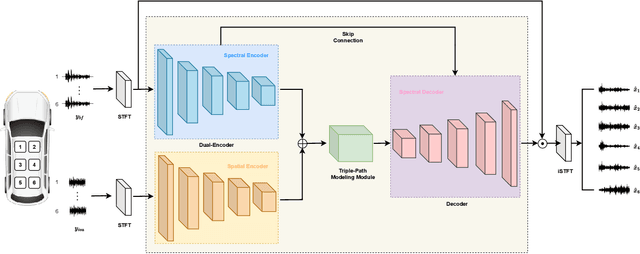
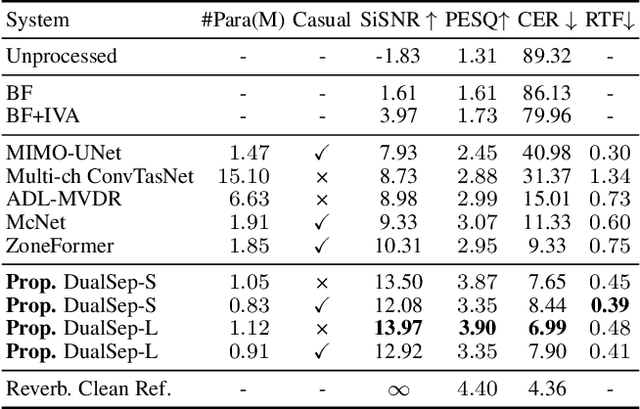
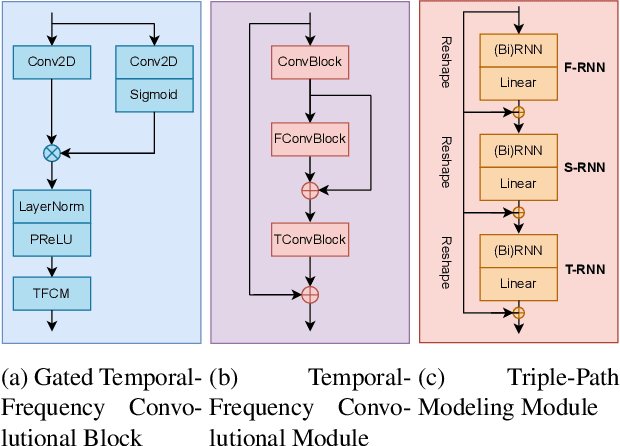
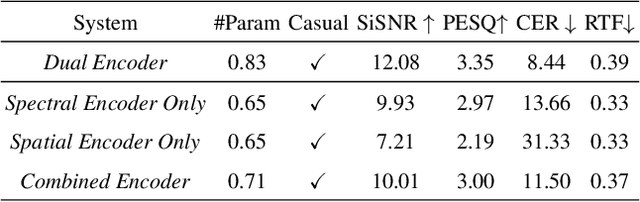
Advancements in deep learning and voice-activated technologies have driven the development of human-vehicle interaction. Distributed microphone arrays are widely used in in-car scenarios because they can accurately capture the voices of passengers from different speech zones. However, the increase in the number of audio channels, coupled with the limited computational resources and low latency requirements of in-car systems, presents challenges for in-car multi-channel speech separation. To migrate the problems, we propose a lightweight framework that cascades digital signal processing (DSP) and neural networks (NN). We utilize fixed beamforming (BF) to reduce computational costs and independent vector analysis (IVA) to provide spatial prior. We employ dual encoders for dual-branch modeling, with spatial encoder capturing spatial cues and spectral encoder preserving spectral information, facilitating spatial-spectral fusion. Our proposed system supports both streaming and non-streaming modes. Experimental results demonstrate the superiority of the proposed system across various metrics. With only 0.83M parameters and 0.39 real-time factor (RTF) on an Intel Core i7 (2.6GHz) CPU, it effectively separates speech into distinct speech zones. Our demos are available at https://honee-w.github.io/DualSep/.
MarsCode Agent: AI-native Automated Bug Fixing
Sep 04, 2024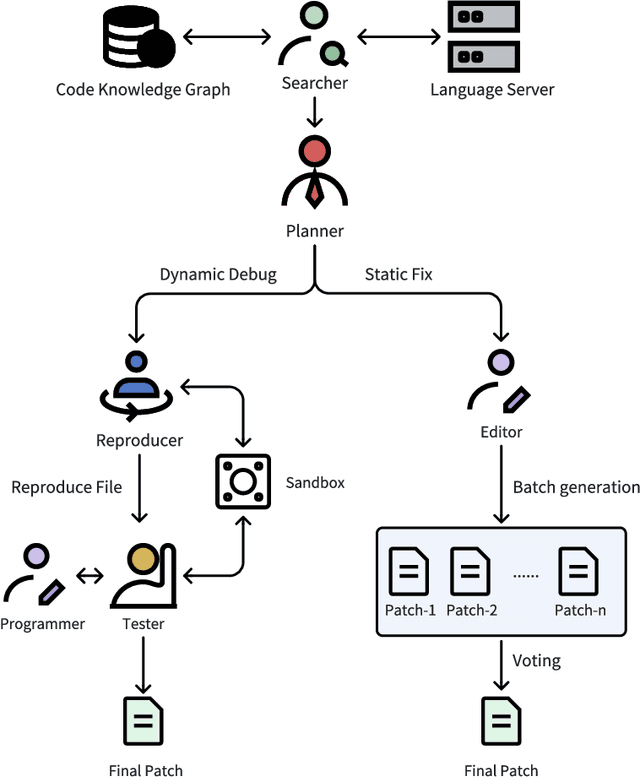
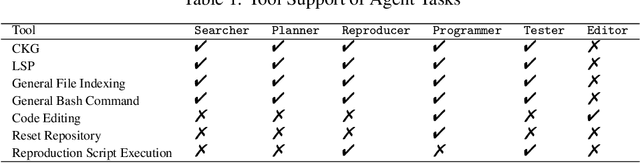
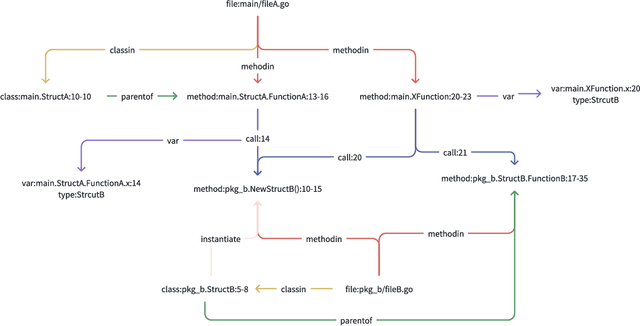
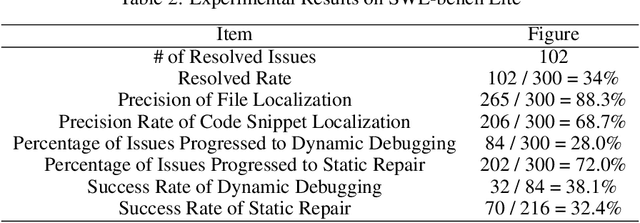
Recent advances in large language models (LLMs) have shown significant potential to automate various software development tasks, including code completion, test generation, and bug fixing. However, the application of LLMs for automated bug fixing remains challenging due to the complexity and diversity of real-world software systems. In this paper, we introduce MarsCode Agent, a novel framework that leverages LLMs to automatically identify and repair bugs in software code. MarsCode Agent combines the power of LLMs with advanced code analysis techniques to accurately localize faults and generate patches. Our approach follows a systematic process of planning, bug reproduction, fault localization, candidate patch generation, and validation to ensure high-quality bug fixes. We evaluated MarsCode Agent on SWE-bench, a comprehensive benchmark of real-world software projects, and our results show that MarsCode Agent achieves a high success rate in bug fixing compared to most of the existing automated approaches.
Online Optimization for Learning to Communicate over Time-Correlated Channels
Sep 01, 2024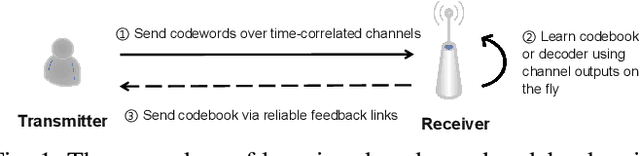


Machine learning techniques have garnered great interest in designing communication systems owing to their capacity in tacking with channel uncertainty. To provide theoretical guarantees for learning-based communication systems, some recent works analyze generalization bounds for devised methods based on the assumption of Independently and Identically Distributed (I.I.D.) channels, a condition rarely met in practical scenarios. In this paper, we drop the I.I.D. channel assumption and study an online optimization problem of learning to communicate over time-correlated channels. To address this issue, we further focus on two specific tasks: optimizing channel decoders for time-correlated fading channels and selecting optimal codebooks for time-correlated additive noise channels. For utilizing temporal dependence of considered channels to better learn communication systems, we develop two online optimization algorithms based on the optimistic online mirror descent framework. Furthermore, we provide theoretical guarantees for proposed algorithms via deriving sub-linear regret bound on the expected error probability of learned systems. Extensive simulation experiments have been conducted to validate that our presented approaches can leverage the channel correlation to achieve a lower average symbol error rate compared to baseline methods, consistent with our theoretical findings.
GEM: Context-Aware Gaze EstiMation with Visual Search Behavior Matching for Chest Radiograph
Aug 10, 2024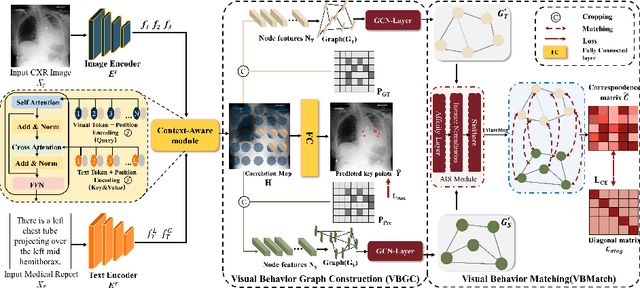

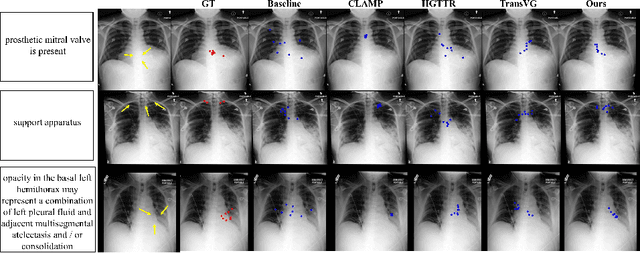

Gaze estimation is pivotal in human scene comprehension tasks, particularly in medical diagnostic analysis. Eye-tracking technology facilitates the recording of physicians' ocular movements during image interpretation, thereby elucidating their visual attention patterns and information-processing strategies. In this paper, we initially define the context-aware gaze estimation problem in medical radiology report settings. To understand the attention allocation and cognitive behavior of radiologists during the medical image interpretation process, we propose a context-aware Gaze EstiMation (GEM) network that utilizes eye gaze data collected from radiologists to simulate their visual search behavior patterns throughout the image interpretation process. It consists of a context-awareness module, visual behavior graph construction, and visual behavior matching. Within the context-awareness module, we achieve intricate multimodal registration by establishing connections between medical reports and images. Subsequently, for a more accurate simulation of genuine visual search behavior patterns, we introduce a visual behavior graph structure, capturing such behavior through high-order relationships (edges) between gaze points (nodes). To maintain the authenticity of visual behavior, we devise a visual behavior-matching approach, adjusting the high-order relationships between them by matching the graph constructed from real and estimated gaze points. Extensive experiments on four publicly available datasets demonstrate the superiority of GEM over existing methods and its strong generalizability, which also provides a new direction for the effective utilization of diverse modalities in medical image interpretation and enhances the interpretability of models in the field of medical imaging. https://github.com/Tiger-SN/GEM
STANet: A Novel Spatio-Temporal Aggregation Network for Depression Classification with Small and Unbalanced FMRI Data
Jul 31, 2024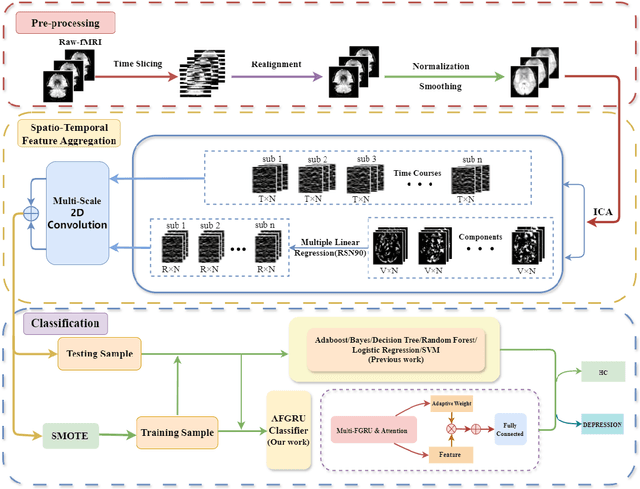

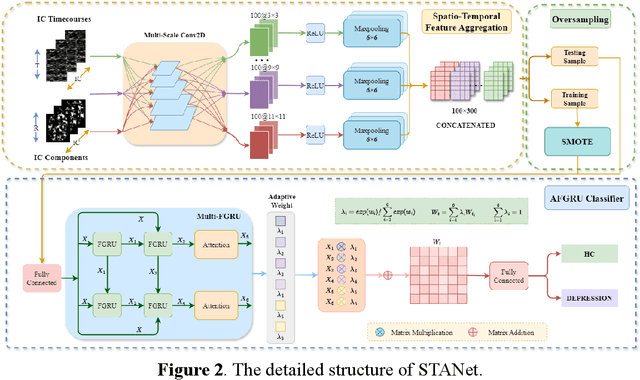

Accurate diagnosis of depression is crucial for timely implementation of optimal treatments, preventing complications and reducing the risk of suicide. Traditional methods rely on self-report questionnaires and clinical assessment, lacking objective biomarkers. Combining fMRI with artificial intelligence can enhance depression diagnosis by integrating neuroimaging indicators. However, the specificity of fMRI acquisition for depression often results in unbalanced and small datasets, challenging the sensitivity and accuracy of classification models. In this study, we propose the Spatio-Temporal Aggregation Network (STANet) for diagnosing depression by integrating CNN and RNN to capture both temporal and spatial features of brain activity. STANet comprises the following steps:(1) Aggregate spatio-temporal information via ICA. (2) Utilize multi-scale deep convolution to capture detailed features. (3) Balance data using the SMOTE to generate new samples for minority classes. (4) Employ the AFGRU classifier, which combines Fourier transformation with GRU, to capture long-term dependencies, with an adaptive weight assignment mechanism to enhance model generalization. The experimental results demonstrate that STANet achieves superior depression diagnostic performance with 82.38% accuracy and a 90.72% AUC. The STFA module enhances classification by capturing deeper features at multiple scales. The AFGRU classifier, with adaptive weights and stacked GRU, attains higher accuracy and AUC. SMOTE outperforms other oversampling methods. Additionally, spatio-temporal aggregated features achieve better performance compared to using only temporal or spatial features. STANet outperforms traditional or deep learning classifiers, and functional connectivity-based classifiers, as demonstrated by ten-fold cross-validation.
RAVSS: Robust Audio-Visual Speech Separation in Multi-Speaker Scenarios with Missing Visual Cues
Jul 27, 2024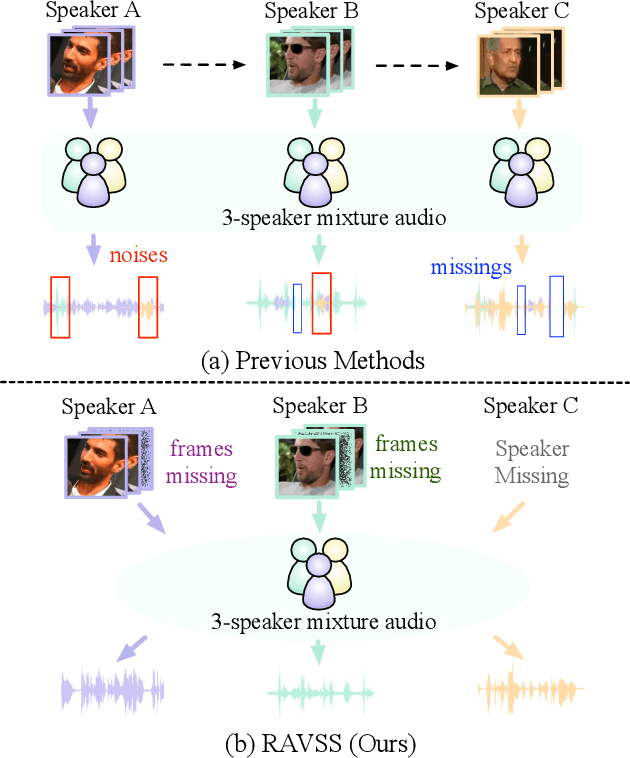
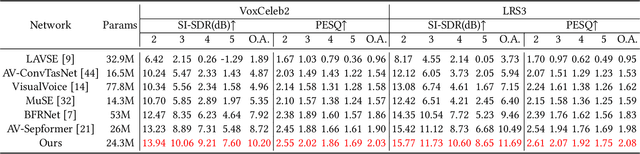
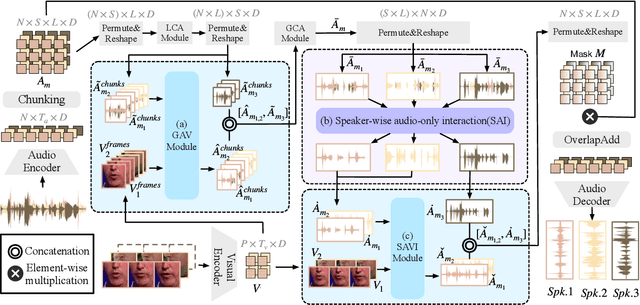
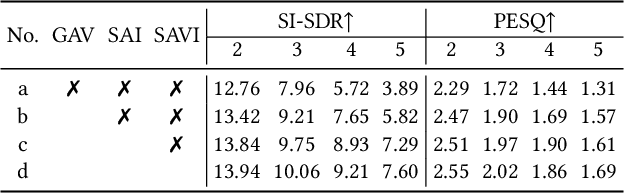
While existing Audio-Visual Speech Separation (AVSS) methods primarily concentrate on the audio-visual fusion strategy for two-speaker separation, they demonstrate a severe performance drop in the multi-speaker separation scenarios. Typically, AVSS methods employ guiding videos to sequentially isolate individual speakers from the given audio mixture, resulting in notable missing and noisy parts across various segments of the separated speech. In this study, we propose a simultaneous multi-speaker separation framework that can facilitate the concurrent separation of multiple speakers within a singular process. We introduce speaker-wise interactions to establish distinctions and correlations among speakers. Experimental results on the VoxCeleb2 and LRS3 datasets demonstrate that our method achieves state-of-the-art performance in separating mixtures with 2, 3, 4, and 5 speakers, respectively. Additionally, our model can utilize speakers with complete audio-visual information to mitigate other visual-deficient speakers, thereby enhancing its resilience to missing visual cues. We also conduct experiments where visual information for specific speakers is entirely absent or visual frames are partially missing. The results demonstrate that our model consistently outperforms others, exhibiting the smallest performance drop across all settings involving 2, 3, 4, and 5 speakers.
DDK: Distilling Domain Knowledge for Efficient Large Language Models
Jul 23, 2024
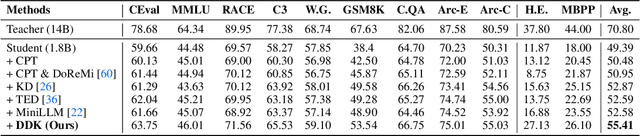


Despite the advanced intelligence abilities of large language models (LLMs) in various applications, they still face significant computational and storage demands. Knowledge Distillation (KD) has emerged as an effective strategy to improve the performance of a smaller LLM (i.e., the student model) by transferring knowledge from a high-performing LLM (i.e., the teacher model). Prevailing techniques in LLM distillation typically use a black-box model API to generate high-quality pretrained and aligned datasets, or utilize white-box distillation by altering the loss function to better transfer knowledge from the teacher LLM. However, these methods ignore the knowledge differences between the student and teacher LLMs across domains. This results in excessive focus on domains with minimal performance gaps and insufficient attention to domains with large gaps, reducing overall performance. In this paper, we introduce a new LLM distillation framework called DDK, which dynamically adjusts the composition of the distillation dataset in a smooth manner according to the domain performance differences between the teacher and student models, making the distillation process more stable and effective. Extensive evaluations show that DDK significantly improves the performance of student models, outperforming both continuously pretrained baselines and existing knowledge distillation methods by a large margin.
GTPT: Group-based Token Pruning Transformer for Efficient Human Pose Estimation
Jul 16, 2024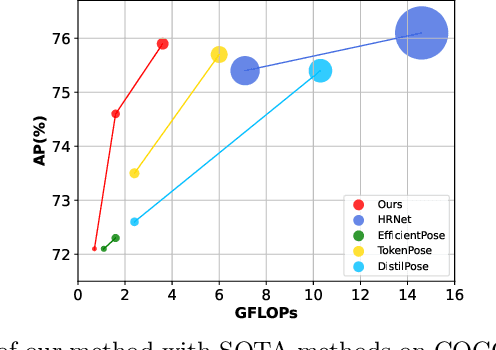
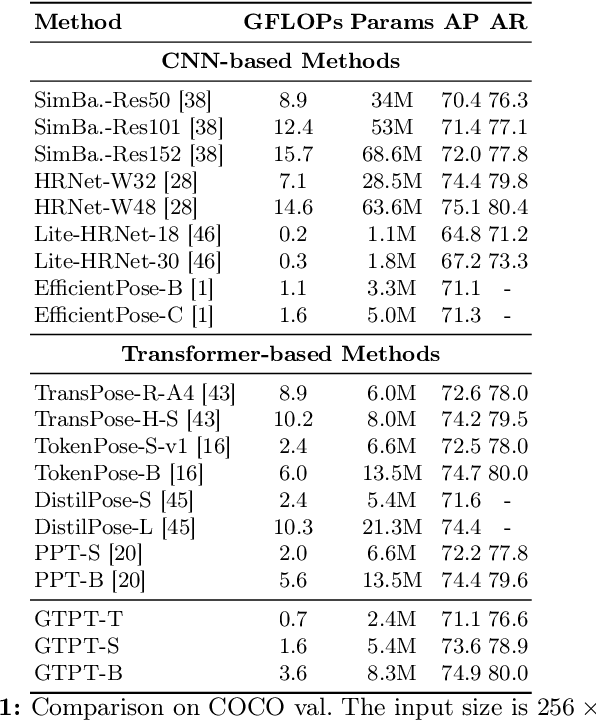
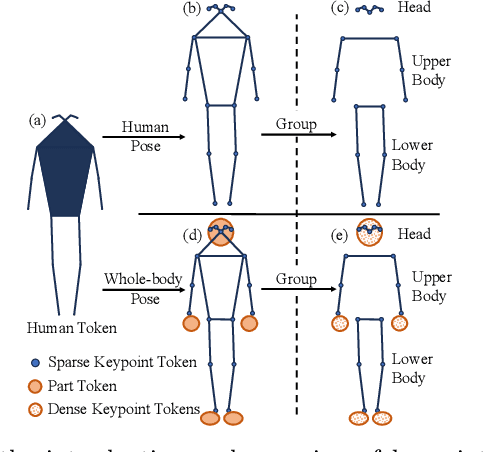
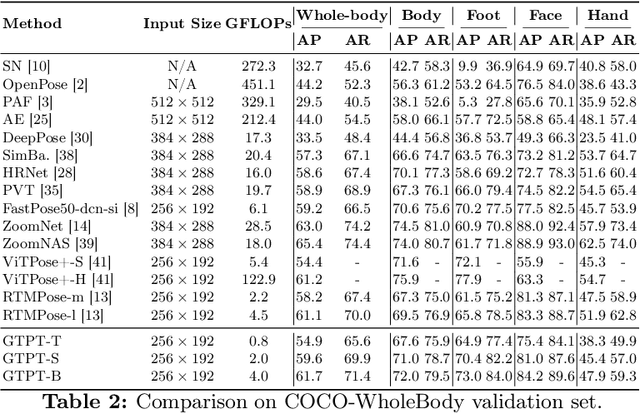
In recent years, 2D human pose estimation has made significant progress on public benchmarks. However, many of these approaches face challenges of less applicability in the industrial community due to the large number of parametric quantities and computational overhead. Efficient human pose estimation remains a hurdle, especially for whole-body pose estimation with numerous keypoints. While most current methods for efficient human pose estimation primarily rely on CNNs, we propose the Group-based Token Pruning Transformer (GTPT) that fully harnesses the advantages of the Transformer. GTPT alleviates the computational burden by gradually introducing keypoints in a coarse-to-fine manner. It minimizes the computation overhead while ensuring high performance. Besides, GTPT groups keypoint tokens and prunes visual tokens to improve model performance while reducing redundancy. We propose the Multi-Head Group Attention (MHGA) between different groups to achieve global interaction with little computational overhead. We conducted experiments on COCO and COCO-WholeBody. Compared to other methods, the experimental results show that GTPT can achieve higher performance with less computation, especially in whole-body with numerous keypoints.