 Add to Chrome
 Add to Firefox
 Add to Edge
RUFNet: Query-Guided Support Mask Refinement and Uncertainty Fusion based on Hybrid Mamba for Few-Shot Brain Tumor Segmentation
Jul 06, 2026
Few-shot brain tumor segmentation remains challenging due to noisy support masks, inter-patient variations between support and query images, and the lack of pixel-wise confidence estimation. This study proposes RUFNet, a Hybrid Mamba-based few-shot framework that combines support mask refinement with uncertainty-aware posterior fusion. To preserve support-query dependencies with manageable cost, RUFNet adopts a Hybrid Mamba interaction backbone with linear complexity. To reduce support-mask noise, an Attention-Guided Mask Refinement module (AGMR) uses query features to recalibrate support masks and improve prototype consistency. To handle ambiguous predictions, an Uncertainty-Aware Posterior Fusion module (UAPF) estimates pixel-wise variance and adaptively balances few-shot predictions with query-aligned priors. On the Brain Tumor Segmentation Challenge (BraTS) 2020 dataset, RUFNet achieves Dice coefficients of 84.3% and 86.1% in the 1-way 1-shot and 1-way 5-shot settings, respectively, outperforming the compared state-of-the-art methods. These results suggest that Hybrid Mamba interaction, mask refinement and uncertainty modelling can improve the robustness of few-shot medical image segmentation. The official implementation code is available at https://github.com/hdy6438/RUFNet.

SUP-MCRL: Subject-aware Unified Pseudo-feature Coded Multimodal Contrastive Representation Learning for EEG Visual Decoding
Jun 18, 2026Non-invasive brain-computer interfaces exhibit significant performance degradation when moving from controlled laboratory stimuli to real-world natural images. This degradation occurs because conventional multimodal contrastive representation learning models focus exclusively on optimizing geometric distance alignment, thereby failing to account for semantic consistency and inter-subject variability in neural representation and selective attention. As a result, these models are prone to producing spurious zero-shot matches. To address these limitations, we propose SUP-MCRL, a unified framework integrating three collaborative mechanisms: (1) a Semantic-entity Aware Visual Encoder (SAVE) that learns spatial attention to extract semantic content without relying on pre-trained saliency models; (2) a Unified EEG Enhancer (UEE) that employs multi-scale atrous convolutions and inter-band attention for adaptive cross-subject robustness; and (3) a Prototype-based Progressive Augmenter (PPA) that maintains an EMA-updated pseudo-feature pool to prevent representation collapse. Zero-shot experiments on the THINGS-EEG achieve 66.0%/91.9% (Top-1/Top-5) intra-subject and 24.0%/52.9% LOSO accuracy, significantly surpassing state-of-the-art methods and demonstrating that structured alignment supervision is key to overcoming the limitations of cross-modal decoding. Code is available at https://github.com/NZWANG/SUP-MCRL.
STAMBRIDGE: Spectral-Temporal Amplitude-aware Mid-Feature Bridge for EEG Visual Decoding
May 27, 2026Electroencephalography (EEG) visual decoding remains challenging due to the modality gap between low-SNR neural signals and highly structured vision--language spaces, making direct cross-modal alignment unstable. To address this, we propose STAMBRIDGE, a versatile two-stage framework that sequentially tackles feature conditioning and cross-modal alignment. First, we introduce a Spectral-Temporal Amplitude-aware Modulation (STAM) to extract well-conditioned EEG representations. By replacing hard frequency masking with amplitude-derived soft channel weighting and multi-scale temporal convolutions, STAM explicitly preserves frequency-aware transients while reducing the risk of time-domain ringing artifacts. Building upon these robust neural features, we further introduce a model-agnostic Mid-Feature Semantic Bridge (MFSB) that constructs a regularized intermediate space through directed cross-modal interactions, enabling staged distillation and more stable semantic alignment. Experiments on the THINGS-EEG benchmark show competitive 200-way zero-shot retrieval performance, with 34.50\% Top-1 and 65.95\% Top-5 accuracy. In addition, embeddings learned by STAMBRIDGE produce semantically coherent image reconstructions with a diffusion model, demonstrating robust EEG-to-vision semantic alignment. The code is available at: https://github.com/thabeatmjh/STAMBRIDGE.
Linguistics and Human Brain: A Perspective of Computational Neuroscience
Feb 09, 2026Elucidating the language-brain relationship requires bridging the methodological gap between the abstract theoretical frameworks of linguistics and the empirical neural data of neuroscience. Serving as an interdisciplinary cornerstone, computational neuroscience formalizes the hierarchical and dynamic structures of language into testable neural models through modeling, simulation, and data analysis. This enables a computational dialogue between linguistic hypotheses and neural mechanisms. Recent advances in deep learning, particularly large language models (LLMs), have powerfully advanced this pursuit. Their high-dimensional representational spaces provide a novel scale for exploring the neural basis of linguistic processing, while the "model-brain alignment" framework offers a methodology to evaluate the biological plausibility of language-related theories.
Prototype-Based Disentanglement for Controllable Dysarthric Speech Synthesis
Feb 09, 2026Dysarthric speech exhibits high variability and limited labeled data, posing major challenges for both automatic speech recognition (ASR) and assistive speech technologies. Existing approaches rely on synthetic data augmentation or speech reconstruction, yet often entangle speaker identity with pathological articulation, limiting controllability and robustness. In this paper, we propose ProtoDisent-TTS, a prototype-based disentanglement TTS framework built on a pre-trained text-to-speech backbone that factorizes speaker timbre and dysarthric articulation within a unified latent space. A pathology prototype codebook provides interpretable and controllable representations of healthy and dysarthric speech patterns, while a dual-classifier objective with a gradient reversal layer enforces invariance of speaker embeddings to pathological attributes. Experiments on the TORGO dataset demonstrate that this design enables bidirectional transformation between healthy and dysarthric speech, leading to consistent ASR performance gains and robust, speaker-aware speech reconstruction.
Region-aware Spatiotemporal Modeling with Collaborative Domain Generalization for Cross-Subject EEG Emotion Recognition
Jan 22, 2026Cross-subject EEG-based emotion recognition (EER) remains challenging due to strong inter-subject variability, which induces substantial distribution shifts in EEG signals, as well as the high complexity of emotion-related neural representations in both spatial organization and temporal evolution. Existing approaches typically improve spatial modeling, temporal modeling, or generalization strategies in isolation, which limits their ability to align representations across subjects while capturing multi-scale dynamics and suppressing subject-specific bias within a unified framework. To address these gaps, we propose a Region-aware Spatiotemporal Modeling framework with Collaborative Domain Generalization (RSM-CoDG) for cross-subject EEG emotion recognition. RSM-CoDG incorporates neuroscience priors derived from functional brain region partitioning to construct region-level spatial representations, thereby improving cross-subject comparability. It also employs multi-scale temporal modeling to characterize the dynamic evolution of emotion-evoked neural activity. In addition, the framework employs a collaborative domain generalization strategy, incorporating multidimensional constraints to reduce subject-specific bias in a fully unseen target subject setting, which enhances the generalization to unknown individuals. Extensive experimental results on SEED series datasets demonstrate that RSM-CoDG consistently outperforms existing competing methods, providing an effective approach for improving robustness. The source code is available at https://github.com/RyanLi-X/RSM-CoDG.
LEREL: Lipschitz Continuity-Constrained Emotion Recognition Ensemble Learning For Electroencephalography
Apr 12, 2025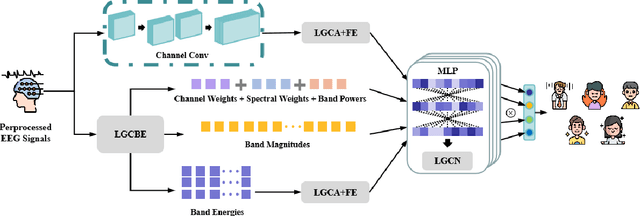
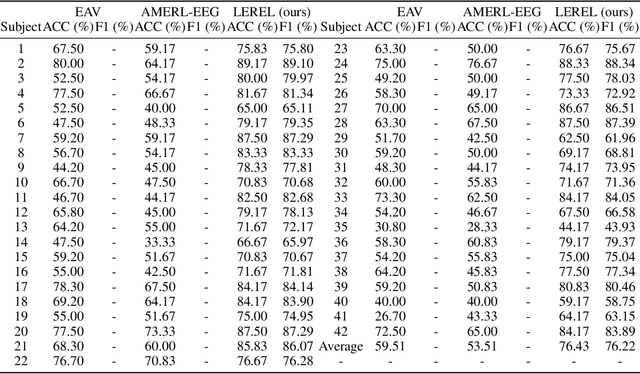
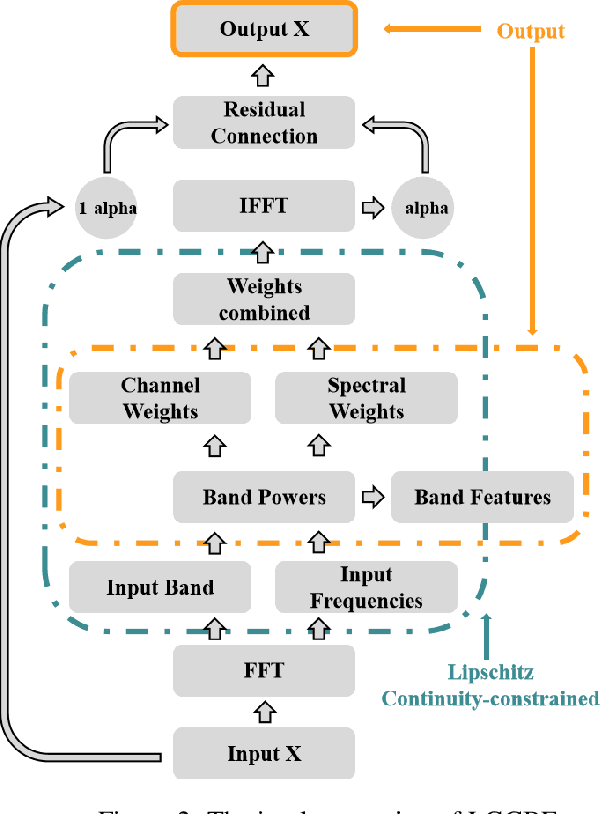
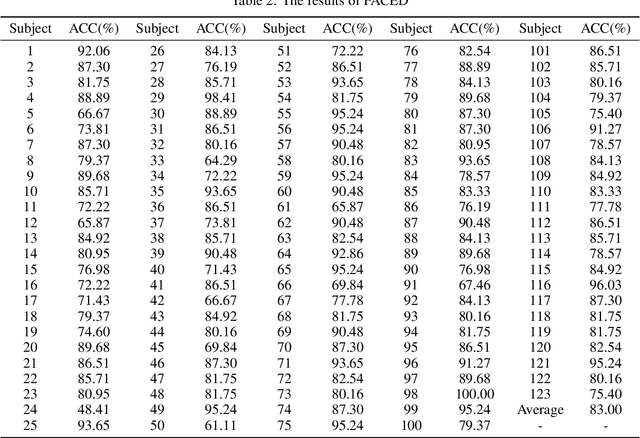
Accurate and efficient perception of emotional states in oneself and others is crucial, as emotion-related disorders are associated with severe psychosocial impairments. While electroencephalography (EEG) offers a powerful tool for emotion detection, current EEG-based emotion recognition (EER) methods face key limitations: insufficient model stability, limited accuracy in processing high-dimensional nonlinear EEG signals, and poor robustness against intra-subject variability and signal noise. To address these challenges, we propose LEREL (Lipschitz continuity-constrained Emotion Recognition Ensemble Learning), a novel framework that significantly enhances both the accuracy and robustness of emotion recognition performance. The LEREL framework employs Lipschitz continuity constraints to enhance model stability and generalization in EEG emotion recognition, reducing signal variability and noise susceptibility while maintaining strong performance on small-sample datasets. The ensemble learning strategy reduces single-model bias and variance through multi-classifier decision fusion, further optimizing overall performance. Experimental results on three public benchmark datasets (EAV, FACED and SEED) demonstrate LEREL's effectiveness, achieving average recognition accuracies of 76.43%, 83.00% and 89.22%, respectively.
Information Bottleneck-Guided Heterogeneous Graph Learning for Interpretable Neurodevelopmental Disorder Diagnosis
Feb 28, 2025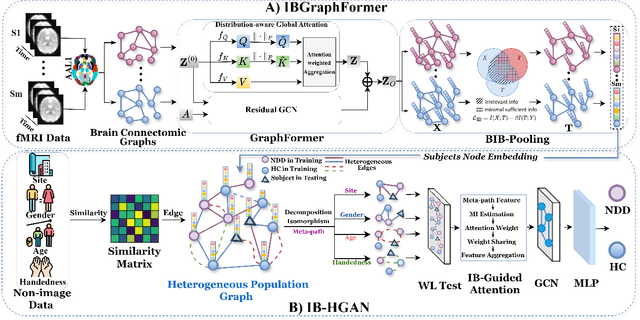
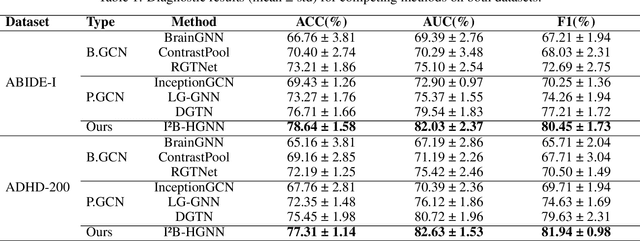


Developing interpretable models for diagnosing neurodevelopmental disorders (NDDs) is highly valuable yet challenging, primarily due to the complexity of encoding, decoding and integrating imaging and non-imaging data. Many existing machine learning models struggle to provide comprehensive interpretability, often failing to extract meaningful biomarkers from imaging data, such as functional magnetic resonance imaging (fMRI), or lacking mechanisms to explain the significance of non-imaging data. In this paper, we propose the Interpretable Information Bottleneck Heterogeneous Graph Neural Network (I2B-HGNN), a novel framework designed to learn from fine-grained local patterns to comprehensive global multi-modal interactions. This framework comprises two key modules. The first module, the Information Bottleneck Graph Transformer (IBGraphFormer) for local patterns, integrates global modeling with brain connectomic-constrained graph neural networks to identify biomarkers through information bottleneck-guided pooling. The second module, the Information Bottleneck Heterogeneous Graph Attention Network (IB-HGAN) for global multi-modal interactions, facilitates interpretable multi-modal fusion of imaging and non-imaging data using heterogeneous graph neural networks. The results of the experiments demonstrate that I2B-HGNN excels in diagnosing NDDs with high accuracy, providing interpretable biomarker identification and effective analysis of non-imaging data.
STARFormer: A Novel Spatio-Temporal Aggregation Reorganization Transformer of FMRI for Brain Disorder Diagnosis
Dec 31, 2024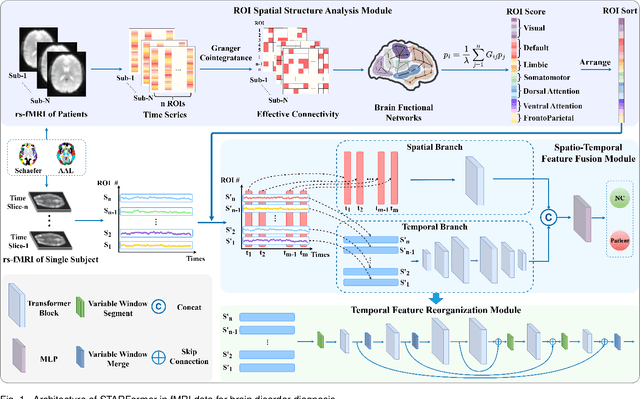
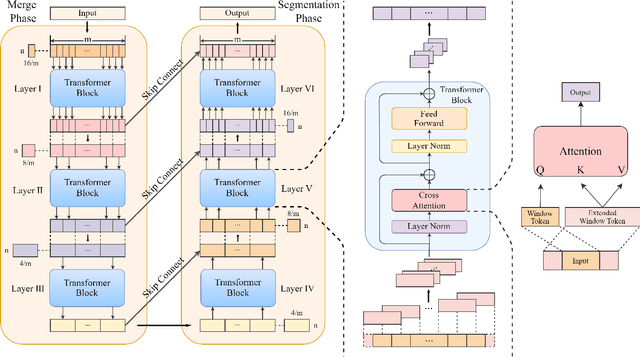
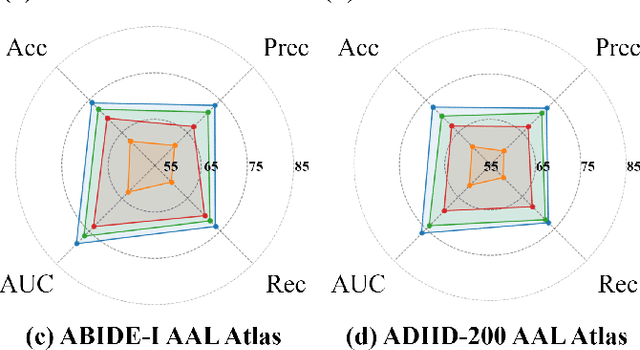
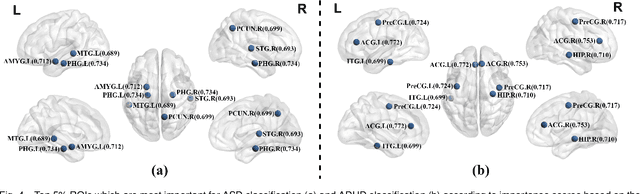
Many existing methods that use functional magnetic resonance imaging (fMRI) classify brain disorders, such as autism spectrum disorder (ASD) and attention deficit hyperactivity disorder (ADHD), often overlook the integration of spatial and temporal dependencies of the blood oxygen level-dependent (BOLD) signals, which may lead to inaccurate or imprecise classification results. To solve this problem, we propose a Spatio-Temporal Aggregation eorganization ransformer (STARFormer) that effectively captures both spatial and temporal features of BOLD signals by incorporating three key modules. The region of interest (ROI) spatial structure analysis module uses eigenvector centrality (EC) to reorganize brain regions based on effective connectivity, highlighting critical spatial relationships relevant to the brain disorder. The temporal feature reorganization module systematically segments the time series into equal-dimensional window tokens and captures multiscale features through variable window and cross-window attention. The spatio-temporal feature fusion module employs a parallel transformer architecture with dedicated temporal and spatial branches to extract integrated features. The proposed STARFormer has been rigorously evaluated on two publicly available datasets for the classification of ASD and ADHD. The experimental results confirm that the STARFormer achieves state-of-the-art performance across multiple evaluation metrics, providing a more accurate and reliable tool for the diagnosis of brain disorders and biomedical research. The codes will be available at: https://github.com/NZWANG/STARFormer.
Neural-MCRL: Neural Multimodal Contrastive Representation Learning for EEG-based Visual Decoding
Dec 23, 2024


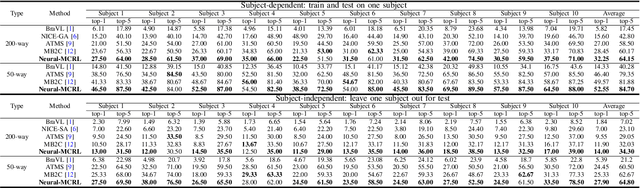
Decoding neural visual representations from electroencephalogram (EEG)-based brain activity is crucial for advancing brain-machine interfaces (BMI) and has transformative potential for neural sensory rehabilitation. While multimodal contrastive representation learning (MCRL) has shown promise in neural decoding, existing methods often overlook semantic consistency and completeness within modalities and lack effective semantic alignment across modalities. This limits their ability to capture the complex representations of visual neural responses. We propose Neural-MCRL, a novel framework that achieves multimodal alignment through semantic bridging and cross-attention mechanisms, while ensuring completeness within modalities and consistency across modalities. Our framework also features the Neural Encoder with Spectral-Temporal Adaptation (NESTA), a EEG encoder that adaptively captures spectral patterns and learns subject-specific transformations. Experimental results demonstrate significant improvements in visual decoding accuracy and model generalization compared to state-of-the-art methods, advancing the field of EEG-based neural visual representation decoding in BMI. Codes will be available at: https://github.com/NZWANG/Neural-MCRL.