 Add to Chrome
 Add to Firefox
 Add to Edge
Training Compact CNNs for Image Classification using Dynamic-coded Filter Fusion
Jul 14, 2021
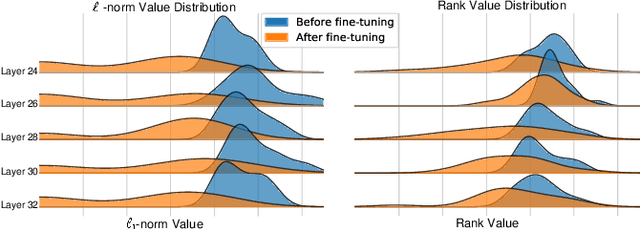
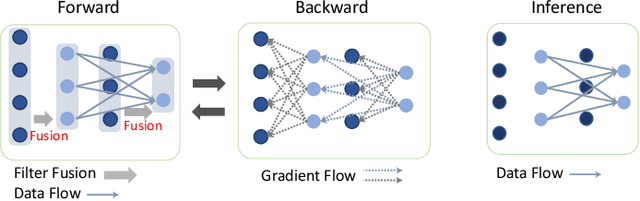
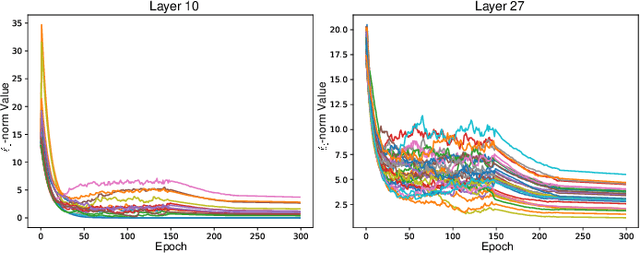

The mainstream approach for filter pruning is usually either to force a hard-coded importance estimation upon a computation-heavy pretrained model to select "important" filters, or to impose a hyperparameter-sensitive sparse constraint on the loss objective to regularize the network training. In this paper, we present a novel filter pruning method, dubbed dynamic-coded filter fusion (DCFF), to derive compact CNNs in a computation-economical and regularization-free manner for efficient image classification. Each filter in our DCFF is firstly given an inter-similarity distribution with a temperature parameter as a filter proxy, on top of which, a fresh Kullback-Leibler divergence based dynamic-coded criterion is proposed to evaluate the filter importance. In contrast to simply keeping high-score filters in other methods, we propose the concept of filter fusion, i.e., the weighted averages using the assigned proxies, as our preserved filters. We obtain a one-hot inter-similarity distribution as the temperature parameter approaches infinity. Thus, the relative importance of each filter can vary along with the training of the compact CNN, leading to dynamically changeable fused filters without both the dependency on the pretrained model and the introduction of sparse constraints. Extensive experiments on classification benchmarks demonstrate the superiority of our DCFF over the compared counterparts. For example, our DCFF derives a compact VGGNet-16 with only 72.77M FLOPs and 1.06M parameters while reaching top-1 accuracy of 93.47% on CIFAR-10. A compact ResNet-50 is obtained with 63.8% FLOPs and 58.6% parameter reductions, retaining 75.60% top-1 accuracy on ILSVRC-2012. Our code, narrower models and training logs are available at https://github.com/lmbxmu/DCFF.

Multi-Target Domain Adaptation with Collaborative Consistency Learning
Jun 07, 2021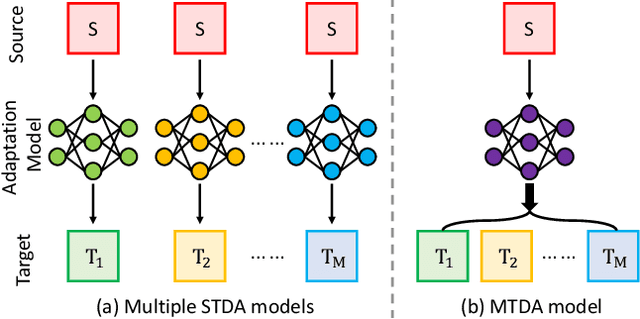
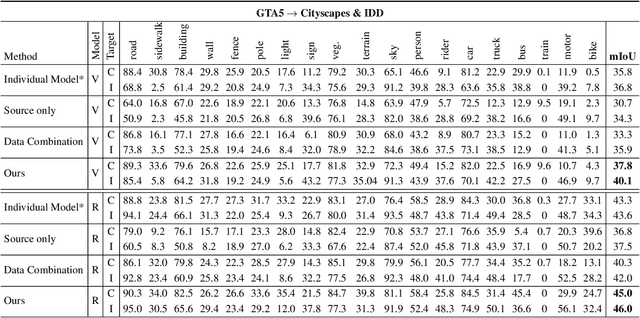
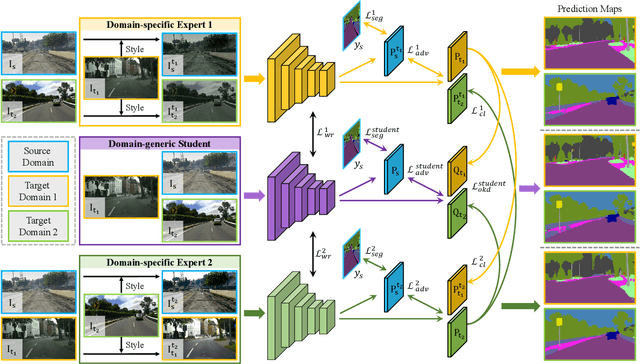
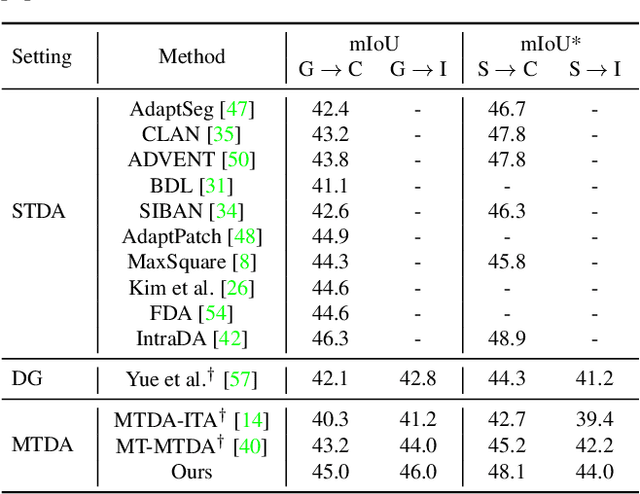
Recently unsupervised domain adaptation for the semantic segmentation task has become more and more popular due to high-cost of pixel-level annotation on real-world images. However, most domain adaptation methods are only restricted to single-source-single-target pair, and can not be directly extended to multiple target domains. In this work, we propose a collaborative learning framework to achieve unsupervised multi-target domain adaptation. An unsupervised domain adaptation expert model is first trained for each source-target pair and is further encouraged to collaborate with each other through a bridge built between different target domains. These expert models are further improved by adding the regularization of making the consistent pixel-wise prediction for each sample with the same structured context. To obtain a single model that works across multiple target domains, we propose to simultaneously learn a student model which is trained to not only imitate the output of each expert on the corresponding target domain, but also to pull different expert close to each other with regularization on their weights. Extensive experiments demonstrate that the proposed method can effectively exploit rich structured information contained in both labeled source domain and multiple unlabeled target domains. Not only does it perform well across multiple target domains but also performs favorably against state-of-the-art unsupervised domain adaptation methods specially trained on a single source-target pair
Uformer: A General U-Shaped Transformer for Image Restoration
Jun 06, 2021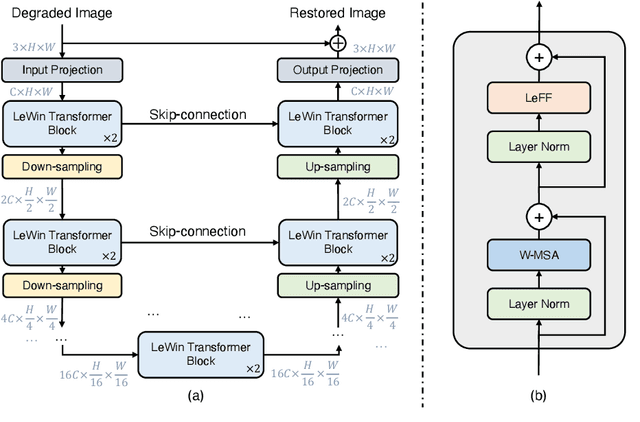
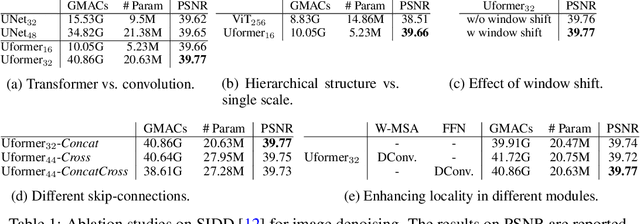
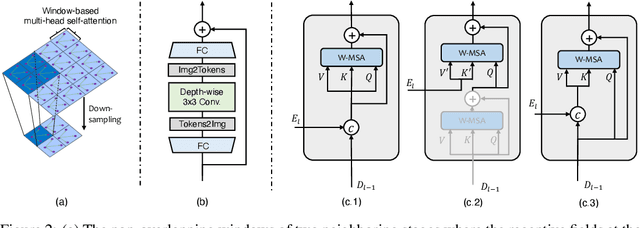
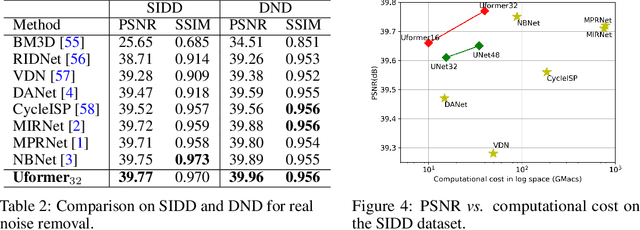
In this paper, we present Uformer, an effective and efficient Transformer-based architecture, in which we build a hierarchical encoder-decoder network using the Transformer block for image restoration. Uformer has two core designs to make it suitable for this task. The first key element is a local-enhanced window Transformer block, where we use non-overlapping window-based self-attention to reduce the computational requirement and employ the depth-wise convolution in the feed-forward network to further improve its potential for capturing local context. The second key element is that we explore three skip-connection schemes to effectively deliver information from the encoder to the decoder. Powered by these two designs, Uformer enjoys a high capability for capturing useful dependencies for image restoration. Extensive experiments on several image restoration tasks demonstrate the superiority of Uformer, including image denoising, deraining, deblurring and demoireing. We expect that our work will encourage further research to explore Transformer-based architectures for low-level vision tasks. The code and models will be available at https://github.com/ZhendongWang6/Uformer.
Towards Compact CNNs via Collaborative Compression
May 24, 2021
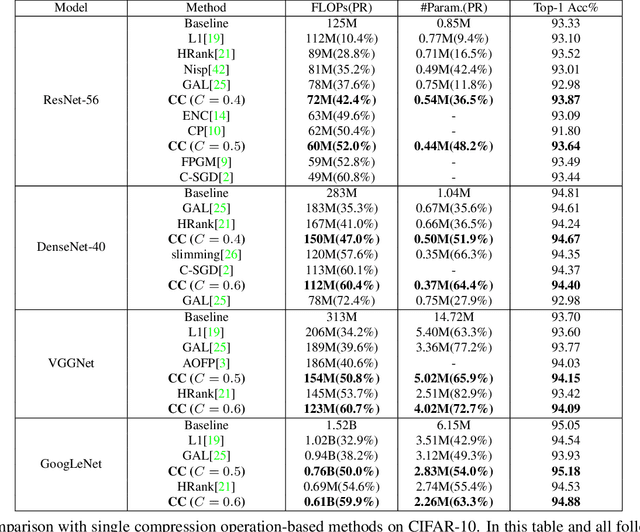
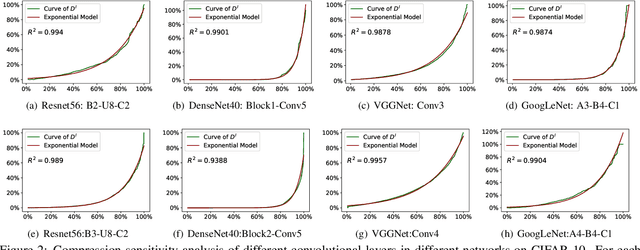
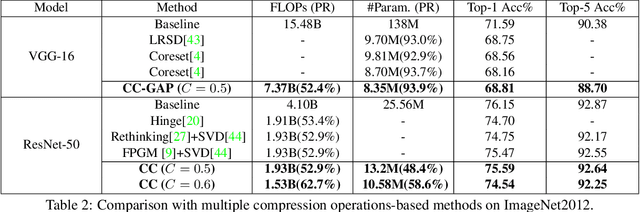
Channel pruning and tensor decomposition have received extensive attention in convolutional neural network compression. However, these two techniques are traditionally deployed in an isolated manner, leading to significant accuracy drop when pursuing high compression rates. In this paper, we propose a Collaborative Compression (CC) scheme, which joints channel pruning and tensor decomposition to compress CNN models by simultaneously learning the model sparsity and low-rankness. Specifically, we first investigate the compression sensitivity of each layer in the network, and then propose a Global Compression Rate Optimization that transforms the decision problem of compression rate into an optimization problem. After that, we propose multi-step heuristic compression to remove redundant compression units step-by-step, which fully considers the effect of the remaining compression space (i.e., unremoved compression units). Our method demonstrates superior performance gains over previous ones on various datasets and backbone architectures. For example, we achieve 52.9% FLOPs reduction by removing 48.4% parameters on ResNet-50 with only a Top-1 accuracy drop of 0.56% on ImageNet 2012.
Multiple instance active learning for object detection
Apr 06, 2021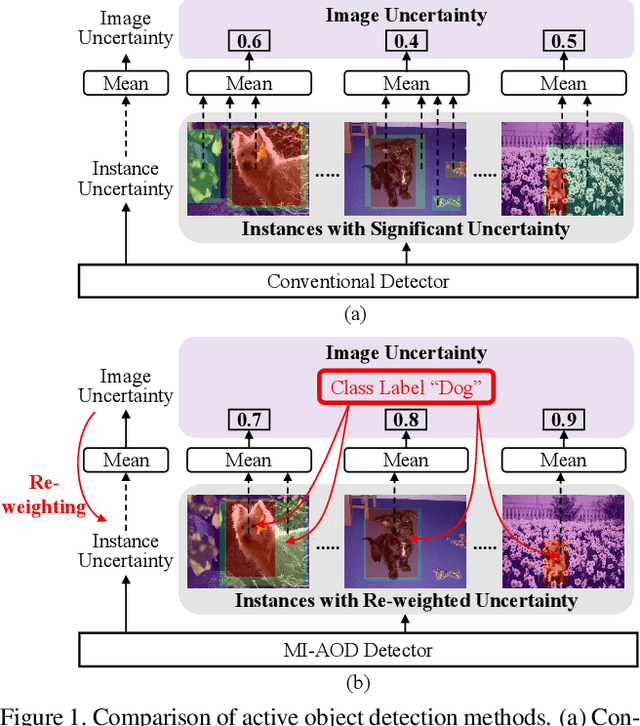
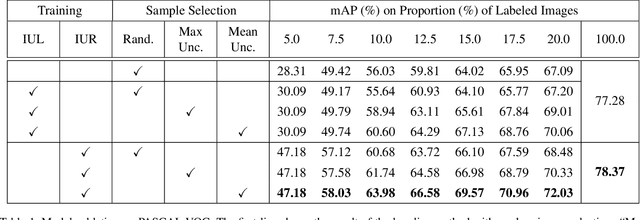
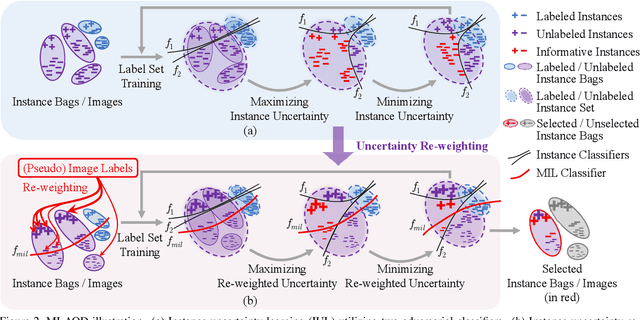
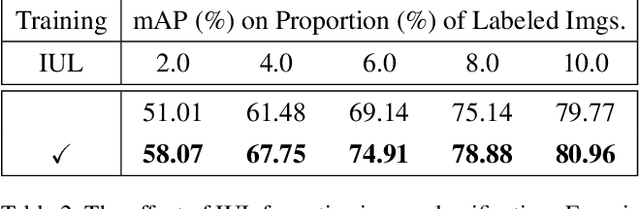
Despite the substantial progress of active learning for image recognition, there still lacks an instance-level active learning method specified for object detection. In this paper, we propose Multiple Instance Active Object Detection (MI-AOD), to select the most informative images for detector training by observing instance-level uncertainty. MI-AOD defines an instance uncertainty learning module, which leverages the discrepancy of two adversarial instance classifiers trained on the labeled set to predict instance uncertainty of the unlabeled set. MI-AOD treats unlabeled images as instance bags and feature anchors in images as instances, and estimates the image uncertainty by re-weighting instances in a multiple instance learning (MIL) fashion. Iterative instance uncertainty learning and re-weighting facilitate suppressing noisy instances, toward bridging the gap between instance uncertainty and image-level uncertainty. Experiments validate that MI-AOD sets a solid baseline for instance-level active learning. On commonly used object detection datasets, MI-AOD outperforms state-of-the-art methods with significant margins, particularly when the labeled sets are small. Code is available at https://github.com/yuantn/MI-AOD.
ReCU: Reviving the Dead Weights in Binary Neural Networks
Mar 23, 2021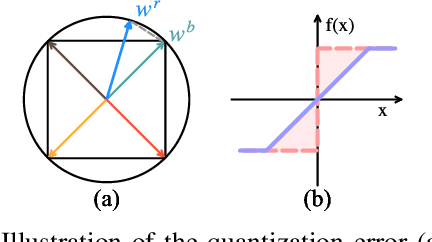
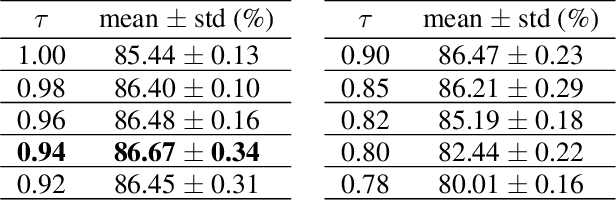
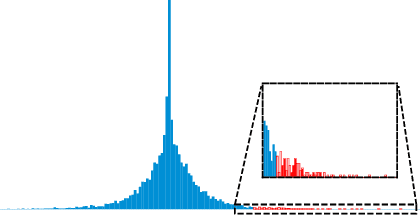
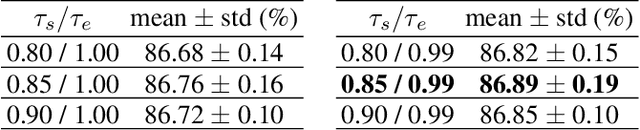
Binary neural networks (BNNs) have received increasing attention due to their superior reductions of computation and memory. Most existing works focus on either lessening the quantization error by minimizing the gap between the full-precision weights and their binarization or designing a gradient approximation to mitigate the gradient mismatch, while leaving the "dead weights" untouched. This leads to slow convergence when training BNNs. In this paper, for the first time, we explore the influence of "dead weights" which refer to a group of weights that are barely updated during the training of BNNs, and then introduce rectified clamp unit (ReCU) to revive the "dead weights" for updating. We prove that reviving the "dead weights" by ReCU can result in a smaller quantization error. Besides, we also take into account the information entropy of the weights, and then mathematically analyze why the weight standardization can benefit BNNs. We demonstrate the inherent contradiction between minimizing the quantization error and maximizing the information entropy, and then propose an adaptive exponential scheduler to identify the range of the "dead weights". By considering the "dead weights", our method offers not only faster BNN training, but also state-of-the-art performance on CIFAR-10 and ImageNet, compared with recent methods. Code can be available at [this https URL](https://github.com/z-hXu/ReCU).
Multi-Source Domain Adaptation with Collaborative Learning for Semantic Segmentation
Mar 16, 2021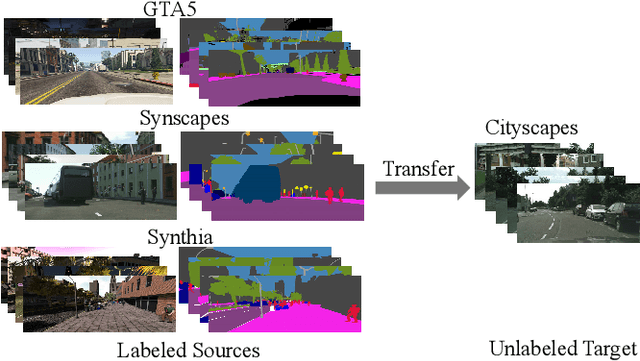
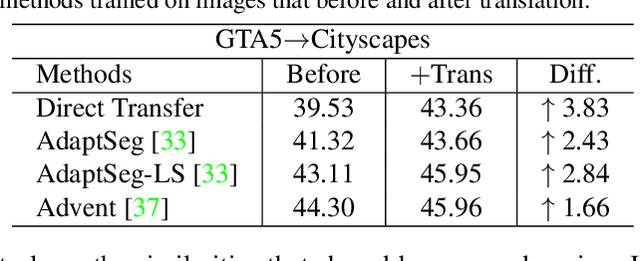
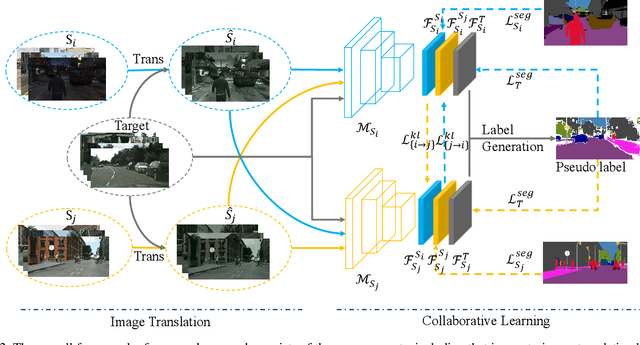
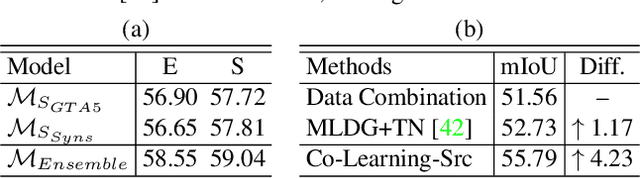
Multi-source unsupervised domain adaptation~(MSDA) aims at adapting models trained on multiple labeled source domains to an unlabeled target domain. In this paper, we propose a novel multi-source domain adaptation framework based on collaborative learning for semantic segmentation. Firstly, a simple image translation method is introduced to align the pixel value distribution to reduce the gap between source domains and target domain to some extent. Then, to fully exploit the essential semantic information across source domains, we propose a collaborative learning method for domain adaptation without seeing any data from target domain. In addition, similar to the setting of unsupervised domain adaptation, unlabeled target domain data is leveraged to further improve the performance of domain adaptation. This is achieved by additionally constraining the outputs of multiple adaptation models with pseudo labels online generated by an ensembled model. Extensive experiments and ablation studies are conducted on the widely-used domain adaptation benchmark datasets in semantic segmentation. Our proposed method achieves 59.0\% mIoU on the validation set of Cityscapes by training on the labeled Synscapes and GTA5 datasets and unlabeled training set of Cityscapes. It significantly outperforms all previous state-of-the-arts single-source and multi-source unsupervised domain adaptation methods.
Semi-supervised Domain Adaptation based on Dual-level Domain Mixing for Semantic Segmentation
Mar 08, 2021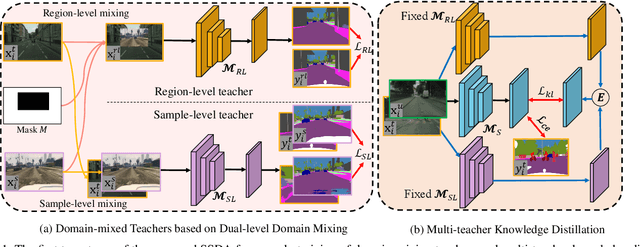
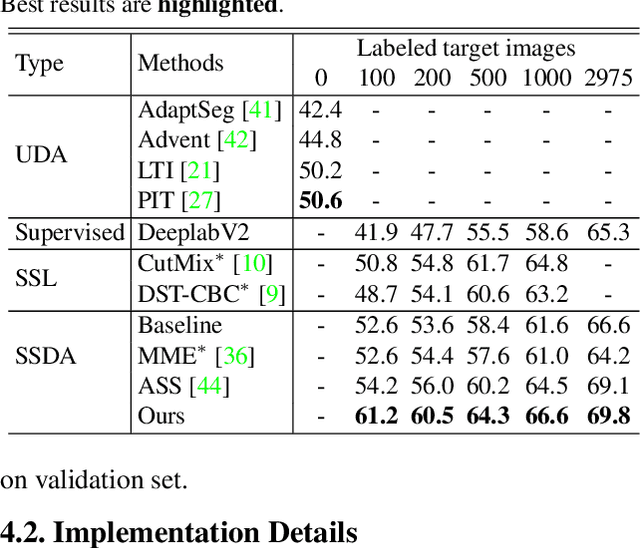
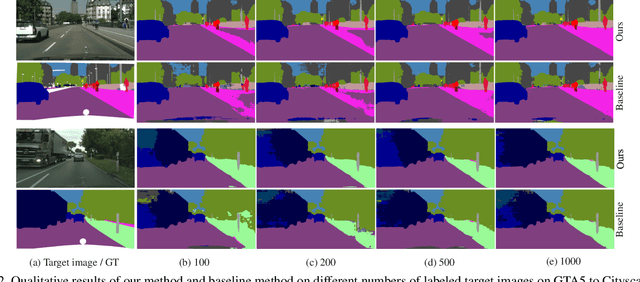
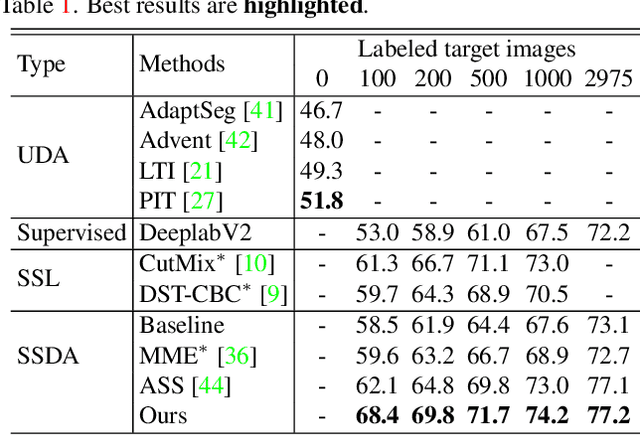
Data-driven based approaches, in spite of great success in many tasks, have poor generalization when applied to unseen image domains, and require expensive cost of annotation especially for dense pixel prediction tasks such as semantic segmentation. Recently, both unsupervised domain adaptation (UDA) from large amounts of synthetic data and semi-supervised learning (SSL) with small set of labeled data have been studied to alleviate this issue. However, there is still a large gap on performance compared to their supervised counterparts. We focus on a more practical setting of semi-supervised domain adaptation (SSDA) where both a small set of labeled target data and large amounts of labeled source data are available. To address the task of SSDA, a novel framework based on dual-level domain mixing is proposed. The proposed framework consists of three stages. First, two kinds of data mixing methods are proposed to reduce domain gap in both region-level and sample-level respectively. We can obtain two complementary domain-mixed teachers based on dual-level mixed data from holistic and partial views respectively. Then, a student model is learned by distilling knowledge from these two teachers. Finally, pseudo labels of unlabeled data are generated in a self-training manner for another few rounds of teachers training. Extensive experimental results have demonstrated the effectiveness of our proposed framework on synthetic-to-real semantic segmentation benchmarks.
Neighbor2Neighbor: Self-Supervised Denoising from Single Noisy Images
Jan 11, 2021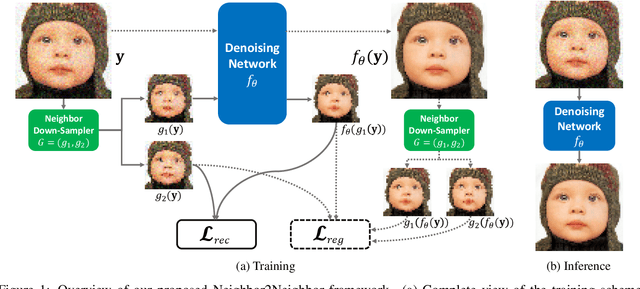
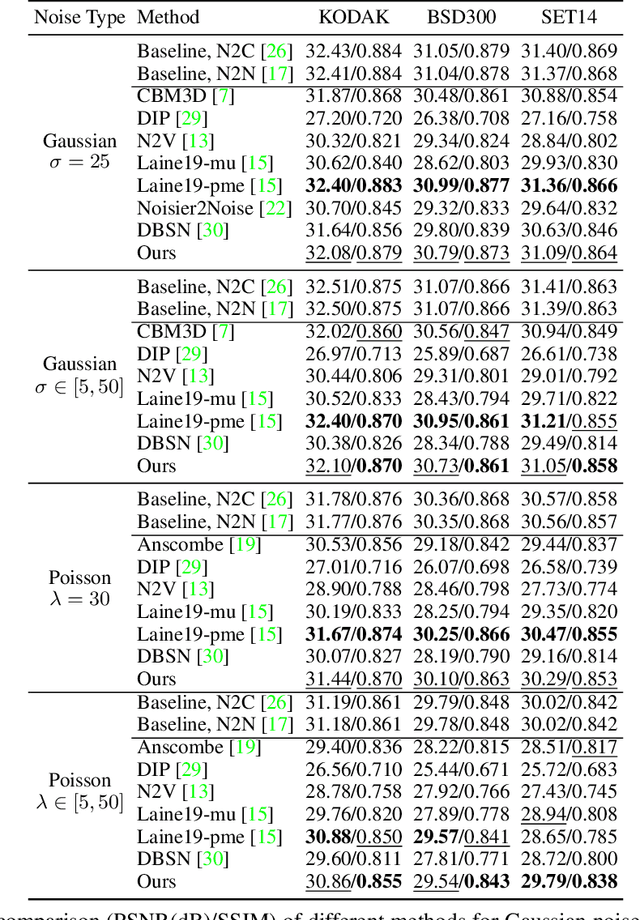
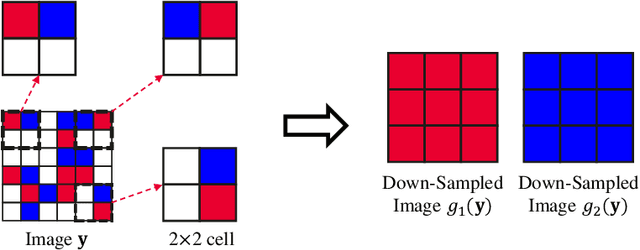
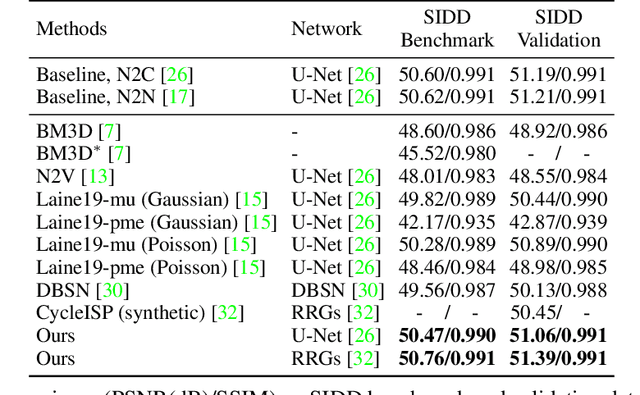
In the last few years, image denoising has benefited a lot from the fast development of neural networks. However, the requirement of large amounts of noisy-clean image pairs for supervision limits the wide use of these models. Although there have been a few attempts in training an image denoising model with only single noisy images, existing self-supervised denoising approaches suffer from inefficient network training, loss of useful information, or dependence on noise modeling. In this paper, we present a very simple yet effective method named Neighbor2Neighbor to train an effective image denoising model with only noisy images. Firstly, a random neighbor down-sampler is proposed for the generation of training image pairs. In detail, input and target used to train a network are images down-sampled from the same noisy image, satisfying the requirement that paired pixels of paired images are neighbors and have very similar appearance with each other. Secondly, a denoising network is trained on down-sampled training pairs generated in the first stage, with a proposed regularizer as additional loss for better performance. The proposed Neighbor2Neighbor framework is able to enjoy the progress of state-of-the-art supervised denoising networks in network architecture design. Moreover, it avoids heavy dependence on the assumption of the noise distribution. We explain our approach from a theoretical perspective and further validate it through extensive experiments, including synthetic experiments with different noise distributions in sRGB space and real-world experiments on a denoising benchmark dataset in raw-RGB space.
Self-Adaptively Learning to Demoire from Focused and Defocused Image Pairs
Nov 05, 2020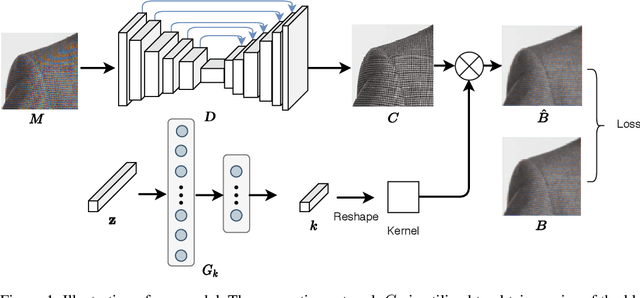
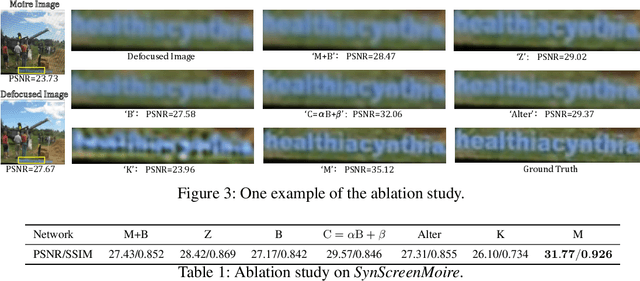
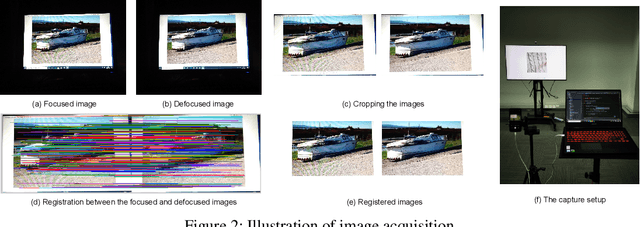

Moire artifacts are common in digital photography, resulting from the interference between high-frequency scene content and the color filter array of the camera. Existing deep learning-based demoireing methods trained on large scale datasets are limited in handling various complex moire patterns, and mainly focus on demoireing of photos taken of digital displays. Moreover, obtaining moire-free ground-truth in natural scenes is difficult but needed for training. In this paper, we propose a self-adaptive learning method for demoireing a high-frequency image, with the help of an additional defocused moire-free blur image. Given an image degraded with moire artifacts and a moire-free blur image, our network predicts a moire-free clean image and a blur kernel with a self-adaptive strategy that does not require an explicit training stage, instead performing test-time adaptation. Our model has two sub-networks and works iteratively. During each iteration, one sub-network takes the moire image as input, removing moire patterns and restoring image details, and the other sub-network estimates the blur kernel from the blur image. The two sub-networks are jointly optimized. Extensive experiments demonstrate that our method outperforms state-of-the-art methods and can produce high-quality demoired results. It can generalize well to the task of removing moire artifacts caused by display screens. In addition, we build a new moire dataset, including images with screen and texture moire artifacts. As far as we know, this is the first dataset with real texture moire patterns.