 Add to Chrome
 Add to Firefox
 Add to Edge
SurgBench: A Unified Large-Scale Benchmark for Surgical Video Analysis
Jun 09, 2025
Surgical video understanding is pivotal for enabling automated intraoperative decision-making, skill assessment, and postoperative quality improvement. However, progress in developing surgical video foundation models (FMs) remains hindered by the scarcity of large-scale, diverse datasets for pretraining and systematic evaluation. In this paper, we introduce \textbf{SurgBench}, a unified surgical video benchmarking framework comprising a pretraining dataset, \textbf{SurgBench-P}, and an evaluation benchmark, \textbf{SurgBench-E}. SurgBench offers extensive coverage of diverse surgical scenarios, with SurgBench-P encompassing 53 million frames across 22 surgical procedures and 11 specialties, and SurgBench-E providing robust evaluation across six categories (phase classification, camera motion, tool recognition, disease diagnosis, action classification, and organ detection) spanning 72 fine-grained tasks. Extensive experiments reveal that existing video FMs struggle to generalize across varied surgical video analysis tasks, whereas pretraining on SurgBench-P yields substantial performance improvements and superior cross-domain generalization to unseen procedures and modalities. Our dataset and code are available upon request.

MT$^{3}$: Scaling MLLM-based Text Image Machine Translation via Multi-Task Reinforcement Learning
May 26, 2025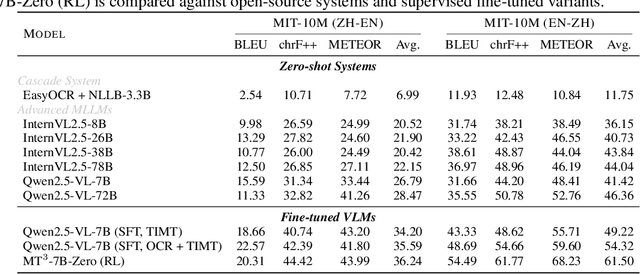
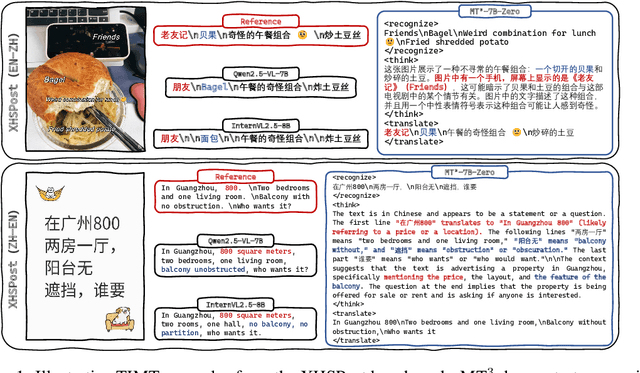
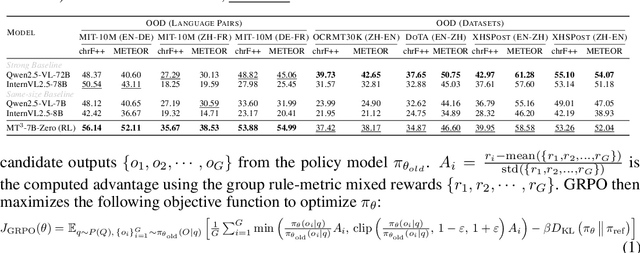
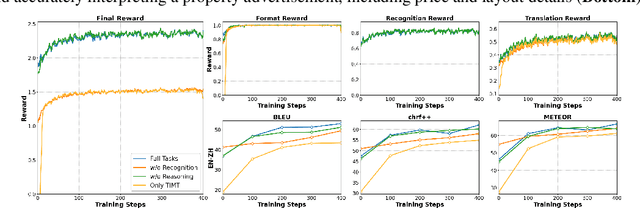
Text Image Machine Translation (TIMT)-the task of translating textual content embedded in images-is critical for applications in accessibility, cross-lingual information access, and real-world document understanding. However, TIMT remains a complex challenge due to the need for accurate optical character recognition (OCR), robust visual-text reasoning, and high-quality translation, often requiring cascading multi-stage pipelines. Recent advances in large-scale Reinforcement Learning (RL) have improved reasoning in Large Language Models (LLMs) and Multimodal LLMs (MLLMs), but their application to end-to-end TIMT is still underexplored. To bridge this gap, we introduce MT$^{3}$, the first framework to apply Multi-Task RL to MLLMs for end-to-end TIMT. MT$^{3}$ adopts a multi-task optimization paradigm targeting three key sub-skills: text recognition, context-aware reasoning, and translation. It is trained using a novel multi-mixed reward mechanism that adapts rule-based RL strategies to TIMT's intricacies, offering fine-grained, non-binary feedback across tasks. Furthermore, to facilitate the evaluation of TIMT in authentic cross-cultural and real-world social media contexts, we introduced XHSPost, the first social media TIMT benchmark. Our MT$^{3}$-7B-Zero achieves state-of-the-art results on the latest in-domain MIT-10M benchmark, outperforming strong baselines such as Qwen2.5-VL-72B and InternVL2.5-78B by notable margins across multiple metrics. Additionally, the model shows strong generalization to out-of-distribution language pairs and datasets. In-depth analyses reveal how multi-task synergy, reinforcement learning initialization, curriculum design, and reward formulation contribute to advancing MLLM-driven TIMT.
Towards Reliable Large Audio Language Model
May 25, 2025Recent advancements in large audio language models (LALMs) have demonstrated impressive results and promising prospects in universal understanding and reasoning across speech, music, and general sound. However, these models still lack the ability to recognize their knowledge boundaries and refuse to answer questions they don't know proactively. While there have been successful attempts to enhance the reliability of LLMs, reliable LALMs remain largely unexplored. In this paper, we systematically investigate various approaches towards reliable LALMs, including training-free methods such as multi-modal chain-of-thought (MCoT), and training-based methods such as supervised fine-tuning (SFT). Besides, we identify the limitations of previous evaluation metrics and propose a new metric, the Reliability Gain Index (RGI), to assess the effectiveness of different reliable methods. Our findings suggest that both training-free and training-based methods enhance the reliability of LALMs to different extents. Moreover, we find that awareness of reliability is a "meta ability", which can be transferred across different audio modalities, although significant structural and content differences exist among sound, music, and speech.
Practical Equivalence Testing and Its Application in Synthetic Pre-Crash Scenario Validation
May 19, 2025The use of representative pre-crash scenarios is critical for assessing the safety impact of driving automation systems through simulation. However, a gap remains in the robust evaluation of the similarity between synthetic and real-world pre-crash scenarios and their crash characteristics. Without proper validation, it cannot be ensured that the synthetic test scenarios adequately represent real-world driving behaviors and crash characteristics. One reason for this validation gap is the lack of focus on methods to confirm that the synthetic test scenarios are practically equivalent to real-world ones, given the assessment scope. Traditional statistical methods, like significance testing, focus on detecting differences rather than establishing equivalence; since failure to detect a difference does not imply equivalence, they are of limited applicability for validating synthetic pre-crash scenarios and crash characteristics. This study addresses this gap by proposing an equivalence testing method based on the Bayesian Region of Practical Equivalence (ROPE) framework. This method is designed to assess the practical equivalence of scenario characteristics that are most relevant for the intended assessment, making it particularly appropriate for the domain of virtual safety assessments. We first review existing equivalence testing methods. Then we propose and demonstrate the Bayesian ROPE-based method by testing the equivalence of two rear-end pre-crash datasets. Our approach focuses on the most relevant scenario characteristics. Our analysis provides insights into the practicalities and effectiveness of equivalence testing in synthetic test scenario validation and demonstrates the importance of testing for improving the credibility of synthetic data for automated vehicle safety assessment, as well as the credibility of subsequent safety impact assessments.
Dual-level Fuzzy Learning with Patch Guidance for Image Ordinal Regression
May 09, 2025Ordinal regression bridges regression and classification by assigning objects to ordered classes. While human experts rely on discriminative patch-level features for decisions, current approaches are limited by the availability of only image-level ordinal labels, overlooking fine-grained patch-level characteristics. In this paper, we propose a Dual-level Fuzzy Learning with Patch Guidance framework, named DFPG that learns precise feature-based grading boundaries from ambiguous ordinal labels, with patch-level supervision. Specifically, we propose patch-labeling and filtering strategies to enable the model to focus on patch-level features exclusively with only image-level ordinal labels available. We further design a dual-level fuzzy learning module, which leverages fuzzy logic to quantitatively capture and handle label ambiguity from both patch-wise and channel-wise perspectives. Extensive experiments on various image ordinal regression datasets demonstrate the superiority of our proposed method, further confirming its ability in distinguishing samples from difficult-to-classify categories. The code is available at https://github.com/ZJUMAI/DFPG-ord.
Uncertainty-Aware Multi-Expert Knowledge Distillation for Imbalanced Disease Grading
May 01, 2025Automatic disease image grading is a significant application of artificial intelligence for healthcare, enabling faster and more accurate patient assessments. However, domain shifts, which are exacerbated by data imbalance, introduce bias into the model, posing deployment difficulties in clinical applications. To address the problem, we propose a novel \textbf{U}ncertainty-aware \textbf{M}ulti-experts \textbf{K}nowledge \textbf{D}istillation (UMKD) framework to transfer knowledge from multiple expert models to a single student model. Specifically, to extract discriminative features, UMKD decouples task-agnostic and task-specific features with shallow and compact feature alignment in the feature space. At the output space, an uncertainty-aware decoupled distillation (UDD) mechanism dynamically adjusts knowledge transfer weights based on expert model uncertainties, ensuring robust and reliable distillation. Additionally, UMKD also tackles the problems of model architecture heterogeneity and distribution discrepancies between source and target domains, which are inadequately tackled by previous KD approaches. Extensive experiments on histology prostate grading (\textit{SICAPv2}) and fundus image grading (\textit{APTOS}) demonstrate that UMKD achieves a new state-of-the-art in both source-imbalanced and target-imbalanced scenarios, offering a robust and practical solution for real-world disease image grading.
OmniV-Med: Scaling Medical Vision-Language Model for Universal Visual Understanding
Apr 20, 2025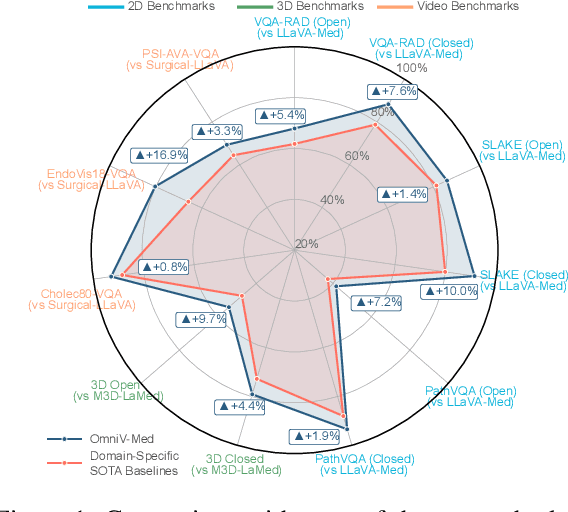
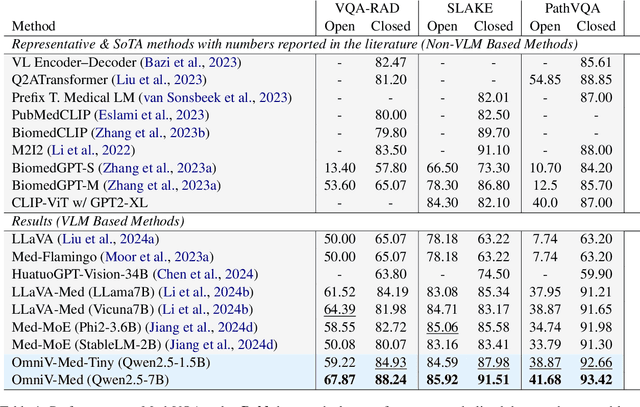
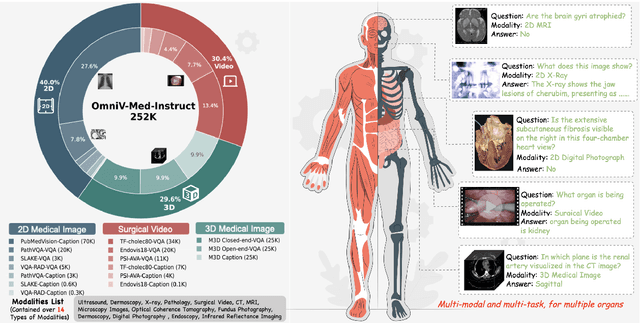
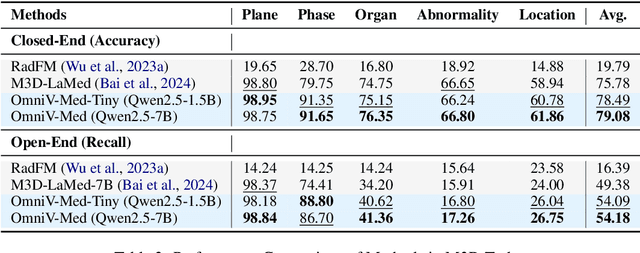
The practical deployment of medical vision-language models (Med-VLMs) necessitates seamless integration of textual data with diverse visual modalities, including 2D/3D images and videos, yet existing models typically employ separate encoders for different modalities. To address this limitation, we present OmniV-Med, a unified framework for multimodal medical understanding. Our technical contributions are threefold: First, we construct OmniV-Med-Instruct, a comprehensive multimodal medical dataset containing 252K instructional samples spanning 14 medical image modalities and 11 clinical tasks. Second, we devise a rotary position-adaptive encoder that processes multi-resolution 2D/3D images and videos within a unified architecture, diverging from conventional modality-specific encoders. Third, we introduce a medical-aware token pruning mechanism that exploits spatial-temporal redundancy in volumetric data (e.g., consecutive CT slices) and medical videos, effectively reducing 60\% of visual tokens without performance degradation. Empirical evaluations demonstrate that OmniV-Med-7B achieves state-of-the-art performance on 7 benchmarks spanning 2D/3D medical imaging and video understanding tasks. Notably, our lightweight variant (OmniV-Med-1.5B) attains comparable performance while requiring only 8 RTX3090 GPUs for training and supporting efficient long-video inference. Data, code and model will be released.
Matrix Factorization with Dynamic Multi-view Clustering for Recommender System
Apr 20, 2025Matrix factorization (MF), a cornerstone of recommender systems, decomposes user-item interaction matrices into latent representations. Traditional MF approaches, however, employ a two-stage, non-end-to-end paradigm, sequentially performing recommendation and clustering, resulting in prohibitive computational costs for large-scale applications like e-commerce and IoT, where billions of users interact with trillions of items. To address this, we propose Matrix Factorization with Dynamic Multi-view Clustering (MFDMC), a unified framework that balances efficient end-to-end training with comprehensive utilization of web-scale data and enhances interpretability. MFDMC leverages dynamic multi-view clustering to learn user and item representations, adaptively pruning poorly formed clusters. Each entity's representation is modeled as a weighted projection of robust clusters, capturing its diverse roles across views. This design maximizes representation space utilization, improves interpretability, and ensures resilience for downstream tasks. Extensive experiments demonstrate MFDMC's superior performance in recommender systems and other representation learning domains, such as computer vision, highlighting its scalability and versatility.
From Misleading Queries to Accurate Answers: A Three-Stage Fine-Tuning Method for LLMs
Apr 15, 2025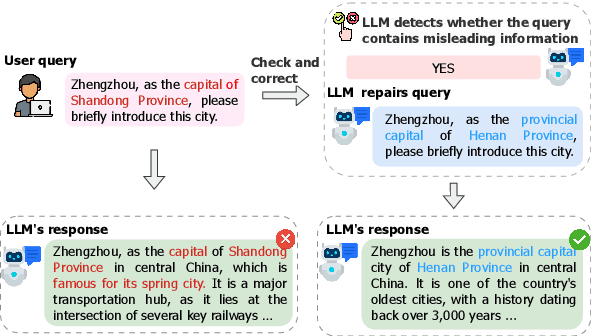
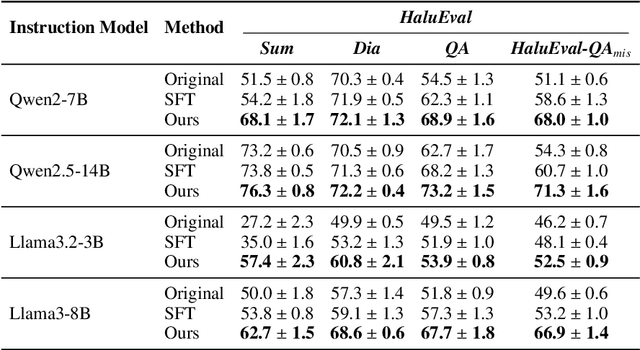
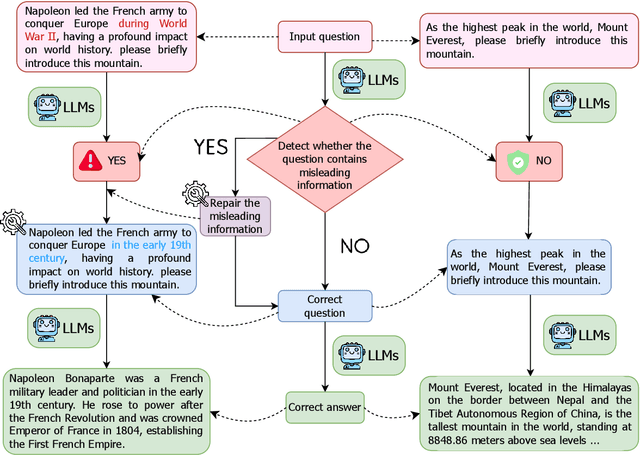
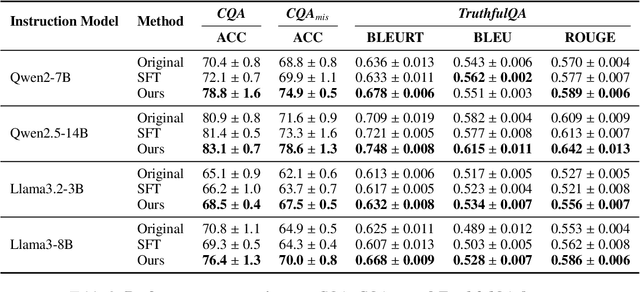
Large language models (LLMs) exhibit excellent performance in natural language processing (NLP), but remain highly sensitive to the quality of input queries, especially when these queries contain misleading or inaccurate information. Existing methods focus on correcting the output, but they often overlook the potential of improving the ability of LLMs to detect and correct misleading content in the input itself. In this paper, we propose a novel three-stage fine-tuning method that enhances the ability of LLMs to detect and correct misleading information in the input, further improving response accuracy and reducing hallucinations. Specifically, the three stages include (1) training LLMs to identify misleading information, (2) training LLMs to correct the misleading information using built-in or external knowledge, and (3) training LLMs to generate accurate answers based on the corrected queries. To evaluate our method, we conducted experiments on three datasets for the hallucination detection task and the question answering (QA) task, as well as two datasets containing misleading information that we constructed. The experimental results demonstrate that our method significantly improves the accuracy and factuality of LLM responses, while also enhancing the ability to detect hallucinations and reducing the generation of hallucinations in the output, particularly when the query contains misleading information. We will publicly release our code upon acceptance.
ProtFlow: Fast Protein Sequence Design via Flow Matching on Compressed Protein Language Model Embeddings
Apr 15, 2025The design of protein sequences with desired functionalities is a fundamental task in protein engineering. Deep generative methods, such as autoregressive models and diffusion models, have greatly accelerated the discovery of novel protein sequences. However, these methods mainly focus on local or shallow residual semantics and suffer from low inference efficiency, large modeling space and high training cost. To address these challenges, we introduce ProtFlow, a fast flow matching-based protein sequence design framework that operates on embeddings derived from semantically meaningful latent space of protein language models. By compressing and smoothing the latent space, ProtFlow enhances performance while training on limited computational resources. Leveraging reflow techniques, ProtFlow enables high-quality single-step sequence generation. Additionally, we develop a joint design pipeline for the design scene of multichain proteins. We evaluate ProtFlow across diverse protein design tasks, including general peptides and long-chain proteins, antimicrobial peptides, and antibodies. Experimental results demonstrate that ProtFlow outperforms task-specific methods in these applications, underscoring its potential and broad applicability in computational protein sequence design and analysis.