 Add to Chrome
 Add to Firefox
 Add to Edge
Hybrid Advantage Estimation with Unified Critic for VLM Agentic Reinforcement Learning
Jul 26, 2026
Large Vision-Language Models (VLMs) now act as agents in interactive environments, where success requires coherent reasoning and decision-making across turns. Although end-to-end training in agentic environments can improve such multi-turn decision-making abilities, current methods mainly rely on either token-wise optimization over concatenated token trajectories or turn-wise optimization with uniform within-turn credit. In this work, we establish theoretical formulations for the two levels of optimization and derive a hybrid advantage that serves both objectives. Furthermore, with an appropriate choice of discount factor and learning target, we prove that a unified critic model can estimate values for both turn-wise and token-wise. As such, we propose HyGAE, an actor-critic framework that jointly optimizes token- and turn-level objectives with the hybrid advantage and unified critic. We conduct extensive evaluations of HyGAE across five multi-turn decision-making environments, where it achieves an average success rate of 91% and a significant improvement of 10% over other methods. Furthermore, we provide an in-depth analysis showing that the exact analytic form of the hybrid advantage and return is crucial for optimization. Project Page: https://wx-zhang.github.io/hygae-web/.

Pailitao-MMSearch: Building Native E-Commerce Multimodal Search Foundation
Jul 20, 2026The evolution of e-commerce has fundamentally transformed how users search for products, shifting from simple text-based keyword queries to complex multimodal interactions that seamlessly combine product images, natural language descriptions, and mixed-intent instructions. However, existing approaches face a critical dilemma: single-modal specialist models, deployed independently for text retrieval, visual search, and voice recognition, operate in isolation and cannot handle cross-modal queries, while general-purpose vision-language models lack the domain-specific knowledge necessary for fine-grained product understanding, user behavior modeling, and commercial intent reasoning. In this work, we present Pailitao-MMSearch, one native e-commerce multimodal search foundation model designed to bridge this gap. Our approach introduces three key innovations: (1)HybSID (Hybrid Semantic ID);(2)a two-stage continual pre-training strategy; and (3)a hybrid reasoning post-training pipeline. Built upon Qwen and deployed on Taobao's Pailitao multimodal search platform, Pailitao-MMSearch achieves substantial improvements in online A/B testing, including up to +13.61\% in Gross Merchandise Volume (GMV) and +8.21\% in transaction volume compared to traditional multi-modal search pipeline, demonstrating the effectiveness of our native e-commerce multimodal search large language models.
Artic-O: End-to-End Articulated Object Reconstruction via Latent Geometry Learning
Jun 20, 2026Reconstructing articulated objects from sparse images requires recovering complete geometry, movable parts, and motion parameters. Recent methods typically separate geometry reconstruction, part reasoning, and articulation estimation into different stages. This separation can weaken consistency between shape, active parts, and motion, while also incurring substantial inference cost. We introduce Artic-O, an end-to-end, feed-forward framework for articulated object reconstruction via latent geometry learning. Instead of fitting geometry in image or view space, Artic-O maps sparse multi-state observations into a pretrained latent geometry space, where a frozen flow-matching decoder provides a complete-shape prior for recovering visible and occluded structures. To connect geometry with articulation, Artic-O fuses visual tokens, geometry latents, and point-wise decoder features in an image-grounded part-reasoning module for active-part segmentation and articulation prediction. We further train the model with a geometry-to-articulation curriculum and a decoupled two-pass strategy to balance reconstruction and part-level supervision. On PartNet-Mobility, Artic-O achieves strong reconstruction quality while being substantially more efficient than LARM, a strong prior method. It reduces Chamfer Distance, improves F-score, and achieves comparable or better articulation accuracy across most joint metrics, while reducing inference time from 9 minutes to about 0.3 seconds per object.
High-Quality and Efficient Turbulence Mitigation with Events
Mar 21, 2026Turbulence mitigation (TM) is highly ill-posed due to the stochastic nature of atmospheric turbulence. Most methods rely on multiple frames recorded by conventional cameras to capture stable patterns in natural scenarios. However, they inevitably suffer from a trade-off between accuracy and efficiency: more frames enhance restoration at the cost of higher system latency and larger data overhead. Event cameras, equipped with microsecond temporal resolution and efficient sensing of dynamic changes, offer an opportunity to break the bottleneck. In this work, we present EHETM, a high-quality and efficient TM method inspired by the superiority of events to model motions in continuous sequences. We discover two key phenomena: (1) turbulence-induced events exhibit distinct polarity alternation correlated with sharp image gradients, providing structural cues for restoring scenes; and (2) dynamic objects form spatiotemporally coherent ``event tubes'' in contrast to irregular patterns within turbulent events, providing motion priors for disentangling objects from turbulence. Based on these insights, we design two complementary modules that respectively leverage polarity-weighted gradients for scene refinement and event-tube constraints for motion decoupling, achieving high-quality restoration with few frames. Furthermore, we construct two real-world event-frame turbulence datasets covering atmospheric and thermal cases. Experiments show that EHETM outperforms SOTA methods, especially under scenes with dynamic objects, while reducing data overhead and system latency by approximately 77.3% and 89.5%, respectively. Our code is available at: https://github.com/Xavier667/EHETM.
Efficient Tuning of Large Language Models for Knowledge-Grounded Dialogue Generation
Apr 10, 2025Large language models (LLMs) demonstrate remarkable text comprehension and generation capabilities but often lack the ability to utilize up-to-date or domain-specific knowledge not included in their training data. To address this gap, we introduce KEDiT, an efficient method for fine-tuning LLMs for knowledge-grounded dialogue generation. KEDiT operates in two main phases: first, it employs an information bottleneck to compress retrieved knowledge into learnable parameters, retaining essential information while minimizing computational overhead. Second, a lightweight knowledge-aware adapter integrates these compressed knowledge vectors into the LLM during fine-tuning, updating less than 2\% of the model parameters. The experimental results on the Wizard of Wikipedia and a newly constructed PubMed-Dialog dataset demonstrate that KEDiT excels in generating contextually relevant and informative responses, outperforming competitive baselines in automatic, LLM-based, and human evaluations. This approach effectively combines the strengths of pretrained LLMs with the adaptability needed for incorporating dynamic knowledge, presenting a scalable solution for fields such as medicine.
Oriented Tiny Object Detection: A Dataset, Benchmark, and Dynamic Unbiased Learning
Dec 16, 2024Detecting oriented tiny objects, which are limited in appearance information yet prevalent in real-world applications, remains an intricate and under-explored problem. To address this, we systemically introduce a new dataset, benchmark, and a dynamic coarse-to-fine learning scheme in this study. Our proposed dataset, AI-TOD-R, features the smallest object sizes among all oriented object detection datasets. Based on AI-TOD-R, we present a benchmark spanning a broad range of detection paradigms, including both fully-supervised and label-efficient approaches. Through investigation, we identify a learning bias presents across various learning pipelines: confident objects become increasingly confident, while vulnerable oriented tiny objects are further marginalized, hindering their detection performance. To mitigate this issue, we propose a Dynamic Coarse-to-Fine Learning (DCFL) scheme to achieve unbiased learning. DCFL dynamically updates prior positions to better align with the limited areas of oriented tiny objects, and it assigns samples in a way that balances both quantity and quality across different object shapes, thus mitigating biases in prior settings and sample selection. Extensive experiments across eight challenging object detection datasets demonstrate that DCFL achieves state-of-the-art accuracy, high efficiency, and remarkable versatility. The dataset, benchmark, and code are available at https://chasel-tsui.github.io/AI-TOD-R/.
A computational transition for detecting correlated stochastic block models by low-degree polynomials
Sep 02, 2024Detection of correlation in a pair of random graphs is a fundamental statistical and computational problem that has been extensively studied in recent years. In this work, we consider a pair of correlated (sparse) stochastic block models $\mathcal{S}(n,\tfrac{\lambda}{n};k,\epsilon;s)$ that are subsampled from a common parent stochastic block model $\mathcal S(n,\tfrac{\lambda}{n};k,\epsilon)$ with $k=O(1)$ symmetric communities, average degree $\lambda=O(1)$, divergence parameter $\epsilon$, and subsampling probability $s$. For the detection problem of distinguishing this model from a pair of independent Erd\H{o}s-R\'enyi graphs with the same edge density $\mathcal{G}(n,\tfrac{\lambda s}{n})$, we focus on tests based on \emph{low-degree polynomials} of the entries of the adjacency matrices, and we determine the threshold that separates the easy and hard regimes. More precisely, we show that this class of tests can distinguish these two models if and only if $s> \min \{ \sqrt{\alpha}, \frac{1}{\lambda \epsilon^2} \}$, where $\alpha\approx 0.338$ is the Otter's constant and $\frac{1}{\lambda \epsilon^2}$ is the Kesten-Stigum threshold. Our proof of low-degree hardness is based on a conditional variant of the low-degree likelihood calculation.
Goldfish: Vision-Language Understanding of Arbitrarily Long Videos
Jul 17, 2024Most current LLM-based models for video understanding can process videos within minutes. However, they struggle with lengthy videos due to challenges such as "noise and redundancy", as well as "memory and computation" constraints. In this paper, we present Goldfish, a methodology tailored for comprehending videos of arbitrary lengths. We also introduce the TVQA-long benchmark, specifically designed to evaluate models' capabilities in understanding long videos with questions in both vision and text content. Goldfish approaches these challenges with an efficient retrieval mechanism that initially gathers the top-k video clips relevant to the instruction before proceeding to provide the desired response. This design of the retrieval mechanism enables the Goldfish to efficiently process arbitrarily long video sequences, facilitating its application in contexts such as movies or television series. To facilitate the retrieval process, we developed MiniGPT4-Video that generates detailed descriptions for the video clips. In addressing the scarcity of benchmarks for long video evaluation, we adapted the TVQA short video benchmark for extended content analysis by aggregating questions from entire episodes, thereby shifting the evaluation from partial to full episode comprehension. We attained a 41.78% accuracy rate on the TVQA-long benchmark, surpassing previous methods by 14.94%. Our MiniGPT4-Video also shows exceptional performance in short video comprehension, exceeding existing state-of-the-art methods by 3.23%, 2.03%, 16.5% and 23.59% on the MSVD, MSRVTT, TGIF, and TVQA short video benchmarks, respectively. These results indicate that our models have significant improvements in both long and short-video understanding. Our models and code have been made publicly available at https://vision-cair.github.io/Goldfish_website/
InfiniBench: A Comprehensive Benchmark for Large Multimodal Models in Very Long Video Understanding
Jun 28, 2024Understanding long videos, ranging from tens of minutes to several hours, presents unique challenges in video comprehension. Despite the increasing importance of long-form video content, existing benchmarks primarily focus on shorter clips. To address this gap, we introduce InfiniBench a comprehensive benchmark for very long video understanding which presents 1)The longest video duration, averaging 76.34 minutes; 2) The largest number of question-answer pairs, 108.2K; 3) Diversity in questions that examine nine different skills and include both multiple-choice questions and open-ended questions; 4) Humancentric, as the video sources come from movies and daily TV shows, with specific human-level question designs such as Movie Spoiler Questions that require critical thinking and comprehensive understanding. Using InfiniBench, we comprehensively evaluate existing Large MultiModality Models (LMMs) on each skill, including the commercial model Gemini 1.5 Flash and the open-source models. The evaluation shows significant challenges in our benchmark.Our results show that the best AI models such Gemini struggles to perform well with 42.72% average accuracy and 2.71 out of 5 average score. We hope this benchmark will stimulate the LMMs community towards long video and human-level understanding. Our benchmark can be accessed at https://vision-cair.github.io/InfiniBench/
VRSBench: A Versatile Vision-Language Benchmark Dataset for Remote Sensing Image Understanding
Jun 18, 2024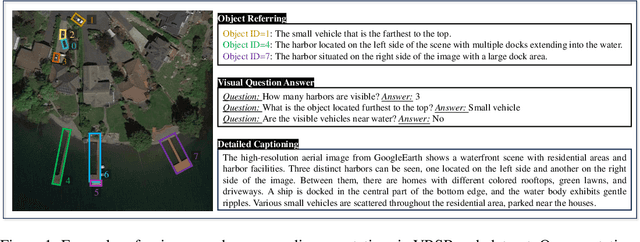
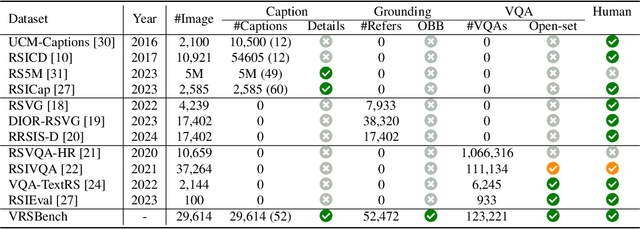

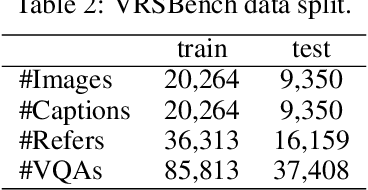
We introduce a new benchmark designed to advance the development of general-purpose, large-scale vision-language models for remote sensing images. Although several vision-language datasets in remote sensing have been proposed to pursue this goal, existing datasets are typically tailored to single tasks, lack detailed object information, or suffer from inadequate quality control. Exploring these improvement opportunities, we present a Versatile vision-language Benchmark for Remote Sensing image understanding, termed VRSBench. This benchmark comprises 29,614 images, with 29,614 human-verified detailed captions, 52,472 object references, and 123,221 question-answer pairs. It facilitates the training and evaluation of vision-language models across a broad spectrum of remote sensing image understanding tasks. We further evaluated state-of-the-art models on this benchmark for three vision-language tasks: image captioning, visual grounding, and visual question answering. Our work aims to significantly contribute to the development of advanced vision-language models in the field of remote sensing. The data and code can be accessed at https://github.com/lx709/VRSBench.