 Add to Chrome
 Add to Firefox
 Add to Edge
ST-$π$: Structured SpatioTemporal VLA for Robotic Manipulation
Apr 20, 2026
Vision-language-action (VLA) models have achieved great success on general robotic tasks, but still face challenges in fine-grained spatiotemporal manipulation. Typically, existing methods mainly embed spatiotemporal knowledge into visual and action representations, and directly perform a cross-modal mapping for step-level action prediction. However, such spatiotemporal reasoning remains largely implicit, making it difficult to handle multiple sequential behaviors with explicit spatiotemporal boundaries. In this work, we propose ST-$π$, a structured spatiotemporal VLA model for robotic manipulation. Our model is guided by two key designs: 1) Spatiotemporal VLM. We encode 4D observations and task instructions into latent spaces, and feed them into the LLM to generate a sequence of causally ordered chunk-level action prompts consisting of sub-tasks, spatial grounding and temporal grounding. 2) Spatiotemporal action expert. Conditioned on chunk-level action prompts, we design a structured dual-generator guidance to jointly model spatial dependencies and temporal causality, thus predicting step-level action parameters. Within this structured framework, the VLM explicitly plans global spatiotemporal behavior, and the action expert further refines local spatiotemporal control. In addition, we propose a real-world robotic dataset with structured spatiotemporal annotations for fine-tuning. Extensive experiments have been conducted to demonstrate the effectiveness of our model. Our code link: https://github.com/chuanhaoma/ST-pi.

High-Quality and Efficient Turbulence Mitigation with Events
Mar 21, 2026Turbulence mitigation (TM) is highly ill-posed due to the stochastic nature of atmospheric turbulence. Most methods rely on multiple frames recorded by conventional cameras to capture stable patterns in natural scenarios. However, they inevitably suffer from a trade-off between accuracy and efficiency: more frames enhance restoration at the cost of higher system latency and larger data overhead. Event cameras, equipped with microsecond temporal resolution and efficient sensing of dynamic changes, offer an opportunity to break the bottleneck. In this work, we present EHETM, a high-quality and efficient TM method inspired by the superiority of events to model motions in continuous sequences. We discover two key phenomena: (1) turbulence-induced events exhibit distinct polarity alternation correlated with sharp image gradients, providing structural cues for restoring scenes; and (2) dynamic objects form spatiotemporally coherent ``event tubes'' in contrast to irregular patterns within turbulent events, providing motion priors for disentangling objects from turbulence. Based on these insights, we design two complementary modules that respectively leverage polarity-weighted gradients for scene refinement and event-tube constraints for motion decoupling, achieving high-quality restoration with few frames. Furthermore, we construct two real-world event-frame turbulence datasets covering atmospheric and thermal cases. Experiments show that EHETM outperforms SOTA methods, especially under scenes with dynamic objects, while reducing data overhead and system latency by approximately 77.3% and 89.5%, respectively. Our code is available at: https://github.com/Xavier667/EHETM.
NEC-Diff: Noise-Robust Event-RAW Complementary Diffusion for Seeing Motion in Extreme Darkness
Mar 20, 2026High-quality imaging of dynamic scenes in extremely low-light conditions is highly challenging. Photon scarcity induces severe noise and texture loss, causing significant image degradation. Event cameras, featuring a high dynamic range (120 dB) and high sensitivity to motion, serve as powerful complements to conventional cameras by offering crucial cues for preserving subtle textures. However, most existing approaches emphasize texture recovery from events, while paying little attention to image noise or the intrinsic noise of events themselves, which ultimately hinders accurate pixel reconstruction under photon-starved conditions. In this work, we propose NEC-Diff, a novel diffusion-based event-RAW hybrid imaging framework that extracts reliable information from heavily noisy signals to reconstruct fine scene structures. The framework is driven by two key insights: (1) combining the linear light-response property of RAW images with the brightness-change nature of events to establish a physics-driven constraint for robust dual-modal denoising; and (2) dynamically estimating the SNR of both modalities based on denoising results to guide adaptive feature fusion, thereby injecting reliable cues into the diffusion process for high-fidelity visual reconstruction. Furthermore, we construct the REAL (Raw and Event Acquired in Low-light) dataset which provides 47,800 pixel-aligned low-light RAW images, events, and high-quality references under 0.001-0.8 lux illumination. Extensive experiments demonstrate the superiority of NEC-Diff under extreme darkness. The project are available at: https://github.com/jinghan-xu/NEC-Diff.
Adapting Depth Anything to Adverse Imaging Conditions with Events
Jan 05, 2026Robust depth estimation under dynamic and adverse lighting conditions is essential for robotic systems. Currently, depth foundation models, such as Depth Anything, achieve great success in ideal scenes but remain challenging under adverse imaging conditions such as extreme illumination and motion blur. These degradations corrupt the visual signals of frame cameras, weakening the discriminative features of frame-based depths across the spatial and temporal dimensions. Typically, existing approaches incorporate event cameras to leverage their high dynamic range and temporal resolution, aiming to compensate for corrupted frame features. However, such specialized fusion models are predominantly trained from scratch on domain-specific datasets, thereby failing to inherit the open-world knowledge and robust generalization inherent to foundation models. In this work, we propose ADAE, an event-guided spatiotemporal fusion framework for Depth Anything in degraded scenes. Our design is guided by two key insights: 1) Entropy-Aware Spatial Fusion. We adaptively merge frame-based and event-based features using an information entropy strategy to indicate illumination-induced degradation. 2) Motion-Guided Temporal Correction. We resort to the event-based motion cue to recalibrate ambiguous features in blurred regions. Under our unified framework, the two components are complementary to each other and jointly enhance Depth Anything under adverse imaging conditions. Extensive experiments have been performed to verify the superiority of the proposed method. Our code will be released upon acceptance.
Blur-Robust Detection via Feature Restoration: An End-to-End Framework for Prior-Guided Infrared UAV Target Detection
Nov 18, 2025Infrared unmanned aerial vehicle (UAV) target images often suffer from motion blur degradation caused by rapid sensor movement, significantly reducing contrast between target and background. Generally, detection performance heavily depends on the discriminative feature representation between target and background. Existing methods typically treat deblurring as a preprocessing step focused on visual quality, while neglecting the enhancement of task-relevant features crucial for detection. Improving feature representation for detection under blur conditions remains challenging. In this paper, we propose a novel Joint Feature-Domain Deblurring and Detection end-to-end framework, dubbed JFD3. We design a dual-branch architecture with shared weights, where the clear branch guides the blurred branch to enhance discriminative feature representation. Specifically, we first introduce a lightweight feature restoration network, where features from the clear branch serve as feature-level supervision to guide the blurred branch, thereby enhancing its distinctive capability for detection. We then propose a frequency structure guidance module that refines the structure prior from the restoration network and integrates it into shallow detection layers to enrich target structural information. Finally, a feature consistency self-supervised loss is imposed between the dual-branch detection backbones, driving the blurred branch to approximate the feature representations of the clear one. Wealso construct a benchmark, named IRBlurUAV, containing 30,000 simulated and 4,118 real infrared UAV target images with diverse motion blur. Extensive experiments on IRBlurUAV demonstrate that JFD3 achieves superior detection performance while maintaining real-time efficiency.
Spatio-Temporal Context Learning with Temporal Difference Convolution for Moving Infrared Small Target Detection
Nov 16, 2025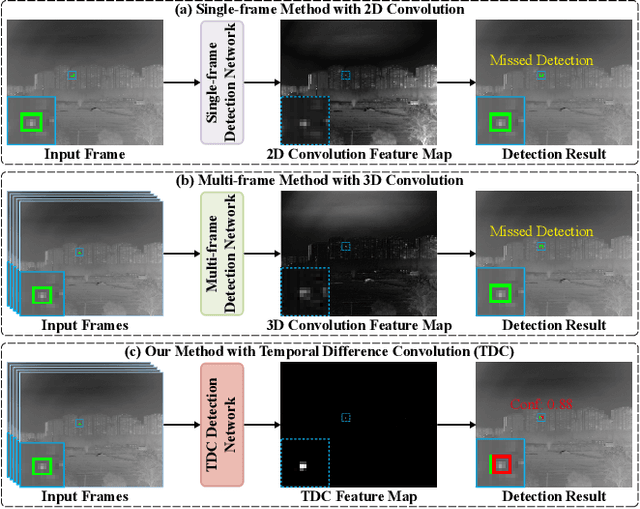
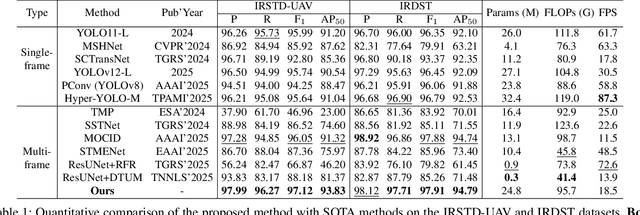
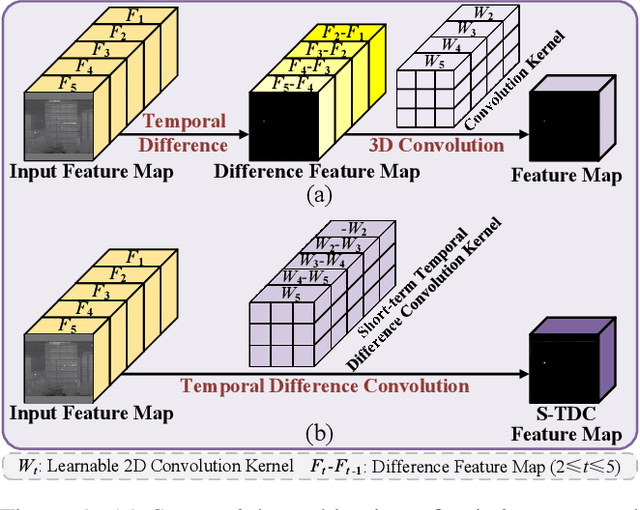

Moving infrared small target detection (IRSTD) plays a critical role in practical applications, such as surveillance of unmanned aerial vehicles (UAVs) and UAV-based search system. Moving IRSTD still remains highly challenging due to weak target features and complex background interference. Accurate spatio-temporal feature modeling is crucial for moving target detection, typically achieved through either temporal differences or spatio-temporal (3D) convolutions. Temporal difference can explicitly leverage motion cues but exhibits limited capability in extracting spatial features, whereas 3D convolution effectively represents spatio-temporal features yet lacks explicit awareness of motion dynamics along the temporal dimension. In this paper, we propose a novel moving IRSTD network (TDCNet), which effectively extracts and enhances spatio-temporal features for accurate target detection. Specifically, we introduce a novel temporal difference convolution (TDC) re-parameterization module that comprises three parallel TDC blocks designed to capture contextual dependencies across different temporal ranges. Each TDC block fuses temporal difference and 3D convolution into a unified spatio-temporal convolution representation. This re-parameterized module can effectively capture multi-scale motion contextual features while suppressing pseudo-motion clutter in complex backgrounds, significantly improving detection performance. Moreover, we propose a TDC-guided spatio-temporal attention mechanism that performs cross-attention between the spatio-temporal features from the TDC-based backbone and a parallel 3D backbone. This mechanism models their global semantic dependencies to refine the current frame's features. Extensive experiments on IRSTD-UAV and public infrared datasets demonstrate that our TDCNet achieves state-of-the-art detection performance in moving target detection.
TimeTracker: Event-based Continuous Point Tracking for Video Frame Interpolation with Non-linear Motion
May 06, 2025Video frame interpolation (VFI) that leverages the bio-inspired event cameras as guidance has recently shown better performance and memory efficiency than the frame-based methods, thanks to the event cameras' advantages, such as high temporal resolution. A hurdle for event-based VFI is how to effectively deal with non-linear motion, caused by the dynamic changes in motion direction and speed within the scene. Existing methods either use events to estimate sparse optical flow or fuse events with image features to estimate dense optical flow. Unfortunately, motion errors often degrade the VFI quality as the continuous motion cues from events do not align with the dense spatial information of images in the temporal dimension. In this paper, we find that object motion is continuous in space, tracking local regions over continuous time enables more accurate identification of spatiotemporal feature correlations. In light of this, we propose a novel continuous point tracking-based VFI framework, named TimeTracker. Specifically, we first design a Scene-Aware Region Segmentation (SARS) module to divide the scene into similar patches. Then, a Continuous Trajectory guided Motion Estimation (CTME) module is proposed to track the continuous motion trajectory of each patch through events. Finally, intermediate frames at any given time are generated through global motion optimization and frame refinement. Moreover, we collect a real-world dataset that features fast non-linear motion. Extensive experiments show that our method outperforms prior arts in both motion estimation and frame interpolation quality.
Detection-Friendly Nonuniformity Correction: A Union Framework for Infrared UAVTarget Detection
Apr 05, 2025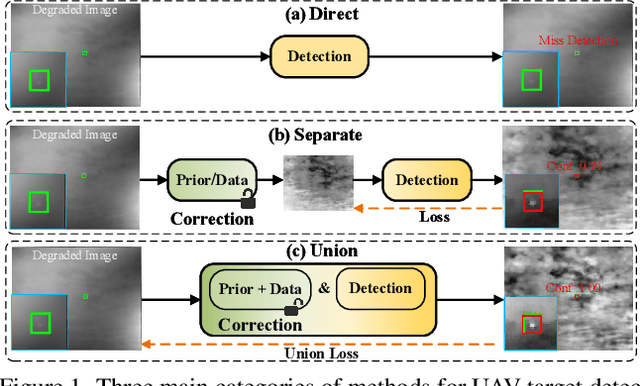
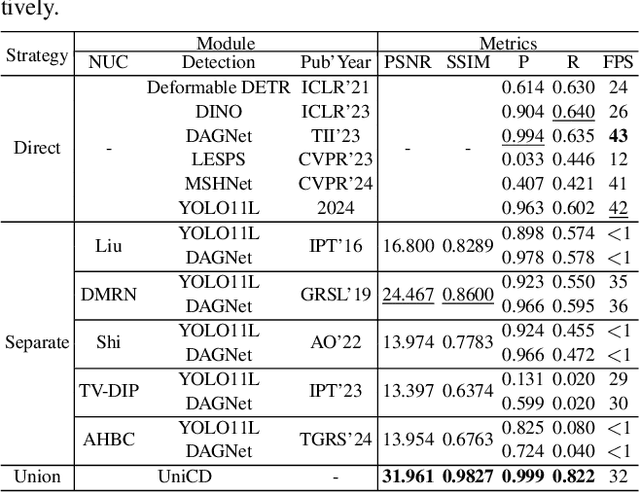
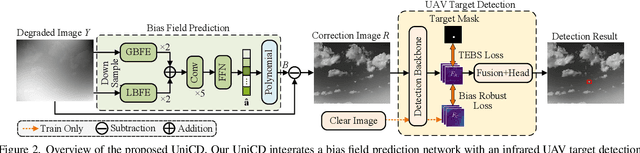
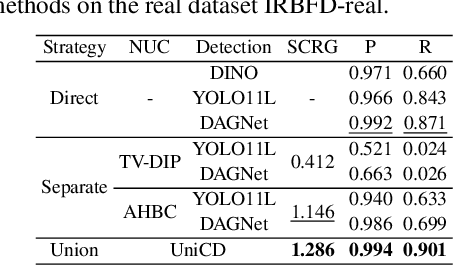
Infrared unmanned aerial vehicle (UAV) images captured using thermal detectors are often affected by temperature dependent low-frequency nonuniformity, which significantly reduces the contrast of the images. Detecting UAV targets under nonuniform conditions is crucial in UAV surveillance applications. Existing methods typically treat infrared nonuniformity correction (NUC) as a preprocessing step for detection, which leads to suboptimal performance. Balancing the two tasks while enhancing detection beneficial information remains challenging. In this paper, we present a detection-friendly union framework, termed UniCD, that simultaneously addresses both infrared NUC and UAV target detection tasks in an end-to-end manner. We first model NUC as a small number of parameter estimation problem jointly driven by priors and data to generate detection-conducive images. Then, we incorporate a new auxiliary loss with target mask supervision into the backbone of the infrared UAV target detection network to strengthen target features while suppressing the background. To better balance correction and detection, we introduce a detection-guided self-supervised loss to reduce feature discrepancies between the two tasks, thereby enhancing detection robustness to varying nonuniformity levels. Additionally, we construct a new benchmark composed of 50,000 infrared images in various nonuniformity types, multi-scale UAV targets and rich backgrounds with target annotations, called IRBFD. Extensive experiments on IRBFD demonstrate that our UniCD is a robust union framework for NUC and UAV target detection while achieving real-time processing capabilities. Dataset can be available at https://github.com/IVPLaboratory/UniCD.
Divide-and-Conquer: Dual-Hierarchical Optimization for Semantic 4D Gaussian Spatting
Mar 25, 2025Semantic 4D Gaussians can be used for reconstructing and understanding dynamic scenes, with temporal variations than static scenes. Directly applying static methods to understand dynamic scenes will fail to capture the temporal features. Few works focus on dynamic scene understanding based on Gaussian Splatting, since once the same update strategy is employed for both dynamic and static parts, regardless of the distinction and interaction between Gaussians, significant artifacts and noise appear. We propose Dual-Hierarchical Optimization (DHO), which consists of Hierarchical Gaussian Flow and Hierarchical Gaussian Guidance in a divide-and-conquer manner. The former implements effective division of static and dynamic rendering and features. The latter helps to mitigate the issue of dynamic foreground rendering distortion in textured complex scenes. Extensive experiments show that our method consistently outperforms the baselines on both synthetic and real-world datasets, and supports various downstream tasks. Project Page: https://sweety-yan.github.io/DHO.
Bridge Frame and Event: Common Spatiotemporal Fusion for High-Dynamic Scene Optical Flow
Mar 11, 2025High-dynamic scene optical flow is a challenging task, which suffers spatial blur and temporal discontinuous motion due to large displacement in frame imaging, thus deteriorating the spatiotemporal feature of optical flow. Typically, existing methods mainly introduce event camera to directly fuse the spatiotemporal features between the two modalities. However, this direct fusion is ineffective, since there exists a large gap due to the heterogeneous data representation between frame and event modalities. To address this issue, we explore a common-latent space as an intermediate bridge to mitigate the modality gap. In this work, we propose a novel common spatiotemporal fusion between frame and event modalities for high-dynamic scene optical flow, including visual boundary localization and motion correlation fusion. Specifically, in visual boundary localization, we figure out that frame and event share the similar spatiotemporal gradients, whose similarity distribution is consistent with the extracted boundary distribution. This motivates us to design the common spatiotemporal gradient to constrain the reference boundary localization. In motion correlation fusion, we discover that the frame-based motion possesses spatially dense but temporally discontinuous correlation, while the event-based motion has spatially sparse but temporally continuous correlation. This inspires us to use the reference boundary to guide the complementary motion knowledge fusion between the two modalities. Moreover, common spatiotemporal fusion can not only relieve the cross-modal feature discrepancy, but also make the fusion process interpretable for dense and continuous optical flow. Extensive experiments have been performed to verify the superiority of the proposed method.