 Add to Chrome
 Add to Firefox
 Add to Edge
SCC-Loc: A Unified Semantic Cascade Consensus Framework for UAV Thermal Geo-Localization
Apr 03, 2026
Cross-modal Thermal Geo-localization (TG) provides a robust, all-weather solution for Unmanned Aerial Vehicles (UAVs) in Global Navigation Satellite System (GNSS)-denied environments. However, profound thermal-visible modality gaps introduce severe feature ambiguity, systematically corrupting conventional coarse-to-fine registration. To dismantle this bottleneck, we propose SCC-Loc, a unified Semantic-Cascade-Consensus localization framework. By sharing a single DINOv2 backbone across global retrieval and MINIMA$_{\text{RoMa}}$ matching, it minimizes memory footprint and achieves zero-shot, highly accurate absolute position estimation. Specifically, we tackle modality ambiguity by introducing three cohesive components. First, we design the Semantic-Guided Viewport Alignment (SGVA) module to adaptively optimize satellite crop regions, effectively correcting initial spatial deviations. Second, we develop the Cascaded Spatial-Adaptive Texture-Structure Filtering (C-SATSF) mechanism to explicitly enforce geometric consistency, thereby eradicating dense cross-modal outliers. Finally, we propose the Consensus-Driven Reliability-Aware Position Selection (CD-RAPS) strategy to derive the optimal solution through a synergy of physically constrained pose optimization. To address data scarcity, we construct Thermal-UAV, a comprehensive dataset providing 11,890 diverse thermal queries referenced against a large-scale satellite ortho-photo and corresponding spatially aligned Digital Surface Model (DSM). Extensive experiments demonstrate that SCC-Loc establishes a new state-of-the-art, suppressing the mean localization error to 9.37 m and providing a 7.6-fold accuracy improvement within a strict 5-m threshold over the strongest baseline. Code and dataset are available at https://github.com/FloralHercules/SCC-Loc.

Subject-Specific Low-Field MRI Synthesis via a Neural Operator
Mar 26, 2026Low-field (LF) magnetic resonance imaging (MRI) improves accessibility and reduces costs but generally has lower signal-to-noise ratios and degraded contrast compared to high field (HF) MRI, limiting its clinical utility. Simulating LF MRI from HF MRI enables virtual evaluation of novel imaging devices and development of LF algorithms. Existing low field simulators rely on noise injection and smoothing, which fail to capture the contrast degradation seen in LF acquisitions. To this end, we introduce an end-to-end LF-MRI synthesis framework that learns HF to LF image degradation directly from a small number of paired HF-LF MRIs. Specifically, we introduce a novel HF to LF coordinate-image decoupled neural operator (H2LO) to model the underlying degradation process, and tailor it to capture high-frequency noise textures and image structure. Experimental results in T1w and T2w MRI demonstrate that H2LO produces more faithful simulated low-field images than existing parameterized noise synthesis models and popular image-to-image translation models. Furthermore, it improves performance in downstream image enhancement tasks, showcasing its potential to enhance LF MRI diagnostic capabilities.
High-Quality and Efficient Turbulence Mitigation with Events
Mar 21, 2026Turbulence mitigation (TM) is highly ill-posed due to the stochastic nature of atmospheric turbulence. Most methods rely on multiple frames recorded by conventional cameras to capture stable patterns in natural scenarios. However, they inevitably suffer from a trade-off between accuracy and efficiency: more frames enhance restoration at the cost of higher system latency and larger data overhead. Event cameras, equipped with microsecond temporal resolution and efficient sensing of dynamic changes, offer an opportunity to break the bottleneck. In this work, we present EHETM, a high-quality and efficient TM method inspired by the superiority of events to model motions in continuous sequences. We discover two key phenomena: (1) turbulence-induced events exhibit distinct polarity alternation correlated with sharp image gradients, providing structural cues for restoring scenes; and (2) dynamic objects form spatiotemporally coherent ``event tubes'' in contrast to irregular patterns within turbulent events, providing motion priors for disentangling objects from turbulence. Based on these insights, we design two complementary modules that respectively leverage polarity-weighted gradients for scene refinement and event-tube constraints for motion decoupling, achieving high-quality restoration with few frames. Furthermore, we construct two real-world event-frame turbulence datasets covering atmospheric and thermal cases. Experiments show that EHETM outperforms SOTA methods, especially under scenes with dynamic objects, while reducing data overhead and system latency by approximately 77.3% and 89.5%, respectively. Our code is available at: https://github.com/Xavier667/EHETM.
Snap-and-tune: combining deep learning and test-time optimization for high-fidelity cardiovascular volumetric meshing
Jun 09, 2025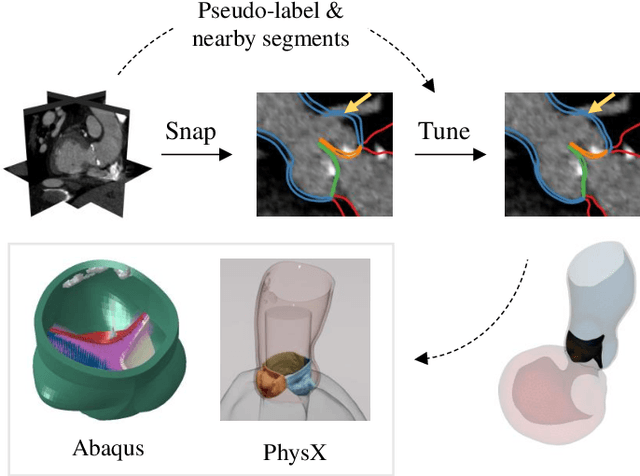

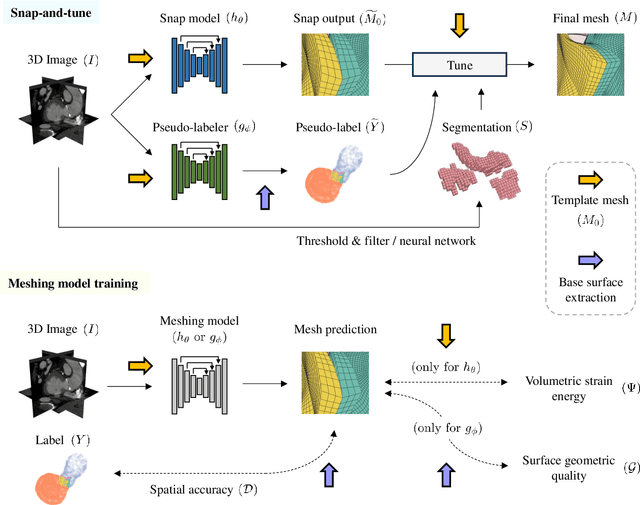
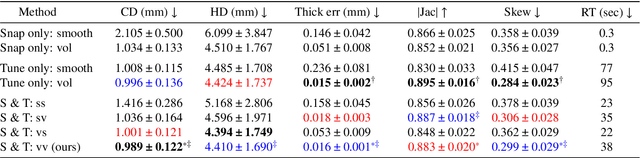
High-quality volumetric meshing from medical images is a key bottleneck for physics-based simulations in personalized medicine. For volumetric meshing of complex medical structures, recent studies have often utilized deep learning (DL)-based template deformation approaches to enable fast test-time generation with high spatial accuracy. However, these approaches still exhibit limitations, such as limited flexibility at high-curvature areas and unrealistic inter-part distances. In this study, we introduce a simple yet effective snap-and-tune strategy that sequentially applies DL and test-time optimization, which combines fast initial shape fitting with more detailed sample-specific mesh corrections. Our method provides significant improvements in both spatial accuracy and mesh quality, while being fully automated and requiring no additional training labels. Finally, we demonstrate the versatility and usefulness of our newly generated meshes via solid mechanics simulations in two different software platforms. Our code is available at https://github.com/danpak94/Deep-Cardiac-Volumetric-Mesh.
DLW-CI: A Dynamic Likelihood-Weighted Cooperative Infotaxis Approach for Multi-Source Search in Urban Environments Using Consumer Drone Networks
Apr 19, 2025Consumer-grade drones equipped with low-cost sensors have emerged as a cornerstone of Autonomous Intelligent Systems (AISs) for environmental monitoring and hazardous substance detection in urban environments. However, existing research primarily addresses single-source search problems, overlooking the complexities of real-world urban scenarios where both the location and quantity of hazardous sources remain unknown. To address this issue, we propose the Dynamic Likelihood-Weighted Cooperative Infotaxis (DLW-CI) approach for consumer drone networks. Our approach enhances multi-drone collaboration in AISs by combining infotaxis (a cognitive search strategy) with optimized source term estimation and an innovative cooperative mechanism. Specifically, we introduce a novel source term estimation method that utilizes multiple parallel particle filters, with each filter dedicated to estimating the parameters of a potentially unknown source within the search scene. Furthermore, we develop a cooperative mechanism based on dynamic likelihood weights to prevent multiple drones from simultaneously estimating and searching for the same source, thus optimizing the energy efficiency and search coverage of the consumer AIS. Experimental results demonstrate that the DLW-CI approach significantly outperforms baseline methods regarding success rate, accuracy, and root mean square error, particularly in scenarios with relatively few sources, regardless of the presence of obstacles. Also, the effectiveness of the proposed approach is verified in a diffusion scenario generated by the computational fluid dynamics (CFD) model. Research findings indicate that our approach could improve source estimation accuracy and search efficiency by consumer drone-based AISs, making a valuable contribution to environmental safety monitoring applications within smart city infrastructure.
Adapting Vision Foundation Models for Real-time Ultrasound Image Segmentation
Mar 31, 2025We propose a novel approach that adapts hierarchical vision foundation models for real-time ultrasound image segmentation. Existing ultrasound segmentation methods often struggle with adaptability to new tasks, relying on costly manual annotations, while real-time approaches generally fail to match state-of-the-art performance. To overcome these limitations, we introduce an adaptive framework that leverages the vision foundation model Hiera to extract multi-scale features, interleaved with DINOv2 representations to enhance visual expressiveness. These enriched features are then decoded to produce precise and robust segmentation. We conduct extensive evaluations on six public datasets and one in-house dataset, covering both cardiac and thyroid ultrasound segmentation. Experiments show that our approach outperforms state-of-the-art methods across multiple datasets and excels with limited supervision, surpassing nnUNet by over 20\% on average in the 1\% and 10\% data settings. Our method achieves $\sim$77 FPS inference speed with TensorRT on a single GPU, enabling real-time clinical applications.
Progressive Test Time Energy Adaptation for Medical Image Segmentation
Mar 20, 2025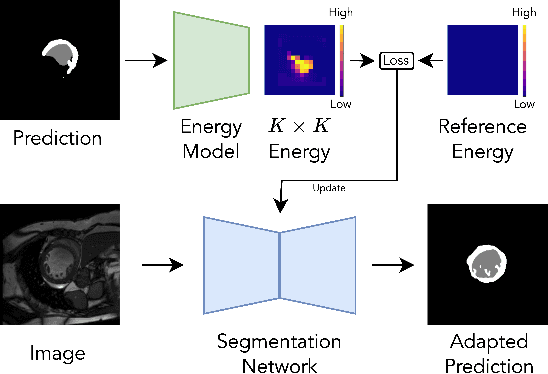
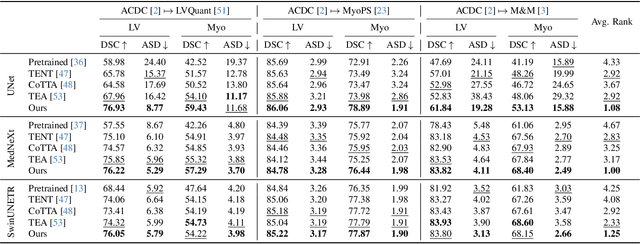
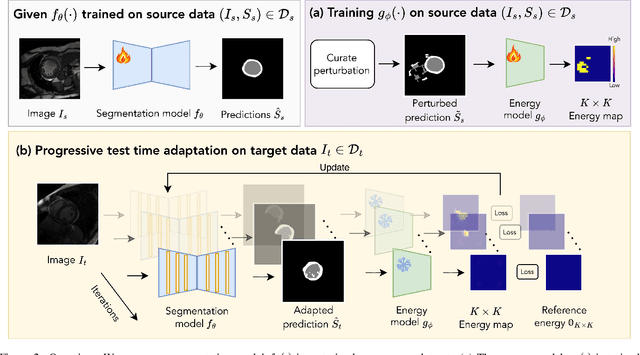
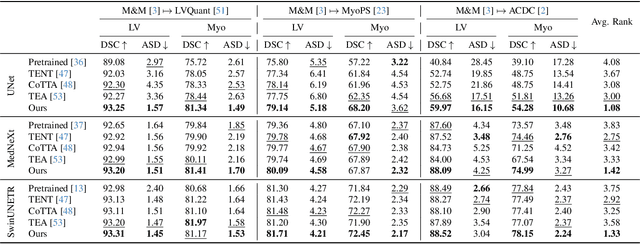
We propose a model-agnostic, progressive test-time energy adaptation approach for medical image segmentation. Maintaining model performance across diverse medical datasets is challenging, as distribution shifts arise from inconsistent imaging protocols and patient variations. Unlike domain adaptation methods that require multiple passes through target data - impractical in clinical settings - our approach adapts pretrained models progressively as they process test data. Our method leverages a shape energy model trained on source data, which assigns an energy score at the patch level to segmentation maps: low energy represents in-distribution (accurate) shapes, while high energy signals out-of-distribution (erroneous) predictions. By minimizing this energy score at test time, we refine the segmentation model to align with the target distribution. To validate the effectiveness and adaptability, we evaluated our framework on eight public MRI (bSSFP, T1- and T2-weighted) and X-ray datasets spanning cardiac, spinal cord, and lung segmentation. We consistently outperform baselines both quantitatively and qualitatively.
L2RSI: Cross-view LiDAR-based Place Recognition for Large-scale Urban Scenes via Remote Sensing Imagery
Mar 14, 2025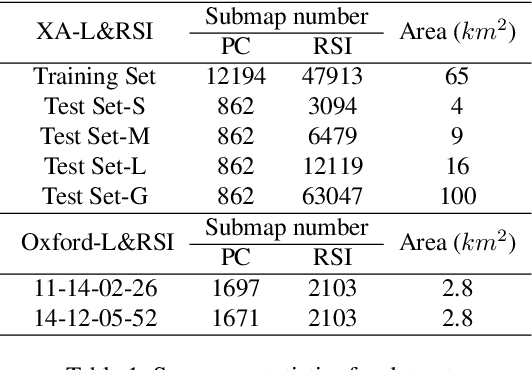
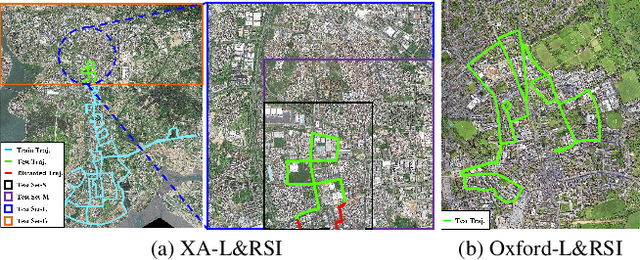
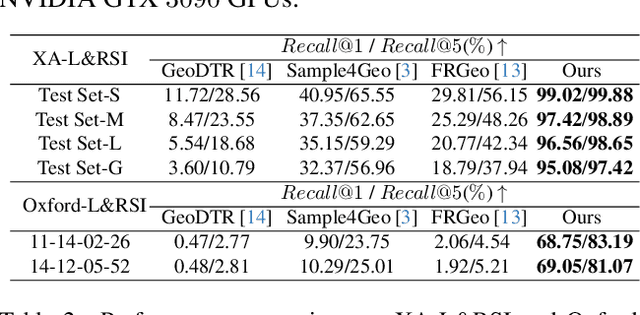
We tackle the challenge of LiDAR-based place recognition, which traditionally depends on costly and time-consuming prior 3D maps. To overcome this, we first construct XA-L&RSI dataset, which encompasses approximately $110,000$ remote sensing submaps and $13,000$ LiDAR point cloud submaps captured in urban scenes, and propose a novel method, L2RSI, for cross-view LiDAR place recognition using high-resolution Remote Sensing Imagery. This approach enables large-scale localization capabilities at a reduced cost by leveraging readily available overhead images as map proxies. L2RSI addresses the dual challenges of cross-view and cross-modal place recognition by learning feature alignment between point cloud submaps and remote sensing submaps in the semantic domain. Additionally, we introduce a novel probability propagation method based on a dynamic Gaussian mixture model to refine position predictions, effectively leveraging temporal and spatial information. This approach enables large-scale retrieval and cross-scene generalization without fine-tuning. Extensive experiments on XA-L&RSI demonstrate that, within a $100km^2$ retrieval range, L2RSI accurately localizes $95.08\%$ of point cloud submaps within a $30m$ radius for top-$1$ retrieved location. We provide a video to more vividly display the place recognition results of L2RSI at https://shizw695.github.io/L2RSI/.
An Adaptive Correspondence Scoring Framework for Unsupervised Image Registration of Medical Images
Dec 01, 2023
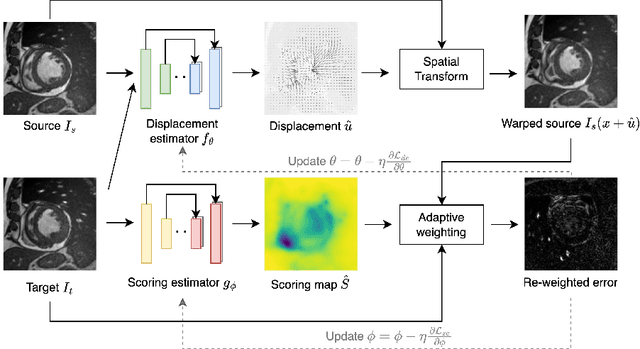

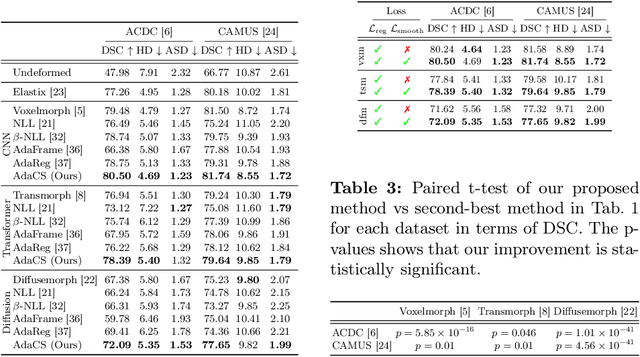
We propose an adaptive training scheme for unsupervised medical image registration. Existing methods rely on image reconstruction as the primary supervision signal. However, nuisance variables (e.g. noise and covisibility) often cause the loss of correspondence between medical images, violating the Lambertian assumption in physical waves (e.g. ultrasound) and consistent imaging acquisition. As the unsupervised learning scheme relies on intensity constancy to establish correspondence between images for reconstruction, this introduces spurious error residuals that are not modeled by the typical training objective. To mitigate this, we propose an adaptive framework that re-weights the error residuals with a correspondence scoring map during training, preventing the parametric displacement estimator from drifting away due to noisy gradients, which leads to performance degradations. To illustrate the versatility and effectiveness of our method, we tested our framework on three representative registration architectures across three medical image datasets along with other baselines. Our proposed adaptive framework consistently outperforms other methods both quantitatively and qualitatively. Paired t-tests show that our improvements are statistically significant. The code will be publicly available at \url{https://voldemort108x.github.io/AdaCS/}.
Heteroscedastic Uncertainty Estimation for Probabilistic Unsupervised Registration of Noisy Medical Images
Dec 01, 2023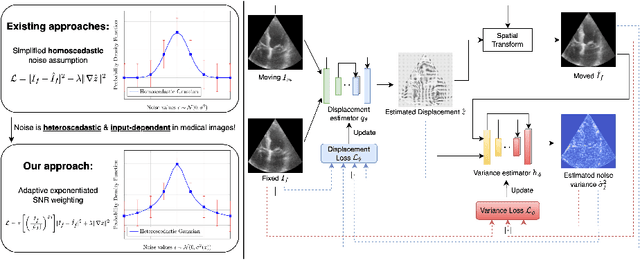
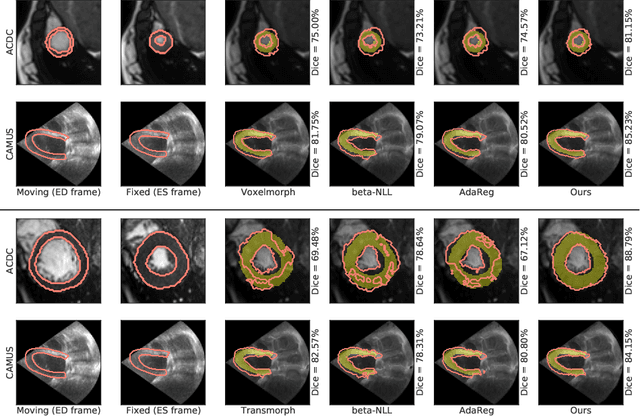
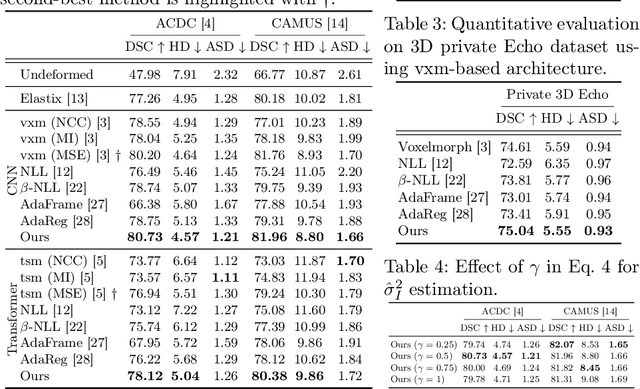
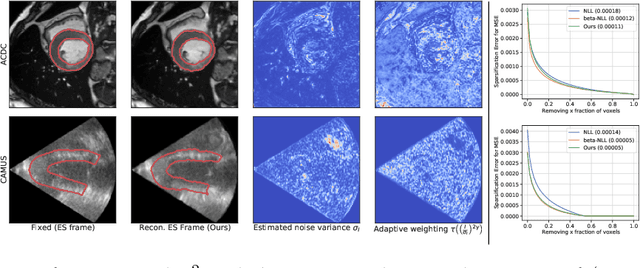
This paper proposes a heteroscedastic uncertainty estimation framework for unsupervised medical image registration. Existing methods rely on objectives (e.g. mean-squared error) that assume a uniform noise level across the image, disregarding the heteroscedastic and input-dependent characteristics of noise distribution in real-world medical images. This further introduces noisy gradients due to undesired penalization on outliers, causing unnatural deformation and performance degradation. To mitigate this, we propose an adaptive weighting scheme with a relative $\gamma$-exponentiated signal-to-noise ratio (SNR) for the displacement estimator after modeling the heteroscedastic noise using a separate variance estimator to prevent the model from being driven away by spurious gradients from error residuals, leading to more accurate displacement estimation. To illustrate the versatility and effectiveness of the proposed method, we tested our framework on two representative registration architectures across three medical image datasets. Our proposed framework consistently outperforms other baselines both quantitatively and qualitatively while also providing accurate and sensible uncertainty measures. Paired t-tests show that our improvements in registration accuracy are statistically significant. The code will be publicly available at \url{https://voldemort108x.github.io/hetero_uncertainty/}.