 Add to Chrome
 Add to Firefox
 Add to Edge
Simulation-Ready Cluttered Scene Estimation via Physics-aware Joint Shape and Pose Optimization
Feb 23, 2026
Estimating simulation-ready scenes from real-world observations is crucial for downstream planning and policy learning tasks. Regretfully, existing methods struggle in cluttered environments, often exhibiting prohibitive computational cost, poor robustness, and restricted generality when scaling to multiple interacting objects. We propose a unified optimization-based formulation for real-to-sim scene estimation that jointly recovers the shapes and poses of multiple rigid objects under physical constraints. Our method is built on two key technical innovations. First, we leverage the recently introduced shape-differentiable contact model, whose global differentiability permits joint optimization over object geometry and pose while modeling inter-object contacts. Second, we exploit the structured sparsity of the augmented Lagrangian Hessian to derive an efficient linear system solver whose computational cost scales favorably with scene complexity. Building on this formulation, we develop an end-to-end real-to-sim scene estimation pipeline that integrates learning-based object initialization, physics-constrained joint shape-pose optimization, and differentiable texture refinement. Experiments on cluttered scenes with up to 5 objects and 22 convex hulls demonstrate that our approach robustly reconstructs physically valid, simulation-ready object shapes and poses.

SDRS: Shape-Differentiable Robot Simulator
Dec 26, 2024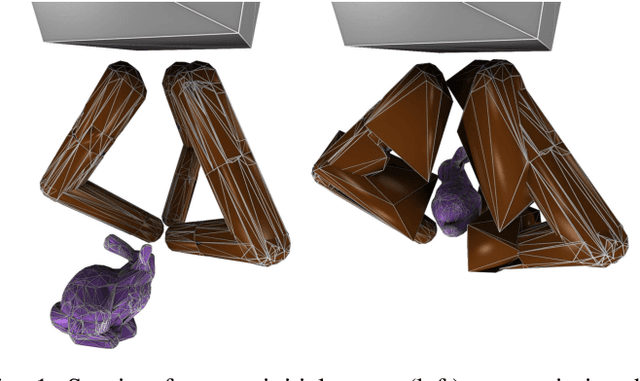

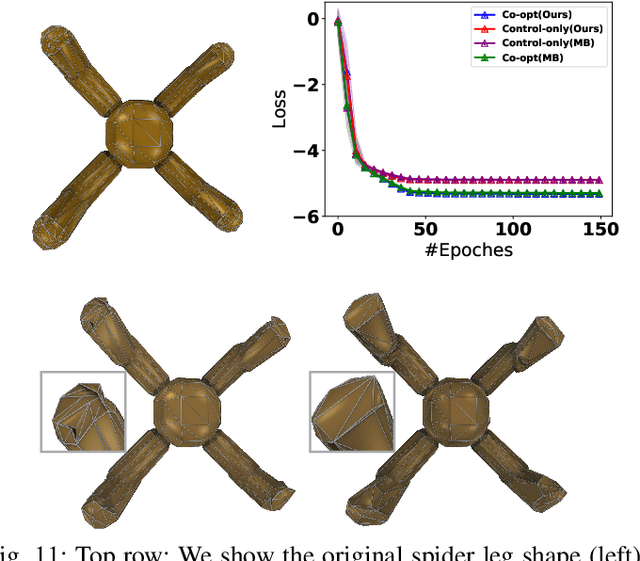
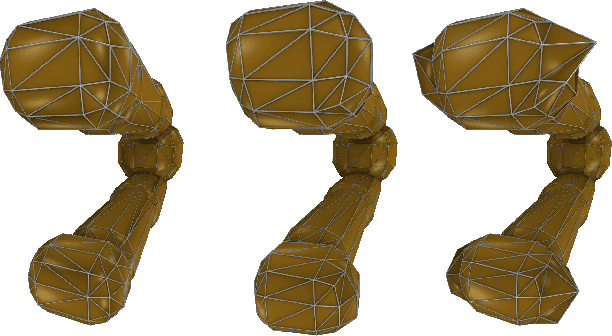
Robot simulators are indispensable tools across many fields, and recent research has significantly improved their functionality by incorporating additional gradient information. However, existing differentiable robot simulators suffer from non-differentiable singularities, when robots undergo substantial shape changes. To address this, we present the Shape-Differentiable Robot Simulator (SDRS), designed to be differentiable under significant robot shape changes. The core innovation of SDRS lies in its representation of robot shapes using a set of convex polyhedrons. This approach allows us to generalize smooth, penalty-based contact mechanics for interactions between any pair of convex polyhedrons. Using the separating hyperplane theorem, SDRS introduces a separating plane for each pair of contacting convex polyhedrons. This separating plane functions as a zero-mass auxiliary entity, with its state determined by the principle of least action. This setup ensures global differentiability, even as robot shapes undergo significant geometric and topological changes. To demonstrate the practical value of SDRS, we provide examples of robot co-design scenarios, where both robot shapes and control movements are optimized simultaneously.