 Add to Chrome
 Add to Firefox
 Add to Edge
Pailitao-MMSearch: Building Native E-Commerce Multimodal Search Foundation
Jul 20, 2026
The evolution of e-commerce has fundamentally transformed how users search for products, shifting from simple text-based keyword queries to complex multimodal interactions that seamlessly combine product images, natural language descriptions, and mixed-intent instructions. However, existing approaches face a critical dilemma: single-modal specialist models, deployed independently for text retrieval, visual search, and voice recognition, operate in isolation and cannot handle cross-modal queries, while general-purpose vision-language models lack the domain-specific knowledge necessary for fine-grained product understanding, user behavior modeling, and commercial intent reasoning. In this work, we present Pailitao-MMSearch, one native e-commerce multimodal search foundation model designed to bridge this gap. Our approach introduces three key innovations: (1)HybSID (Hybrid Semantic ID);(2)a two-stage continual pre-training strategy; and (3)a hybrid reasoning post-training pipeline. Built upon Qwen and deployed on Taobao's Pailitao multimodal search platform, Pailitao-MMSearch achieves substantial improvements in online A/B testing, including up to +13.61\% in Gross Merchandise Volume (GMV) and +8.21\% in transaction volume compared to traditional multi-modal search pipeline, demonstrating the effectiveness of our native e-commerce multimodal search large language models.

CaT: Weakly Supervised Object Detection with Category Transfer
Aug 17, 2021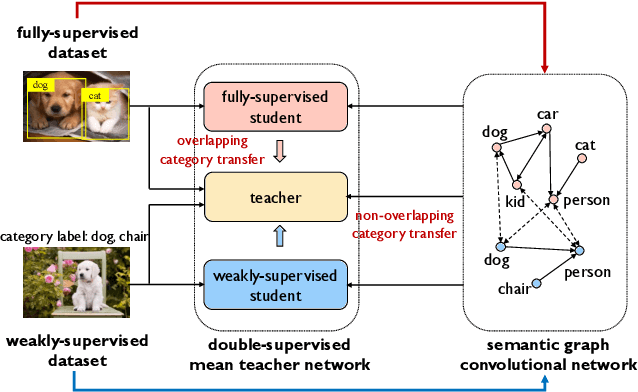
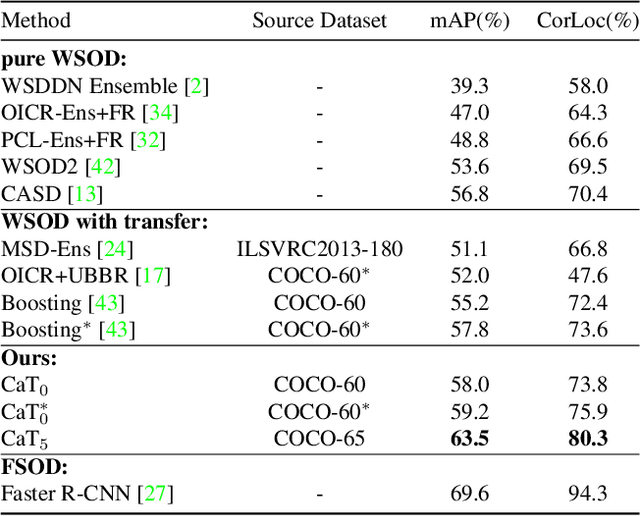
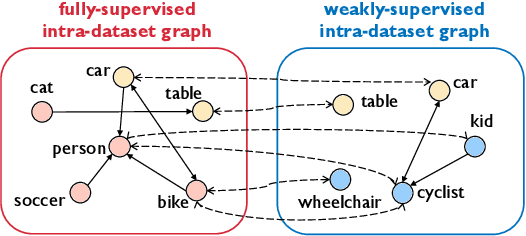
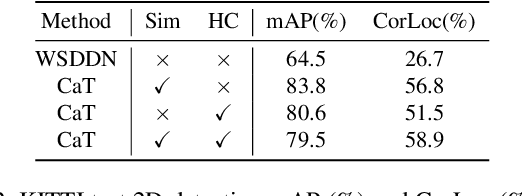
A large gap exists between fully-supervised object detection and weakly-supervised object detection. To narrow this gap, some methods consider knowledge transfer from additional fully-supervised dataset. But these methods do not fully exploit discriminative category information in the fully-supervised dataset, thus causing low mAP. To solve this issue, we propose a novel category transfer framework for weakly supervised object detection. The intuition is to fully leverage both visually-discriminative and semantically-correlated category information in the fully-supervised dataset to enhance the object-classification ability of a weakly-supervised detector. To handle overlapping category transfer, we propose a double-supervision mean teacher to gather common category information and bridge the domain gap between two datasets. To handle non-overlapping category transfer, we propose a semantic graph convolutional network to promote the aggregation of semantic features between correlated categories. Experiments are conducted with Pascal VOC 2007 as the target weakly-supervised dataset and COCO as the source fully-supervised dataset. Our category transfer framework achieves 63.5% mAP and 80.3% CorLoc with 5 overlapping categories between two datasets, which outperforms the state-of-the-art methods. Codes are avaliable at https://github.com/MediaBrain-SJTU/CaT.