 Add to Chrome
 Add to Firefox
 Add to Edge
SiriusDeliver: Automating Data Warehouse Delivery at Tencent
Aug 10, 2026
Enterprise data warehouses (DWs) support business-critical analytics, but warehouse task delivery remains a complicated production process involving context retrieval, workflow configuration, code generation, platform submission, and failure diagnosis. Although large language models (LLMs) and coding agents have improved software development, they are insufficient for production DW delivery, which requires dependency-aware orchestration, lifecycle-aware artifact control, and continuous adaptation to evolving platform practices. We present SiriusDeliver, an end-to-end delivery automation agent for production warehouse task submission. SiriusDeliver integrates three components: a hierarchical delivery agent that orchestrates warehouse skills, an artifact lifecycle control module that verifies and revises artifacts before and after platform execution, and a trace-driven skill evolution mechanism that maintains reusable skills from delivery trajectories. We evaluate SiriusDeliver through offline datasets and large-scale production deployment on Tencent Cloud WeData. Offline experiments on real-world warehouse delivery cases show that SiriusDeliver improves delivery success and automation efficiency over representative baselines. During a two-month deployment across 6 business teams and 4 warehouse task types, SiriusDeliver served 3,600 monthly active users and supported 18,240 delivery sessions, achieving an 87.2% end-to-end success rate and a 73.5% autonomous submission rate. A one-month A/B test shows that SiriusDeliver reduces median delivery time from 228 to 23 minutes and engineer effort from 95 to 11 minutes, while maintaining comparable final delivery success.

DataClawEval: A Benchmark for Data Engineering Agents in Real Industrial Harness
Jul 30, 2026Large language models (LLMs) and LLM-based agents are increasingly being deployed to automate complex workflows, promising to revolutionize data management and processing. However, existing benchmarks predominantly focus on simplified Text-to-SQL translation or data analysis, leaving the critical and complex domain of end-to-end data engineering largely unexplored. To bridge this gap, we introduce DataClawEval, the first comprehensive benchmark designed specifically to evaluate the end-to-end task completion capabilities of autonomous agents in real-world data engineering scenarios. Built upon production-grade code authored by professional enterprise data engineers, it comprises 100 rigorous, end-to-end tasks spanning five execution engines: PySpark, MySQL, HiveSQL, PrestoSQL/Trino, and FlinkSQL. Rather than non-deterministic LLM-as-a-judge scoring, each task is executed within a case-specific, isolated sandbox and graded by deterministic, rule-based scripts. Evaluating 16 frontier agents exposes critical limitations: The strongest model attains only 74.9 overall, and no single model dominates, as each excels on a different engine, revealing strict domain specialization rather than omnipotent proficiency. Thus, autonomous data engineering remains a formidable, unresolved challenge. We release our dataset, containerized environments, and deterministic evaluation scripts at https://github.com/Dicemy/DataClawEval/tree/master
Do Pathology Vision-Language Models Truly See Pathology?
Jul 23, 2026Pathology vision-language models (VLMs) have recently progressed rapidly and are commonly evaluated by answer accuracy on pathology VQA benchmarks. However, we dig into current evaluations and identify three overlooked issues: 1) Visual evidence is not always necessary. For instance, Gemini-3-Pro achieves 53.5% average accuracy across 5 VQA benchmarks without any visual input. 2) Domain training can improve accuracy without proportional gains in visual binding. Compared with Qwen2.5-VL-7B, Patho-R1-7B exhibits a 5.8-point lower multimodal gain and a 3.7-point lower attention IoU. 3) Entity-level attention is diffuse and weakly query-specific. On PathVG, attention maps remain highly correlated across different entity queries. These issues can lead to substantial misjudgments of pathology VLMs' actual multimodal capabilities. To this end, we present PathBind, a benchmark comprising 2,600 samples: PathBind-VQA with 1,500 questions across six dimensions, PathBind-PTA with 600 questions from a private pathology teaching atlas, and PathBind-Grounding with 500 expert-curated region-level samples. Each component undergoes task-specific automated filtering and expert review to reduce textual shortcuts and improve entity-region correspondence. We evaluate 18 representative VLMs on VQA samples of PathBind and five existing pathology VQA benchmarks, and further evaluate 10 VLMs on PathBind-Grounding and PathVG. Results show that current pathology VLMs still exhibit a substantial gap between answer-side performance and visual-semantic binding.
Task-Oriented Edge-Assisted Cross-System Design for Real-Time Human-Robot Interaction in Industrial Metaverse
Aug 28, 2025Real-time human-device interaction in industrial Metaverse faces challenges such as high computational load, limited bandwidth, and strict latency. This paper proposes a task-oriented edge-assisted cross-system framework using digital twins (DTs) to enable responsive interactions. By predicting operator motions, the system supports: 1) proactive Metaverse rendering for visual feedback, and 2) preemptive control of remote devices. The DTs are decoupled into two virtual functions-visual display and robotic control-optimizing both performance and adaptability. To enhance generalizability, we introduce the Human-In-The-Loop Model-Agnostic Meta-Learning (HITL-MAML) algorithm, which dynamically adjusts prediction horizons. Evaluation on two tasks demonstrates the framework's effectiveness: in a Trajectory-Based Drawing Control task, it reduces weighted RMSE from 0.0712 m to 0.0101 m; in a real-time 3D scene representation task for nuclear decommissioning, it achieves a PSNR of 22.11, SSIM of 0.8729, and LPIPS of 0.1298. These results show the framework's capability to ensure spatial precision and visual fidelity in real-time, high-risk industrial environments.
Precision Neural Network Quantization via Learnable Adaptive Modules
Apr 24, 2025
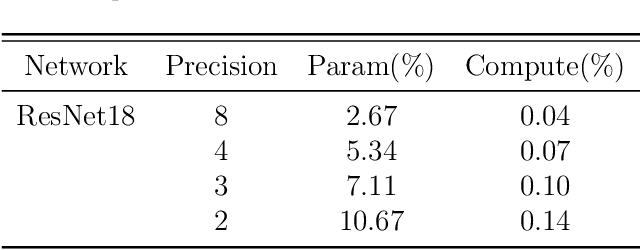
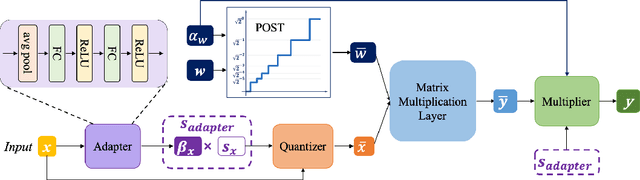
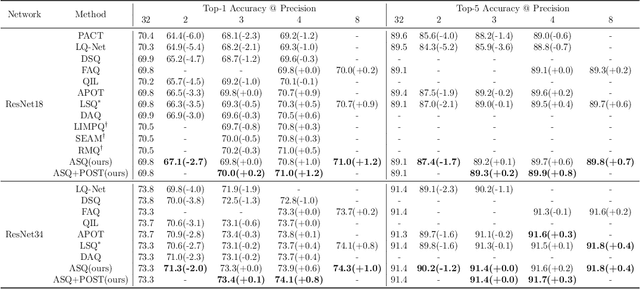
Quantization Aware Training (QAT) is a neural network quantization technique that compresses model size and improves operational efficiency while effectively maintaining model performance. The paradigm of QAT is to introduce fake quantization operators during the training process, allowing the model to autonomously compensate for information loss caused by quantization. Making quantization parameters trainable can significantly improve the performance of QAT, but at the cost of compromising the flexibility during inference, especially when dealing with activation values with substantially different distributions. In this paper, we propose an effective learnable adaptive neural network quantization method, called Adaptive Step Size Quantization (ASQ), to resolve this conflict. Specifically, the proposed ASQ method first dynamically adjusts quantization scaling factors through a trained module capable of accommodating different activations. Then, to address the rigid resolution issue inherent in Power of Two (POT) quantization, we propose an efficient non-uniform quantization scheme. We utilize the Power Of Square root of Two (POST) as the basis for exponential quantization, effectively handling the bell-shaped distribution of neural network weights across various bit-widths while maintaining computational efficiency through a Look-Up Table method (LUT). Extensive experimental results demonstrate that the proposed ASQ method is superior to the state-of-the-art QAT approaches. Notably that the ASQ is even competitive compared to full precision baselines, with its 4-bit quantized ResNet34 model improving accuracy by 1.2\% on ImageNet.
Randomized Kaczmarz Methods with Beyond-Krylov Convergence
Jan 20, 2025Randomized Kaczmarz methods form a family of linear system solvers which converge by repeatedly projecting their iterates onto randomly sampled equations. While effective in some contexts, such as highly over-determined least squares, Kaczmarz methods are traditionally deemed secondary to Krylov subspace methods, since this latter family of solvers can exploit outliers in the input's singular value distribution to attain fast convergence on ill-conditioned systems. In this paper, we introduce Kaczmarz++, an accelerated randomized block Kaczmarz algorithm that exploits outlying singular values in the input to attain a fast Krylov-style convergence. Moreover, we show that Kaczmarz++ captures large outlying singular values provably faster than popular Krylov methods, for both over- and under-determined systems. We also develop an optimized variant for positive semidefinite systems, called CD++, demonstrating empirically that it is competitive in arithmetic operations with both CG and GMRES on a collection of benchmark problems. To attain these results, we introduce several novel algorithmic improvements to the Kaczmarz framework, including adaptive momentum acceleration, Tikhonov-regularized projections, and a memoization scheme for reusing information from previously sampled equation~blocks.
Task-Oriented Edge-Assisted Cooperative Data Compression, Communications and Computing for UGV-Enhanced Warehouse Logistics
Oct 02, 2024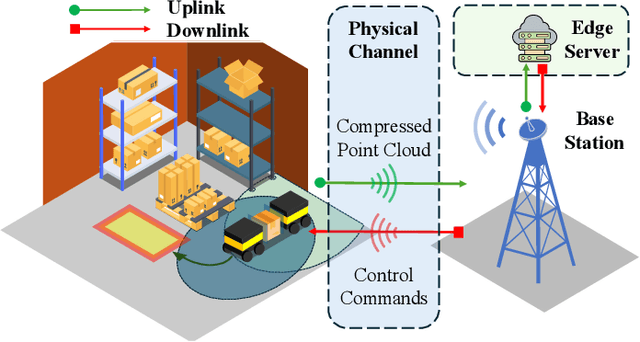

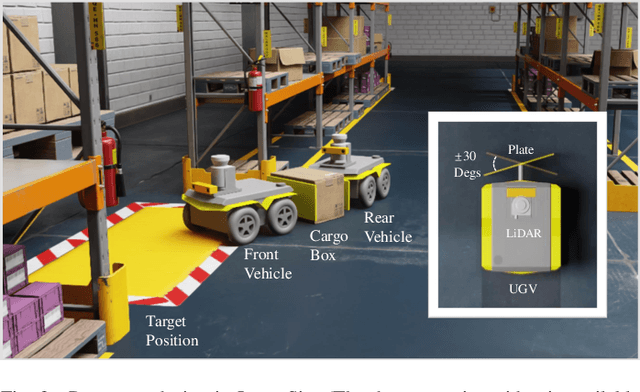

Only the chairs can edit This paper explores the growing need for task-oriented communications in warehouse logistics, where traditional communication Key Performance Indicators (KPIs)-such as latency, reliability, and throughput-often do not fully meet task requirements. As the complexity of data flow management in large-scale device networks increases, there is also a pressing need for innovative cross-system designs that balance data compression, communication, and computation. To address these challenges, we propose a task-oriented, edge-assisted framework for cooperative data compression, communication, and computing in Unmanned Ground Vehicle (UGV)-enhanced warehouse logistics. In this framework, two UGVs collaborate to transport cargo, with control functions-navigation for the front UGV and following/conveyance for the rear UGV-offloaded to the edge server to accommodate their limited on-board computing resources. We develop a Deep Reinforcement Learning (DRL)-based two-stage point cloud data compression algorithm that dynamically and collaboratively adjusts compression ratios according to task requirements, significantly reducing communication overhead. System-level simulations of our UGV logistics prototype demonstrate the framework's effectiveness and its potential for swift real-world implementation.
Faster Linear Systems and Matrix Norm Approximation via Multi-level Sketched Preconditioning
May 09, 2024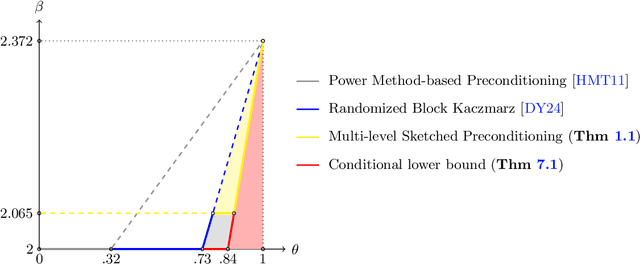
We present a new class of preconditioned iterative methods for solving linear systems of the form $Ax = b$. Our methods are based on constructing a low-rank Nystr\"om approximation to $A$ using sparse random sketching. This approximation is used to construct a preconditioner, which itself is inverted quickly using additional levels of random sketching and preconditioning. We prove that the convergence of our methods depends on a natural average condition number of $A$, which improves as the rank of the Nystr\"om approximation increases. Concretely, this allows us to obtain faster runtimes for a number of fundamental linear algebraic problems: 1. We show how to solve any $n\times n$ linear system that is well-conditioned except for $k$ outlying large singular values in $\tilde{O}(n^{2.065} + k^\omega)$ time, improving on a recent result of [Derezi\'nski, Yang, STOC 2024] for all $k \gtrsim n^{0.78}$. 2. We give the first $\tilde{O}(n^2 + {d_\lambda}^{\omega}$) time algorithm for solving a regularized linear system $(A + \lambda I)x = b$, where $A$ is positive semidefinite with effective dimension $d_\lambda$. This problem arises in applications like Gaussian process regression. 3. We give faster algorithms for approximating Schatten $p$-norms and other matrix norms. For example, for the Schatten 1 (nuclear) norm, we give an algorithm that runs in $\tilde{O}(n^{2.11})$ time, improving on an $\tilde{O}(n^{2.18})$ method of [Musco et al., ITCS 2018]. Interestingly, previous state-of-the-art algorithms for most of the problems above relied on stochastic iterative methods, like stochastic coordinate and gradient descent. Our work takes a completely different approach, instead leveraging tools from matrix sketching.
HERTA: A High-Efficiency and Rigorous Training Algorithm for Unfolded Graph Neural Networks
Mar 26, 2024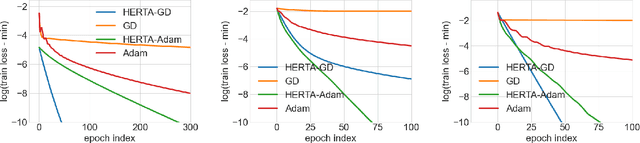

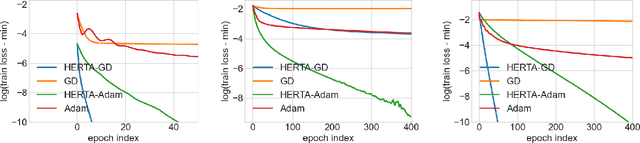
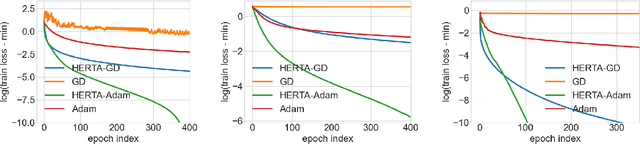
As a variant of Graph Neural Networks (GNNs), Unfolded GNNs offer enhanced interpretability and flexibility over traditional designs. Nevertheless, they still suffer from scalability challenges when it comes to the training cost. Although many methods have been proposed to address the scalability issues, they mostly focus on per-iteration efficiency, without worst-case convergence guarantees. Moreover, those methods typically add components to or modify the original model, thus possibly breaking the interpretability of Unfolded GNNs. In this paper, we propose HERTA: a High-Efficiency and Rigorous Training Algorithm for Unfolded GNNs that accelerates the whole training process, achieving a nearly-linear time worst-case training guarantee. Crucially, HERTA converges to the optimum of the original model, thus preserving the interpretability of Unfolded GNNs. Additionally, as a byproduct of HERTA, we propose a new spectral sparsification method applicable to normalized and regularized graph Laplacians that ensures tighter bounds for our algorithm than existing spectral sparsifiers do. Experiments on real-world datasets verify the superiority of HERTA as well as its adaptability to various loss functions and optimizers.
Solving Dense Linear Systems Faster than via Preconditioning
Dec 14, 2023We give a stochastic optimization algorithm that solves a dense $n\times n$ real-valued linear system $Ax=b$, returning $\tilde x$ such that $\|A\tilde x-b\|\leq \epsilon\|b\|$ in time: $$\tilde O((n^2+nk^{\omega-1})\log1/\epsilon),$$ where $k$ is the number of singular values of $A$ larger than $O(1)$ times its smallest positive singular value, $\omega < 2.372$ is the matrix multiplication exponent, and $\tilde O$ hides a poly-logarithmic in $n$ factor. When $k=O(n^{1-\theta})$ (namely, $A$ has a flat-tailed spectrum, e.g., due to noisy data or regularization), this improves on both the cost of solving the system directly, as well as on the cost of preconditioning an iterative method such as conjugate gradient. In particular, our algorithm has an $\tilde O(n^2)$ runtime when $k=O(n^{0.729})$. We further adapt this result to sparse positive semidefinite matrices and least squares regression. Our main algorithm can be viewed as a randomized block coordinate descent method, where the key challenge is simultaneously ensuring good convergence and fast per-iteration time. In our analysis, we use theory of majorization for elementary symmetric polynomials to establish a sharp convergence guarantee when coordinate blocks are sampled using a determinantal point process. We then use a Markov chain coupling argument to show that similar convergence can be attained with a cheaper sampling scheme, and accelerate the block coordinate descent update via matrix sketching.