 Add to Chrome
 Add to Firefox
 Add to Edge
SiriusDeliver: Automating Data Warehouse Delivery at Tencent
Aug 10, 2026
Enterprise data warehouses (DWs) support business-critical analytics, but warehouse task delivery remains a complicated production process involving context retrieval, workflow configuration, code generation, platform submission, and failure diagnosis. Although large language models (LLMs) and coding agents have improved software development, they are insufficient for production DW delivery, which requires dependency-aware orchestration, lifecycle-aware artifact control, and continuous adaptation to evolving platform practices. We present SiriusDeliver, an end-to-end delivery automation agent for production warehouse task submission. SiriusDeliver integrates three components: a hierarchical delivery agent that orchestrates warehouse skills, an artifact lifecycle control module that verifies and revises artifacts before and after platform execution, and a trace-driven skill evolution mechanism that maintains reusable skills from delivery trajectories. We evaluate SiriusDeliver through offline datasets and large-scale production deployment on Tencent Cloud WeData. Offline experiments on real-world warehouse delivery cases show that SiriusDeliver improves delivery success and automation efficiency over representative baselines. During a two-month deployment across 6 business teams and 4 warehouse task types, SiriusDeliver served 3,600 monthly active users and supported 18,240 delivery sessions, achieving an 87.2% end-to-end success rate and a 73.5% autonomous submission rate. A one-month A/B test shows that SiriusDeliver reduces median delivery time from 228 to 23 minutes and engineer effort from 95 to 11 minutes, while maintaining comparable final delivery success.

PATS: Policy-Aware Training Scaffolding for Agentic Reinforcement Learning
Jul 23, 2026In long-horizon LLM agent reinforcement learning, weak policies often repeat similar failures, producing uninformative rollout trajectories and limiting effective policy optimization. Existing skill-centric methods improve exploration by optimizing, filtering, or internalizing reusable skills. However, they remain centered on the skills themselves rather than being designed as adaptive training-time support for the evolving policy. To address this, we propose a policy-centric training paradigm that reframes skills as a dynamic training scaffold. Our framework, Pats, converts rollout groups from the latest policy into evidence cards and uses task-specific evaluation to adjust the context used in subsequent rollouts. Concrete guidance helps weak policies to complete challenging tasks. As policy improves, redundant context is revised or removed to reduce reliance on explicit guidance while preserving useful rollout variation. The policy is optimized with environmental rewards using standard RLVR, and the training scaffold is discarded at deployment. On ALFWorld and WebShop, Pats improves over strong baselines by up to 18.6%. Across seven search-augmented QA benchmarks, it remains competitive while using 32.1% fewer prompt tokens than the baseline.
Dual Objective Approach Using A Convolutional Neural Network for Magnetic Resonance Elastography
Dec 02, 2018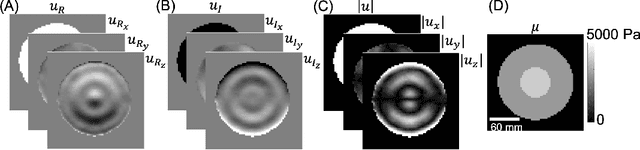
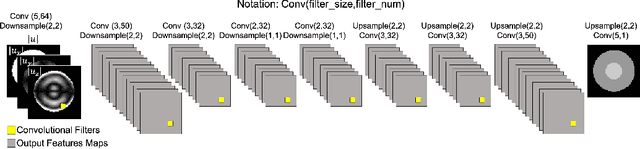
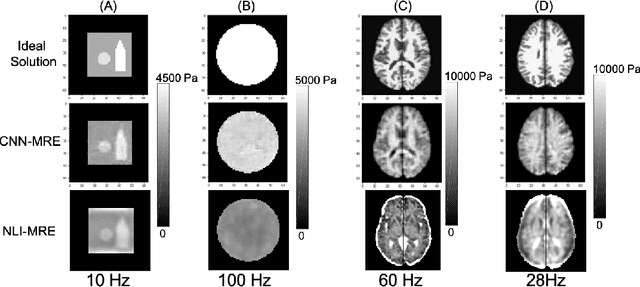
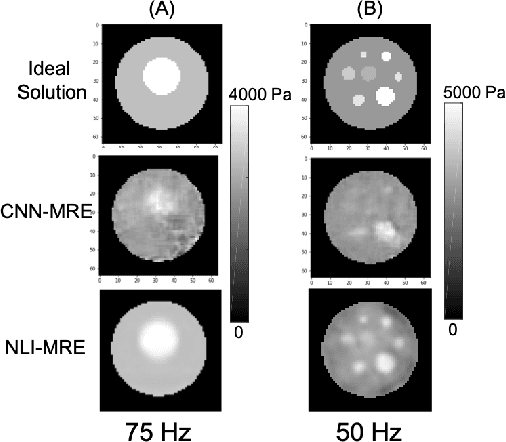
Traditionally, nonlinear inversion, direct inversion, or wave estimation methods have been used for reconstructing images from MRE displacement data. In this work, we propose a convolutional neural network architecture that can map MRE displacement data directly into elastograms, circumventing the costly and computationally intensive classical approaches. In addition to the mean squared error reconstruction objective, we also introduce a secondary loss inspired by the MRE mechanical models for training the neural network. Our network is demonstrated to be effective for generating MRE images that compare well with equivalents from the nonlinear inversion method.