 Add to Chrome
 Add to Firefox
 Add to Edge
SiriusDeliver: Automating Data Warehouse Delivery at Tencent
Aug 10, 2026
Enterprise data warehouses (DWs) support business-critical analytics, but warehouse task delivery remains a complicated production process involving context retrieval, workflow configuration, code generation, platform submission, and failure diagnosis. Although large language models (LLMs) and coding agents have improved software development, they are insufficient for production DW delivery, which requires dependency-aware orchestration, lifecycle-aware artifact control, and continuous adaptation to evolving platform practices. We present SiriusDeliver, an end-to-end delivery automation agent for production warehouse task submission. SiriusDeliver integrates three components: a hierarchical delivery agent that orchestrates warehouse skills, an artifact lifecycle control module that verifies and revises artifacts before and after platform execution, and a trace-driven skill evolution mechanism that maintains reusable skills from delivery trajectories. We evaluate SiriusDeliver through offline datasets and large-scale production deployment on Tencent Cloud WeData. Offline experiments on real-world warehouse delivery cases show that SiriusDeliver improves delivery success and automation efficiency over representative baselines. During a two-month deployment across 6 business teams and 4 warehouse task types, SiriusDeliver served 3,600 monthly active users and supported 18,240 delivery sessions, achieving an 87.2% end-to-end success rate and a 73.5% autonomous submission rate. A one-month A/B test shows that SiriusDeliver reduces median delivery time from 228 to 23 minutes and engineer effort from 95 to 11 minutes, while maintaining comparable final delivery success.

Not All Problems Are Best Modeled as MILP: A DSL-Centric Framework for Flexible and Accurate Optimization Modeling
Aug 07, 2026Solving combinatorial optimization problems (COPs) requires not only efficient algorithms but also carefully crafted formulations. While recent works have leveraged LLMs to automate optimization modeling, current frameworks predominantly rely on a rigid mixed-integer linear programming (MILP) paradigm. In this paper, we argue that not all problems are best modeled as MILP, as forcing complex domains into linear constraints can induce prohibitive modeling complexity and severely restrict solver flexibility. To address this, we propose OptiDSL, a framework that shifts the focus from rigid MILP formulations to domain-specific language (DSL) representations. By utilizing LLMs to map natural language onto standardized, domain-accepted structures, OptiDSL decouples problem formulation from execution. This paradigm enables seamless integration with a diverse library of specialized solvers, ranging from traditional heuristics to modern learning-based methods. Experimental results on the comprehensive benchmark of 44 COP types show that OptiDSL significantly surpasses MILP-based pipelines, yielding a 51.66% gain in formulation accuracy and a 91.71% decrease in modeling time. Notably, it also outperforms MILP-based pipelines on the existing benchmark, achieving a 23.09% higher formulation accuracy. Our code is available at https://anonymous.4open.science/r/OptiDSL.
DataClawEval: A Benchmark for Data Engineering Agents in Real Industrial Harness
Jul 30, 2026Large language models (LLMs) and LLM-based agents are increasingly being deployed to automate complex workflows, promising to revolutionize data management and processing. However, existing benchmarks predominantly focus on simplified Text-to-SQL translation or data analysis, leaving the critical and complex domain of end-to-end data engineering largely unexplored. To bridge this gap, we introduce DataClawEval, the first comprehensive benchmark designed specifically to evaluate the end-to-end task completion capabilities of autonomous agents in real-world data engineering scenarios. Built upon production-grade code authored by professional enterprise data engineers, it comprises 100 rigorous, end-to-end tasks spanning five execution engines: PySpark, MySQL, HiveSQL, PrestoSQL/Trino, and FlinkSQL. Rather than non-deterministic LLM-as-a-judge scoring, each task is executed within a case-specific, isolated sandbox and graded by deterministic, rule-based scripts. Evaluating 16 frontier agents exposes critical limitations: The strongest model attains only 74.9 overall, and no single model dominates, as each excels on a different engine, revealing strict domain specialization rather than omnipotent proficiency. Thus, autonomous data engineering remains a formidable, unresolved challenge. We release our dataset, containerized environments, and deterministic evaluation scripts at https://github.com/Dicemy/DataClawEval/tree/master
ATOD: Annealed Turn-aware On-policy Distillation for Multi-turn Autonomous Agents
Jun 26, 2026Training small language-model agents for long-horizon interactive tasks requires both fast imitation and reward-driven improvement. On-policy distillation (OPD) provides dense teacher guidance and typically improves rapidly in the early stage, but its gains saturate once the student approaches the teacher, limiting the final performance ceiling. Reinforcement learning (RL) directly optimizes environment rewards and encourages exploratory improvement toward a higher reward-defined ceiling, but sparse and delayed feedback makes early-stage learning much less efficient than OPD. In this paper, we propose ATOD (Annealed Turn-aware On-policy Distillation), a hybrid online distillation algorithm that explicitly exploits this complementarity. (1) ATOD uses an annealed OPD-RL schedule: OPD dominates early training to approach teacher-level behavior, while RL is gradually strengthened to drive reward-based exploration. (2) ATOD introduces Turn-level Disagreement-Uncertainty Reweighting (T-DUR), which softly amplifies high-utility turns and improves dense supervision in long trajectories. Experiments on ALFWorld, WebShop, and Search-QA show that ATOD consistently outperforms competing post-training baselines: across the three student sizes, ATOD improves average success rate by 3.03 points over OPD and 23.62 points over GRPO, while surpassing the corresponding teacher models by 2.16 points.
Efficient Agentic Reinforcement Learning with On-Policy Intrinsic Knowledge Boundary Enhancement
May 26, 2026Agentic reinforcement learning (RL) has proven effective for training LLM-based agents with external tool-use capabilities. However, we identify that agentic RL training induces increasing redundant tool calls and blurs the model's intrinsic knowledge boundary, where the model fails to distinguish when tools are needed versus when parametric knowledge suffices. Existing solutions based on reward shaping create coarse-grained optimization targets that tend to incentivize indiscriminate tool-call suppression, leading to reward hacking. In this paper, we propose AKBE (Agentic Knowledge Boundary Enhancement), an on-policy method that dynamically probes the model's intrinsic knowledge boundary through dual-path (with-tool and no-tool) rollouts during training. We define the knowledge boundary as the per-instance determination of whether tools are required and the minimum tool calls necessary. By comparing correctness across paths, AKBE categorizes trajectories and constructs targeted supervisory signals that guide efficient tool-use patterns for each question. These signals are integrated seamlessly into the agentic RL training loop. Experiments on seven QA benchmarks demonstrate that AKBE improves task accuracy by +1.85 on average and reduces tool calls by 18% over standard agentic RL, yielding 25% higher tool productivity without any accuracy-efficiency trade-off. Further analysis suggests its plug-and-play compatibility across different RL algorithms and the mechanism of each signal category. Our code is available at https://github.com/CuSO4-Chen/AKBE.
A$^2$TGPO: Agentic Turn-Group Policy Optimization with Adaptive Turn-level Clipping
May 07, 2026Reinforcement learning for agentic large language models (LLMs) typically relies on a sparse, trajectory-level outcome reward, making it difficult to evaluate the contribution of individual tool-calls within multi-turn interactions. Existing approaches to such process credit assignment either depend on separate external process reward models that introduce additional consumption, or tree-based structural rollout that merely redistributes the outcome signal while constraining trajectory diversity. A promising alternative leverages the per-turn change in the policy's predicted probability of the ground-truth, termed Information Gain (IG), as an intrinsic process signal without an external evaluator. However, prior work on leveraging IG signals within the RL training loop faces three systematic challenges: normalizing across turns that face heterogeneous positional contexts can distort the relative standing of individual turns, accumulating a variable number of terms causes advantage magnitudes to drift with trajectory depth, and a fixed clipping range governs policy updates identically for turns with vastly different IG signals. In this paper, we propose A$^2$TGPO (Agentic Turn-Group Policy Optimization with Adaptive Turn-level Clipping), which retains IG as the intrinsic signal but re-designs how it is normalized, accumulated, and consumed: (i) turn-group normalization: normalizes IG within each (prompt, turn-index) group so that each turn is compared only against peers at the same interaction depth; (ii) variance-rescaled discounted accumulation: divides cumulative normalized IG by square root of accumulated terms to keep advantage magnitudes comparable across turn positions; and (iii) adaptive turn-level clipping: modulates each turn's clipping range based on its normalized IG, widening the update region for informative turns and narrowing it for uninformative ones.
AT$^2$PO: Agentic Turn-based Policy Optimization via Tree Search
Jan 08, 2026LLM agents have emerged as powerful systems for tackling multi-turn tasks by interleaving internal reasoning and external tool interactions. Agentic Reinforcement Learning has recently drawn significant research attention as a critical post-training paradigm to further refine these capabilities. In this paper, we present AT$^2$PO (Agentic Turn-based Policy Optimization via Tree Search), a unified framework for multi-turn agentic RL that addresses three core challenges: limited exploration diversity, sparse credit assignment, and misaligned policy optimization. AT$^2$PO introduces a turn-level tree structure that jointly enables Entropy-Guided Tree Expansion for strategic exploration and Turn-wise Credit Assignment for fine-grained reward propagation from sparse outcomes. Complementing this, we propose Agentic Turn-based Policy Optimization, a turn-level learning objective that aligns policy updates with the natural decision granularity of agentic interactions. ATPO is orthogonal to tree search and can be readily integrated into any multi-turn RL pipeline. Experiments across seven benchmarks demonstrate consistent improvements over the state-of-the-art baseline by up to 1.84 percentage points in average, with ablation studies validating the effectiveness of each component. Our code is available at https://github.com/zzfoutofspace/ATPO.
UniCO: Towards a Unified Model for Combinatorial Optimization Problems
May 07, 2025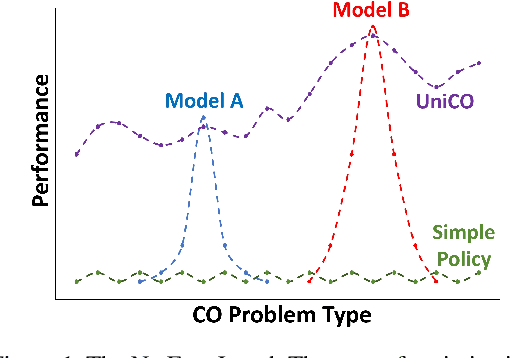
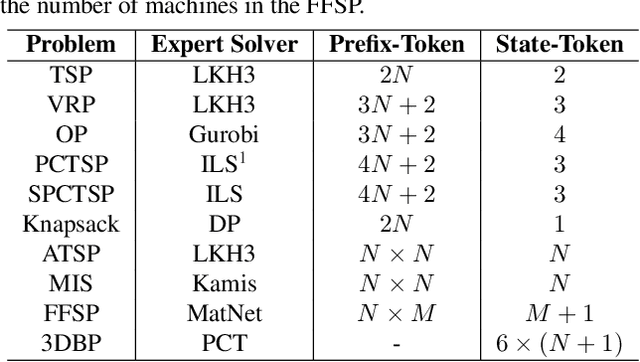
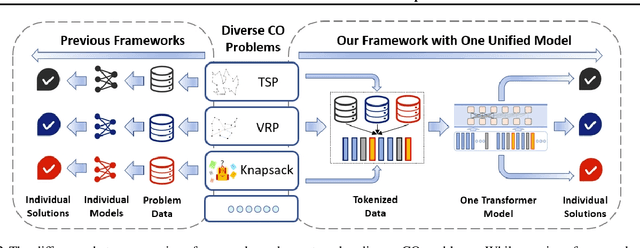
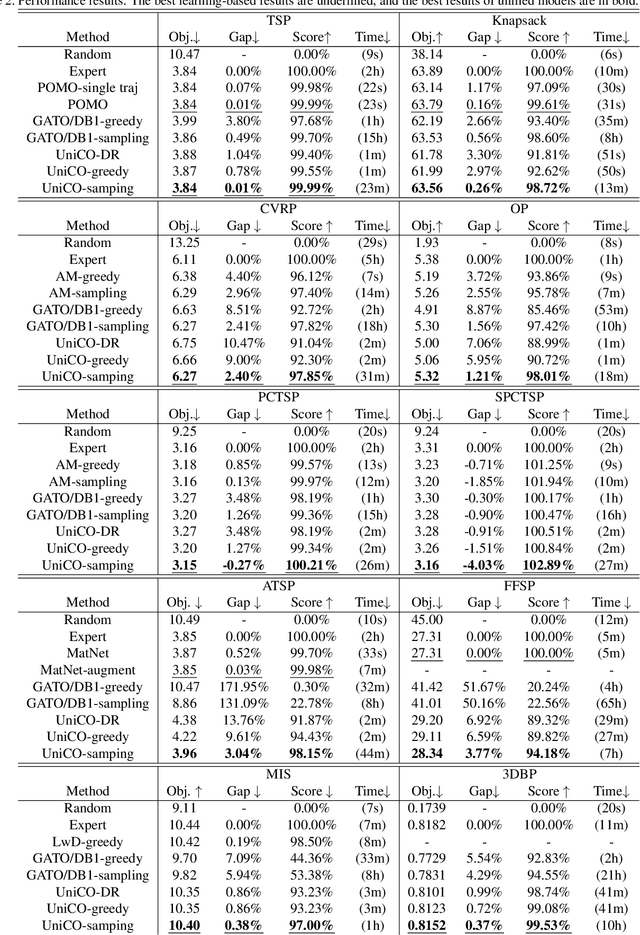
Combinatorial Optimization (CO) encompasses a wide range of problems that arise in many real-world scenarios. While significant progress has been made in developing learning-based methods for specialized CO problems, a unified model with a single architecture and parameter set for diverse CO problems remains elusive. Such a model would offer substantial advantages in terms of efficiency and convenience. In this paper, we introduce UniCO, a unified model for solving various CO problems. Inspired by the success of next-token prediction, we frame each problem-solving process as a Markov Decision Process (MDP), tokenize the corresponding sequential trajectory data, and train the model using a transformer backbone. To reduce token length in the trajectory data, we propose a CO-prefix design that aggregates static problem features. To address the heterogeneity of state and action tokens within the MDP, we employ a two-stage self-supervised learning approach. In this approach, a dynamic prediction model is first trained and then serves as a pre-trained model for subsequent policy generation. Experiments across 10 CO problems showcase the versatility of UniCO, emphasizing its ability to generalize to new, unseen problems with minimal fine-tuning, achieving even few-shot or zero-shot performance. Our framework offers a valuable complement to existing neural CO methods that focus on optimizing performance for individual problems.
Towards Large Reasoning Models: A Survey on Scaling LLM Reasoning Capabilities
Jan 17, 2025

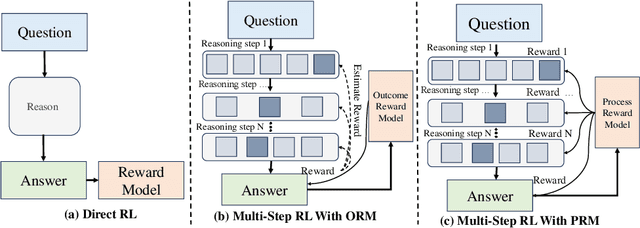

Language has long been conceived as an essential tool for human reasoning. The breakthrough of Large Language Models (LLMs) has sparked significant research interest in leveraging these models to tackle complex reasoning tasks. Researchers have moved beyond simple autoregressive token generation by introducing the concept of "thought" -- a sequence of tokens representing intermediate steps in the reasoning process. This innovative paradigm enables LLMs' to mimic complex human reasoning processes, such as tree search and reflective thinking. Recently, an emerging trend of learning to reason has applied reinforcement learning (RL) to train LLMs to master reasoning processes. This approach enables the automatic generation of high-quality reasoning trajectories through trial-and-error search algorithms, significantly expanding LLMs' reasoning capacity by providing substantially more training data. Furthermore, recent studies demonstrate that encouraging LLMs to "think" with more tokens during test-time inference can further significantly boost reasoning accuracy. Therefore, the train-time and test-time scaling combined to show a new research frontier -- a path toward Large Reasoning Model. The introduction of OpenAI's o1 series marks a significant milestone in this research direction. In this survey, we present a comprehensive review of recent progress in LLM reasoning. We begin by introducing the foundational background of LLMs and then explore the key technical components driving the development of large reasoning models, with a focus on automated data construction, learning-to-reason techniques, and test-time scaling. We also analyze popular open-source projects at building large reasoning models, and conclude with open challenges and future research directions.
Towards Large Reasoning Models: A Survey of Reinforced Reasoning with Large Language Models
Jan 16, 2025Language has long been conceived as an essential tool for human reasoning. The breakthrough of Large Language Models (LLMs) has sparked significant research interest in leveraging these models to tackle complex reasoning tasks. Researchers have moved beyond simple autoregressive token generation by introducing the concept of "thought" -- a sequence of tokens representing intermediate steps in the reasoning process. This innovative paradigm enables LLMs' to mimic complex human reasoning processes, such as tree search and reflective thinking. Recently, an emerging trend of learning to reason has applied reinforcement learning (RL) to train LLMs to master reasoning processes. This approach enables the automatic generation of high-quality reasoning trajectories through trial-and-error search algorithms, significantly expanding LLMs' reasoning capacity by providing substantially more training data. Furthermore, recent studies demonstrate that encouraging LLMs to "think" with more tokens during test-time inference can further significantly boost reasoning accuracy. Therefore, the train-time and test-time scaling combined to show a new research frontier -- a path toward Large Reasoning Model. The introduction of OpenAI's o1 series marks a significant milestone in this research direction. In this survey, we present a comprehensive review of recent progress in LLM reasoning. We begin by introducing the foundational background of LLMs and then explore the key technical components driving the development of large reasoning models, with a focus on automated data construction, learning-to-reason techniques, and test-time scaling. We also analyze popular open-source projects at building large reasoning models, and conclude with open challenges and future research directions.