 Add to Chrome
 Add to Firefox
 Add to Edge
SiriusDeliver: Automating Data Warehouse Delivery at Tencent
Aug 10, 2026
Enterprise data warehouses (DWs) support business-critical analytics, but warehouse task delivery remains a complicated production process involving context retrieval, workflow configuration, code generation, platform submission, and failure diagnosis. Although large language models (LLMs) and coding agents have improved software development, they are insufficient for production DW delivery, which requires dependency-aware orchestration, lifecycle-aware artifact control, and continuous adaptation to evolving platform practices. We present SiriusDeliver, an end-to-end delivery automation agent for production warehouse task submission. SiriusDeliver integrates three components: a hierarchical delivery agent that orchestrates warehouse skills, an artifact lifecycle control module that verifies and revises artifacts before and after platform execution, and a trace-driven skill evolution mechanism that maintains reusable skills from delivery trajectories. We evaluate SiriusDeliver through offline datasets and large-scale production deployment on Tencent Cloud WeData. Offline experiments on real-world warehouse delivery cases show that SiriusDeliver improves delivery success and automation efficiency over representative baselines. During a two-month deployment across 6 business teams and 4 warehouse task types, SiriusDeliver served 3,600 monthly active users and supported 18,240 delivery sessions, achieving an 87.2% end-to-end success rate and a 73.5% autonomous submission rate. A one-month A/B test shows that SiriusDeliver reduces median delivery time from 228 to 23 minutes and engineer effort from 95 to 11 minutes, while maintaining comparable final delivery success.

DataClawEval: A Benchmark for Data Engineering Agents in Real Industrial Harness
Jul 30, 2026Large language models (LLMs) and LLM-based agents are increasingly being deployed to automate complex workflows, promising to revolutionize data management and processing. However, existing benchmarks predominantly focus on simplified Text-to-SQL translation or data analysis, leaving the critical and complex domain of end-to-end data engineering largely unexplored. To bridge this gap, we introduce DataClawEval, the first comprehensive benchmark designed specifically to evaluate the end-to-end task completion capabilities of autonomous agents in real-world data engineering scenarios. Built upon production-grade code authored by professional enterprise data engineers, it comprises 100 rigorous, end-to-end tasks spanning five execution engines: PySpark, MySQL, HiveSQL, PrestoSQL/Trino, and FlinkSQL. Rather than non-deterministic LLM-as-a-judge scoring, each task is executed within a case-specific, isolated sandbox and graded by deterministic, rule-based scripts. Evaluating 16 frontier agents exposes critical limitations: The strongest model attains only 74.9 overall, and no single model dominates, as each excels on a different engine, revealing strict domain specialization rather than omnipotent proficiency. Thus, autonomous data engineering remains a formidable, unresolved challenge. We release our dataset, containerized environments, and deterministic evaluation scripts at https://github.com/Dicemy/DataClawEval/tree/master
SIRIUS-SQL: Anchoring Multi-Candidate Text-to-SQL in Execution Feedback
May 31, 2026Text-to-SQL on complex schemas is unreliable on a single pass, so recent systems generate multiple SQL candidates and let voting filter out errors. Yet voting alone is not enough, because the multi-candidate recipe has three coupled weaknesses: 1) sampling more from a single generator produces increasingly redundant candidates, 2) existing pipelines apply one generic correction to every non-clean execution result, while runtime errors, timeouts, and empty results each indicate a different distance from correctness, and 3) existing selectors rely on a single angle such as result-majority voting or pairwise SQL comparison, missing what other angles would have caught. We present SIRIUS-SQL, which addresses all three weaknesses. A difficulty-smoothing RL recipe trains SIRIUS-32B to generate diverse executable SQL candidates, paired with a generalist LLM that fills in gaps left by the specialist. An execution-grounded lifecycle classifies each outcome and applies targeted repair before candidates re-enter the pool. A confidence-gated hybrid selector combines execution-result agreement with pairwise SQL-form judgment, escalating only near-tied cases to a deterministic structural check. SIRIUS-SQL reaches 75.88% on BIRD dev and 91.20% on SPIDER test. Two of three generalist pairings surpass Agentar-Scale-SQL, the strongest published multi-candidate system on BIRD dev.
ZhuJiu: A Multi-dimensional, Multi-faceted Chinese Benchmark for Large Language Models
Aug 28, 2023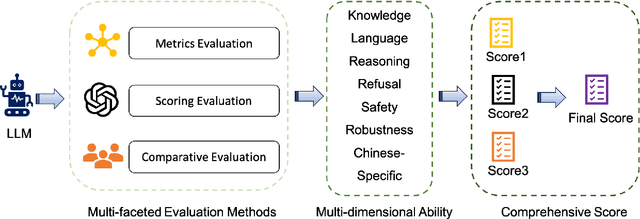
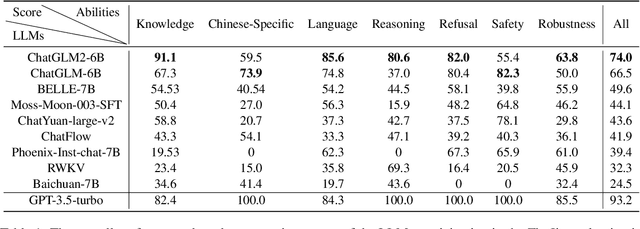
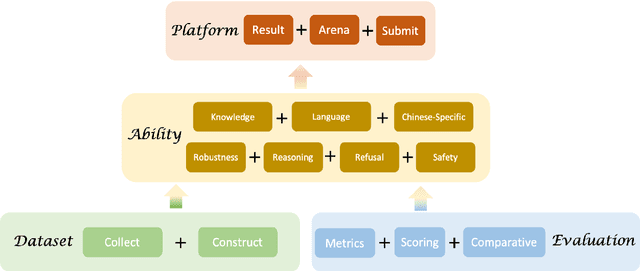
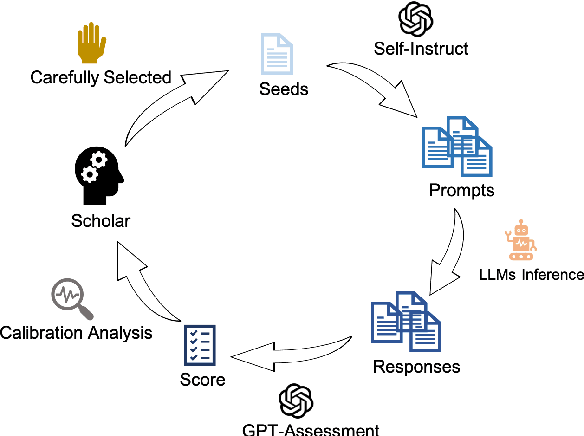
The unprecedented performance of large language models (LLMs) requires comprehensive and accurate evaluation. We argue that for LLMs evaluation, benchmarks need to be comprehensive and systematic. To this end, we propose the ZhuJiu benchmark, which has the following strengths: (1) Multi-dimensional ability coverage: We comprehensively evaluate LLMs across 7 ability dimensions covering 51 tasks. Especially, we also propose a new benchmark that focuses on knowledge ability of LLMs. (2) Multi-faceted evaluation methods collaboration: We use 3 different yet complementary evaluation methods to comprehensively evaluate LLMs, which can ensure the authority and accuracy of the evaluation results. (3) Comprehensive Chinese benchmark: ZhuJiu is the pioneering benchmark that fully assesses LLMs in Chinese, while also providing equally robust evaluation abilities in English. (4) Avoiding potential data leakage: To avoid data leakage, we construct evaluation data specifically for 37 tasks. We evaluate 10 current mainstream LLMs and conduct an in-depth discussion and analysis of their results. The ZhuJiu benchmark and open-participation leaderboard are publicly released at http://www.zhujiu-benchmark.com/ and we also provide a demo video at https://youtu.be/qypkJ89L1Ic.