 Add to Chrome
 Add to Firefox
 Add to Edge
G$^2$V$^2$former: Graph Guided Video Vision Transformer for Face Anti-Spoofing
Aug 14, 2024
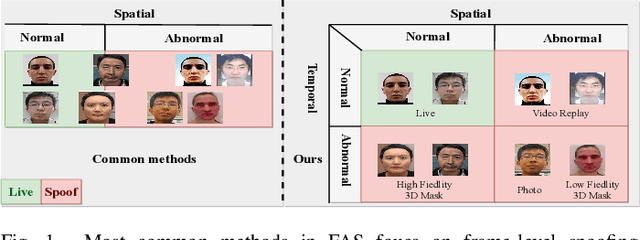
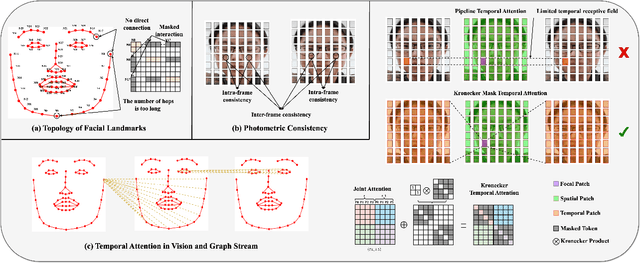
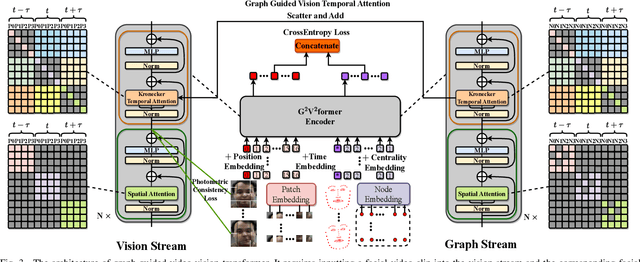
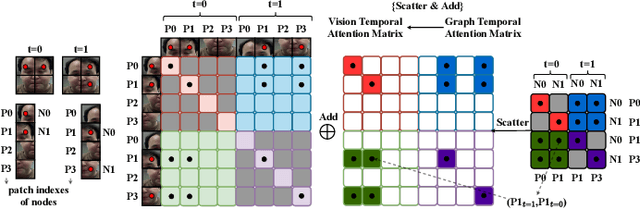
In videos containing spoofed faces, we may uncover the spoofing evidence based on either photometric or dynamic abnormality, even a combination of both. Prevailing face anti-spoofing (FAS) approaches generally concentrate on the single-frame scenario, however, purely photometric-driven methods overlook the dynamic spoofing clues that may be exposed over time. This may lead FAS systems to conclude incorrect judgments, especially in cases where it is easily distinguishable in terms of dynamics but challenging to discern in terms of photometrics. To this end, we propose the Graph Guided Video Vision Transformer (G$^2$V$^2$former), which combines faces with facial landmarks for photometric and dynamic feature fusion. We factorize the attention into space and time, and fuse them via a spatiotemporal block. Specifically, we design a novel temporal attention called Kronecker temporal attention, which has a wider receptive field, and is beneficial for capturing dynamic information. Moreover, we leverage the low-semantic motion of facial landmarks to guide the high-semantic change of facial expressions based on the motivation that regions containing landmarks may reveal more dynamic clues. Extensive experiments on nine benchmark datasets demonstrate that our method achieves superior performance under various scenarios. The codes will be released soon.

Beyond Inter-Item Relations: Dynamic Adaptive Mixture-of-Experts for LLM-Based Sequential Recommendation
Aug 14, 2024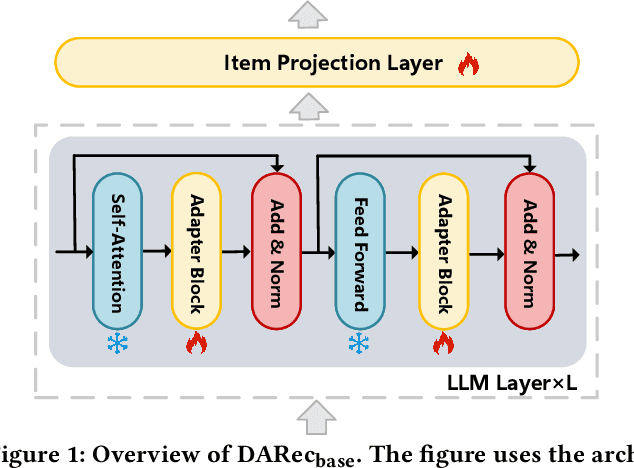
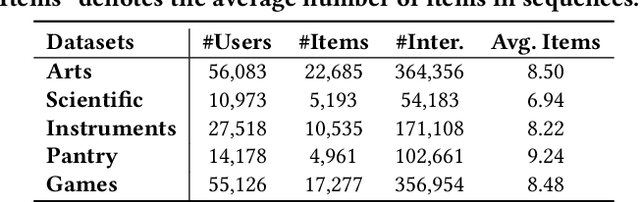
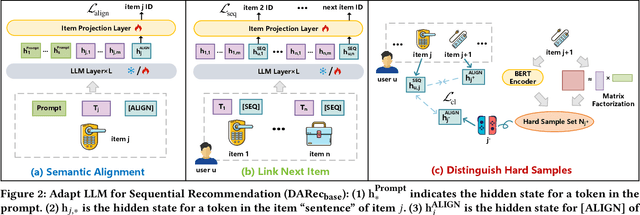
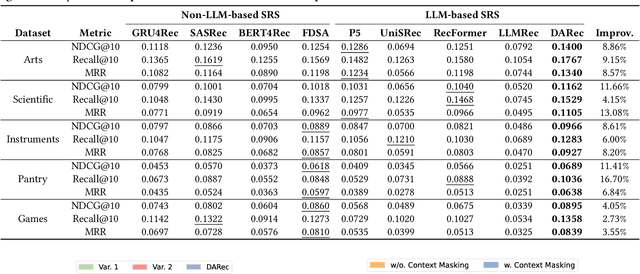
Sequential recommender system (SRS) predicts the next items that users may prefer based on user historical interaction sequences. Inspired by the rise of large language models (LLMs) in various AI applications, there is a surge of work on LLM-based SRS. Despite their attractive performance, existing LLM-based SRS still exhibit some limitations, including neglecting intra-item relations, ignoring long-term collaborative knowledge and using inflexible architecture designs for adaption. To alleviate these issues, we propose an LLM-based SRS named MixRec. Built on top of coarse-grained adaption for capturing inter-item relations, MixRec is further enhanced with (1) context masking that models intra-item relations to help LLM better understand token and item semantics in the context of SRS, (2) collaborative knowledge injection that helps LLM incorporate long-term collaborative knowledge, and (3) a dynamic adaptive mixture-of-experts design that can flexibly choose expert architectures based on Bayesian optimization to better incorporate different sequential information. Extensive experiments demonstrate that MixRec can effectively handle sequential recommendation in a dynamic and adaptive manner.
Multi-Turn Context Jailbreak Attack on Large Language Models From First Principles
Aug 08, 2024Large language models (LLMs) have significantly enhanced the performance of numerous applications, from intelligent conversations to text generation. However, their inherent security vulnerabilities have become an increasingly significant challenge, especially with respect to jailbreak attacks. Attackers can circumvent the security mechanisms of these LLMs, breaching security constraints and causing harmful outputs. Focusing on multi-turn semantic jailbreak attacks, we observe that existing methods lack specific considerations for the role of multiturn dialogues in attack strategies, leading to semantic deviations during continuous interactions. Therefore, in this paper, we establish a theoretical foundation for multi-turn attacks by considering their support in jailbreak attacks, and based on this, propose a context-based contextual fusion black-box jailbreak attack method, named Context Fusion Attack (CFA). This method approach involves filtering and extracting key terms from the target, constructing contextual scenarios around these terms, dynamically integrating the target into the scenarios, replacing malicious key terms within the target, and thereby concealing the direct malicious intent. Through comparisons on various mainstream LLMs and red team datasets, we have demonstrated CFA's superior success rate, divergence, and harmfulness compared to other multi-turn attack strategies, particularly showcasing significant advantages on Llama3 and GPT-4.
Generalized Face Anti-spoofing via Finer Domain Partition and Disentangling Liveness-irrelevant Factors
Jul 11, 2024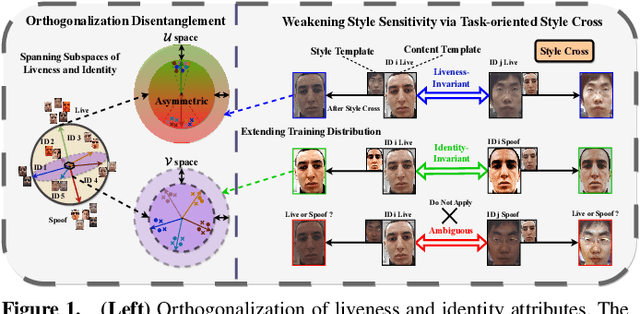
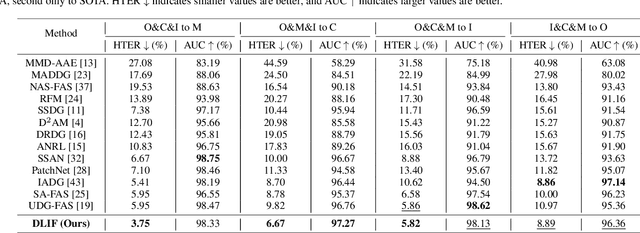
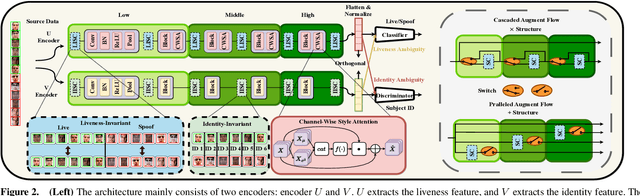
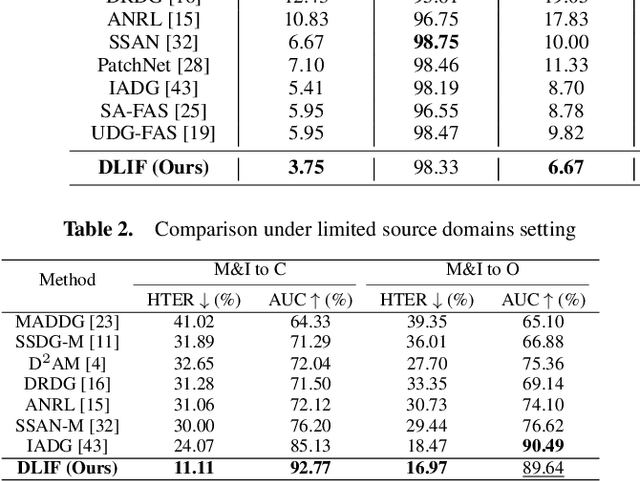
Face anti-spoofing techniques based on domain generalization have recently been studied widely. Adversarial learning and meta-learning techniques have been adopted to learn domain-invariant representations. However, prior approaches often consider the dataset gap as the primary factor behind domain shifts. This perspective is not fine-grained enough to reflect the intrinsic gap among the data accurately. In our work, we redefine domains based on identities rather than datasets, aiming to disentangle liveness and identity attributes. We emphasize ignoring the adverse effect of identity shift, focusing on learning identity-invariant liveness representations through orthogonalizing liveness and identity features. To cope with style shifts, we propose Style Cross module to expand the stylistic diversity and Channel-wise Style Attention module to weaken the sensitivity to style shifts, aiming to learn robust liveness representations. Furthermore, acknowledging the asymmetry between live and spoof samples, we introduce a novel contrastive loss, Asymmetric Augmented Instance Contrast. Extensive experiments on four public datasets demonstrate that our method achieves state-of-the-art performance under cross-dataset and limited source dataset scenarios. Additionally, our method has good scalability when expanding diversity of identities. The codes will be released soon.
Nemotron-4 340B Technical Report
Jun 17, 2024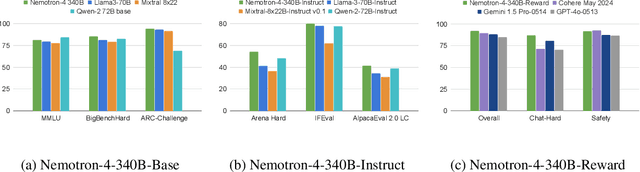

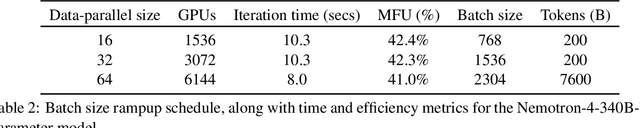
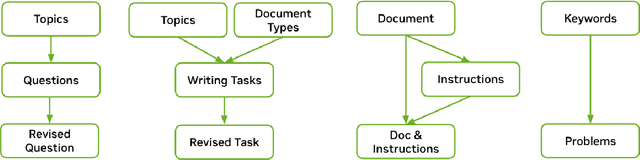
We release the Nemotron-4 340B model family, including Nemotron-4-340B-Base, Nemotron-4-340B-Instruct, and Nemotron-4-340B-Reward. Our models are open access under the NVIDIA Open Model License Agreement, a permissive model license that allows distribution, modification, and use of the models and its outputs. These models perform competitively to open access models on a wide range of evaluation benchmarks, and were sized to fit on a single DGX H100 with 8 GPUs when deployed in FP8 precision. We believe that the community can benefit from these models in various research studies and commercial applications, especially for generating synthetic data to train smaller language models. Notably, over 98% of data used in our model alignment process is synthetically generated, showcasing the effectiveness of these models in generating synthetic data. To further support open research and facilitate model development, we are also open-sourcing the synthetic data generation pipeline used in our model alignment process.
Hallo: Hierarchical Audio-Driven Visual Synthesis for Portrait Image Animation
Jun 16, 2024
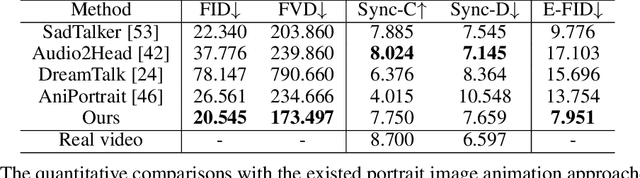
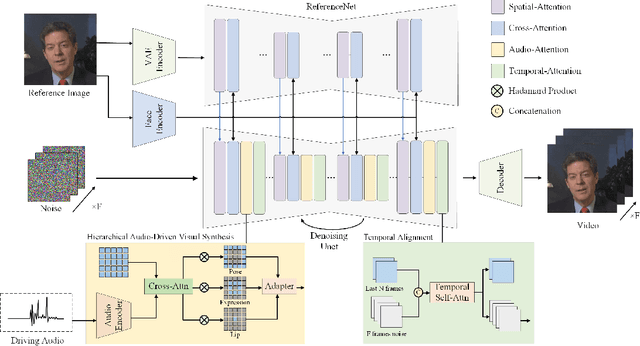
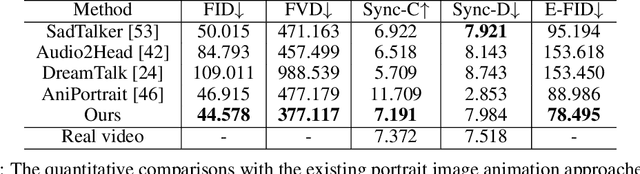
The field of portrait image animation, driven by speech audio input, has experienced significant advancements in the generation of realistic and dynamic portraits. This research delves into the complexities of synchronizing facial movements and creating visually appealing, temporally consistent animations within the framework of diffusion-based methodologies. Moving away from traditional paradigms that rely on parametric models for intermediate facial representations, our innovative approach embraces the end-to-end diffusion paradigm and introduces a hierarchical audio-driven visual synthesis module to enhance the precision of alignment between audio inputs and visual outputs, encompassing lip, expression, and pose motion. Our proposed network architecture seamlessly integrates diffusion-based generative models, a UNet-based denoiser, temporal alignment techniques, and a reference network. The proposed hierarchical audio-driven visual synthesis offers adaptive control over expression and pose diversity, enabling more effective personalization tailored to different identities. Through a comprehensive evaluation that incorporates both qualitative and quantitative analyses, our approach demonstrates obvious enhancements in image and video quality, lip synchronization precision, and motion diversity. Further visualization and access to the source code can be found at: https://fudan-generative-vision.github.io/hallo.
CrossFuse: A Novel Cross Attention Mechanism based Infrared and Visible Image Fusion Approach
Jun 15, 2024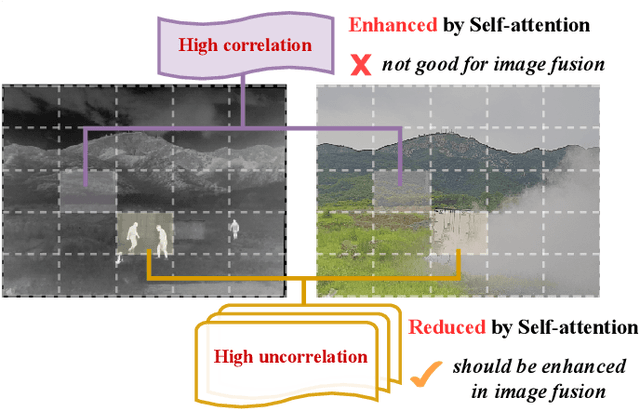
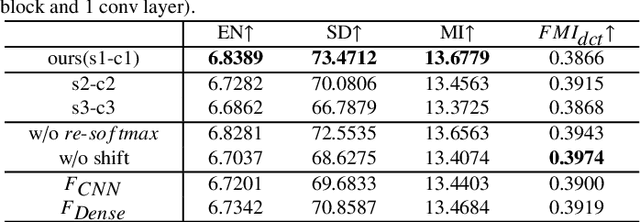
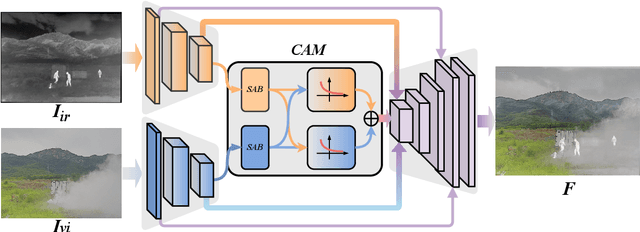

Multimodal visual information fusion aims to integrate the multi-sensor data into a single image which contains more complementary information and less redundant features. However the complementary information is hard to extract, especially for infrared and visible images which contain big similarity gap between these two modalities. The common cross attention modules only consider the correlation, on the contrary, image fusion tasks need focus on complementarity (uncorrelation). Hence, in this paper, a novel cross attention mechanism (CAM) is proposed to enhance the complementary information. Furthermore, a two-stage training strategy based fusion scheme is presented to generate the fused images. For the first stage, two auto-encoder networks with same architecture are trained for each modality. Then, with the fixed encoders, the CAM and a decoder are trained in the second stage. With the trained CAM, features extracted from two modalities are integrated into one fused feature in which the complementary information is enhanced and the redundant features are reduced. Finally, the fused image can be generated by the trained decoder. The experimental results illustrate that our proposed fusion method obtains the SOTA fusion performance compared with the existing fusion networks. The codes are available at https://github.com/hli1221/CrossFuse
Panoptic-FlashOcc: An Efficient Baseline to Marry Semantic Occupancy with Panoptic via Instance Center
Jun 15, 2024Panoptic occupancy poses a novel challenge by aiming to integrate instance occupancy and semantic occupancy within a unified framework. However, there is still a lack of efficient solutions for panoptic occupancy. In this paper, we propose Panoptic-FlashOcc, a straightforward yet robust 2D feature framework that enables realtime panoptic occupancy. Building upon the lightweight design of FlashOcc, our approach simultaneously learns semantic occupancy and class-aware instance clustering in a single network, these outputs are jointly incorporated through panoptic occupancy procession for panoptic occupancy. This approach effectively addresses the drawbacks of high memory and computation requirements associated with three-dimensional voxel-level representations. With its straightforward and efficient design that facilitates easy deployment, Panoptic-FlashOcc demonstrates remarkable achievements in panoptic occupancy prediction. On the Occ3D-nuScenes benchmark, it achieves exceptional performance, with 38.5 RayIoU and 29.1 mIoU for semantic occupancy, operating at a rapid speed of 43.9 FPS. Furthermore, it attains a notable score of 16.0 RayPQ for panoptic occupancy, accompanied by a fast inference speed of 30.2 FPS. These results surpass the performance of existing methodologies in terms of both speed and accuracy. The source code and trained models can be found at the following github repository: https://github.com/Yzichen/FlashOCC.
CDeFuse: Continuous Decomposition for Infrared and Visible Image Fusion
Jun 07, 2024As a common image processing technique, image decomposition is often used to extract complementary information between modalities. In current decomposition-based image fusion methods, typically, source images are decomposed into three parts at single scale (i.e., visible-exclusive part, infrared-exclusive part, and common part) and lacking interaction between modalities during the decomposition process. These results in the inability of fusion images to effectively focus on finer complementary information between modalities at various scales. To address the above issue, a novel decomposition mechanism, Continuous Decomposition Fusion (CDeFuse), is proposed. Firstly, CDeFuse extends the original three-part decomposition to a more general K-part decomposition at each scale through similarity constraints to fuse multi-scale information and achieve a finer representation of decomposition features. Secondly, a Continuous Decomposition Module (CDM) is introduced to assist K-part decomposition. Its core component, State Transformer (ST), efficiently captures complementary information between modalities by utilizing multi-head self-attention mechanism. Finally, a novel decomposition loss function and the corresponding computational optimization strategy are utilized to ensure the smooth progress of the decomposition process while maintaining linear growth in time complexity with the number of decomposition results K. Extensive experiments demonstrate that our CDeFuse achieves comparable performance compared to previous methods. The code will be publicly available.
Seed-TTS: A Family of High-Quality Versatile Speech Generation Models
Jun 04, 2024


We introduce Seed-TTS, a family of large-scale autoregressive text-to-speech (TTS) models capable of generating speech that is virtually indistinguishable from human speech. Seed-TTS serves as a foundation model for speech generation and excels in speech in-context learning, achieving performance in speaker similarity and naturalness that matches ground truth human speech in both objective and subjective evaluations. With fine-tuning, we achieve even higher subjective scores across these metrics. Seed-TTS offers superior controllability over various speech attributes such as emotion and is capable of generating highly expressive and diverse speech for speakers in the wild. Furthermore, we propose a self-distillation method for speech factorization, as well as a reinforcement learning approach to enhance model robustness, speaker similarity, and controllability. We additionally present a non-autoregressive (NAR) variant of the Seed-TTS model, named $\text{Seed-TTS}_\text{DiT}$, which utilizes a fully diffusion-based architecture. Unlike previous NAR-based TTS systems, $\text{Seed-TTS}_\text{DiT}$ does not depend on pre-estimated phoneme durations and performs speech generation through end-to-end processing. We demonstrate that this variant achieves comparable performance to the language model-based variant and showcase its effectiveness in speech editing. We encourage readers to listen to demos at \url{https://bytedancespeech.github.io/seedtts_tech_report}.