 Add to Chrome
 Add to Firefox
 Add to Edge
Spider: A Unified Framework for Context-dependent Concept Understanding
May 02, 2024
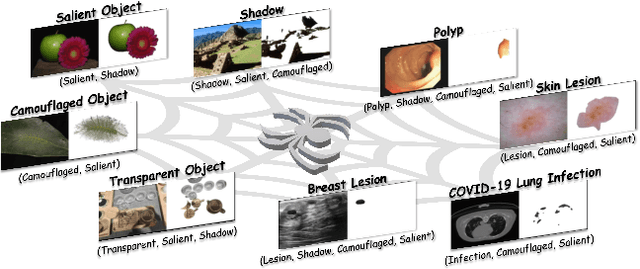
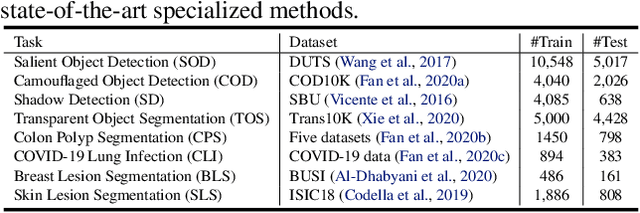
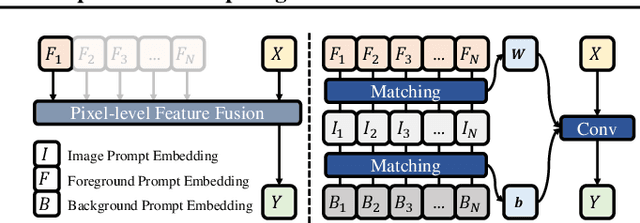
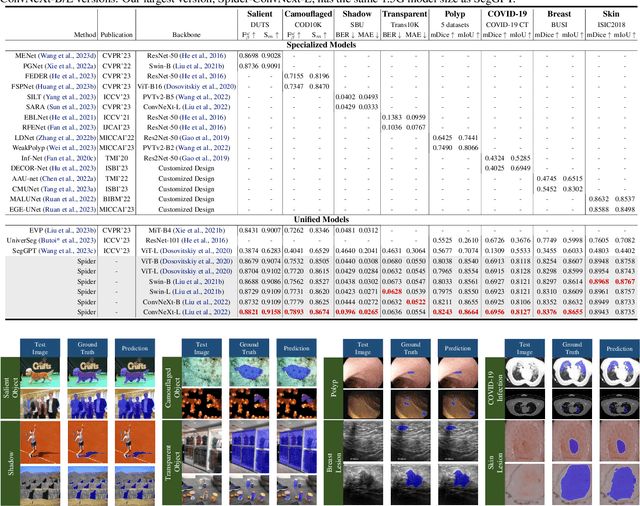
Different from the context-independent (CI) concepts such as human, car, and airplane, context-dependent (CD) concepts require higher visual understanding ability, such as camouflaged object and medical lesion. Despite the rapid advance of many CD understanding tasks in respective branches, the isolated evolution leads to their limited cross-domain generalisation and repetitive technique innovation. Since there is a strong coupling relationship between foreground and background context in CD tasks, existing methods require to train separate models in their focused domains. This restricts their real-world CD concept understanding towards artificial general intelligence (AGI). We propose a unified model with a single set of parameters, Spider, which only needs to be trained once. With the help of the proposed concept filter driven by the image-mask group prompt, Spider is able to understand and distinguish diverse strong context-dependent concepts to accurately capture the Prompter's intention. Without bells and whistles, Spider significantly outperforms the state-of-the-art specialized models in 8 different context-dependent segmentation tasks, including 4 natural scenes (salient, camouflaged, and transparent objects and shadow) and 4 medical lesions (COVID-19, polyp, breast, and skin lesion with color colonoscopy, CT, ultrasound, and dermoscopy modalities). Besides, Spider shows obvious advantages in continuous learning. It can easily complete the training of new tasks by fine-tuning parameters less than 1\% and bring a tolerable performance degradation of less than 5\% for all old tasks. The source code will be publicly available at \href{https://github.com/Xiaoqi-Zhao-DLUT/Spider-UniCDSeg}{Spider-UniCDSeg}.

Deep Boosting Learning: A Brand-new Cooperative Approach for Image-Text Matching
Apr 28, 2024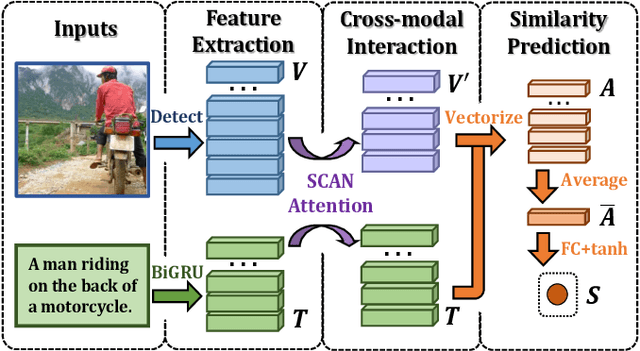
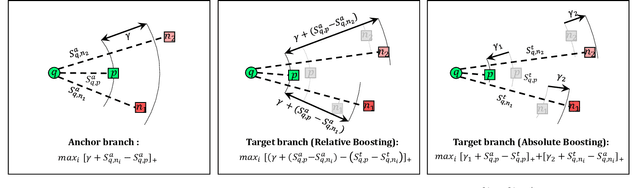
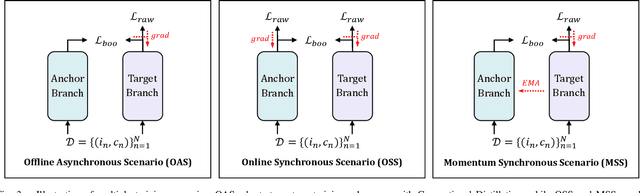
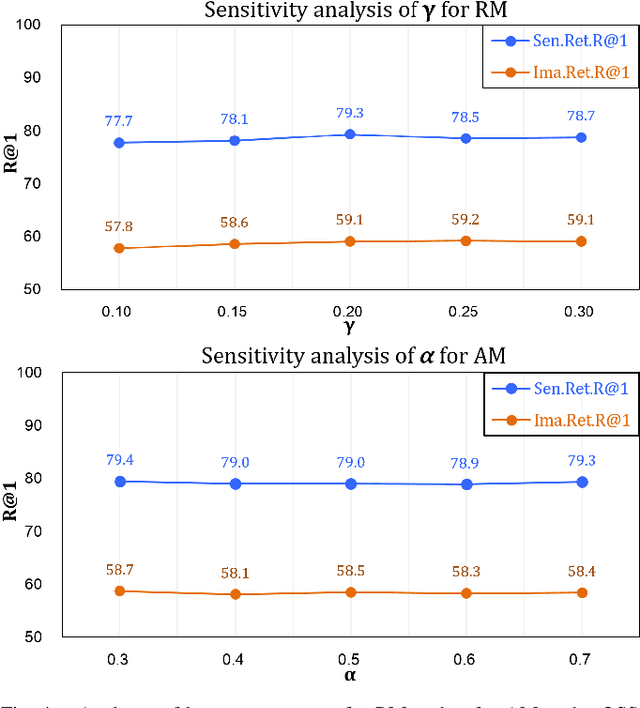
Image-text matching remains a challenging task due to heterogeneous semantic diversity across modalities and insufficient distance separability within triplets. Different from previous approaches focusing on enhancing multi-modal representations or exploiting cross-modal correspondence for more accurate retrieval, in this paper we aim to leverage the knowledge transfer between peer branches in a boosting manner to seek a more powerful matching model. Specifically, we propose a brand-new Deep Boosting Learning (DBL) algorithm, where an anchor branch is first trained to provide insights into the data properties, with a target branch gaining more advanced knowledge to develop optimal features and distance metrics. Concretely, an anchor branch initially learns the absolute or relative distance between positive and negative pairs, providing a foundational understanding of the particular network and data distribution. Building upon this knowledge, a target branch is concurrently tasked with more adaptive margin constraints to further enlarge the relative distance between matched and unmatched samples. Extensive experiments validate that our DBL can achieve impressive and consistent improvements based on various recent state-of-the-art models in the image-text matching field, and outperform related popular cooperative strategies, e.g., Conventional Distillation, Mutual Learning, and Contrastive Learning. Beyond the above, we confirm that DBL can be seamlessly integrated into their training scenarios and achieve superior performance under the same computational costs, demonstrating the flexibility and broad applicability of our proposed method. Our code is publicly available at: https://github.com/Paranioar/DBL.
CharacterFactory: Sampling Consistent Characters with GANs for Diffusion Models
Apr 27, 2024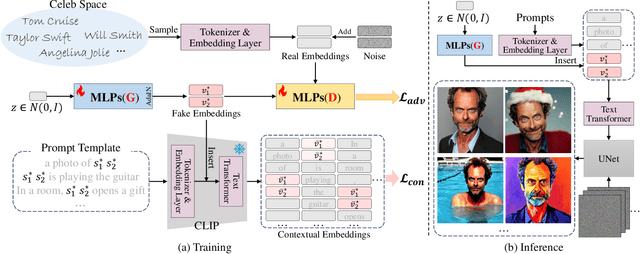

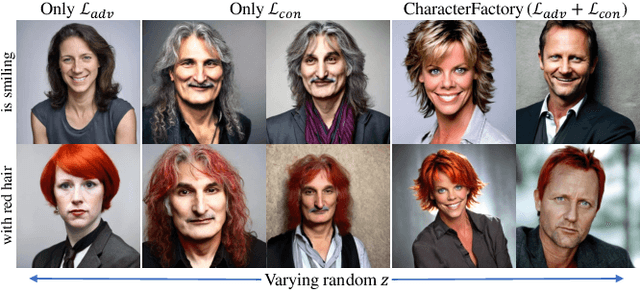

Recent advances in text-to-image models have opened new frontiers in human-centric generation. However, these models cannot be directly employed to generate images with consistent newly coined identities. In this work, we propose CharacterFactory, a framework that allows sampling new characters with consistent identities in the latent space of GANs for diffusion models. More specifically, we consider the word embeddings of celeb names as ground truths for the identity-consistent generation task and train a GAN model to learn the mapping from a latent space to the celeb embedding space. In addition, we design a context-consistent loss to ensure that the generated identity embeddings can produce identity-consistent images in various contexts. Remarkably, the whole model only takes 10 minutes for training, and can sample infinite characters end-to-end during inference. Extensive experiments demonstrate excellent performance of the proposed CharacterFactory on character creation in terms of identity consistency and editability. Furthermore, the generated characters can be seamlessly combined with the off-the-shelf image/video/3D diffusion models. We believe that the proposed CharacterFactory is an important step for identity-consistent character generation. Project page is available at: https://qinghew.github.io/CharacterFactory/.
MAS-SAM: Segment Any Marine Animal with Aggregated Features
Apr 24, 2024
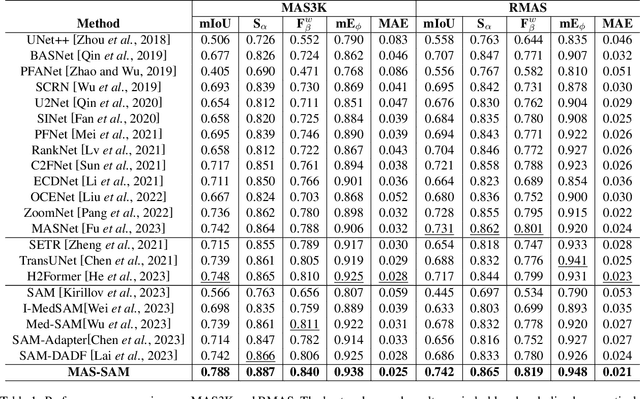
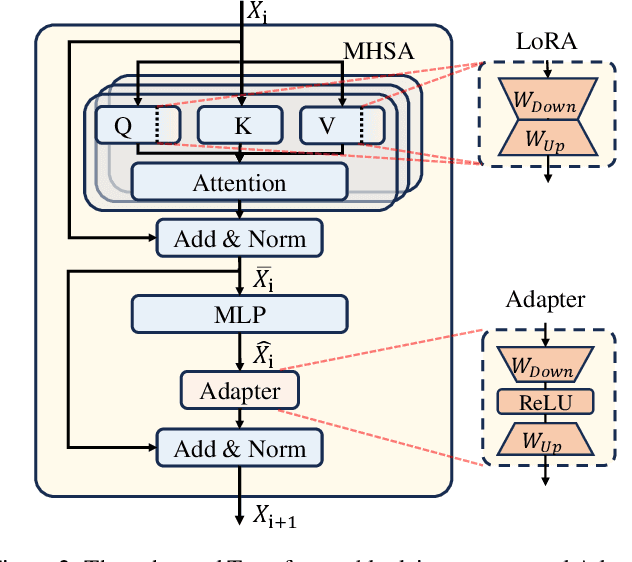
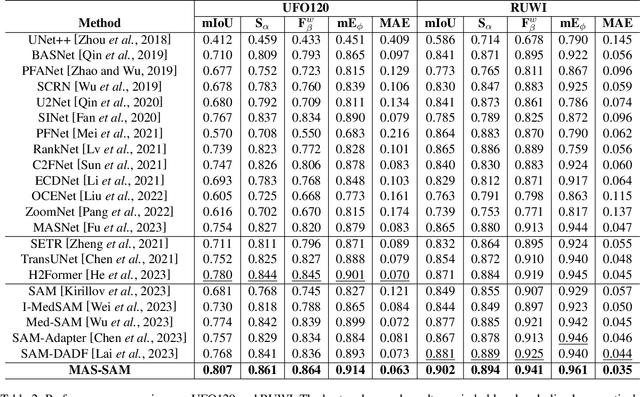
Recently, Segment Anything Model (SAM) shows exceptional performance in generating high-quality object masks and achieving zero-shot image segmentation. However, as a versatile vision model, SAM is primarily trained with large-scale natural light images. In underwater scenes, it exhibits substantial performance degradation due to the light scattering and absorption. Meanwhile, the simplicity of the SAM's decoder might lead to the loss of fine-grained object details. To address the above issues, we propose a novel feature learning framework named MAS-SAM for marine animal segmentation, which involves integrating effective adapters into the SAM's encoder and constructing a pyramidal decoder. More specifically, we first build a new SAM's encoder with effective adapters for underwater scenes. Then, we introduce a Hypermap Extraction Module (HEM) to generate multi-scale features for a comprehensive guidance. Finally, we propose a Progressive Prediction Decoder (PPD) to aggregate the multi-scale features and predict the final segmentation results. When grafting with the Fusion Attention Module (FAM), our method enables to extract richer marine information from global contextual cues to fine-grained local details. Extensive experiments on four public MAS datasets demonstrate that our MAS-SAM can obtain better results than other typical segmentation methods. The source code is available at https://github.com/Drchip61/MAS-SAM.
Other Tokens Matter: Exploring Global and Local Features of Vision Transformers for Object Re-Identification
Apr 23, 2024Object Re-Identification (Re-ID) aims to identify and retrieve specific objects from images captured at different places and times. Recently, object Re-ID has achieved great success with the advances of Vision Transformers (ViT). However, the effects of the global-local relation have not been fully explored in Transformers for object Re-ID. In this work, we first explore the influence of global and local features of ViT and then further propose a novel Global-Local Transformer (GLTrans) for high-performance object Re-ID. We find that the features from last few layers of ViT already have a strong representational ability, and the global and local information can mutually enhance each other. Based on this fact, we propose a Global Aggregation Encoder (GAE) to utilize the class tokens of the last few Transformer layers and learn comprehensive global features effectively. Meanwhile, we propose the Local Multi-layer Fusion (LMF) which leverages both the global cues from GAE and multi-layer patch tokens to explore the discriminative local representations. Extensive experiments demonstrate that our proposed method achieves superior performance on four object Re-ID benchmarks.
Automated Evaluation of Large Vision-Language Models on Self-driving Corner Cases
Apr 16, 2024


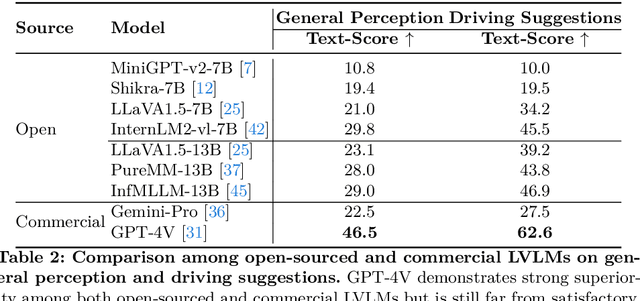
Large Vision-Language Models (LVLMs), due to the remarkable visual reasoning ability to understand images and videos, have received widespread attention in the autonomous driving domain, which significantly advances the development of interpretable end-to-end autonomous driving. However, current evaluations of LVLMs primarily focus on the multi-faceted capabilities in common scenarios, lacking quantifiable and automated assessment in autonomous driving contexts, let alone severe road corner cases that even the state-of-the-art autonomous driving perception systems struggle to handle. In this paper, we propose CODA-LM, a novel vision-language benchmark for self-driving, which provides the first automatic and quantitative evaluation of LVLMs for interpretable autonomous driving including general perception, regional perception, and driving suggestions. CODA-LM utilizes the texts to describe the road images, exploiting powerful text-only large language models (LLMs) without image inputs to assess the capabilities of LVLMs in autonomous driving scenarios, which reveals stronger alignment with human preferences than LVLM judges. Experiments demonstrate that even the closed-sourced commercial LVLMs like GPT-4V cannot deal with road corner cases well, suggesting that we are still far from a strong LVLM-powered intelligent driving agent, and we hope our CODA-LM can become the catalyst to promote future development.
Multi-view Aggregation Network for Dichotomous Image Segmentation
Apr 11, 2024Dichotomous Image Segmentation (DIS) has recently emerged towards high-precision object segmentation from high-resolution natural images. When designing an effective DIS model, the main challenge is how to balance the semantic dispersion of high-resolution targets in the small receptive field and the loss of high-precision details in the large receptive field. Existing methods rely on tedious multiple encoder-decoder streams and stages to gradually complete the global localization and local refinement. Human visual system captures regions of interest by observing them from multiple views. Inspired by it, we model DIS as a multi-view object perception problem and provide a parsimonious multi-view aggregation network (MVANet), which unifies the feature fusion of the distant view and close-up view into a single stream with one encoder-decoder structure. With the help of the proposed multi-view complementary localization and refinement modules, our approach established long-range, profound visual interactions across multiple views, allowing the features of the detailed close-up view to focus on highly slender structures.Experiments on the popular DIS-5K dataset show that our MVANet significantly outperforms state-of-the-art methods in both accuracy and speed. The source code and datasets will be publicly available at \href{https://github.com/qianyu-dlut/MVANet}{MVANet}.
Spatial-Temporal Multi-level Association for Video Object Segmentation
Apr 09, 2024Existing semi-supervised video object segmentation methods either focus on temporal feature matching or spatial-temporal feature modeling. However, they do not address the issues of sufficient target interaction and efficient parallel processing simultaneously, thereby constraining the learning of dynamic, target-aware features. To tackle these limitations, this paper proposes a spatial-temporal multi-level association framework, which jointly associates reference frame, test frame, and object features to achieve sufficient interaction and parallel target ID association with a spatial-temporal memory bank for efficient video object segmentation. Specifically, we construct a spatial-temporal multi-level feature association module to learn better target-aware features, which formulates feature extraction and interaction as the efficient operations of object self-attention, reference object enhancement, and test reference correlation. In addition, we propose a spatial-temporal memory to assist feature association and temporal ID assignment and correlation. We evaluate the proposed method by conducting extensive experiments on numerous video object segmentation datasets, including DAVIS 2016/2017 val, DAVIS 2017 test-dev, and YouTube-VOS 2018/2019 val. The favorable performance against the state-of-the-art methods demonstrates the effectiveness of our approach. All source code and trained models will be made publicly available.
Fantastic Animals and Where to Find Them: Segment Any Marine Animal with Dual SAM
Apr 07, 2024As an important pillar of underwater intelligence, Marine Animal Segmentation (MAS) involves segmenting animals within marine environments. Previous methods don't excel in extracting long-range contextual features and overlook the connectivity between discrete pixels. Recently, Segment Anything Model (SAM) offers a universal framework for general segmentation tasks. Unfortunately, trained with natural images, SAM does not obtain the prior knowledge from marine images. In addition, the single-position prompt of SAM is very insufficient for prior guidance. To address these issues, we propose a novel feature learning framework, named Dual-SAM for high-performance MAS. To this end, we first introduce a dual structure with SAM's paradigm to enhance feature learning of marine images. Then, we propose a Multi-level Coupled Prompt (MCP) strategy to instruct comprehensive underwater prior information, and enhance the multi-level features of SAM's encoder with adapters. Subsequently, we design a Dilated Fusion Attention Module (DFAM) to progressively integrate multi-level features from SAM's encoder. Finally, instead of directly predicting the masks of marine animals, we propose a Criss-Cross Connectivity Prediction (C$^3$P) paradigm to capture the inter-connectivity between discrete pixels. With dual decoders, it generates pseudo-labels and achieves mutual supervision for complementary feature representations, resulting in considerable improvements over previous techniques. Extensive experiments verify that our proposed method achieves state-of-the-art performances on five widely-used MAS datasets. The code is available at https://github.com/Drchip61/Dual_SAM.
Exploring Dynamic Transformer for Efficient Object Tracking
Mar 26, 2024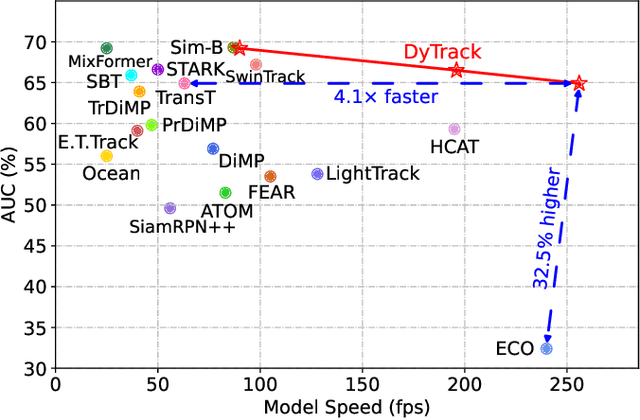
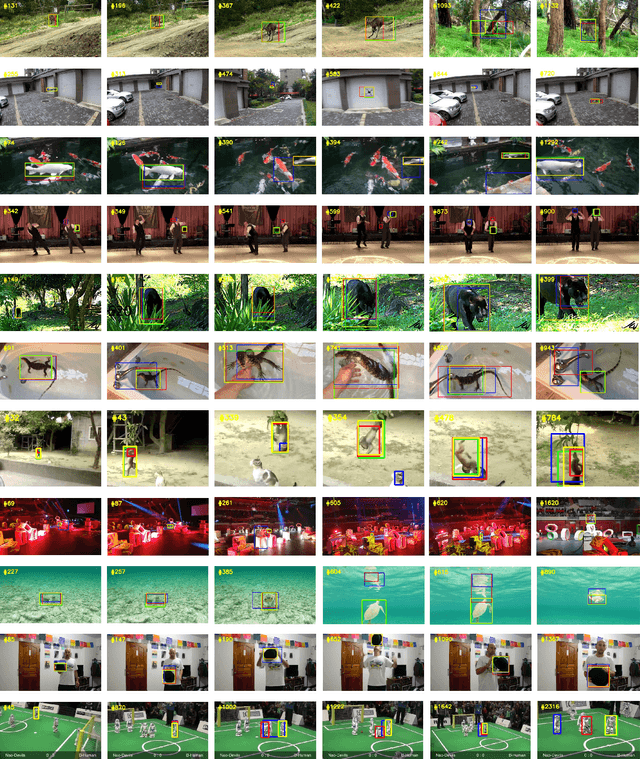
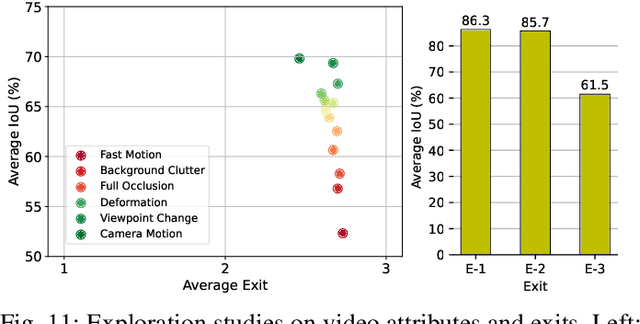
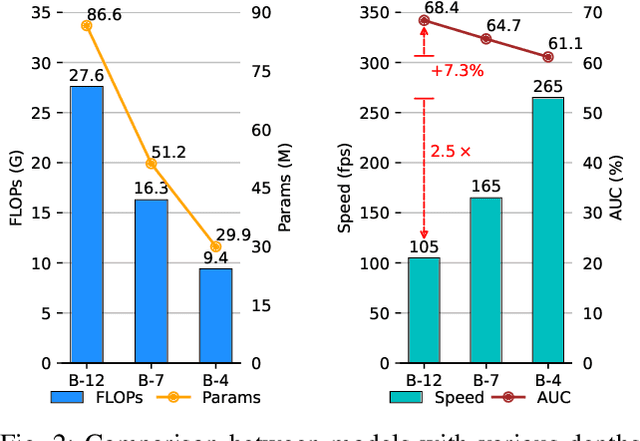
The speed-precision trade-off is a critical problem for visual object tracking which usually requires low latency and deployment on constrained resources. Existing solutions for efficient tracking mainly focus on adopting light-weight backbones or modules, which nevertheless come at the cost of a sacrifice in precision. In this paper, inspired by dynamic network routing, we propose DyTrack, a dynamic transformer framework for efficient tracking. Real-world tracking scenarios exhibit diverse levels of complexity. We argue that a simple network is sufficient for easy frames in video sequences, while more computation could be assigned to difficult ones. DyTrack automatically learns to configure proper reasoning routes for various inputs, gaining better utilization of the available computational budget. Thus, it can achieve higher performance with the same running speed. We formulate instance-specific tracking as a sequential decision problem and attach terminating branches to intermediate layers of the entire model. Especially, to fully utilize the computations, we introduce the feature recycling mechanism to reuse the outputs of predecessors. Furthermore, a target-aware self-distillation strategy is designed to enhance the discriminating capabilities of early predictions by effectively mimicking the representation pattern of the deep model. Extensive experiments on multiple benchmarks demonstrate that DyTrack achieves promising speed-precision trade-offs with only a single model. For instance, DyTrack obtains 64.9% AUC on LaSOT with a speed of 256 fps.