 Add to Chrome
 Add to Firefox
 Add to Edge
POEM: Phase-Aware $\mathrm{SO}(2)$ Feature Rotation for Time Series Forecasting Under Periodicity Drift
Aug 04, 2026
Deep learning has advanced time series forecasting, but periodicity drift, in which cycle timing and phase vary over time, remains a challenging problem. Existing methods predominantly model these sequences on fixed time grids, suffering from a limited ability to accommodate phase-related variation. To address this limitation, we propose \textbf{POEM}, a phase-aware forecasting framework based on latent feature rotation using the special orthogonal group in two dimensions, denoted by $\mathrm{SO}(2)$. POEM aims to reduce the phase-related variability by learning a phase-correction coordinate and applying an invertible $\mathrm{SO}(2)$-based rotation to paired latent features. To extrapolate this correction coordinate, Directional Phase Increment Attention (DPIA) retrieves historical phase increments from similar temporal contexts and integrates them into future phase corrections. Experiments demonstrate that POEM achieves competitive performance, while qualitative visualizations suggest that the learned phase-aware transformation makes latent trajectories more regular.

MerchantBench: Benchmarking LLM Agents for Long-Term Coherence in E-Commerce Operations
Jul 31, 2026Large language model agents are increasingly evaluated as autonomous tool users, yet most benchmarks focus on bounded tasks with immediate success criteria. Real-world deployments often require Long-Term Coherence, the capacity to preserve purposeful behavior across extended horizons while adapting decisions to accumulated evidence. Evaluating this capacity requires a persistent environment in which actions constrain future choices, feedback arrives at heterogeneous delays, and incoherent behavior produces measurable cumulative effects. Seller-side e-commerce provides a suitable setting for this evaluation through recurrent and interdependent decisions over Product Sourcing, Listing and Pricing Control, Cash-Flow Management, and Mixed-Latency Feedback Adaptation. We introduce MerchantBench, a 365-day order-level simulation grounded in 98,843 real e-commerce product records and equipped with 26 tools for agent interaction. MerchantBench couples promptly observable Upstream Supplier Events with delayed Downstream Order Outcomes, requiring agents to follow individual order lifecycles and revisit earlier decisions. We evaluate eight LLMs under two agent frameworks in 48 runs, each spanning 365 simulated days. Our results reveal a substantial gap between even the latest LLMs and human participants, with the best LLM configuration attaining only 27.3\% of the mean final net assets achieved by human participants.
SKILL-KD: Contrastive Skill Distillation for LLM Agents
Jul 30, 2026Skill-based prompting has become a practical mechanism for improving large language model (LLM) agents, yet existing skill acquisition methods often treat skills as experience summaries, memory entries, or direct summaries of successful demonstrations. This creates a mismatch for weaker student agents: when a student fails because it lacks task knowledge or operational strategy, its failed trajectory may not contain enough evidence to infer the missing behavior, while the teacher trajectory may be too implicit to be internalized as reusable guidance. We propose SKILL-KD, a contrastive skill distillation framework that treats skills as an explicit distillation medium between agents of different capabilities. Given a student failure and the teacher trajectory on the same task, SKILL-KD distills their actionable discrepancy into a textual skill patch, evaluates the patch by re-running the student, and iteratively refines the patch when the student still fails. To prevent repeated local updates from causing skill drift, SKILL-KD further maintains trace-linked edit histories and performs Drift-Aware Skill Consolidation, deciding whether each patch should add a new rule, delete or modify an existing rule, or be skipped. Across five agent benchmarks and two student settings, SKILL-KD consistently improves frozen student agents over fixed-model adaptation baselines.
AnomalyAgent: Training-Free Agentic Models for Zero-/Few-Shot Anomaly Detection
May 28, 2026Benefiting from generalizability of vision-language models (VLMs) such as CLIP, many zero-/few-shot anomaly detection (AD) approaches have achieved impressive detection performance across various datasets. Nevertheless, they require substantial training on large auxiliary datasets to adapt VLMs to anomaly detection, and their inference largely relies on visual-text embedding similarity-based anomaly scores, lacking reasoning abilities to detect complex anomalies that require in-depth contextual understanding. To address this limitation, we propose \textbf{AnomalyAgent}, a novel training-free, agentic framework that leverages the advanced reasoning and generalization capabilities of multimodal large language models (MLLMs) for anomaly detection. The key ingredients include \textbf{1)} a comprehensive anomaly-centric toolset that enables adaptive MLLM-driven, agentic anomaly reasoning in zero-shot settings, and \textbf{2)} a customized memory module that grounds anomaly reasoning with few-shot, in-context reference examples. We extend evaluation beyond the detection of simple anomalies (e.g., surface defects like cracks and dents and clear lesions) in widely used benchmarks to more diverse types of anomalies such as logical/contextual anomalies in logistics and manufacturing settings. Extensive experiment results demonstrate that our AnomalyAgent achieves substantially better performance compared to training-free VLM-based AD and generic agentic methods, highlighting its superior generalization capability in both zero-shot and few-shot anomaly detection settings. The code implementation can be find at this address.
Dynamic TMoE: A Drift-Aware Dynamic Mixture of Experts Framework for Non-Stationary Time Series Forecasting
May 20, 2026Non-stationary time series forecasting is challenged by evolving distribution shifts that static models struggle to capture. While Mixture-of-Experts (MoE) architectures offer a promising paradigm for decoupling complex drift patterns, existing approaches are limited by fixed expert pools and memoryless routing, hampering their ability to adapt to abrupt regime shifts. To address this, we propose Dynamic TMoE, a framework that unifies architectural evolution with temporal continuity during learning phase. By detecting distribution shifts via Maximum Mean Discrepancy (MMD), we dynamically instantiate heterogeneous experts and prune redundant ones to optimize capacity. Additionally, a temporal memory router leverages recurrent states and an anomaly repository to ensure stable, context-aware expert selection without requiring test-time updates. Experiments on nine benchmarks demonstrate state-of-the-art performance, reducing MSE by 10.4% and MAE by 7.8%. Code is available at https://github.com/andone-07/Dynamic-TMoE.
InCTRLv2: Generalist Residual Models for Few-Shot Anomaly Detection and Segmentation
Apr 06, 2026While recent anomaly detection (AD) methods have made substantial progress in recognizing abnormal patterns within specific domains, most of them are specialist models that are trained on large training samples from a specific target dataset, struggling to generalize to unseen datasets. To address this limitation, the paradigm of Generalist Anomaly Detection (GAD) has emerged in recent years, aiming to learn a single generalist model to detect anomalies across diverse domains without retraining. To this end, this work introduces InCTRLv2, a novel few-shot Generalist Anomaly Detection and Segmentation (GADS) framework that significantly extends our previously proposed GAD model, InCTRL. Building on the idea of learning in-context residuals with few-shot normal examples to detect anomalies as in InCTRL, InCTRLv2 introduces two new, complementary perspectives of anomaly perception under a dual-branch framework. This is accomplished by two novel modules upon InCTRL: i) Discriminative Anomaly Score Learning (DASL) with both normal and abnormal data in the main branch, which learns a semantic-guided abnormality and normality space that supports the classification of query samples from both the abnormality and normality perspectives; and ii) One-class Anomaly Score Learning (OASL) using only the normal data, which learns generalized normality patterns in a semantic space via an auxiliary branch, focusing on detecting anomalies through the lens of normality solely. Both branches are guided by rich visual-text semantic priors encoded by large-scale vision-language models. Together, they offer a dual semantic perspective for AD: one emphasizes normal-abnormal discriminations, while the other emphasizes normality-deviated semantics. Extensive experiments on ten AD datasets demonstrate that InCTRLv2 achieves SotA performance in both anomaly detection and segmentation tasks across various settings.
Unleashing Vision-Language Semantics for Deepfake Video Detection
Mar 25, 2026Recent Deepfake Video Detection (DFD) studies have demonstrated that pre-trained Vision-Language Models (VLMs) such as CLIP exhibit strong generalization capabilities in detecting artifacts across different identities. However, existing approaches focus on leveraging visual features only, overlooking their most distinctive strength -- the rich vision-language semantics embedded in the latent space. We propose VLAForge, a novel DFD framework that unleashes the potential of such cross-modal semantics to enhance model's discriminability in deepfake detection. This work i) enhances the visual perception of VLM through a ForgePerceiver, which acts as an independent learner to capture diverse, subtle forgery cues both granularly and holistically, while preserving the pretrained Vision-Language Alignment (VLA) knowledge, and ii) provides a complementary discriminative cue -- Identity-Aware VLA score, derived by coupling cross-modal semantics with the forgery cues learned by ForgePerceiver. Notably, the VLA score is augmented by an identity prior-informed text prompting to capture authenticity cues tailored to each identity, thereby enabling more discriminative cross-modal semantics. Comprehensive experiments on video DFD benchmarks, including classical face-swapping forgeries and recent full-face generation forgeries, demonstrate that our VLAForge substantially outperforms state-of-the-art methods at both frame and video levels. Code is available at https://github.com/mala-lab/VLAForge.
YOLO-Master: MOE-Accelerated with Specialized Transformers for Enhanced Real-time Detection
Dec 30, 2025Existing Real-Time Object Detection (RTOD) methods commonly adopt YOLO-like architectures for their favorable trade-off between accuracy and speed. However, these models rely on static dense computation that applies uniform processing to all inputs, misallocating representational capacity and computational resources such as over-allocating on trivial scenes while under-serving complex ones. This mismatch results in both computational redundancy and suboptimal detection performance. To overcome this limitation, we propose YOLO-Master, a novel YOLO-like framework that introduces instance-conditional adaptive computation for RTOD. This is achieved through a Efficient Sparse Mixture-of-Experts (ES-MoE) block that dynamically allocates computational resources to each input according to its scene complexity. At its core, a lightweight dynamic routing network guides expert specialization during training through a diversity enhancing objective, encouraging complementary expertise among experts. Additionally, the routing network adaptively learns to activate only the most relevant experts, thereby improving detection performance while minimizing computational overhead during inference. Comprehensive experiments on five large-scale benchmarks demonstrate the superiority of YOLO-Master. On MS COCO, our model achieves 42.4% AP with 1.62ms latency, outperforming YOLOv13-N by +0.8% mAP and 17.8% faster inference. Notably, the gains are most pronounced on challenging dense scenes, while the model preserves efficiency on typical inputs and maintains real-time inference speed. Code will be available.
Regularizing Subspace Redundancy of Low-Rank Adaptation
Jul 28, 2025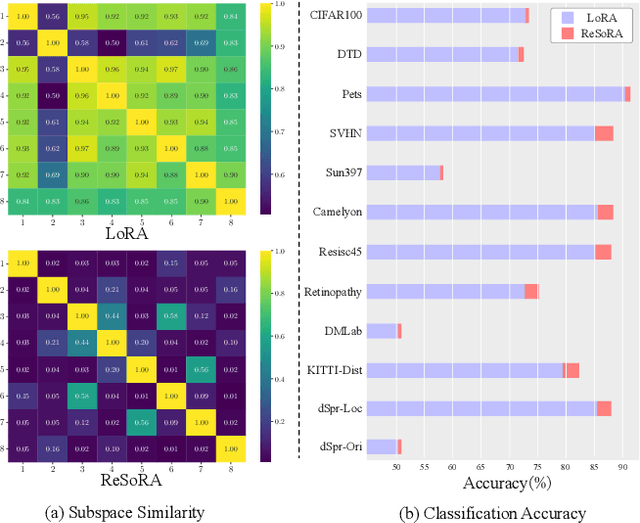
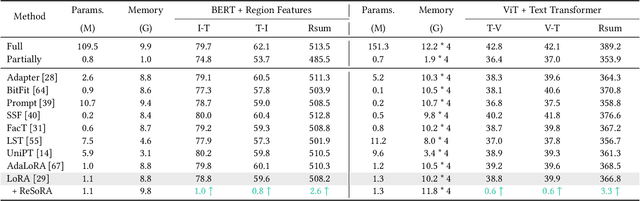
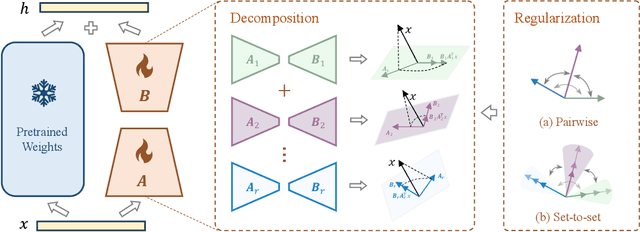

Low-Rank Adaptation (LoRA) and its variants have delivered strong capability in Parameter-Efficient Transfer Learning (PETL) by minimizing trainable parameters and benefiting from reparameterization. However, their projection matrices remain unrestricted during training, causing high representation redundancy and diminishing the effectiveness of feature adaptation in the resulting subspaces. While existing methods mitigate this by manually adjusting the rank or implicitly applying channel-wise masks, they lack flexibility and generalize poorly across various datasets and architectures. Hence, we propose ReSoRA, a method that explicitly models redundancy between mapping subspaces and adaptively Regularizes Subspace redundancy of Low-Rank Adaptation. Specifically, it theoretically decomposes the low-rank submatrices into multiple equivalent subspaces and systematically applies de-redundancy constraints to the feature distributions across different projections. Extensive experiments validate that our proposed method consistently facilitates existing state-of-the-art PETL methods across various backbones and datasets in vision-language retrieval and standard visual classification benchmarks. Besides, as a training supervision, ReSoRA can be seamlessly integrated into existing approaches in a plug-and-play manner, with no additional inference costs. Code is publicly available at: https://github.com/Lucenova/ReSoRA.
Adapting Large Language Models for Parameter-Efficient Log Anomaly Detection
Mar 11, 2025Log Anomaly Detection (LAD) seeks to identify atypical patterns in log data that are crucial to assessing the security and condition of systems. Although Large Language Models (LLMs) have shown tremendous success in various fields, the use of LLMs in enabling the detection of log anomalies is largely unexplored. This work aims to fill this gap. Due to the prohibitive costs involved in fully fine-tuning LLMs, we explore the use of parameter-efficient fine-tuning techniques (PEFTs) for adapting LLMs to LAD. To have an in-depth exploration of the potential of LLM-driven LAD, we present a comprehensive investigation of leveraging two of the most popular PEFTs -- Low-Rank Adaptation (LoRA) and Representation Fine-tuning (ReFT) -- to tap into three prominent LLMs of varying size, including RoBERTa, GPT-2, and Llama-3, for parameter-efficient LAD. Comprehensive experiments on four public log datasets are performed to reveal important insights into effective LLM-driven LAD in several key perspectives, including the efficacy of these PEFT-based LLM-driven LAD methods, their stability, sample efficiency, robustness w.r.t. unstable logs, and cross-dataset generalization. Code is available at https://github.com/mala-lab/LogADReft.