 Add to Chrome
 Add to Firefox
 Add to Edge
ReNeg: Learning Negative Embedding with Reward Guidance
Dec 27, 2024
In text-to-image (T2I) generation applications, negative embeddings have proven to be a simple yet effective approach for enhancing generation quality. Typically, these negative embeddings are derived from user-defined negative prompts, which, while being functional, are not necessarily optimal. In this paper, we introduce ReNeg, an end-to-end method designed to learn improved Negative embeddings guided by a Reward model. We employ a reward feedback learning framework and integrate classifier-free guidance (CFG) into the training process, which was previously utilized only during inference, thus enabling the effective learning of negative embeddings. We also propose two strategies for learning both global and per-sample negative embeddings. Extensive experiments show that the learned negative embedding significantly outperforms null-text and handcrafted counterparts, achieving substantial improvements in human preference alignment. Additionally, the negative embedding learned within the same text embedding space exhibits strong generalization capabilities. For example, using the same CLIP text encoder, the negative embedding learned on SD1.5 can be seamlessly transferred to text-to-image or even text-to-video models such as ControlNet, ZeroScope, and VideoCrafter2, resulting in consistent performance improvements across the board.

SUTrack: Towards Simple and Unified Single Object Tracking
Dec 26, 2024
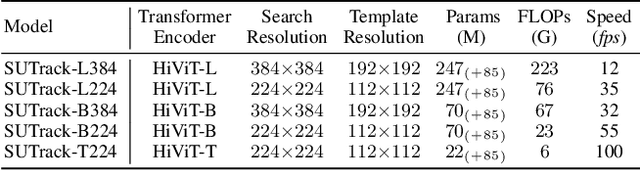
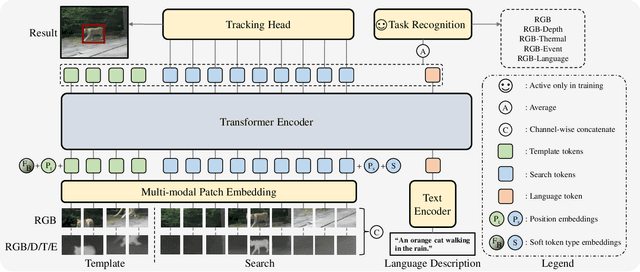

In this paper, we propose a simple yet unified single object tracking (SOT) framework, dubbed SUTrack. It consolidates five SOT tasks (RGB-based, RGB-Depth, RGB-Thermal, RGB-Event, RGB-Language Tracking) into a unified model trained in a single session. Due to the distinct nature of the data, current methods typically design individual architectures and train separate models for each task. This fragmentation results in redundant training processes, repetitive technological innovations, and limited cross-modal knowledge sharing. In contrast, SUTrack demonstrates that a single model with a unified input representation can effectively handle various common SOT tasks, eliminating the need for task-specific designs and separate training sessions. Additionally, we introduce a task-recognition auxiliary training strategy and a soft token type embedding to further enhance SUTrack's performance with minimal overhead. Experiments show that SUTrack outperforms previous task-specific counterparts across 11 datasets spanning five SOT tasks. Moreover, we provide a range of models catering edge devices as well as high-performance GPUs, striking a good trade-off between speed and accuracy. We hope SUTrack could serve as a strong foundation for further compelling research into unified tracking models. Code and models are available at github.com/chenxin-dlut/SUTrack.
Unity is Strength: Unifying Convolutional and Transformeral Features for Better Person Re-Identification
Dec 23, 2024Person Re-identification (ReID) aims to retrieve the specific person across non-overlapping cameras, which greatly helps intelligent transportation systems. As we all know, Convolutional Neural Networks (CNNs) and Transformers have the unique strengths to extract local and global features, respectively. Considering this fact, we focus on the mutual fusion between them to learn more comprehensive representations for persons. In particular, we utilize the complementary integration of deep features from different model structures. We propose a novel fusion framework called FusionReID to unify the strengths of CNNs and Transformers for image-based person ReID. More specifically, we first deploy a Dual-branch Feature Extraction (DFE) to extract features through CNNs and Transformers from a single image. Moreover, we design a novel Dual-attention Mutual Fusion (DMF) to achieve sufficient feature fusions. The DMF comprises Local Refinement Units (LRU) and Heterogenous Transmission Modules (HTM). LRU utilizes depth-separable convolutions to align deep features in channel dimensions and spatial sizes. HTM consists of a Shared Encoding Unit (SEU) and two Mutual Fusion Units (MFU). Through the continuous stacking of HTM, deep features after LRU are repeatedly utilized to generate more discriminative features. Extensive experiments on three public ReID benchmarks demonstrate that our method can attain superior performances than most state-of-the-arts. The source code is available at https://github.com/924973292/FusionReID.
Autoregressive Video Generation without Vector Quantization
Dec 18, 2024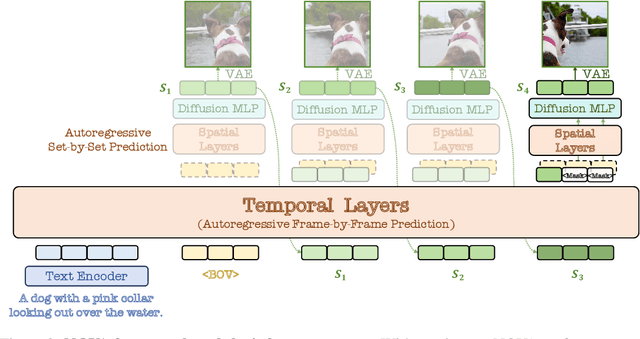
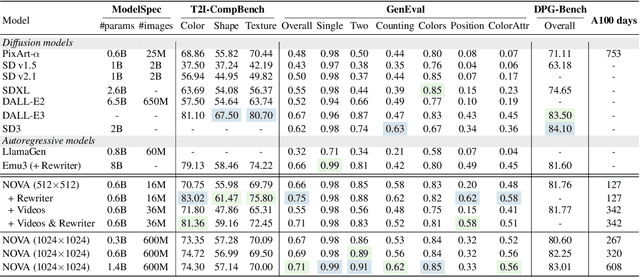
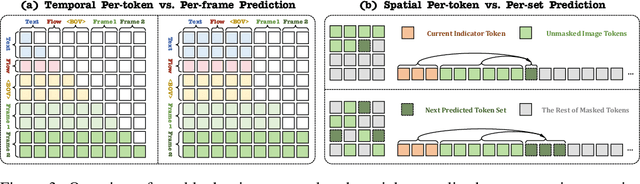
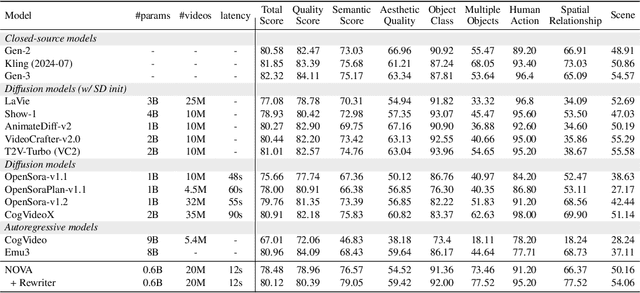
This paper presents a novel approach that enables autoregressive video generation with high efficiency. We propose to reformulate the video generation problem as a non-quantized autoregressive modeling of temporal frame-by-frame prediction and spatial set-by-set prediction. Unlike raster-scan prediction in prior autoregressive models or joint distribution modeling of fixed-length tokens in diffusion models, our approach maintains the causal property of GPT-style models for flexible in-context capabilities, while leveraging bidirectional modeling within individual frames for efficiency. With the proposed approach, we train a novel video autoregressive model without vector quantization, termed NOVA. Our results demonstrate that NOVA surpasses prior autoregressive video models in data efficiency, inference speed, visual fidelity, and video fluency, even with a much smaller model capacity, i.e., 0.6B parameters. NOVA also outperforms state-of-the-art image diffusion models in text-to-image generation tasks, with a significantly lower training cost. Additionally, NOVA generalizes well across extended video durations and enables diverse zero-shot applications in one unified model. Code and models are publicly available at https://github.com/baaivision/NOVA.
MambaPro: Multi-Modal Object Re-Identification with Mamba Aggregation and Synergistic Prompt
Dec 14, 2024


Multi-modal object Re-IDentification (ReID) aims to retrieve specific objects by utilizing complementary image information from different modalities. Recently, large-scale pre-trained models like CLIP have demonstrated impressive performance in traditional single-modal object ReID tasks. However, they remain unexplored for multi-modal object ReID. Furthermore, current multi-modal aggregation methods have obvious limitations in dealing with long sequences from different modalities. To address above issues, we introduce a novel framework called MambaPro for multi-modal object ReID. To be specific, we first employ a Parallel Feed-Forward Adapter (PFA) for adapting CLIP to multi-modal object ReID. Then, we propose the Synergistic Residual Prompt (SRP) to guide the joint learning of multi-modal features. Finally, leveraging Mamba's superior scalability for long sequences, we introduce Mamba Aggregation (MA) to efficiently model interactions between different modalities. As a result, MambaPro could extract more robust features with lower complexity. Extensive experiments on three multi-modal object ReID benchmarks (i.e., RGBNT201, RGBNT100 and MSVR310) validate the effectiveness of our proposed methods. The source code is available at https://github.com/924973292/MambaPro.
Towards Real-Time Open-Vocabulary Video Instance Segmentation
Dec 05, 2024In this paper, we address the challenge of performing open-vocabulary video instance segmentation (OV-VIS) in real-time. We analyze the computational bottlenecks of state-of-the-art foundation models that performs OV-VIS, and propose a new method, TROY-VIS, that significantly improves processing speed while maintaining high accuracy. We introduce three key techniques: (1) Decoupled Attention Feature Enhancer to speed up information interaction between different modalities and scales; (2) Flash Embedding Memory for obtaining fast text embeddings of object categories; and, (3) Kernel Interpolation for exploiting the temporal continuity in videos. Our experiments demonstrate that TROY-VIS achieves the best trade-off between accuracy and speed on two large-scale OV-VIS benchmarks, BURST and LV-VIS, running 20x faster than GLEE-Lite (25 FPS v.s. 1.25 FPS) with comparable or even better accuracy. These results demonstrate TROY-VIS's potential for real-time applications in dynamic environments such as mobile robotics and augmented reality. Code and model will be released at https://github.com/google-research/troyvis.
MoTrans: Customized Motion Transfer with Text-driven Video Diffusion Models
Dec 02, 2024
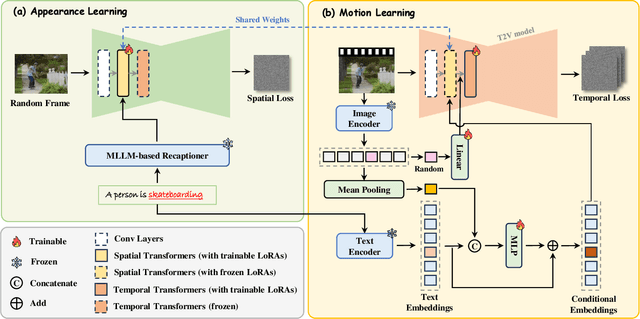
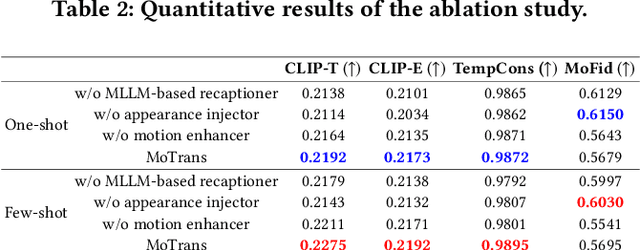
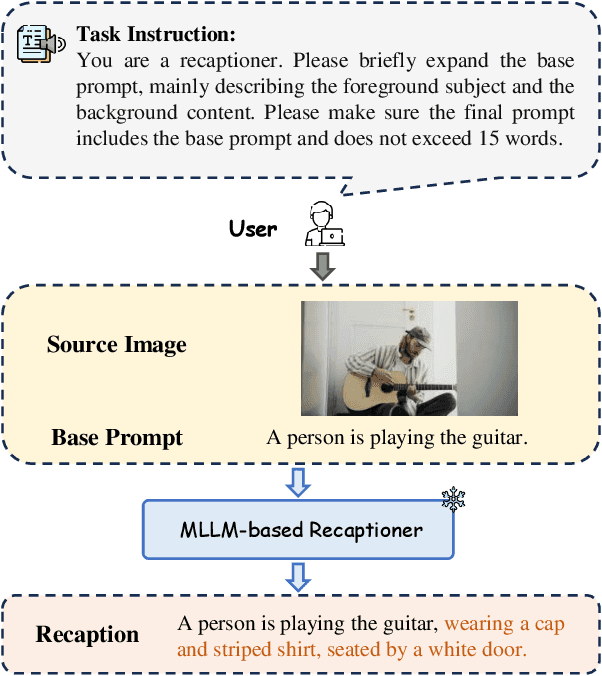
Existing pretrained text-to-video (T2V) models have demonstrated impressive abilities in generating realistic videos with basic motion or camera movement. However, these models exhibit significant limitations when generating intricate, human-centric motions. Current efforts primarily focus on fine-tuning models on a small set of videos containing a specific motion. They often fail to effectively decouple motion and the appearance in the limited reference videos, thereby weakening the modeling capability of motion patterns. To this end, we propose MoTrans, a customized motion transfer method enabling video generation of similar motion in new context. Specifically, we introduce a multimodal large language model (MLLM)-based recaptioner to expand the initial prompt to focus more on appearance and an appearance injection module to adapt appearance prior from video frames to the motion modeling process. These complementary multimodal representations from recaptioned prompt and video frames promote the modeling of appearance and facilitate the decoupling of appearance and motion. In addition, we devise a motion-specific embedding for further enhancing the modeling of the specific motion. Experimental results demonstrate that our method effectively learns specific motion pattern from singular or multiple reference videos, performing favorably against existing methods in customized video generation.
Inspiring the Next Generation of Segment Anything Models: Comprehensively Evaluate SAM and SAM 2 with Diverse Prompts Towards Context-Dependent Concepts under Different Scenes
Dec 02, 2024As a foundational model, SAM has significantly influenced multiple fields within computer vision, and its upgraded version, SAM 2, enhances capabilities in video segmentation, poised to make a substantial impact once again. While SAMs (SAM and SAM 2) have demonstrated excellent performance in segmenting context-independent concepts like people, cars, and roads, they overlook more challenging context-dependent (CD) concepts, such as visual saliency, camouflage, product defects, and medical lesions. CD concepts rely heavily on global and local contextual information, making them susceptible to shifts in different contexts, which requires strong discriminative capabilities from the model. The lack of comprehensive evaluation of SAMs limits understanding of their performance boundaries, which may hinder the design of future models. In this paper, we conduct a thorough quantitative evaluation of SAMs on 11 CD concepts across 2D and 3D images and videos in various visual modalities within natural, medical, and industrial scenes. We develop a unified evaluation framework for SAM and SAM 2 that supports manual, automatic, and intermediate self-prompting, aided by our specific prompt generation and interaction strategies. We further explore the potential of SAM 2 for in-context learning and introduce prompt robustness testing to simulate real-world imperfect prompts. Finally, we analyze the benefits and limitations of SAMs in understanding CD concepts and discuss their future development in segmentation tasks. This work aims to provide valuable insights to guide future research in both context-independent and context-dependent concepts segmentation, potentially informing the development of the next version - SAM 3.
Bootstraping Clustering of Gaussians for View-consistent 3D Scene Understanding
Nov 29, 2024Injecting semantics into 3D Gaussian Splatting (3DGS) has recently garnered significant attention. While current approaches typically distill 3D semantic features from 2D foundational models (e.g., CLIP and SAM) to facilitate novel view segmentation and semantic understanding, their heavy reliance on 2D supervision can undermine cross-view semantic consistency and necessitate complex data preparation processes, therefore hindering view-consistent scene understanding. In this work, we present FreeGS, an unsupervised semantic-embedded 3DGS framework that achieves view-consistent 3D scene understanding without the need for 2D labels. Instead of directly learning semantic features, we introduce the IDentity-coupled Semantic Field (IDSF) into 3DGS, which captures both semantic representations and view-consistent instance indices for each Gaussian. We optimize IDSF with a two-step alternating strategy: semantics help to extract coherent instances in 3D space, while the resulting instances regularize the injection of stable semantics from 2D space. Additionally, we adopt a 2D-3D joint contrastive loss to enhance the complementarity between view-consistent 3D geometry and rich semantics during the bootstrapping process, enabling FreeGS to uniformly perform tasks such as novel-view semantic segmentation, object selection, and 3D object detection. Extensive experiments on LERF-Mask, 3D-OVS, and ScanNet datasets demonstrate that FreeGS performs comparably to state-of-the-art methods while avoiding the complex data preprocessing workload.
DreamMix: Decoupling Object Attributes for Enhanced Editability in Customized Image Inpainting
Nov 26, 2024Subject-driven image inpainting has emerged as a popular task in image editing alongside recent advancements in diffusion models. Previous methods primarily focus on identity preservation but struggle to maintain the editability of inserted objects. In response, this paper introduces DreamMix, a diffusion-based generative model adept at inserting target objects into given scenes at user-specified locations while concurrently enabling arbitrary text-driven modifications to their attributes. In particular, we leverage advanced foundational inpainting models and introduce a disentangled local-global inpainting framework to balance precise local object insertion with effective global visual coherence. Additionally, we propose an Attribute Decoupling Mechanism (ADM) and a Textual Attribute Substitution (TAS) module to improve the diversity and discriminative capability of the text-based attribute guidance, respectively. Extensive experiments demonstrate that DreamMix effectively balances identity preservation and attribute editability across various application scenarios, including object insertion, attribute editing, and small object inpainting. Our code is publicly available at https://github.com/mycfhs/DreamMix.