 Add to Chrome
 Add to Firefox
 Add to Edge
MedPruner: Training-Free Hierarchical Token Pruning for Efficient 3D Medical Image Understanding in Vision-Language Models
Mar 12, 2026
While specialized Medical Vision-Language Models (VLMs) have achieved remarkable success in interpreting 2D and 3D medical modalities, their deployment for 3D volumetric data remains constrained by significant computational inefficiencies. Current architectures typically suffer from massive anatomical redundancy due to the direct concatenation of consecutive 2D slices and lack the flexibility to handle heterogeneous information densities across different slices using fixed pruning ratios. To address these challenges, we propose MedPruner, a training-free and model-agnostic hierarchical token pruning framework specifically designed for efficient 3D medical image understanding. MedPruner introduces a two-stage mechanism: an Inter-slice Anchor-based Filtering module to eliminate slice-level temporal redundancy, followed by a Dynamic Information Nucleus Selection strategy that achieves adaptive token-level compression by quantifying cumulative attention weights. Extensive experiments on three 3D medical benchmarks and across three diverse medical VLMs reveal massive token redundancy in existing architectures. Notably, MedPruner enables models such as MedGemma to maintain or even exceed their original performance while retaining fewer than 5% of visual tokens, thereby drastically reducing computational overhead and validating the necessity of dynamic token selection for practical clinical deployment. Our code will be released.

UETrack: A Unified and Efficient Framework for Single Object Tracking
Mar 03, 2026With growing real-world demands, efficient tracking has received increasing attention. However, most existing methods are limited to RGB inputs and struggle in multi-modal scenarios. Moreover, current multi-modal tracking approaches typically use complex designs, making them too heavy and slow for resource-constrained deployment. To tackle these limitations, we propose UETrack, an efficient framework for single object tracking. UETrack demonstrates high practicality and versatility, efficiently handling multiple modalities including RGB, Depth, Thermal, Event, and Language, and addresses the gap in efficient multi-modal tracking. It introduces two key components: a Token-Pooling-based Mixture-of-Experts mechanism that enhances modeling capacity through feature aggregation and expert specialization, and a Target-aware Adaptive Distillation strategy that selectively performs distillation based on sample characteristics, reducing redundant supervision and improving performance. Extensive experiments on 12 benchmarks across 3 hardware platforms show that UETrack achieves a superior speed-accuracy trade-off compared to previous methods. For instance, UETrack-B achieves 69.2% AUC on LaSOT and runs at 163/56/60 FPS on GPU/CPU/AGX, demonstrating strong practicality and versatility. Code is available at https://github.com/kangben258/UETrack.
MedSAM-Agent: Empowering Interactive Medical Image Segmentation with Multi-turn Agentic Reinforcement Learning
Feb 03, 2026Medical image segmentation is evolving from task-specific models toward generalizable frameworks. Recent research leverages Multi-modal Large Language Models (MLLMs) as autonomous agents, employing reinforcement learning with verifiable reward (RLVR) to orchestrate specialized tools like the Segment Anything Model (SAM). However, these approaches often rely on single-turn, rigid interaction strategies and lack process-level supervision during training, which hinders their ability to fully exploit the dynamic potential of interactive tools and leads to redundant actions. To bridge this gap, we propose MedSAM-Agent, a framework that reformulates interactive segmentation as a multi-step autonomous decision-making process. First, we introduce a hybrid prompting strategy for expert-curated trajectory generation, enabling the model to internalize human-like decision heuristics and adaptive refinement strategies. Furthermore, we develop a two-stage training pipeline that integrates multi-turn, end-to-end outcome verification with a clinical-fidelity process reward design to promote interaction parsimony and decision efficiency. Extensive experiments across 6 medical modalities and 21 datasets demonstrate that MedSAM-Agent achieves state-of-the-art performance, effectively unifying autonomous medical reasoning with robust, iterative optimization. Code is available \href{https://github.com/CUHK-AIM-Group/MedSAM-Agent}{here}.
SUTrack: Towards Simple and Unified Single Object Tracking
Dec 26, 2024
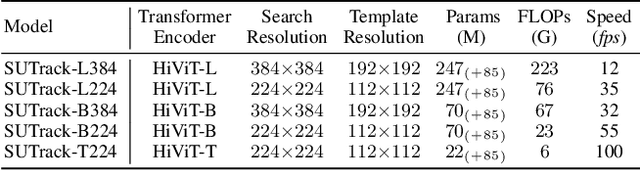
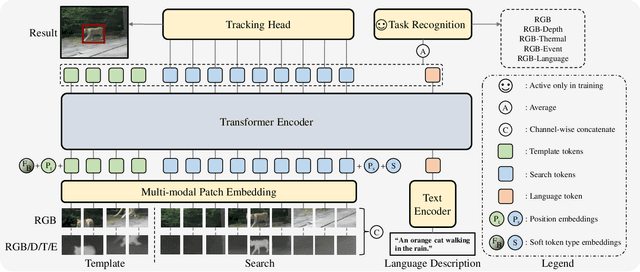

In this paper, we propose a simple yet unified single object tracking (SOT) framework, dubbed SUTrack. It consolidates five SOT tasks (RGB-based, RGB-Depth, RGB-Thermal, RGB-Event, RGB-Language Tracking) into a unified model trained in a single session. Due to the distinct nature of the data, current methods typically design individual architectures and train separate models for each task. This fragmentation results in redundant training processes, repetitive technological innovations, and limited cross-modal knowledge sharing. In contrast, SUTrack demonstrates that a single model with a unified input representation can effectively handle various common SOT tasks, eliminating the need for task-specific designs and separate training sessions. Additionally, we introduce a task-recognition auxiliary training strategy and a soft token type embedding to further enhance SUTrack's performance with minimal overhead. Experiments show that SUTrack outperforms previous task-specific counterparts across 11 datasets spanning five SOT tasks. Moreover, we provide a range of models catering edge devices as well as high-performance GPUs, striking a good trade-off between speed and accuracy. We hope SUTrack could serve as a strong foundation for further compelling research into unified tracking models. Code and models are available at github.com/chenxin-dlut/SUTrack.