 Add to Chrome
 Add to Firefox
 Add to Edge
Autoregressive B-Rep Shape Generation with Parametric Surfaces
Jul 19, 2026
Generative CAD modeling has broad design and application potential. Despite significant advances in Boundary Representation (B-Rep) generation, the dominant representation in CAD, existing methods largely depend on uniformly sampled point- or grid-based geometry representations, sacrificing native surface types and parameters and thereby limiting geometric fidelity and downstream usability. We present ParaCAD, an autoregressive framework for point-cloud-conditioned B-Rep generation that directly operates on native parametric surfaces. ParaCAD introduces a surface-centric tokenization that explicitly encodes each face by its exact surface type and continuous parameters, preserving the intrinsic semantics of CAD geometry. Our model first generates parametric surfaces with constrained UV domains, and then constructs a valid B-Rep by globally intersecting these surfaces to recover edges and vertices. ParaCAD places point-cloud-conditioned generation at the core of B-Rep synthesis, making it practical for user-guided reconstruction and seamless integration into existing 3D generation pipelines. Extensive experiments demonstrate that ParaCAD produces accurate B-Reps with faithful point-cloud alignment, outperforming point-based baselines in geometric precision, robustness, watertightness and downstream usability.

Contact Matrix: Enhancing Dance Motion Synthesis with Precise Interaction Modeling
May 06, 2026Generating realistic reactive motions, in which one person reacts to the fixed motions of others, is challenging due to strict interaction constraints and a limited feasible solution space. This paper focuses on a typical scenario: duet dance, where high-quality data is scarce, motion patterns are complex, and the details of human interactions are both intricate and abundant. To tackle these challenges, we propose a novel two-stage framework. In the first stage, we introduce a motion VQ-VAE with separate body-part encoders and a joint decoder, enabling specialized codebooks to enhance representation capacity while dynamically modeling dependencies across body parts during decoding, thereby preventing inconsistencies in the generated motions. In the second stage, we propose a contact-aware diffusion model for reactive motion generation that jointly generates motion and a contact matrix between individuals, enabling explicit interaction modeling and providing guidance toward more precise and constrained interaction dynamics during sampling. Experiments show that our method outperforms Duolando with lower $\text{FID}_k$ (8.89 vs. 25.30) and $\text{FID}_{cd}$ (8.01 vs. 9.97), as well as a higher BED (0.4606 vs. 0.2858), indicating improved interaction fidelity and rhythmic synchronization.
Strips as Tokens: Artist Mesh Generation with Native UV Segmentation
Apr 10, 2026Recent advancements in autoregressive transformers have demonstrated remarkable potential for generating artist-quality meshes. However, the token ordering strategies employed by existing methods typically fail to meet professional artist standards, where coordinate-based sorting yields inefficiently long sequences, and patch-based heuristics disrupt the continuous edge flow and structural regularity essential for high-quality modeling. To address these limitations, we propose Strips as Tokens (SATO), a novel framework with a token ordering strategy inspired by triangle strips. By constructing the sequence as a connected chain of faces that explicitly encodes UV boundaries, our method naturally preserves the organized edge flow and semantic layout characteristic of artist-created meshes. A key advantage of this formulation is its unified representation, enabling the same token sequence to be decoded into either a triangle or quadrilateral mesh. This flexibility facilitates joint training on both data types: large-scale triangle data provides fundamental structural priors, while high-quality quad data enhances the geometric regularity of the outputs. Extensive experiments demonstrate that SATO consistently outperforms prior methods in terms of geometric quality, structural coherence, and UV segmentation.
Gloria: Consistent Character Video Generation via Content Anchors
Mar 31, 2026Digital characters are central to modern media, yet generating character videos with long-duration, consistent multi-view appearance and expressive identity remains challenging. Existing approaches either provide insufficient context to preserve identity or leverage non-character-centric information as the memory, leading to suboptimal consistency. Recognizing that character video generation inherently resembles an outside-looking-in scenario. In this work, we propose representing the character visual attributes through a compact set of anchor frames. This design provides stable references for consistency, while reference-based video generation inherently faces challenges of copy-pasting and multi-reference conflicts. To address these, we introduce two mechanisms: Superset Content Anchoring, providing intra- and extra-training clip cues to prevent duplication, and RoPE as Weak Condition, encoding positional offsets to distinguish multiple anchors. Furthermore, we construct a scalable pipeline to extract these anchors from massive videos. Experiments show our method generates high-quality character videos exceeding 10 minutes, and achieves expressive identity and appearance consistency across views, surpassing existing methods.
EmbodMocap: In-the-Wild 4D Human-Scene Reconstruction for Embodied Agents
Feb 26, 2026Human behaviors in the real world naturally encode rich, long-term contextual information that can be leveraged to train embodied agents for perception, understanding, and acting. However, existing capture systems typically rely on costly studio setups and wearable devices, limiting the large-scale collection of scene-conditioned human motion data in the wild. To address this, we propose EmbodMocap, a portable and affordable data collection pipeline using two moving iPhones. Our key idea is to jointly calibrate dual RGB-D sequences to reconstruct both humans and scenes within a unified metric world coordinate frame. The proposed method allows metric-scale and scene-consistent capture in everyday environments without static cameras or markers, bridging human motion and scene geometry seamlessly. Compared with optical capture ground truth, we demonstrate that the dual-view setting exhibits a remarkable ability to mitigate depth ambiguity, achieving superior alignment and reconstruction performance over single iphone or monocular models. Based on the collected data, we empower three embodied AI tasks: monocular human-scene-reconstruction, where we fine-tune on feedforward models that output metric-scale, world-space aligned humans and scenes; physics-based character animation, where we prove our data could be used to scale human-object interaction skills and scene-aware motion tracking; and robot motion control, where we train a humanoid robot via sim-to-real RL to replicate human motions depicted in videos. Experimental results validate the effectiveness of our pipeline and its contributions towards advancing embodied AI research.
CoDA: Coordinated Diffusion Noise Optimization for Whole-Body Manipulation of Articulated Objects
May 27, 2025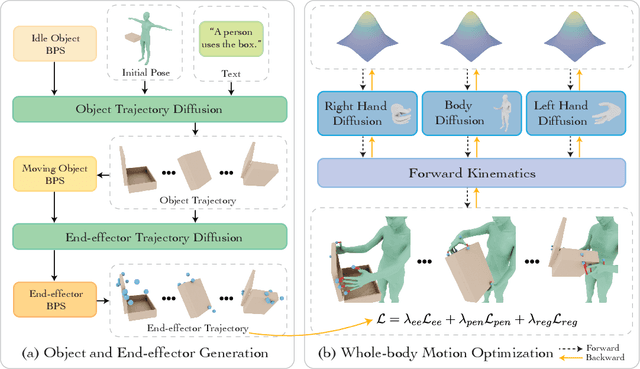
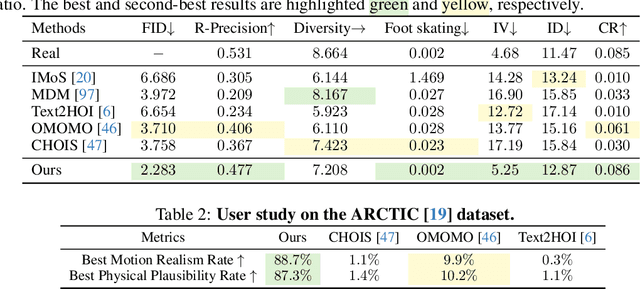
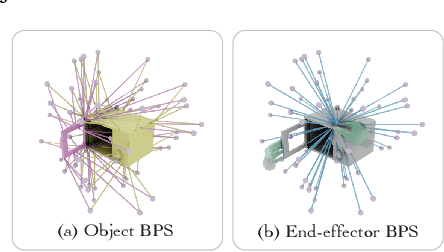
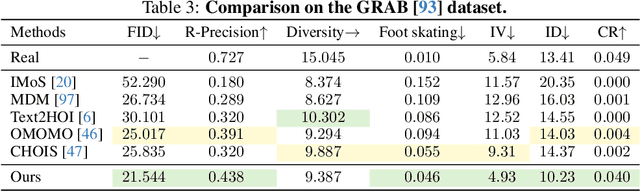
Synthesizing whole-body manipulation of articulated objects, including body motion, hand motion, and object motion, is a critical yet challenging task with broad applications in virtual humans and robotics. The core challenges are twofold. First, achieving realistic whole-body motion requires tight coordination between the hands and the rest of the body, as their movements are interdependent during manipulation. Second, articulated object manipulation typically involves high degrees of freedom and demands higher precision, often requiring the fingers to be placed at specific regions to actuate movable parts. To address these challenges, we propose a novel coordinated diffusion noise optimization framework. Specifically, we perform noise-space optimization over three specialized diffusion models for the body, left hand, and right hand, each trained on its own motion dataset to improve generalization. Coordination naturally emerges through gradient flow along the human kinematic chain, allowing the global body posture to adapt in response to hand motion objectives with high fidelity. To further enhance precision in hand-object interaction, we adopt a unified representation based on basis point sets (BPS), where end-effector positions are encoded as distances to the same BPS used for object geometry. This unified representation captures fine-grained spatial relationships between the hand and articulated object parts, and the resulting trajectories serve as targets to guide the optimization of diffusion noise, producing highly accurate interaction motion. We conduct extensive experiments demonstrating that our method outperforms existing approaches in motion quality and physical plausibility, and enables various capabilities such as object pose control, simultaneous walking and manipulation, and whole-body generation from hand-only data.
MotionStreamer: Streaming Motion Generation via Diffusion-based Autoregressive Model in Causal Latent Space
Mar 19, 2025This paper addresses the challenge of text-conditioned streaming motion generation, which requires us to predict the next-step human pose based on variable-length historical motions and incoming texts. Existing methods struggle to achieve streaming motion generation, e.g., diffusion models are constrained by pre-defined motion lengths, while GPT-based methods suffer from delayed response and error accumulation problem due to discretized non-causal tokenization. To solve these problems, we propose MotionStreamer, a novel framework that incorporates a continuous causal latent space into a probabilistic autoregressive model. The continuous latents mitigate information loss caused by discretization and effectively reduce error accumulation during long-term autoregressive generation. In addition, by establishing temporal causal dependencies between current and historical motion latents, our model fully utilizes the available information to achieve accurate online motion decoding. Experiments show that our method outperforms existing approaches while offering more applications, including multi-round generation, long-term generation, and dynamic motion composition. Project Page: https://zju3dv.github.io/MotionStreamer/
Mocap-2-to-3: Lifting 2D Diffusion-Based Pretrained Models for 3D Motion Capture
Mar 05, 2025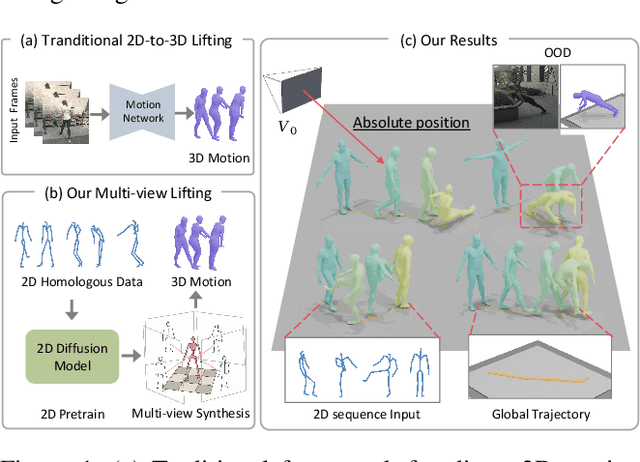
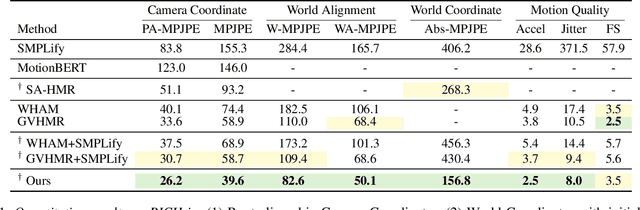
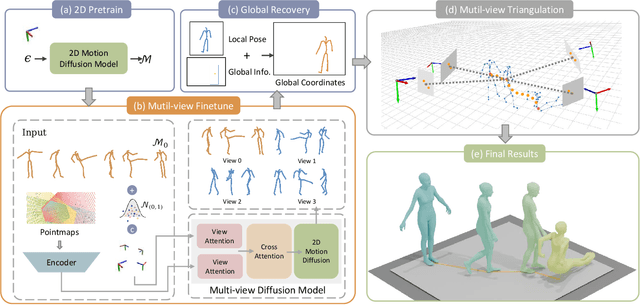
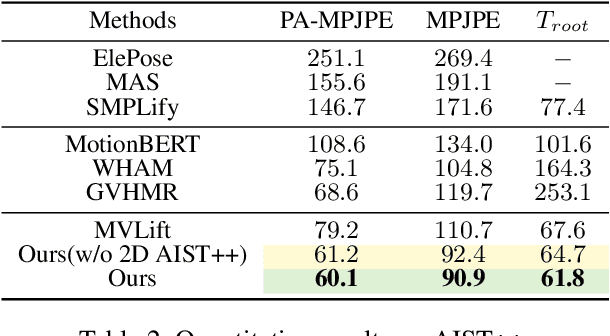
Recovering absolute poses in the world coordinate system from monocular views presents significant challenges. Two primary issues arise in this context. Firstly, existing methods rely on 3D motion data for training, which requires collection in limited environments. Acquiring such 3D labels for new actions in a timely manner is impractical, severely restricting the model's generalization capabilities. In contrast, 2D poses are far more accessible and easier to obtain. Secondly, estimating a person's absolute position in metric space from a single viewpoint is inherently more complex. To address these challenges, we introduce Mocap-2-to-3, a novel framework that decomposes intricate 3D motions into 2D poses, leveraging 2D data to enhance 3D motion reconstruction in diverse scenarios and accurately predict absolute positions in the world coordinate system. We initially pretrain a single-view diffusion model with extensive 2D data, followed by fine-tuning a multi-view diffusion model for view consistency using publicly available 3D data. This strategy facilitates the effective use of large-scale 2D data. Additionally, we propose an innovative human motion representation that decouples local actions from global movements and encodes geometric priors of the ground, ensuring the generative model learns accurate motion priors from 2D data. During inference, this allows for the gradual recovery of global movements, resulting in more plausible positioning. We evaluate our model's performance on real-world datasets, demonstrating superior accuracy in motion and absolute human positioning compared to state-of-the-art methods, along with enhanced generalization and scalability. Our code will be made publicly available.
Ready-to-React: Online Reaction Policy for Two-Character Interaction Generation
Feb 27, 2025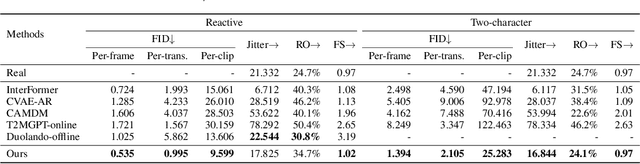
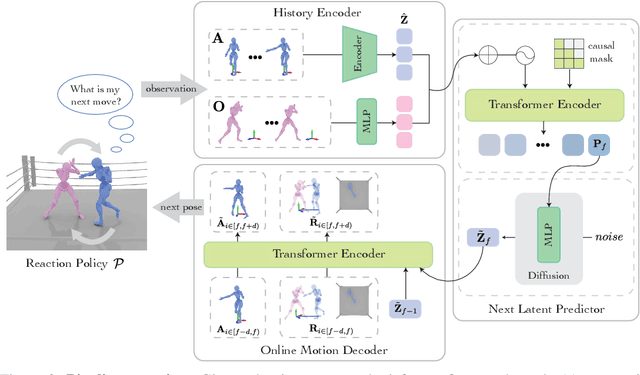

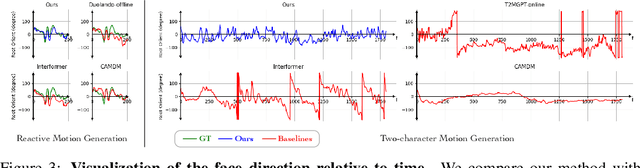
This paper addresses the task of generating two-character online interactions. Previously, two main settings existed for two-character interaction generation: (1) generating one's motions based on the counterpart's complete motion sequence, and (2) jointly generating two-character motions based on specific conditions. We argue that these settings fail to model the process of real-life two-character interactions, where humans will react to their counterparts in real time and act as independent individuals. In contrast, we propose an online reaction policy, called Ready-to-React, to generate the next character pose based on past observed motions. Each character has its own reaction policy as its "brain", enabling them to interact like real humans in a streaming manner. Our policy is implemented by incorporating a diffusion head into an auto-regressive model, which can dynamically respond to the counterpart's motions while effectively mitigating the error accumulation throughout the generation process. We conduct comprehensive experiments using the challenging boxing task. Experimental results demonstrate that our method outperforms existing baselines and can generate extended motion sequences. Additionally, we show that our approach can be controlled by sparse signals, making it well-suited for VR and other online interactive environments.
Motion-2-to-3: Leveraging 2D Motion Data to Boost 3D Motion Generation
Dec 17, 2024Text-driven human motion synthesis is capturing significant attention for its ability to effortlessly generate intricate movements from abstract text cues, showcasing its potential for revolutionizing motion design not only in film narratives but also in virtual reality experiences and computer game development. Existing methods often rely on 3D motion capture data, which require special setups resulting in higher costs for data acquisition, ultimately limiting the diversity and scope of human motion. In contrast, 2D human videos offer a vast and accessible source of motion data, covering a wider range of styles and activities. In this paper, we explore leveraging 2D human motion extracted from videos as an alternative data source to improve text-driven 3D motion generation. Our approach introduces a novel framework that disentangles local joint motion from global movements, enabling efficient learning of local motion priors from 2D data. We first train a single-view 2D local motion generator on a large dataset of text-motion pairs. To enhance this model to synthesize 3D motion, we fine-tune the generator with 3D data, transforming it into a multi-view generator that predicts view-consistent local joint motion and root dynamics. Experiments on the HumanML3D dataset and novel text prompts demonstrate that our method efficiently utilizes 2D data, supporting realistic 3D human motion generation and broadening the range of motion types it supports. Our code will be made publicly available at https://zju3dv.github.io/Motion-2-to-3/.