 Add to Chrome
 Add to Firefox
 Add to Edge
Strips as Tokens: Artist Mesh Generation with Native UV Segmentation
Apr 10, 2026
Recent advancements in autoregressive transformers have demonstrated remarkable potential for generating artist-quality meshes. However, the token ordering strategies employed by existing methods typically fail to meet professional artist standards, where coordinate-based sorting yields inefficiently long sequences, and patch-based heuristics disrupt the continuous edge flow and structural regularity essential for high-quality modeling. To address these limitations, we propose Strips as Tokens (SATO), a novel framework with a token ordering strategy inspired by triangle strips. By constructing the sequence as a connected chain of faces that explicitly encodes UV boundaries, our method naturally preserves the organized edge flow and semantic layout characteristic of artist-created meshes. A key advantage of this formulation is its unified representation, enabling the same token sequence to be decoded into either a triangle or quadrilateral mesh. This flexibility facilitates joint training on both data types: large-scale triangle data provides fundamental structural priors, while high-quality quad data enhances the geometric regularity of the outputs. Extensive experiments demonstrate that SATO consistently outperforms prior methods in terms of geometric quality, structural coherence, and UV segmentation.

How GPT learns layer by layer
Jan 13, 2025
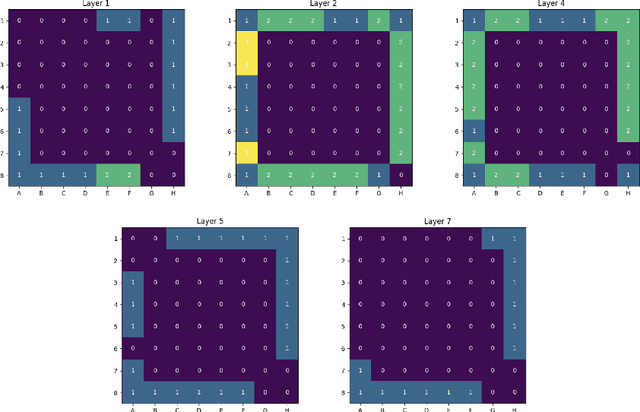
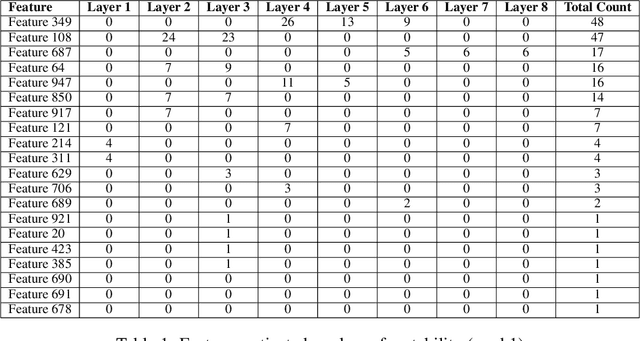
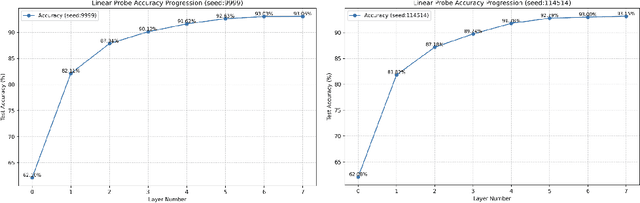
Large Language Models (LLMs) excel at tasks like language processing, strategy games, and reasoning but struggle to build generalizable internal representations essential for adaptive decision-making in agents. For agents to effectively navigate complex environments, they must construct reliable world models. While LLMs perform well on specific benchmarks, they often fail to generalize, leading to brittle representations that limit their real-world effectiveness. Understanding how LLMs build internal world models is key to developing agents capable of consistent, adaptive behavior across tasks. We analyze OthelloGPT, a GPT-based model trained on Othello gameplay, as a controlled testbed for studying representation learning. Despite being trained solely on next-token prediction with random valid moves, OthelloGPT shows meaningful layer-wise progression in understanding board state and gameplay. Early layers capture static attributes like board edges, while deeper layers reflect dynamic tile changes. To interpret these representations, we compare Sparse Autoencoders (SAEs) with linear probes, finding that SAEs offer more robust, disentangled insights into compositional features, whereas linear probes mainly detect features useful for classification. We use SAEs to decode features related to tile color and tile stability, a previously unexamined feature that reflects complex gameplay concepts like board control and long-term planning. We study the progression of linear probe accuracy and tile color using both SAE's and linear probes to compare their effectiveness at capturing what the model is learning. Although we begin with a smaller language model, OthelloGPT, this study establishes a framework for understanding the internal representations learned by GPT models, transformers, and LLMs more broadly. Our code is publicly available: https://github.com/ALT-JS/OthelloSAE.