 Add to Chrome
 Add to Firefox
 Add to Edge
Science Edge Evaluation: SEE the Missing Step Toward Real Scientific Discovery
Aug 07, 2026
Large language models (LLMs) are increasingly involved in scientific discovery, yet it remains unclear whether they can support complex real laboratory science. Here we introduce Science Edge Evaluation (SEE), a multimodal benchmark of expert-curated questions grounded in peer-reviewed literature and experimental practice in chemistry, biology, and materials science. Evaluation of 19 multimodal large language models (MLLMs) shows that even the best-performing model reaches only 48.7% accuracy. Moreover, general-purpose models outperform science-specialized models on average. In the visual-agent evaluation, the use of tools increases the best accuracy to 52.7%. Tool use can expand the information available to models, but more information does not necessarily lead to reliable scientific reasoning. The key challenge is whether models can manage tool-derived information within the boundaries of the original experimental evidence. Together, these findings reveal that current MLLMs still cannot reliably make justified and evidence-bounded inferences from experimental results, which is an essential capability in real scientific discovery. Bridging this gap requires MLLMs to transition from explaining established scientific concepts to deriving novel and evidence-based insights from experimental data.

Right Answer, Wrong Method: Shortcut Hacking Misleads the Evaluation of LLM Reasoning on Frontier Science Benchmarks
Aug 03, 2026Scientific reasoning benchmarks typically evaluate large language models (LLMs) using final-answer accuracy. However, a correct answer does not necessarily demonstrate the reasoning capability targeted by the problem. We identify Solution Hacking, a failure mode in which an LLM reaches the correct answer through invalid shortcuts, such as numerical search, enumeration, guessing, or answer-first verification, without providing a valid task-targeted derivation. We systematically analyze this phenomenon across difficulty levels, scientific domains, and frontier models. Solution hacking increases sharply with benchmark difficulty, from 2.2\% on common problems to 28.3\% on Olympiad-level problems and 37.4\% on HLE. Moreover, 8.2\%-44.1\% of answers credited as correct across frontier models are identified as hacked solutions. We further develop expert-inspired anti-hacking strategies, including an automatic judge and a test-time instruction. The results show that suppressing shortcut behavior substantially reduces reported accuracy while having a smaller effect on correct and non-hacked accuracy. These findings reveal that answer-only evaluation can overestimate the scientific reasoning capabilities of frontier LLMs.
Before the Action: Benchmarking LLMs on Prospective Hypothesis Discovery
Jul 17, 2026Large language models (LLMs) excel at answering pre-specified questions, yet their ability to navigate the open-ended, pre-conclusion stage of discovery remains largely unmeasured. We introduce Prospective Hypothesis Discovery (PHD), which asks models to autonomously construct grounded, discriminative, and testable hypothesis spaces from inconclusive evidence, including anomalous observations and fragmented records, to guide subsequent investigation. To evaluate this capability, we introduce HypoArena, comprising HypoData, a benchmark of 988 cases across six scientific and analytical domains, and HypoEval, an evaluation framework for open-ended hypothesis sets. To construct HypoData at scale, we propose Retrospective Context Regression, a Forge--Audit pipeline that reconstructs pre-conclusion contexts from completed expert documents by removing explicit conclusions, target hypotheses, and retrospective causal attributions while preserving the factual substrate. Because PHD admits multiple valid outputs, HypoEval combines bidirectional pairwise judgments with Bradley--Terry--Davidson aggregation for ranking and six-dimensional rubric scoring for diagnosis. Experiments on 15 frontier LLMs reveal clear capability stratification and model-dependent effects of structured analytical skills, with gains for several lower-performing models on HypoArena but regressions for other systems, including a top-performing model. Compared with absolute rubric scoring, arena evaluation resolves finer-grained differences among models, with aggregated rankings showing strong agreement with human experts and an independent judge. Together, these results support treating PHD as a distinct target for evaluating how LLMs formulate investigative directions when final conclusions are withheld. Our code and data are publicly available at github.com/SKYLENAGE-AI/HypoArena and github.com/SKYLENAGE-AI/HypoArena.
LongMedBench: Benchmarking Medical Agents for Long-Horizon Clinical Decision-Making
Jul 13, 2026In this work, we introduce LongMedBench, a real-world EHR-based benchmark for long-horizon clinical decision-making. Prior evaluations of LLM-based medical agents have largely emphasized short-context knowledge QA and tool use. However, real-world medical care is inherently longitudinal, and clinicians must aggregate evidence across repeated visits, tests, and evolving treatments. Therefore, long-horizon interaction is essential for realistic assessment. LongMedBench is constructed via a reproducible pipeline that integrates MIMIC-IV admission records and clinical notes into time-series event streams and long-context memory datasets, enabling long-horizon, multi-session interactions between agents and a clinical environment. It comprises 335 patients, with 19.72 inpatient visits per patient on average and 44.91 medical events per visit. Guided by the long-horizon decision process, we propose an evaluation taxonomy with three suites: fact-based QA, temporal reasoning, and long-horizon decision-making. This taxonomy measures how agents understand and leverage historical patient information over extended horizons. Our experiments show that while recent LLMs can make good use of explicit timestamps, they have challenges in implicit time inference; The RAG and agent memory system can improve the performance of information retrieval tasks, but the performance of decision-making tasks is highly dependent on the model's immediate context.
ClinConsensus: A Consensus-Based Benchmark for Evaluating Chinese Medical LLMs across Difficulty Levels
Mar 03, 2026Large language models (LLMs) are increasingly applied to health management, showing promise across disease prevention, clinical decision-making, and long-term care. However, existing medical benchmarks remain largely static and task-isolated, failing to capture the openness, longitudinal structure, and safety-critical complexity of real-world clinical workflows. We introduce ClinConsensus, a Chinese medical benchmark curated, validated, and quality-controlled by clinical experts. ClinConsensus comprises 2500 open-ended cases spanning the full continuum of care--from prevention and intervention to long-term follow-up--covering 36 medical specialties, 12 common clinical task types, and progressively increasing levels of complexity. To enable reliable evaluation of such complex scenarios, we adopt a rubric-based grading protocol and propose the Clinically Applicable Consistency Score (CACS@k). We further introduce a dual-judge evaluation framework, combining a high-capability LLM-as-judge with a distilled, locally deployable judge model trained via supervised fine-tuning, enabling scalable and reproducible evaluation aligned with physician judgment. Using ClinConsensus, we conduct a comprehensive assessment of several leading LLMs and reveal substantial heterogeneity across task themes, care stages, and medical specialties. While top-performing models achieve comparable overall scores, they differ markedly in reasoning, evidence use, and longitudinal follow-up capabilities, and clinically actionable treatment planning remains a key bottleneck. We release ClinConsensus as an extensible benchmark to support the development and evaluation of medical LLMs that are robust, clinically grounded, and ready for real-world deployment.
HLE-Verified: A Systematic Verification and Structured Revision of Humanity's Last Exam
Feb 17, 2026Humanity's Last Exam (HLE) has become a widely used benchmark for evaluating frontier large language models on challenging, multi-domain questions. However, community-led analyses have raised concerns that HLE contains a non-trivial number of noisy items, which can bias evaluation results and distort cross-model comparisons. To address this challenge, we introduce HLE-Verified, a verified and revised version of HLE with a transparent verification protocol and fine-grained error taxonomy. Our construction follows a two-stage validation-and-repair workflow resulting in a certified benchmark. In Stage I, each item undergoes binary validation of the problem and final answer through domain-expert review and model-based cross-checks, yielding 641 verified items. In Stage II, flawed but fixable items are revised under strict constraints preserving the original evaluation intent, through dual independent expert repairs, model-assisted auditing, and final adjudication, resulting in 1,170 revised-and-certified items. The remaining 689 items are released as a documented uncertain set with explicit uncertainty sources and expertise tags for future refinement. We evaluate seven state-of-the-art language models on HLE and HLE-Verified, observing an average absolute accuracy gain of 7--10 percentage points on HLE-Verified. The improvement is particularly pronounced on items where the original problem statement and/or reference answer is erroneous, with gains of 30--40 percentage points. Our analyses further reveal a strong association between model confidence and the presence of errors in the problem statement or reference answer, supporting the effectiveness of our revisions. Overall, HLE-Verified improves HLE-style evaluations by reducing annotation noise and enabling more faithful measurement of model capabilities. Data is available at: https://github.com/SKYLENAGE-AI/HLE-Verified
Unmasking Reasoning Processes: A Process-aware Benchmark for Evaluating Structural Mathematical Reasoning in LLMs
Jan 31, 2026Recent large language models (LLMs) achieve near-saturation accuracy on many established mathematical reasoning benchmarks, raising concerns about their ability to diagnose genuine reasoning competence. This saturation largely stems from the dominance of template-based computation and shallow arithmetic decomposition in existing datasets, which underrepresent reasoning skills such as multi-constraint coordination, constructive logical synthesis, and spatial inference. To address this gap, we introduce ReasoningMath-Plus, a benchmark of 150 carefully curated problems explicitly designed to evaluate structural reasoning. Each problem emphasizes reasoning under interacting constraints, constructive solution formation, or non-trivial structural insight, and is annotated with a minimal reasoning skeleton to support fine-grained process-level evaluation. Alongside the dataset, we introduce HCRS (Hazard-aware Chain-based Rule Score), a deterministic step-level scoring function, and train a Process Reward Model (PRM) on the annotated reasoning traces. Empirically, while leading models attain relatively high final-answer accuracy (up to 5.8/10), HCRS-based holistic evaluation yields substantially lower scores (average 4.36/10, best 5.14/10), showing that answer-only metrics can overestimate reasoning robustness.
VANER: Leveraging Large Language Model for Versatile and Adaptive Biomedical Named Entity Recognition
Apr 27, 2024Prevalent solution for BioNER involves using representation learning techniques coupled with sequence labeling. However, such methods are inherently task-specific, demonstrate poor generalizability, and often require dedicated model for each dataset. To leverage the versatile capabilities of recently remarkable large language models (LLMs), several endeavors have explored generative approaches to entity extraction. Yet, these approaches often fall short of the effectiveness of previouly sequence labeling approaches. In this paper, we utilize the open-sourced LLM LLaMA2 as the backbone model, and design specific instructions to distinguish between different types of entities and datasets. By combining the LLM's understanding of instructions with sequence labeling techniques, we use mix of datasets to train a model capable of extracting various types of entities. Given that the backbone LLMs lacks specialized medical knowledge, we also integrate external entity knowledge bases and employ instruction tuning to compel the model to densely recognize carefully curated entities. Our model VANER, trained with a small partition of parameters, significantly outperforms previous LLMs-based models and, for the first time, as a model based on LLM, surpasses the majority of conventional state-of-the-art BioNER systems, achieving the highest F1 scores across three datasets.
DMNER: Biomedical Entity Recognition by Detection and Matching
Jul 05, 2023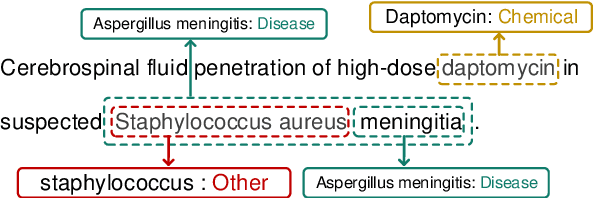
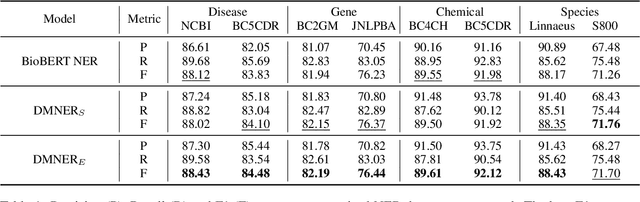
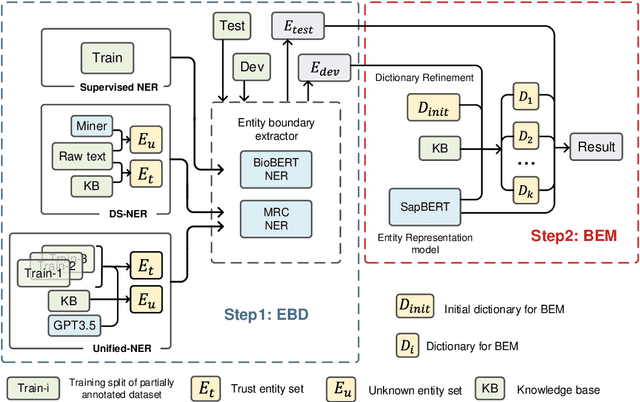
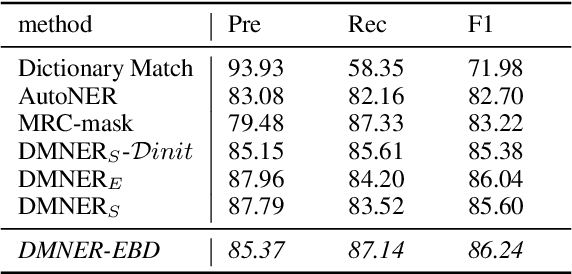
Biomedical named entity recognition (BNER) serves as the foundation for numerous biomedical text mining tasks. Unlike general NER, BNER require a comprehensive grasp of the domain, and incorporating external knowledge beyond training data poses a significant challenge. In this study, we propose a novel BNER framework called DMNER. By leveraging existing entity representation models SAPBERT, we tackle BNER as a two-step process: entity boundary detection and biomedical entity matching. DMNER exhibits applicability across multiple NER scenarios: 1) In supervised NER, we observe that DMNER effectively rectifies the output of baseline NER models, thereby further enhancing performance. 2) In distantly supervised NER, combining MRC and AutoNER as span boundary detectors enables DMNER to achieve satisfactory results. 3) For training NER by merging multiple datasets, we adopt a framework similar to DS-NER but additionally leverage ChatGPT to obtain high-quality phrases in the training. Through extensive experiments conducted on 10 benchmark datasets, we demonstrate the versatility and effectiveness of DMNER.