 Add to Chrome
 Add to Firefox
 Add to Edge
Evidence-RL: Towards Evidence-intensive Visual Reasoning
Aug 08, 2026
Vision-Language Models (VLMs) should answer from concrete image evidence rather than language priors, dataset shortcuts, or irrelevant visual context. Existing perception-aware post-training methods encourage image use through global perturbations or attention proxies, but they do not test whether a sampled answer causally depends on the local evidence that supports it. We propose Counterfactual Evidence Disentanglement (CED), a training-time evidence audit for VLM grounding. For each response, CED neutralizes an object-centric Evidence Region and compares the resulting support drop against matched non-evidence Regions. We combine this signal with answer correctness inside GRPO, rewarding correct answers that rely on the evidence path rather than shortcut or nuisance paths. CED uses weak object-level proposals, requires no question-specific evidence annotations, and adds no inference-time overhead. Across nine public benchmarks and four backbones, CED outperforms prior RL-based post-training methods, with targeted analyses verifying its object-centric signal.

Scale Up Strategically: Learning Compositional Generalization via Bias-Aware Evaluation and Data Collection for Robotic Manipulation
Jul 23, 2026Compositional generalization is essential for robot to follow diverse instructions. However, pretrained policies are known to take shortcuts, deferring to salient cues rather than grounding language. We introduce a diagnostic framework that localizes this failure to individual \textit{instruction factors}, \textit{e.g.,} reusable semantic components such as color, verb, object, size, and spatial attribute. Our framework formalizes instruction factor bias, the tendency of fine-tuned policies to over-rely on dominant factors as shortcuts, and quantifies it through two metrics: Factor Dominance Rate (FDR), capturing pairwise bias between factors, and Factor Dominance Hierarchy (FDH), aggregating these into a global ranking. Evaluation on six foundation policies reveals broadly consistent ordering, \textit{i.e.}, color $\geq$ object $\geq$ spatial $\geq$ verb $\geq$ size, with color dominant, and verb and size most under-grounded. We further show the diagnosis is actionable: a bias-aware data collection strategy that reallocates a fixed budget toward under-grounded factors outperforms baselines in simulation and on a real robot using half the demonstrations, thereby enabling more sample-efficient and generalizable policy learning.
Retriever: Composing Closed-Loop Asynchronous Robot Programs
Jul 19, 2026Building long-horizon robot agents requires composing closed-loop pipelines -- perception, belief update, planning, and control -- whose components run at different clocks and with variable latency. Today, these systems are often assembled with ad-hoc concurrency and pub/sub conventions that make timing and input-consumption semantics implicit, yielding schedule-dependent behavior that is hard to reproduce, debug, and reuse. Current solutions typically solve parts of this problem at either the algorithmic or the systems layer, but not both. In this work, we propose Retriever, which spans the entire stack: an asynchronous decision model, a programming model, a runtime, and an example closed-loop agent pipeline. Retriever represents an agent as a graph of stateful causal stream functions executed on explicit run clocks. We formalize this view via an asynchronous environment-agent loop over continuous-time streams and show that finite-memory causal policies can be represented by compositions of these operators. Retriever compiles these graphs into a runtime that supports multiple backends, enabling systematic debugging across running environments and deterministic replay from logged asynchronous data. We evaluate Retriever through a real-robot case study together with controlled studies of runtime overhead and deterministic replay behavior.
Pix2Act: Image-Space Manipulation Policies with Equivariant Augmentation
Jul 13, 2026Representing manipulation actions as 2D trajectories in the camera plane provides a compact and interpretable basis for learning complex 3D manipulation policies. However, it also creates challenges from out-of-frame trajectories and limited precision. We propose Pix2Act, an imitation learning method that addresses these challenges by generating continuous image-space keypoint trajectories in each camera plane and losslessly recovering end-effector poses via triangulation. This reformulates high-dimensional 3D control as a simpler, more learnable 2D prediction problem. Crucially, it aligns observations and actions in the same coordinate space, enabling equivariant transformations to jointly rotate individual camera images together with their image-space actions. We analyze the symmetry properties of this augmentation and design a network architecture that can fuse multiple camera views while respecting their per-view rotations. As a result, Pix2Act implicitly enlarges the support of the data distribution and learns invariant action structures across transformations, yielding improved generalization and overall performance. Across diverse simulated and real-world manipulation tasks, Pix2Act outperforms state-of-the-art baselines and remains robust under camera perturbations.
Action Map Policy: Learning 3D Closed-loop Manipulation via Pixel Classification
Jul 12, 2026The action space poses a major challenge in robot learning, since it is often high-dimensional, can span long time horizons, and frequently admits multi-modal optimal solutions. A good choice of action representation and loss function can help to address these concerns, but there are often trade offs. We propose Action Map Policy (AMP), which casts 3D closed-loop manipulation policy learning as a classification problem in image space. While classification has been an effective formulation in generative language models, applying it to robot action learning is difficult because naively discretizing high-dimensional continuous actions explodes the token vocabulary. Our key idea is to project 3D actions onto the camera image planes and treat each pixel location as a discrete class, thus controlling dimensionality while retaining multi-modality. This method supports millimeter-level precision for high-dimensional actions without requiring a prohibitively large vocabulary, while preserving fine-grained pixel-wise visual signals. Furthermore, it can predict the entire action chunk in a single forward pass, avoiding complex noise scheduling and iterative denoising while achieving substantially faster inference than diffusion policies. Experiments on various manipulation tasks show that AMP outperforms strong baselines, achieving higher success rates, faster inference, and enhanced spatial reasoning.
The Latent Space: Foundation, Evolution, Mechanism, Ability, and Outlook
Apr 02, 2026Latent space is rapidly emerging as a native substrate for language-based models. While modern systems are still commonly understood through explicit token-level generation, an increasing body of work shows that many critical internal processes are more naturally carried out in continuous latent space than in human-readable verbal traces. This shift is driven by the structural limitations of explicit-space computation, including linguistic redundancy, discretization bottlenecks, sequential inefficiency, and semantic loss. This survey aims to provide a unified and up-to-date landscape of latent space in language-based models. We organize the survey into five sequential perspectives: Foundation, Evolution, Mechanism, Ability, and Outlook. We begin by delineating the scope of latent space, distinguishing it from explicit or verbal space and from the latent spaces commonly studied in generative visual models. We then trace the field's evolution from early exploratory efforts to the current large-scale expansion. To organize the technical landscape, we examine existing work through the complementary lenses of mechanism and ability. From the perspective of Mechanism, we identify four major lines of development: Architecture, Representation, Computation, and Optimization. From the perspective of Ability, we show how latent space supports a broad capability spectrum spanning Reasoning, Planning, Modeling, Perception, Memory, Collaboration, and Embodiment. Beyond consolidation, we discuss the key open challenges, and outline promising directions for future research. We hope this survey serves not only as a reference for existing work, but also as a foundation for understanding latent space as a general computational and systems paradigm for next-generation intelligence.
MME-CoF-Pro: Evaluating Reasoning Coherence in Video Generative Models with Text and Visual Hints
Mar 20, 2026Video generative models show emerging reasoning behaviors. It is essential to ensure that generated events remain causally consistent across frames for reliable deployment, a property we define as reasoning coherence. To bridge the gap in literature for missing reasoning coherence evaluation, we propose MME-CoF-Pro, a comprehensive video reasoning benchmark to assess reasoning coherence in video models. Specifically, MME-CoF-Pro contains 303 samples across 16 categories, ranging from visual logical to scientific reasoning. It introduces Reasoning Score as evaluation metric for assessing process-level necessary intermediate reasoning steps, and includes three evaluation settings, (a) no hint (b) text hint and (c) visual hint, enabling a controlled investigation into the underlying mechanisms of reasoning hint guidance. Evaluation results in 7 open and closed-source video models reveals insights including: (1) Video generative models exhibit weak reasoning coherence, decoupled from generation quality. (2) Text hints boost apparent correctness but often cause inconsistency and hallucinated reasoning (3) Visual hints benefit structured perceptual tasks but struggle with fine-grained perception. Website: https://video-reasoning-coherence.github.io/
3D Equivariant Visuomotor Policy Learning via Spherical Projection
May 22, 2025Equivariant models have recently been shown to improve the data efficiency of diffusion policy by a significant margin. However, prior work that explored this direction focused primarily on point cloud inputs generated by multiple cameras fixed in the workspace. This type of point cloud input is not compatible with the now-common setting where the primary input modality is an eye-in-hand RGB camera like a GoPro. This paper closes this gap by incorporating into the diffusion policy model a process that projects features from the 2D RGB camera image onto a sphere. This enables us to reason about symmetries in SO(3) without explicitly reconstructing a point cloud. We perform extensive experiments in both simulation and the real world that demonstrate that our method consistently outperforms strong baselines in terms of both performance and sample efficiency. Our work is the first SO(3)-equivariant policy learning framework for robotic manipulation that works using only monocular RGB inputs.
Coarse-to-Fine 3D Keyframe Transporter
Feb 03, 2025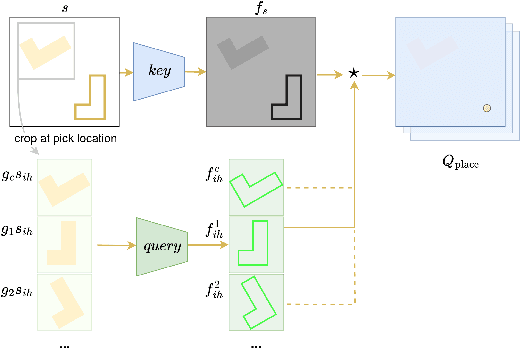
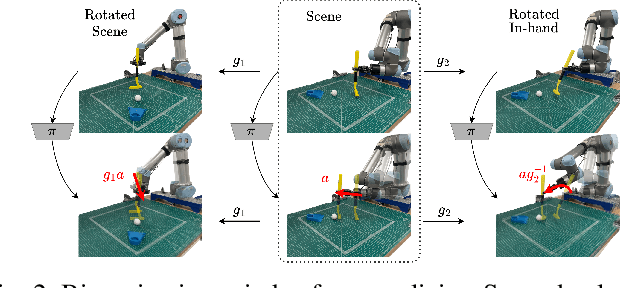
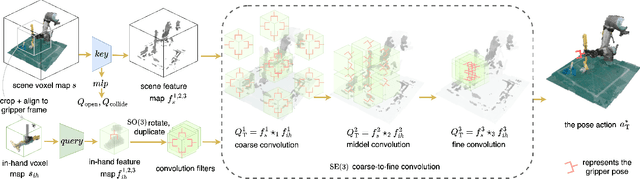
Recent advances in Keyframe Imitation Learning (IL) have enabled learning-based agents to solve a diverse range of manipulation tasks. However, most approaches ignore the rich symmetries in the problem setting and, as a consequence, are sample-inefficient. This work identifies and utilizes the bi-equivariant symmetry within Keyframe IL to design a policy that generalizes to transformations of both the workspace and the objects grasped by the gripper. We make two main contributions: First, we analyze the bi-equivariance properties of the keyframe action scheme and propose a Keyframe Transporter derived from the Transporter Networks, which evaluates actions using cross-correlation between the features of the grasped object and the features of the scene. Second, we propose a computationally efficient coarse-to-fine SE(3) action evaluation scheme for reasoning the intertwined translation and rotation action. The resulting method outperforms strong Keyframe IL baselines by an average of >10% on a wide range of simulation tasks, and by an average of 55% in 4 physical experiments.
Leverage Task Context for Object Affordance Ranking
Nov 25, 2024Intelligent agents accomplish different tasks by utilizing various objects based on their affordance, but how to select appropriate objects according to task context is not well-explored. Current studies treat objects within the affordance category as equivalent, ignoring that object affordances vary in priority with different task contexts, hindering accurate decision-making in complex environments. To enable agents to develop a deeper understanding of the objects required to perform tasks, we propose to leverage task context for object affordance ranking, i.e., given image of a complex scene and the textual description of the affordance and task context, revealing task-object relationships and clarifying the priority rank of detected objects. To this end, we propose a novel Context-embed Group Ranking Framework with task relation mining module and graph group update module to deeply integrate task context and perform global relative relationship transmission. Due to the lack of such data, we construct the first large-scale task-oriented affordance ranking dataset with 25 common tasks, over 50k images and more than 661k objects. Experimental results demonstrate the feasibility of the task context based affordance learning paradigm and the superiority of our model over state-of-the-art models in the fields of saliency ranking and multimodal object detection. The source code and dataset will be made available to the public.