 Add to Chrome
 Add to Firefox
 Add to Edge
CORAL: Learning Amyloid Fibril Ligand Docking with Cooperative Binding Rewards
Jul 19, 2026
A hallmark of neurodegenerative diseases such as Alzheimer's and Parkinson's is the aberrant aggregation of proteins into amyloid fibrils, and small molecules that selectively bind to these fibrils hold promise as diagnostics, imaging probes, and therapeutics. Predicting how such ligands bind to fibril targets, however, presents two fundamental challenges. First, resolved co-crystal structures of amyloid-ligand complexes are exceptionally scarce; even with recent advances in cryo-EM only a handful have been structurally characterized, making supervised training of docking models impractical for this target class. Second, amyloid fibrils present a binding mode fundamentally different from globular proteins: ligands intercalate into longitudinal cross-$β$ grooves and stack cooperatively along the fibril axis, a geometry that existing docking models are not designed to capture. To address these challenges, we present CORAL (COopeRative Amyloid Ligand docking), a reinforcement learning framework that trains a generative docking model to produce ligand pose distributions tailored to the cross-$β$ groove geometry. Our reward explicitly incorporates cooperative ligand-ligand stacking energy alongside protein-ligand docking affinity, directly capturing the distinctive binding geometry of amyloid fibrils. We further introduce a curated evaluation set of amyloid-ligand complexes constructed from model-generated poses validated by domain experts. Experiments on both experimentally resolved structures and this evaluation set demonstrate improved pose quality and binding affinity correlation over existing docking baselines.

SciDiagramEdit: Learning to Edit Scientific Diagrams from Paper Revisions
Jul 16, 2026Editing the figures in a research paper is a routine and time-consuming part of everyday research practice: authors relabel components, rearrange panels, and restyle visuals as they revise their manuscripts. Automating this editing workflow under a natural-language instruction, however, is challenging, because a scientific figure is a dense infographic in which heterogeneous visual elements such as schematics, plots, photos, captions, and arrows are composed under a tight visual grammar to advance a specific argument. To address this, we present SciDiagramEdit, a benchmark and skill-evolution framework that learns from natural paper revisions and operates on the figure's editable vector source, where users can inspect and co-edit individual primitives alongside the agent. Our benchmark mines before/after figure pairs from arXiv version histories, each grounded in the authors' own revision intent. To accommodate the diversity of editing instructions, we adopt agentic learning via skill evolution: an agentic proposer continually refines the agent's skill specification from execution traces over multiple epochs. The resulting skill progressively lifts edit accuracy on a held-out validation set, providing evidence that natural paper revisions are an effective training signal for instruction-driven figure editing.
Neural Computers
Apr 07, 2026We propose a new frontier: Neural Computers (NCs) -- an emerging machine form that unifies computation, memory, and I/O in a learned runtime state. Unlike conventional computers, which execute explicit programs, agents, which act over external execution environments, and world models, which learn environment dynamics, NCs aim to make the model itself the running computer. Our long-term goal is the Completely Neural Computer (CNC): the mature, general-purpose realization of this emerging machine form, with stable execution, explicit reprogramming, and durable capability reuse. As an initial step, we study whether early NC primitives can be learned solely from collected I/O traces, without instrumented program state. Concretely, we instantiate NCs as video models that roll out screen frames from instructions, pixels, and user actions (when available) in CLI and GUI settings. These implementations show that learned runtimes can acquire early interface primitives, especially I/O alignment and short-horizon control, while routine reuse, controlled updates, and symbolic stability remain open. We outline a roadmap toward CNCs around these challenges. If overcome, CNCs could establish a new computing paradigm beyond today's agents, world models, and conventional computers.
OneLatent: Single-Token Compression for Visual Latent Reasoning
Feb 14, 2026Chain-of-thought (CoT) prompting improves reasoning but often increases inference cost by one to two orders of magnitude. To address these challenges, we present \textbf{OneLatent}, a framework that compresses intermediate reasoning into a single latent token via supervision from rendered CoT images and DeepSeek-OCR hidden states. By rendering textual steps into images, we obtain a deterministic supervision signal that can be inspected and audited without requiring the model to output verbose textual rationales. Across benchmarks, OneLatent reduces average output length by $11\times$ with only a $2.21\%$ average accuracy drop relative to textual CoT, while improving output token contribution (OTC) by $6.8\times$. On long-chain logical reasoning, OneLatent reaches $99.80\%$ on ProntoQA and $97.80\%$ on ProsQA with one latent token, with compression up to $87.4\times$, supporting compression-constrained generalization.
AudCast: Audio-Driven Human Video Generation by Cascaded Diffusion Transformers
Mar 25, 2025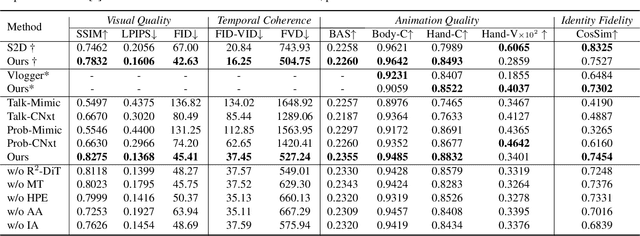
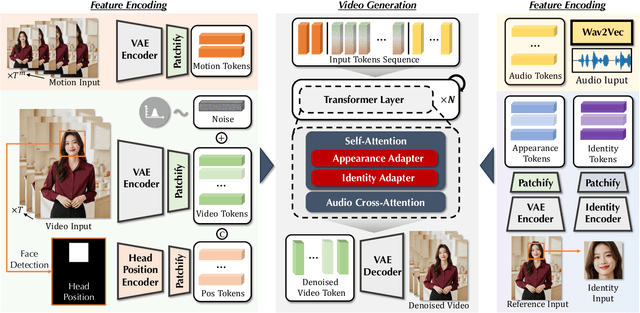
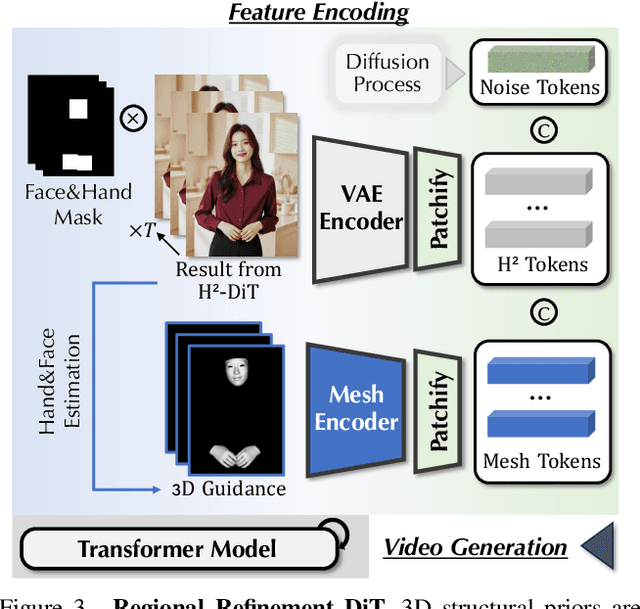
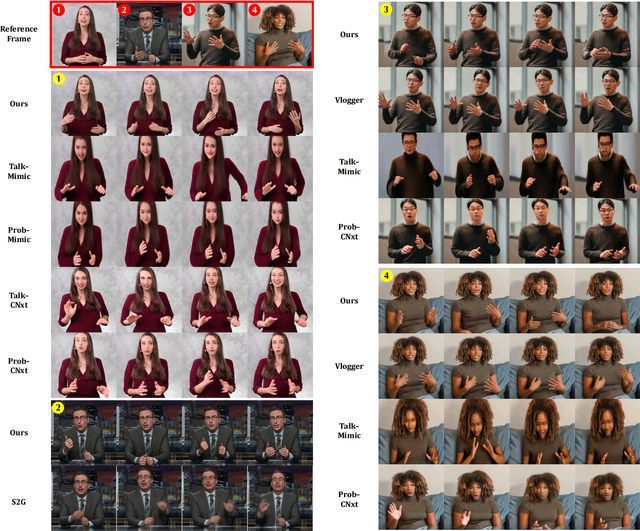
Despite the recent progress of audio-driven video generation, existing methods mostly focus on driving facial movements, leading to non-coherent head and body dynamics. Moving forward, it is desirable yet challenging to generate holistic human videos with both accurate lip-sync and delicate co-speech gestures w.r.t. given audio. In this work, we propose AudCast, a generalized audio-driven human video generation framework adopting a cascade Diffusion-Transformers (DiTs) paradigm, which synthesizes holistic human videos based on a reference image and a given audio. 1) Firstly, an audio-conditioned Holistic Human DiT architecture is proposed to directly drive the movements of any human body with vivid gesture dynamics. 2) Then to enhance hand and face details that are well-knownly difficult to handle, a Regional Refinement DiT leverages regional 3D fitting as the bridge to reform the signals, producing the final results. Extensive experiments demonstrate that our framework generates high-fidelity audio-driven holistic human videos with temporal coherence and fine facial and hand details. Resources can be found at https://guanjz20.github.io/projects/AudCast.
Cosh-DiT: Co-Speech Gesture Video Synthesis via Hybrid Audio-Visual Diffusion Transformers
Mar 13, 2025Co-speech gesture video synthesis is a challenging task that requires both probabilistic modeling of human gestures and the synthesis of realistic images that align with the rhythmic nuances of speech. To address these challenges, we propose Cosh-DiT, a Co-speech gesture video system with hybrid Diffusion Transformers that perform audio-to-motion and motion-to-video synthesis using discrete and continuous diffusion modeling, respectively. First, we introduce an audio Diffusion Transformer (Cosh-DiT-A) to synthesize expressive gesture dynamics synchronized with speech rhythms. To capture upper body, facial, and hand movement priors, we employ vector-quantized variational autoencoders (VQ-VAEs) to jointly learn their dependencies within a discrete latent space. Then, for realistic video synthesis conditioned on the generated speech-driven motion, we design a visual Diffusion Transformer (Cosh-DiT-V) that effectively integrates spatial and temporal contexts. Extensive experiments demonstrate that our framework consistently generates lifelike videos with expressive facial expressions and natural, smooth gestures that align seamlessly with speech.
OccScene: Semantic Occupancy-based Cross-task Mutual Learning for 3D Scene Generation
Dec 15, 2024


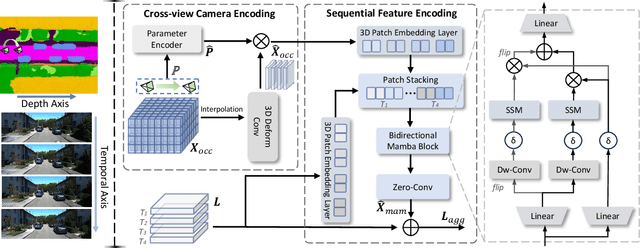
Recent diffusion models have demonstrated remarkable performance in both 3D scene generation and perception tasks. Nevertheless, existing methods typically separate these two processes, acting as a data augmenter to generate synthetic data for downstream perception tasks. In this work, we propose OccScene, a novel mutual learning paradigm that integrates fine-grained 3D perception and high-quality generation in a unified framework, achieving a cross-task win-win effect. OccScene generates new and consistent 3D realistic scenes only depending on text prompts, guided with semantic occupancy in a joint-training diffusion framework. To align the occupancy with the diffusion latent, a Mamba-based Dual Alignment module is introduced to incorporate fine-grained semantics and geometry as perception priors. Within OccScene, the perception module can be effectively improved with customized and diverse generated scenes, while the perception priors in return enhance the generation performance for mutual benefits. Extensive experiments show that OccScene achieves realistic 3D scene generation in broad indoor and outdoor scenarios, while concurrently boosting the perception models to achieve substantial performance improvements in the 3D perception task of semantic occupancy prediction.
Hierarchical Context Alignment with Disentangled Geometric and Temporal Modeling for Semantic Occupancy Prediction
Dec 11, 2024


Camera-based 3D Semantic Occupancy Prediction (SOP) is crucial for understanding complex 3D scenes from limited 2D image observations. Existing SOP methods typically aggregate contextual features to assist the occupancy representation learning, alleviating issues like occlusion or ambiguity. However, these solutions often face misalignment issues wherein the corresponding features at the same position across different frames may have different semantic meanings during the aggregation process, which leads to unreliable contextual fusion results and an unstable representation learning process. To address this problem, we introduce a new Hierarchical context alignment paradigm for a more accurate SOP (Hi-SOP). Hi-SOP first disentangles the geometric and temporal context for separate alignment, which two branches are then composed to enhance the reliability of SOP. This parsing of the visual input into a local-global alignment hierarchy includes: (I) disentangled geometric and temporal separate alignment, within each leverages depth confidence and camera pose as prior for relevant feature matching respectively; (II) global alignment and composition of the transformed geometric and temporal volumes based on semantics consistency. Our method outperforms SOTAs for semantic scene completion on the SemanticKITTI & NuScenes-Occupancy datasets and LiDAR semantic segmentation on the NuScenes dataset.
AVI-Talking: Learning Audio-Visual Instructions for Expressive 3D Talking Face Generation
Feb 25, 2024While considerable progress has been made in achieving accurate lip synchronization for 3D speech-driven talking face generation, the task of incorporating expressive facial detail synthesis aligned with the speaker's speaking status remains challenging. Our goal is to directly leverage the inherent style information conveyed by human speech for generating an expressive talking face that aligns with the speaking status. In this paper, we propose AVI-Talking, an Audio-Visual Instruction system for expressive Talking face generation. This system harnesses the robust contextual reasoning and hallucination capability offered by Large Language Models (LLMs) to instruct the realistic synthesis of 3D talking faces. Instead of directly learning facial movements from human speech, our two-stage strategy involves the LLMs first comprehending audio information and generating instructions implying expressive facial details seamlessly corresponding to the speech. Subsequently, a diffusion-based generative network executes these instructions. This two-stage process, coupled with the incorporation of LLMs, enhances model interpretability and provides users with flexibility to comprehend instructions and specify desired operations or modifications. Extensive experiments showcase the effectiveness of our approach in producing vivid talking faces with expressive facial movements and consistent emotional status.
ImageBrush: Learning Visual In-Context Instructions for Exemplar-Based Image Manipulation
Aug 02, 2023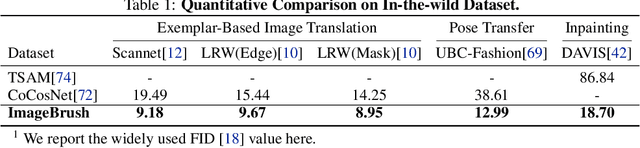
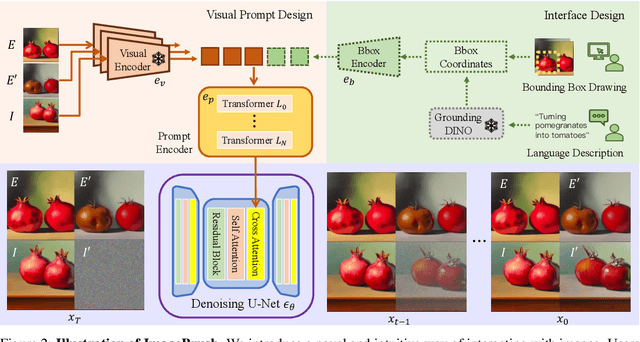

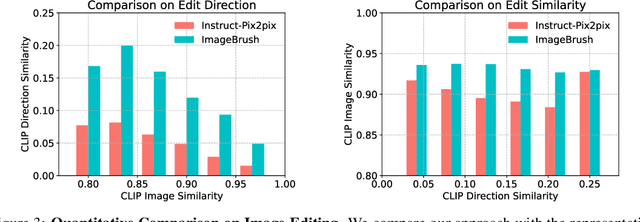
While language-guided image manipulation has made remarkable progress, the challenge of how to instruct the manipulation process faithfully reflecting human intentions persists. An accurate and comprehensive description of a manipulation task using natural language is laborious and sometimes even impossible, primarily due to the inherent uncertainty and ambiguity present in linguistic expressions. Is it feasible to accomplish image manipulation without resorting to external cross-modal language information? If this possibility exists, the inherent modality gap would be effortlessly eliminated. In this paper, we propose a novel manipulation methodology, dubbed ImageBrush, that learns visual instructions for more accurate image editing. Our key idea is to employ a pair of transformation images as visual instructions, which not only precisely captures human intention but also facilitates accessibility in real-world scenarios. Capturing visual instructions is particularly challenging because it involves extracting the underlying intentions solely from visual demonstrations and then applying this operation to a new image. To address this challenge, we formulate visual instruction learning as a diffusion-based inpainting problem, where the contextual information is fully exploited through an iterative process of generation. A visual prompting encoder is carefully devised to enhance the model's capacity in uncovering human intent behind the visual instructions. Extensive experiments show that our method generates engaging manipulation results conforming to the transformations entailed in demonstrations. Moreover, our model exhibits robust generalization capabilities on various downstream tasks such as pose transfer, image translation and video inpainting.