 Add to Chrome
 Add to Firefox
 Add to Edge
JoyAI-Video-Edit: Real-Time Open-Ended Video Editing with Autoregressive Diffusion
Aug 04, 2026
Real-time video editing requires low-latency causal generation with bounded computational resources while preserving source fidelity and long-term temporal consistency. We present JoyAI-Video-Edit, a 16B-parameter autoregressive diffusion framework for real-time, open-ended video editing without access to future frames or a predefined video duration. Our method combines chunk-wise autoregressive adaptation, Source-Anchored Distribution Matching Distillation (SA-DMD), and Long-Horizon Autoregressive Distillation to reduce train--inference mismatch, preserve source fidelity during two-step generation, and mitigate accumulated temporal drift. Extensive automatic and human evaluations show that JoyAI-Video-Edit substantially outperforms existing streaming editors and remains competitive with strong offline systems on both short and long videos. The complete system achieves end-to-end 720p video editing at approximately 30 FPS on a single Nvidia B200 GPU. Code is available at https://github.com/jd-opensource/JoyAI-Video-Edit.

Oxygen-TryOn: Fashion-Native Foundation Model for Any-item Virtual Try-On
Jul 23, 2026We present Oxygen-TryOn, a unified foundation model for any-item virtual try-on. Rather than repurposing a general-purpose image editor, Oxygen-TryOn is fashion-native, built for try-on through a dedicated data engine and try-on-specific training. Given one or more reference items (clean product shots or in-the-wild worn-on photos) and a single target subject image, it synthesizes a photorealistic image of the subject wearing the items across virtually any fashion category. Prior systems handle a single garment category in a studio setting, and recent multi-reference methods remain garment-centric; in contrast, Oxygen-TryOn supports diverse items and scenarios, including full- and half-body views, a variable number of references, and free multi-item composition, while faithfully preserving both subject identity and item appearance. Instead of mask-based inpainting, we reformulate try-on as a multi-reference, understanding-driven generation task. We build a data engine that collects, manufactures, annotates, and filters high-quality try-on data at scale, and design a three-stage recipe of continued pre-training (CPT), supervised fine-tuning (SFT), and reinforcement learning (RL). The RL stage uses a hybrid reward combining an in-house try-on reward model with a proprietary, rubric-guided general-purpose model, jointly supervising fine-grained consistency and instruction-level quality. It also follows general editing instructions (e.g., pose changes) in the same pass. Across public benchmarks and our in-house Oxygen-TryOn Bench, it achieves state-of-the-art consistency and realism on single-item try-on and leads on multi-item try-on, matching or surpassing both leading proprietary systems (Nano Banana Pro, GPT-Image-2, Seedream5 Lite) and open-source models (FLUX.2).
Perceptual Flow Matching for Few-Step Generative Modeling
Jul 03, 2026We propose Perceptual Flow Matching (PFM), a simple yet effective framework for few-step generation in flow-matching models. Rather than performing velocity regression in the conventional VAE latent space, PFM supervises flow matching in a perceptual feature space using pretrained perceptual models. This simple change substantially improves the few-step generation capability of flow-matching models, reducing the number of sampling steps from 35-50 to 4-8 while preserving generation quality. Unlike existing acceleration and distillation approaches, PFM requires neither teacher models nor auxiliary score networks and can be integrated into standard flow-matching training pipelines with minimal modifications. Extensive experiments on image generation, video generation, and image editing tasks demonstrate that PFM consistently produces high-quality results while producing fewer artifacts than existing distillation-based methods. We further show that perceptual supervision shifts the regression minimizer from mean-seeking to mode-seeking, biasing predictions toward on-manifold modes that remain accurate under coarse few-step integration. Our results reveal that standard flow-matching training can naturally yield high-quality few-step generators when supervised in an appropriate representation space. We hope this insight inspires future research into representation-aware objectives for efficient generative modeling.
MonoFormer: One Transformer for Both Diffusion and Autoregression
Sep 24, 2024
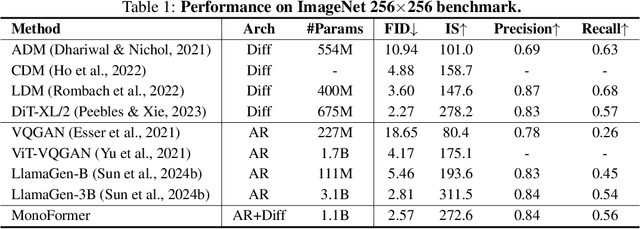


Most existing multimodality methods use separate backbones for autoregression-based discrete text generation and diffusion-based continuous visual generation, or the same backbone by discretizing the visual data to use autoregression for both text and visual generation. In this paper, we propose to study a simple idea: share one transformer for both autoregression and diffusion. The feasibility comes from two main aspects: (i) Transformer is successfully applied to diffusion for visual generation, and (ii) transformer training for autoregression and diffusion is very similar, and the difference merely lies in that diffusion uses bidirectional attention mask and autoregression uses causal attention mask. Experimental results show that our approach achieves comparable image generation performance to current state-of-the-art methods as well as maintains the text generation capability. The project is publicly available at https://monoformer.github.io/.
MS-DETR: Efficient DETR Training with Mixed Supervision
Jan 08, 2024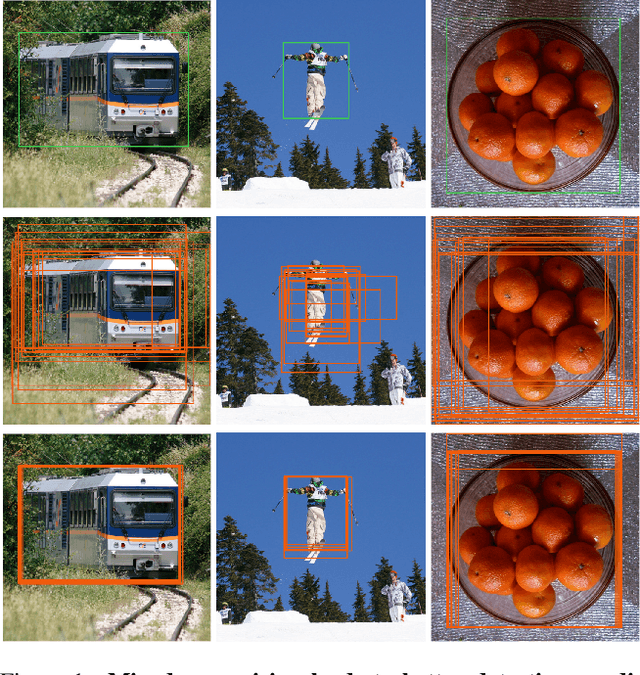

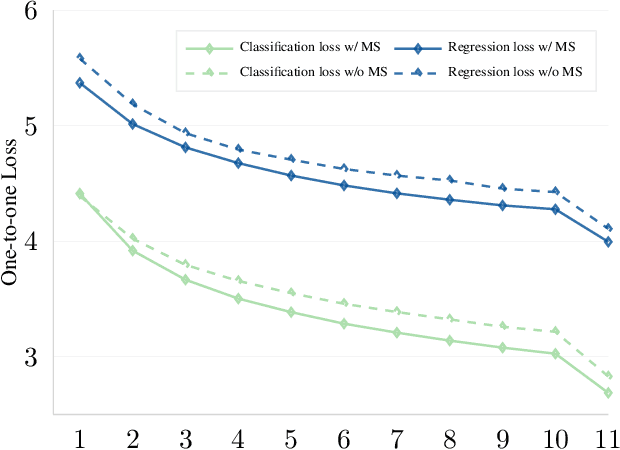
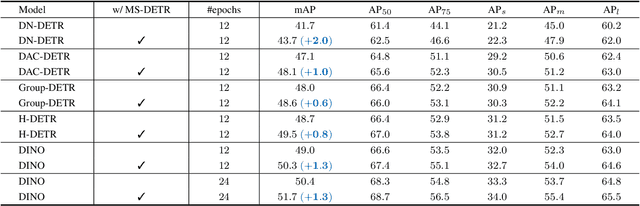
DETR accomplishes end-to-end object detection through iteratively generating multiple object candidates based on image features and promoting one candidate for each ground-truth object. The traditional training procedure using one-to-one supervision in the original DETR lacks direct supervision for the object detection candidates. We aim at improving the DETR training efficiency by explicitly supervising the candidate generation procedure through mixing one-to-one supervision and one-to-many supervision. Our approach, namely MS-DETR, is simple, and places one-to-many supervision to the object queries of the primary decoder that is used for inference. In comparison to existing DETR variants with one-to-many supervision, such as Group DETR and Hybrid DETR, our approach does not need additional decoder branches or object queries. The object queries of the primary decoder in our approach directly benefit from one-to-many supervision and thus are superior in object candidate prediction. Experimental results show that our approach outperforms related DETR variants, such as DN-DETR, Hybrid DETR, and Group DETR, and the combination with related DETR variants further improves the performance.
Style Variable and Irrelevant Learning for Generalizable Person Re-identification
Sep 12, 2022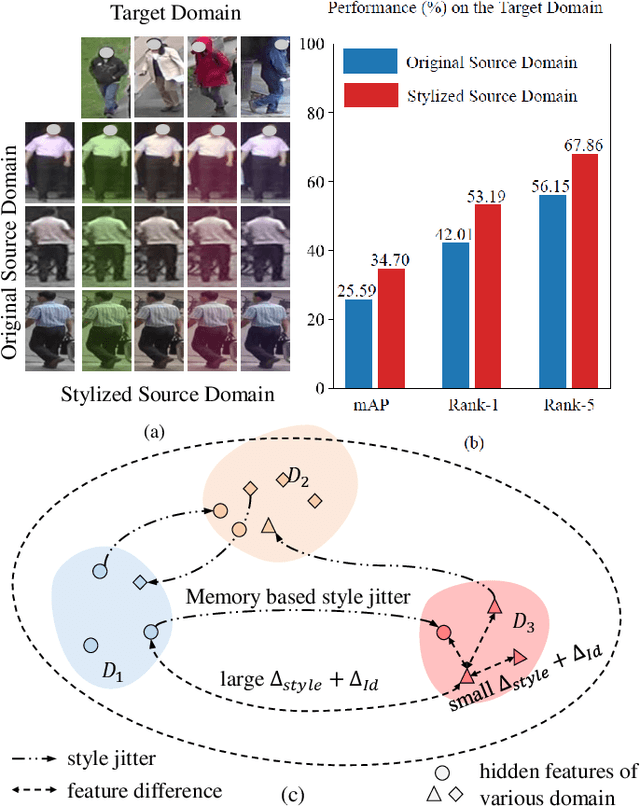
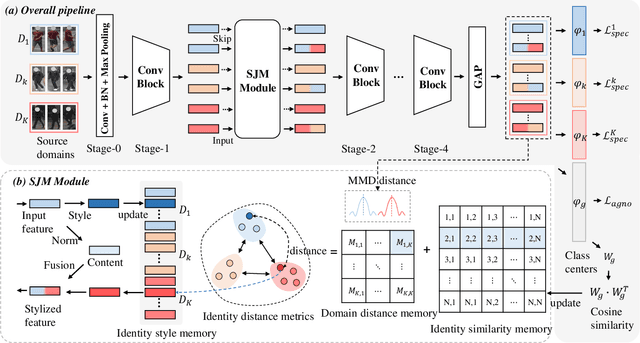
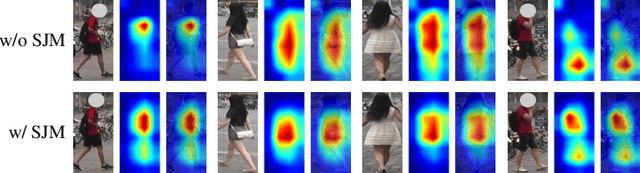
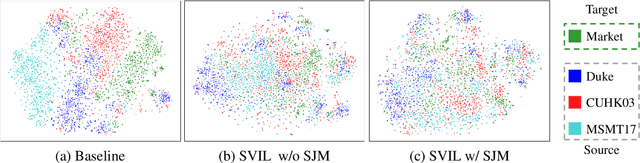
Recently, due to the poor performance of supervised person re-identification (ReID) to an unseen domain, Domain Generalization (DG) person ReID has attracted a lot of attention which aims to learn a domain-insensitive model and can resist the influence of domain bias. In this paper, we first verify through an experiment that style factors are a vital part of domain bias. Base on this conclusion, we propose a Style Variable and Irrelevant Learning (SVIL) method to eliminate the effect of style factors on the model. Specifically, we design a Style Jitter Module (SJM) in SVIL. The SJM module can enrich the style diversity of the specific source domain and reduce the style differences of various source domains. This leads to the model focusing on identity-relevant information and being insensitive to the style changes. Besides, we organically combine the SJM module with a meta-learning algorithm, maximizing the benefits and further improving the generalization ability of the model. Note that our SJM module is plug-and-play and inference cost-free. Extensive experiments confirm the effectiveness of our SVIL and our method outperforms the state-of-the-art methods on DG-ReID benchmarks by a large margin.
Symmetric Network with Spatial Relationship Modeling for Natural Language-based Vehicle Retrieval
Jun 22, 2022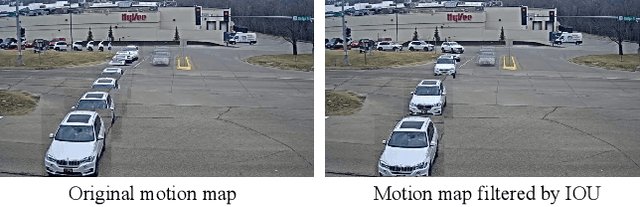
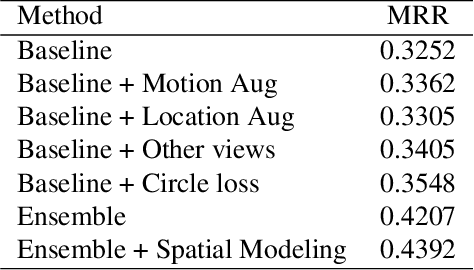
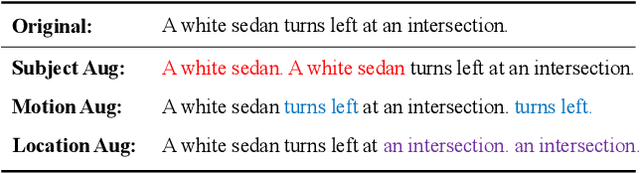
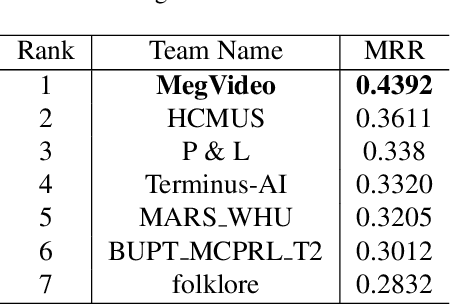
Natural language (NL) based vehicle retrieval aims to search specific vehicle given text description. Different from the image-based vehicle retrieval, NL-based vehicle retrieval requires considering not only vehicle appearance, but also surrounding environment and temporal relations. In this paper, we propose a Symmetric Network with Spatial Relationship Modeling (SSM) method for NL-based vehicle retrieval. Specifically, we design a symmetric network to learn the unified cross-modal representations between text descriptions and vehicle images, where vehicle appearance details and vehicle trajectory global information are preserved. Besides, to make better use of location information, we propose a spatial relationship modeling methods to take surrounding environment and mutual relationship between vehicles into consideration. The qualitative and quantitative experiments verify the effectiveness of the proposed method. We achieve 43.92% MRR accuracy on the test set of the 6th AI City Challenge on natural language-based vehicle retrieval track, yielding the 1st place among all valid submissions on the public leaderboard. The code is available at https://github.com/hbchen121/AICITY2022_Track2_SSM.
* 8 pages, 3 figures, publised to CVPRW