 Add to Chrome
 Add to Firefox
 Add to Edge
GeoWeaver: Accurate Long-Sequence 3D Reconstruction via Hierarchical Geometric Assembly
Aug 18, 2026
Long-sequence 3D reconstruction from RGB videos requires both accurate local geometry and globally consistent camera motion. Feed-forward models provide strong depth and pose predictions, but their memory cost prevents joint inference over long sequences. Chunk-wise processing improves scalability, yet independently predicted chunks often exhibit scale drift, pose errors, and point-cloud misalignment. We present GeoWeaver, a unified framework comprising a Geometric Prior Model (GPM) and Test-Time Adaptation (TTA). The GPM predicts chunk-wise depth, confidence, and camera parameters as adjustable geometric priors. TTA then performs sequential initialization, global chunk-level Sim(3) alignment, and coarse-to-fine refinement of camera poses, affine depth corrections, and intrinsics. Dense correspondences provide adjacent, cross-chunk, and long-range constraints, while a robust CDF-style objective jointly optimizes weighted 2D reprojection and 3D consistency residuals. This design preserves local geometric accuracy while correcting accumulated pose, scale, depth, and calibration errors. Experiments across diverse long-sequence benchmarks demonstrate improved camera accuracy, global consistency, and point-cloud quality. Ablations verify the contribution of each adaptation stage, and applying the same TTA procedure to different geometric prior models consistently improves their trajectory estimates, demonstrating that GeoWeaver is not tied to a specific GPM.

UniQuery4R: Unified 4D Scene Reconstruction from a Single Query
Aug 18, 2026Reconstructing dynamic 4D scenes requires jointly estimating correspondence, geometry, object motion, and camera motion. Existing feed-forward methods typically predict dense task-specific maps or independently process source-target pairs, leading to unnecessary computation for sparse queries and limited feature reuse across different frame pairs. We present UniQuery4R, a query-conditioned framework that encodes a multi-frame clip once and selects the source view, target view, and continuous source-image coordinate only at decoding time via source-to-target cross-attention. Each query jointly predicts target correspondence, target-time 3D position, and scene flow, along with source depth, while camera parameters are estimated per view. This design allows the encoded clip to be reused across arbitrary source-target selections and supports both sparse inference and dense reconstruction through batched queries, without learned temporal embeddings tied to a fixed clip length. We further introduce a direction-magnitude parameterization of scene flow with separate supervision for moving and static points. Among the evaluated methods, UniQuery4R achieves the best macro-average results on WorldTrack for both scene-flow estimation and dynamic-point reconstruction.
City-Level 3D Surface Reconstruction with Viewpoint Orientation Partitioning and Scene Completion
Jul 04, 2026Multi-view 3D surface reconstruction is a longstanding challenge in computer vision. Although recent large-scale reconstruction methods based on 3D Gaussian Splatting (3DGS) achieve impressive novel-view synthesis, producing high-quality surfaces over large scenes remains difficult, due to complex geometry, long optimization, and limited memory. In this paper, we propose a novel yet simple partitioning method to efficiently and faithfully reconstruct large-scale scene surfaces. Our key insight lies in a scene partitioning method based on viewpoint orientation. This partitioning approach ensures that views with similar orientations are jointly involved for more accurate depth estimations, leading to precise surface reconstructions and balanced computation on multiple GPUs in parallel. In addition, we propose a strategy to detect and repair missing regions in the initial point cloud caused by sparse viewpoints or insufficient textures, thereby further improving the geometric quality. Extensive experiments on the GauU-Scene, MatrixCity, and UrbanScene3D datasets demonstrate that our method outperforms the state-of-the-art approaches in surface reconstruction for large-scale scenes. Project page: https://hanl2010.github.io/VOP-GS.
Sparse-View Surface Reconstruction using Gaussian Splatting through High-Confidence Depth Propagation with Normal Priors
Jul 04, 20263D reconstruction from sparse views is a challenging task in 3D computer vision. Recent studies on 3D Gaussian Splatting (3DGS) have achieved remarkable results with sparse views in novel view synthesis, yet reconstructing high-quality geometric surfaces from sparse views remains a challenge, due to the limited geometry clues and the discreteness of Gaussians. In this paper, we propose a novel 3DGS-based method for high-fidelity surface reconstruction from sparse views. Our key insight is to introduce a normal-guided depth propagation approach, which can extend depth information from high-confidence regions to constrain the depth in low-confidence areas. Additionally, we propose an abnormal depth edge-aware regularization to address depth discontinuities caused by the discreteness of Gaussians. Extensive experiments on DTU and Tanks-and-Temples datasets demonstrate that our method outperforms the state-of-the-art methods in sparse view surface reconstruction. Project page: https://hanl2010.github.io/DP-GS.
GaussianGrow: Geometry-aware Gaussian Growing from 3D Point Clouds with Text Guidance
Apr 07, 20263D Gaussian Splatting has demonstrated superior performance in rendering efficiency and quality, yet the generation of 3D Gaussians still remains a challenge without proper geometric priors. Existing methods have explored predicting point maps as geometric references for inferring Gaussian primitives, while the unreliable estimated geometries may lead to poor generations. In this work, we introduce GaussianGrow, a novel approach that generates 3D Gaussians by learning to grow them from easily accessible 3D point clouds, naturally enforcing geometric accuracy in Gaussian generation. Specifically, we design a text-guided Gaussian growing scheme that leverages a multi-view diffusion model to synthesize consistent appearances from input point clouds for supervision. To mitigate artifacts caused by fusing neighboring views, we constrain novel views generated at non-preset camera poses identified in overlapping regions across different views. For completing the hard-to-observe regions, we propose to iteratively detect the camera pose by observing the largest un-grown regions in point clouds and inpainting them by inpainting the rendered view with a pretrained 2D diffusion model. The process continues until complete Gaussians are generated. We extensively evaluate GaussianGrow on text-guided Gaussian generation from synthetic and even real-scanned point clouds. Project Page: https://weiqi-zhang.github.io/GaussianGrow
4C4D: 4 Camera 4D Gaussian Splatting
Apr 05, 2026This paper tackles the challenge of recovering 4D dynamic scenes from videos captured by as few as four portable cameras. Learning to model scene dynamics for temporally consistent novel-view rendering is a foundational task in computer graphics, where previous works often require dense multi-view captures using camera arrays of dozens or even hundreds of views. We propose \textbf{4C4D}, a novel framework that enables high-fidelity 4D Gaussian Splatting from video captures of extremely sparse cameras. Our key insight lies that the geometric learning under sparse settings is substantially more difficult than modeling appearance. Driven by this observation, we introduce a Neural Decaying Function on Gaussian opacities for enhancing the geometric modeling capability of 4D Gaussians. This design mitigates the inherent imbalance between geometry and appearance modeling in 4DGS by encouraging the 4DGS gradients to focus more on geometric learning. Extensive experiments across sparse-view datasets with varying camera overlaps show that 4C4D achieves superior performance over prior art. Project page at: https://junshengzhou.github.io/4C4D.
AnchoredDream: Zero-Shot 360° Indoor Scene Generation from a Single View via Geometric Grounding
Jan 26, 2026Single-view indoor scene generation plays a crucial role in a range of real-world applications. However, generating a complete 360° scene from a single image remains a highly ill-posed and challenging problem. Recent approaches have made progress by leveraging diffusion models and depth estimation networks, yet they still struggle to maintain appearance consistency and geometric plausibility under large viewpoint changes, limiting their effectiveness in full-scene generation. To address this, we propose AnchoredDream, a novel zero-shot pipeline that anchors 360° scene generation on high-fidelity geometry via an appearance-geometry mutual boosting mechanism. Given a single-view image, our method first performs appearance-guided geometry generation to construct a reliable 3D scene layout. Then, we progressively generate the complete scene through a series of modules: warp-and-inpaint, warp-and-refine, post-optimization, and a novel Grouting Block, which ensures seamless transitions between the input view and generated regions. Extensive experiments demonstrate that AnchoredDream outperforms existing methods by a large margin in both appearance consistency and geometric plausibility--all in a zero-shot manner. Our results highlight the potential of geometric grounding for high-quality, zero-shot single-view scene generation.
GAP: Gaussianize Any Point Clouds with Text Guidance
Aug 07, 20253D Gaussian Splatting (3DGS) has demonstrated its advantages in achieving fast and high-quality rendering. As point clouds serve as a widely-used and easily accessible form of 3D representation, bridging the gap between point clouds and Gaussians becomes increasingly important. Recent studies have explored how to convert the colored points into Gaussians, but directly generating Gaussians from colorless 3D point clouds remains an unsolved challenge. In this paper, we propose GAP, a novel approach that gaussianizes raw point clouds into high-fidelity 3D Gaussians with text guidance. Our key idea is to design a multi-view optimization framework that leverages a depth-aware image diffusion model to synthesize consistent appearances across different viewpoints. To ensure geometric accuracy, we introduce a surface-anchoring mechanism that effectively constrains Gaussians to lie on the surfaces of 3D shapes during optimization. Furthermore, GAP incorporates a diffuse-based inpainting strategy that specifically targets at completing hard-to-observe regions. We evaluate GAP on the Point-to-Gaussian generation task across varying complexity levels, from synthetic point clouds to challenging real-world scans, and even large-scale scenes. Project Page: https://weiqi-zhang.github.io/GAP.
iDiT-HOI: Inpainting-based Hand Object Interaction Reenactment via Video Diffusion Transformer
Jun 15, 2025Digital human video generation is gaining traction in fields like education and e-commerce, driven by advancements in head-body animation and lip-syncing technologies. However, realistic Hand-Object Interaction (HOI) - the complex dynamics between human hands and objects - continues to pose challenges. Generating natural and believable HOI reenactments is difficult due to issues such as occlusion between hands and objects, variations in object shapes and orientations, and the necessity for precise physical interactions, and importantly, the ability to generalize to unseen humans and objects. This paper presents a novel framework iDiT-HOI that enables in-the-wild HOI reenactment generation. Specifically, we propose a unified inpainting-based token process method, called Inp-TPU, with a two-stage video diffusion transformer (DiT) model. The first stage generates a key frame by inserting the designated object into the hand region, providing a reference for subsequent frames. The second stage ensures temporal coherence and fluidity in hand-object interactions. The key contribution of our method is to reuse the pretrained model's context perception capabilities without introducing additional parameters, enabling strong generalization to unseen objects and scenarios, and our proposed paradigm naturally supports long video generation. Comprehensive evaluations demonstrate that our approach outperforms existing methods, particularly in challenging real-world scenes, offering enhanced realism and more seamless hand-object interactions.
DFEN: Dual Feature Equalization Network for Medical Image Segmentation
May 09, 2025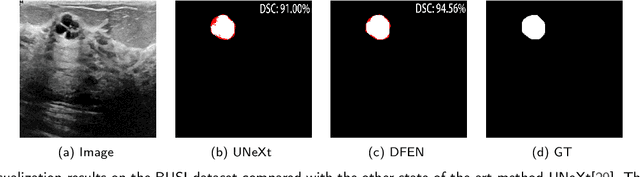
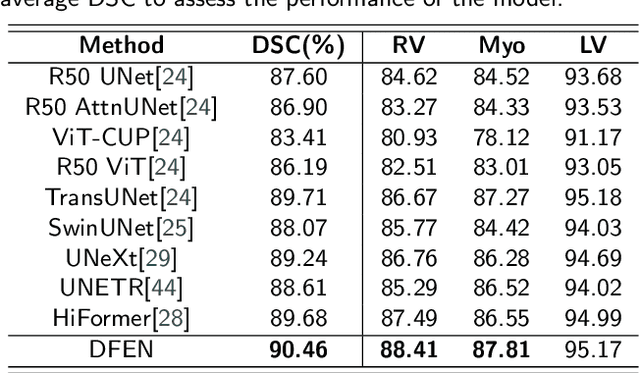
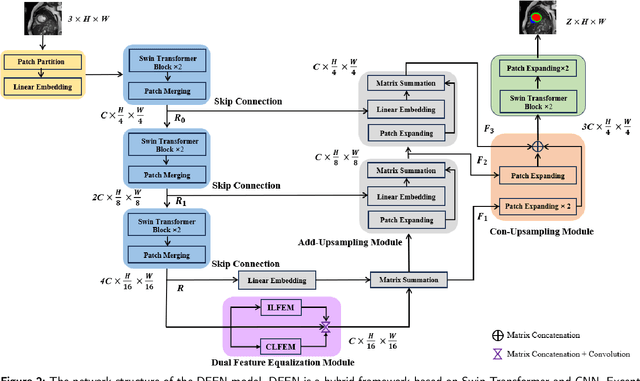
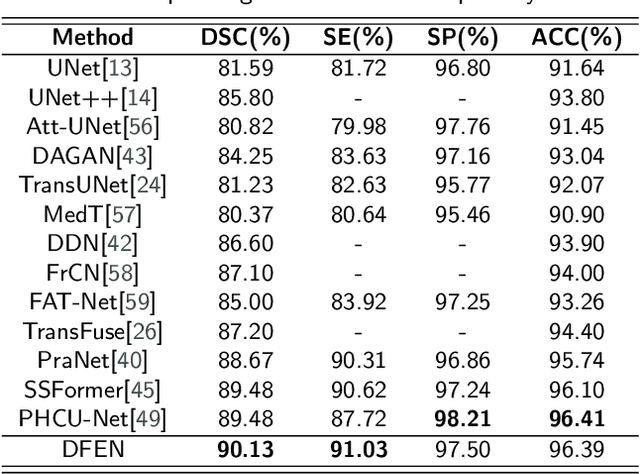
Current methods for medical image segmentation primarily focus on extracting contextual feature information from the perspective of the whole image. While these methods have shown effective performance, none of them take into account the fact that pixels at the boundary and regions with a low number of class pixels capture more contextual feature information from other classes, leading to misclassification of pixels by unequal contextual feature information. In this paper, we propose a dual feature equalization network based on the hybrid architecture of Swin Transformer and Convolutional Neural Network, aiming to augment the pixel feature representations by image-level equalization feature information and class-level equalization feature information. Firstly, the image-level feature equalization module is designed to equalize the contextual information of pixels within the image. Secondly, we aggregate regions of the same class to equalize the pixel feature representations of the corresponding class by class-level feature equalization module. Finally, the pixel feature representations are enhanced by learning weights for image-level equalization feature information and class-level equalization feature information. In addition, Swin Transformer is utilized as both the encoder and decoder, thereby bolstering the ability of the model to capture long-range dependencies and spatial correlations. We conducted extensive experiments on Breast Ultrasound Images (BUSI), International Skin Imaging Collaboration (ISIC2017), Automated Cardiac Diagnosis Challenge (ACDC) and PH$^2$ datasets. The experimental results demonstrate that our method have achieved state-of-the-art performance. Our code is publicly available at https://github.com/JianJianYin/DFEN.